Lady's Eardrops
Fuchsia boliviana
The Gardening Year
Best months in UK gardens · full planting calendar →
🖨 Printable care card (PDF)At a Glance
| Botanical name | Fuchsia boliviana |
|---|---|
| Common name(s) | lady's eardrops |
| Family | Onagraceae |
| Plant type | shrub (evergreen shrub) |
| Height × Spread | 2–4 m × 100–150 cm |
| Position | Full sun, Partial shade |
| Soil | moist but well-drained, humus-rich soil; peat-free multi-purpose potting compost with added perlite for drainage |
| Flowering | August–November |
| Toxicity | — |
| Native range | southern Peru, Bolivia and northern Argentina |
Fuchsia boliviana is a tender evergreen sub-shrub from the Andean cloud forests of Bolivia, Peru, Ecuador and north-west Argentina. In the UK it is grown principally as a conservatory or patio container plant, brought indoors or into a heated greenhouse before the first frosts. It is grown for its long, pendulous trusses of slender-tubed, trumpet-shaped scarlet flowers — among the showiest of any species fuchsia in cultivation — and for its luxuriant, slightly downy foliage. Although it is unrelated to the hardy hedging fuchsias (such as Fuchsia magellanica) that thrive in gardens across the south and west of the British Isles, F. boliviana is one of the most spectacular of the tender Andean fuchsias and a rewarding subject for a frost-free glasshouse.
Overview
Fuchsia boliviana belongs to the willowherb family, Onagraceae, and is one of the larger-leaved and larger-flowered species in the genus. In its native range it can reach 1.5–3 m in the ground, scrambling through other vegetation in cool, humid montane forest. In British cultivation it is usually smaller — typically 0.6–1.5 m in a large container — and is grown as a specimen plant for its late-summer display rather than as a landscape shrub. It flowers from mid-summer well into autumn, most prolifically under glass, and rewards the grower who can keep it cool, bright and just damp through the winter.
In the UK, F. boliviana is most often confused at the point of sale with Fuchsia magellanica. The two are easily distinguished once in growth: F. boliviana has noticeably larger, softer leaves and far longer flower-tubes carried in heavy pendulous trusses, while F. magellanica has smaller flowers on a hardy deciduous shrub that survives outdoors in most of lowland Britain. Plant the wrong one in the wrong place and a hard winter will finish it; the two are not interchangeable.
Appearance
Fuchsia boliviana makes a lax, semi-scandent sub-shrub, often with a rather open, arching habit that lends itself to training up a tripod, an obelisk or against a warm wall. In a large pot it will throw long, slightly woody canes from the base, with side-shoots carrying the flowers. The leaves are opposite or in whorls, lance-shaped to elliptic, 8–20 cm long, soft mid-green with a faintly downy surface; in some forms the veins carry a pinkish flush.
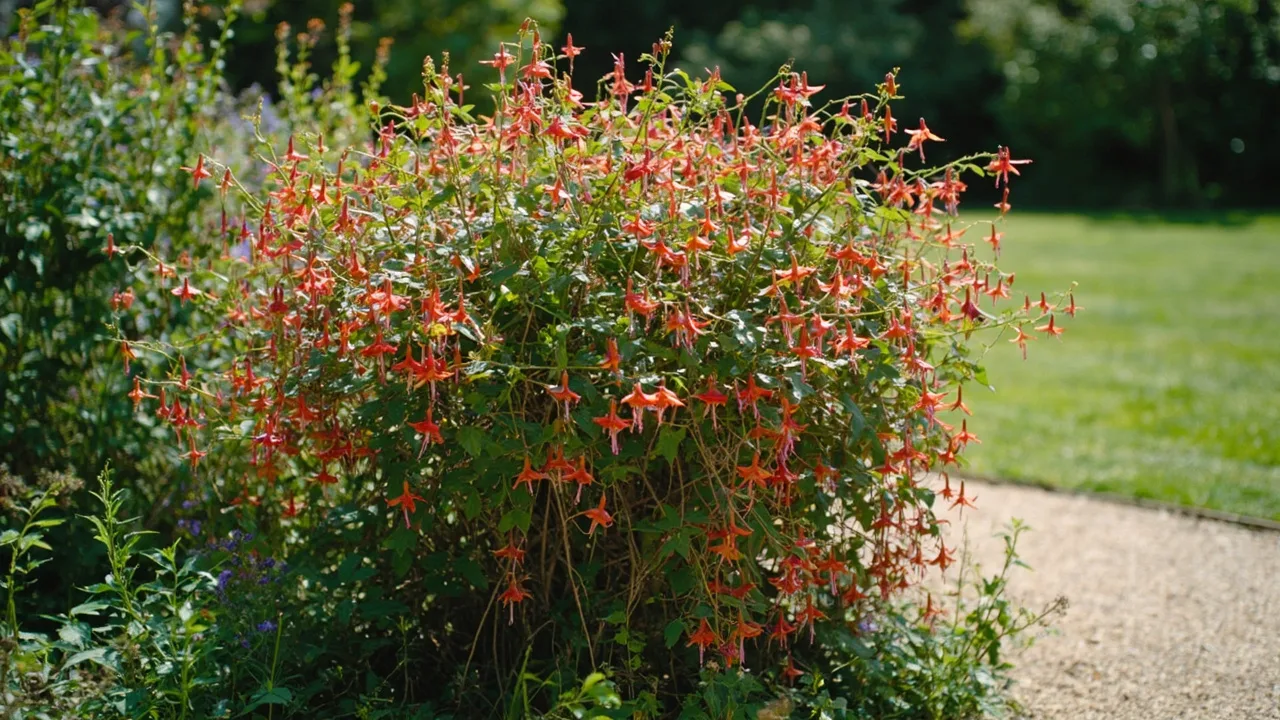
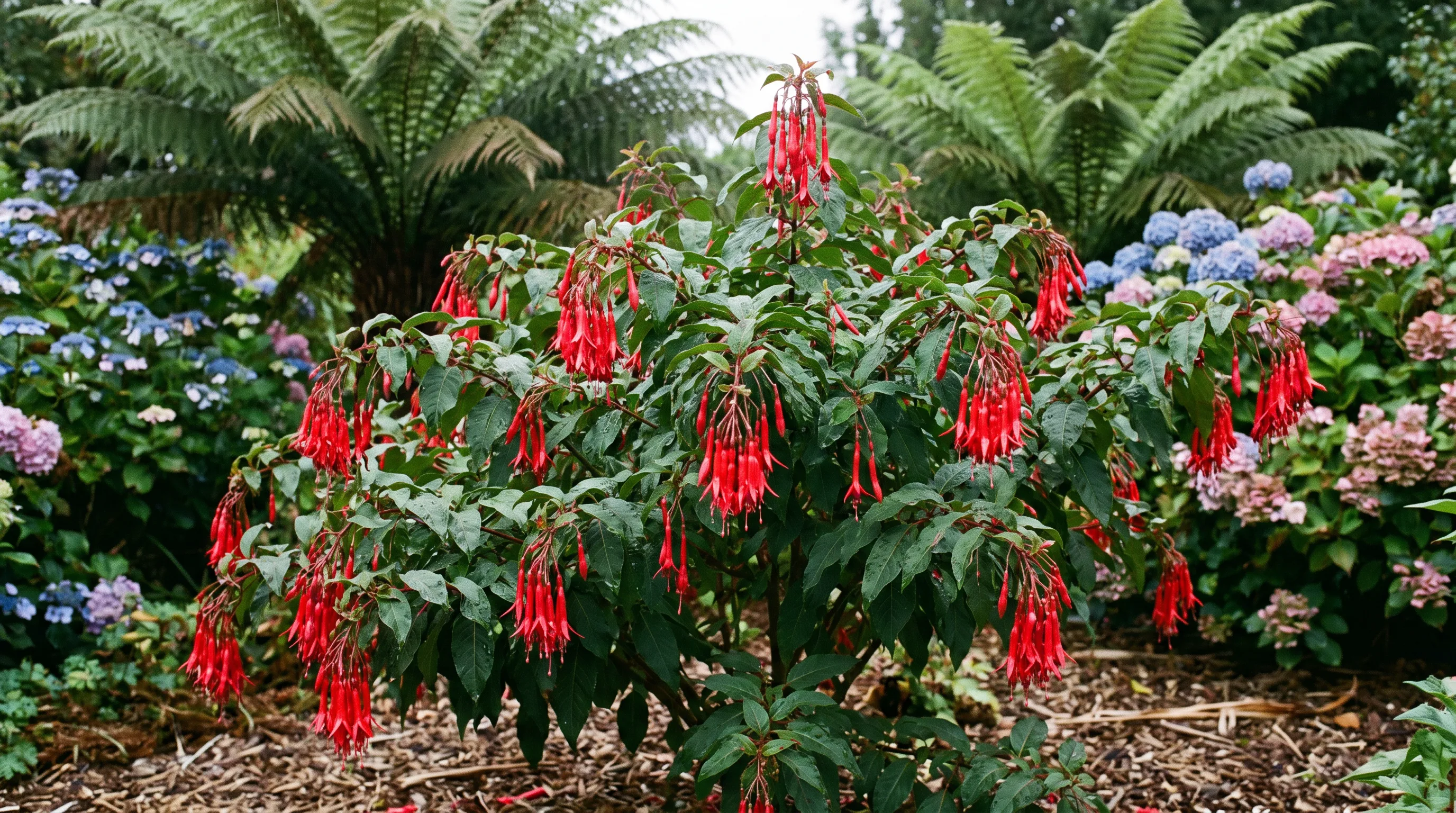
The flowers are the principal ornament. Each is borne in a long, pendulous terminal or axillary truss, the individual blooms consisting of a slender tube 4–7 cm long and four spreading sepals above four shorter petals. In the common form the sepals are scarlet to crimson and the corolla a rich scarlet, giving an overall brilliant red appearance; in the white-flowered form the sepals are pale pink to white and the corolla is white to blush. The eight stamens and the long style protrude well beyond the petals — a classic species-fuchsia feature that hybrid cultivars often lose. The flowers are followed by small, oblong, dark purple edible berries, sometimes called "grape fuchsia berries" in its native range; in Britain they are a curiosity rather than a crop, but they are a useful note for gardeners interested in pollinator-friendly plants.
The combination of large, soft foliage and heavy, dangling trusses of long-tubed flowers distinguishes F. boliviana from all the common hardy fuchsias and from the smaller-flowered species such as Fuchsia procumbens.
Growing Conditions
Fuchsia boliviana thrives in conditions that mimic its native cloud-forest edge: bright but filtered light, steady warmth, reasonably high humidity, and a humus-rich, moisture-retentive but free-draining compost.
Light. Under glass, give it the brightest position available short of direct midday sun, which can scorch the soft leaves. Outdoors, once danger of frost has passed, it relishes full sun to dappled shade on a sheltered patio.
Temperature. This is a tender plant. Foliage scorch and leaf-drop begin at surprisingly mild cold: nights below about 4 °C mark the damage threshold, and the plant must be overwintered at a minimum of roughly 5–10 °C in a frost-free conservatory, heated greenhouse or bright porch. In much of mainland Britain this means a heated glasshouse, not a cold frame.
Humidity and ventilation. F. boliviana appreciates humidity but tolerates the average ambient humidity of a well-ventilated UK conservatory. Stagnant, damp air is the greater danger, encouraging grey mould.
Compost and soil. Use a humus-rich, free-draining mix. A standard John Innes No. 3 with added leafmould and a generous handful of perlite is the conventional choice for container-grown plants. The pH should sit between about 6.0 and 7.0 — neutral to slightly acid.
Hardiness. Fuchsia boliviana is tender in UK conditions and must be kept frost-free over winter. Its position in the GardenWizz hardiness scale is shown in the badge below the title; treat it accordingly and do not plant it out in the open garden in mainland Britain.
Planting and Care
Potting. Pot on annually in spring as new growth resumes, shifting up one pot size at a time until the plant is in an 8–10 L container; thereafter, top-dress each spring by removing the upper 3–4 cm of compost and replacing with fresh John Innes No. 3 mixed with leafmould. Always pot into fresh, peat-free multipurpose or loam-based compost rather than reusing old tired material.
Watering. Keep the compost evenly moist through the growing season — typically April to September for outdoor-grown plants — but allow the surface to dry slightly between waterings. In winter, reduce watering sharply without letting the rootball dry out completely.
Feeding. From late spring through to the end of flowering, apply a balanced liquid feed weekly. A tomato fertiliser at quarter to half strength is the traditional choice and encourages strong flowering rather than leafy growth. Stop feeding in late autumn.
Pruning. A light tip-prune in late winter or early spring (February to March, under glass) tidies leggy growth and encourages branching from lower down. Harder cut-backs are tolerated where leaves have dropped, but most plants respond better to a gentle annual shaping than to drastic cutting back into old wood. As a sub-shrub, F. boliviana benefits from a defined annual prune and will otherwise become leggy and bare at the base.
Overwintering. Move containers indoors before the first frost in September or October, before night temperatures fall below about 5 °C. A cool, bright, frost-free room, conservatory or heated greenhouse at 5–10 °C is ideal. Water sparingly, withhold feed, and watch for glasshouse whitefly and grey mould.
Propagation. Take softwood cuttings in spring or semi-ripe cuttings in late summer; root them in a peat-free cuttings mix under a propagator at 18–20 °C. Always propagate from clean, pest-free stock: fuchsia gall mite (see below) is readily spread through cuttings from unknown sources.
Seasonal calendar. Under glass, expect new growth from late winter, flowering from mid-summer into autumn. Outdoors, plants flower from mid-summer until the first frosts. Pruning falls in late winter to early spring; potting on in mid-spring; overwintering in from early autumn to mid-spring.
Common Problems
Glasshouse whitefly (Trialeurodes vaporariorum) is the most common pest of conservatory fuchsias. Sticky leaves and a faint dusting of tiny white flies on the undersides of foliage are the tell-tale signs. Biological control with the parasitoid wasp Encarsia formosa works well in a heated greenhouse; otherwise, careful use of insecticidal soap or fatty-acid sprays will check populations.
Aphids (greenfly and blackfly) build up rapidly on the soft spring growth of indoor and forced plants. Pinch out infested tips and encourage ladybirds and hoverflies outdoors.
Fuchsia gall mite (Aculops fuchsiae) is a statutory notifiable pest and the most serious threat to fuchsias in Britain. It distorts leaf tips and flower buds, producing characteristic bunched, swollen growth. Historically concentrated on Fuchsia magellanica cultivars in the south of England, it is now spreading to other species. There is no effective home-garden cure once a plant is infested; suspected infestations should be reported to Defra via the Plant Health portal, and affected stock should be destroyed (not composted). Buy only from reputable specialist nurseries and isolate new plants before introducing them to a collection.
Botrytis (grey mould) appears as fuzzy grey-brown mould on damaged leaves and flowers in cool, damp, poorly ventilated glasshouses. Remove affected material, improve airflow and avoid overhead watering in cool conditions.
Vine weevil grubs eat the roots of pot-grown plants, particularly in peat-free multipurpose composts, and can quickly kill a container specimen. Check pots in autumn and spring; biological control with Steinernema kraussei nematodes is effective where soil temperatures are above about 12 °C.
Capsid bugs distort new growth on outdoor and container plants, although they are less of a problem on F. boliviana than on hybrid fuchsia cultivars.
Popular Varieties
Named, clonal cultivars of Fuchsia boliviana are scarce in UK cultivation. Unlike the hybrid fuchsia trade — which lists hundreds of clonal cultivar names registered with the American Fuchsia Society and the British Fuchsia Society — the species itself is sold principally under the plain binomial, as seed-raised or cutting-raised stock from specialist Andean-plant nurseries, botanical glasshouse collections and a handful of fuchsia specialists. There is no widely recognised, vegetatively propagated named cultivar of F. boliviana established in mainstream British commerce, and buyers should be wary of any nursery offering a "named" F. boliviana without clear provenance: trade names attached to the species in catalogues usually refer to seed-raised colour forms rather than to stable, clonal cultivars, and plant-to-plant variation should be expected.
The botanical varieties and forms within the species complex are, however, well documented and are the principal way the plant is differentiated in collections and specialist catalogues. These are infraspecific taxa rather than clonal cultivars, but they are the closest the species comes to a "varieties list" in UK horticulture:
- Fuchsia boliviana var. boliviana — the typical scarlet-flowered form, with scarlet to crimson sepals and a rich scarlet corolla. This is the default plant sold in the UK trade and the form most widely grown under glass.
- Fuchsia boliviana var. alba — the white- or blush-flowered form, with pale pink to white sepals and a white to blush corolla. Sought-after by collectors and offered occasionally by specialist fuchsia nurseries such as Roualeyn, Fibrex and Pennard Plants. Stock should be treated as seed-raised unless the supplier specifically confirms clonal cutting origin.
A closely related Andean form sometimes listed under F. boliviana is recognised in some floras as Fuchsia boliviana var. luxurians, distinguished by particularly luxuriant foliage and long, slim flower-tubes; it is grown as a tender conservatory subject in the same way as the species and is similarly scarce in the UK trade.
F. boliviana has been used in hybridising programmes aimed at producing large-flowered, long-tubed container fuchsias, but it is not the parent of the common hardy hedging fuchsias — those derive from Fuchsia magellanica and related species and tolerate British winters in a very different way. Gardeners looking for a hardy outdoor fuchsia should look to F. magellanica cultivars rather than to F. boliviana.
Pests and Diseases
| Problem | Symptoms | Management |
|---|---|---|
| Fuchsia gall mite | Shoot tips become distorted into masses of yellowish-green or reddish-pink tissue instead of normal leaves. | Prune out and burn affected growth immediately to prevent spread, as chemical control is difficult. |
| Fuchsia rust | Orange pustules appear on the lower leaf surfaces, causing leaves to shrivel and fall. | Remove infected leaves promptly and avoid wetting foliage; do not plant near Epilobium or Abies. |
| Aphids | Clusters of small soft-bodied insects cluster on new growth and flower buds, causing stunting. | Encourage natural predators like ladybirds or use a strong jet of water to dislodge them. |
| Glasshouse red spider mite | Fine webbing appears on leaves which become speckled, yellowed, and may drop prematurely. | Increase humidity around the plant and treat with horticultural oil or a biological control. |
| Vine weevil | Notches appear on leaf margins while larvae feed on roots in the pot, causing wilting. | Use nematodes to control soil-dwelling larvae or apply a systemic insecticide to the compost. |
For step-by-step help, read Controlling Aphids Naturally. Or browse the full plant problem solver to diagnose an issue by symptom.
Recommended Products
GardenWizz earns a commission from qualifying purchases made through affiliate links on this page (including links within the article) — as an Amazon Associate, and from Thompson & Morgan via the Awin network. This does not affect the price you pay. See our disclaimer for details.