Winter Jasmine
Jasminum nudiflorum · winter-flowered jasmine
The Gardening Year
Best months in UK gardens · full planting calendar →
🖨 Printable care card (PDF)At a Glance
| Botanical name | Jasminum nudiflorum |
|---|---|
| Common name(s) | winter jasmine, winter-flowered jasmine |
| Family | Oleaceae |
| Plant type | shrub |
| Height × Spread | 2.5 m × 2.5 m |
| Position | Full sun, Partial shade |
| Soil | Well-drained; tolerates chalk, clay, sand and poor ground; wide pH range |
| Flowering | January, February, March, December |
| Toxicity | — |
| Native range | — |
Overview
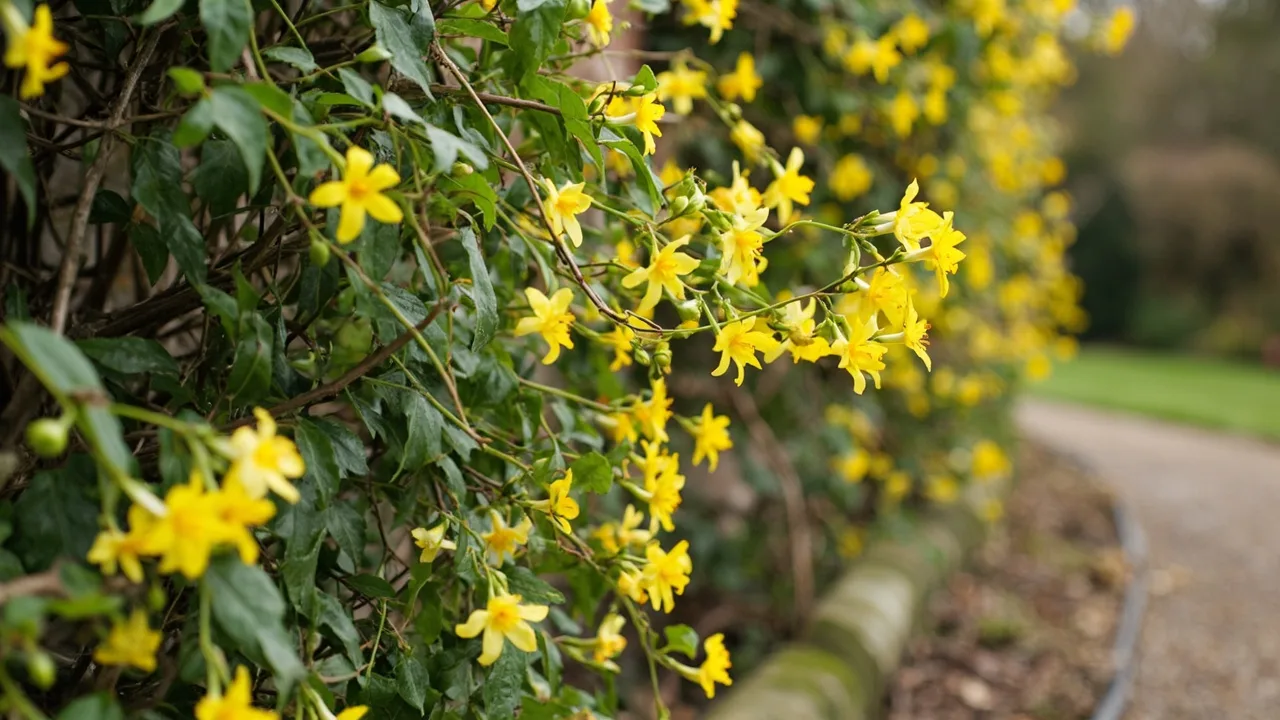
Winter jasmine (Jasminum nudiflorum) is the bright-yellow, scrambling member of the olive family (Oleaceae) that puts on its main show in the depths of a British winter. A native of northern China and not of the British Isles, it is grown almost everywhere in the UK as a wall shrub or ground-cover plant because it flowers reliably when little else is in bloom. It carries its bright yellow flowers, each to about 2.5 cm across, on bare green stems from late December into March, with the peak display typically in February; the small trifoliate leaves only emerge afterwards. The accepted name on Kew's Plants of the World Online is Jasminum nudiflorum Lindl. (synonym Jasminum sieboldianum), and the RHS lists it under the same name.
Winter jasmine is one of the standard choices for a north-facing or cold wall because, unlike true twining climbers, it is a sprawling shrub that simply needs its long arching shoots tied in to a framework of wires or trellis. It is rated RHS hardiness H5, meaning it is hardy in most places throughout the UK even in severe winters, with the RHS definition placing the lower limit at roughly −15 to −10 °C. It is not, however, related to the strongly scented summer jasmine, which is a true twining climber with white flowers that opens its blooms in high summer; for a scented climber on a pergola in July the reader should look at Jasminum officinale instead. For an unscented but reliably winter-flowering shrub on a cold wall, on a low fence, or sprawling over a sunny bank, J. nudiflorum is the go-to choice, and it sits naturally alongside the other winter wall shrubs and the broader winter-flowering shrubs cluster in a UK planting plan.
Appearance
Winter jasmine is a medium-sized deciduous shrub that builds up over years into a tangle of long, arching, bright-green shoots. The mature plant reaches about 2.5 m in height and a similar spread when left untrimmed, though on a wall it is usually restricted by training and pruning to a neater shape. The shoots are distinctly green — not woody-brown like many wall shrubs — and this green whip is one of the easiest identification cues in winter, when the same plant is carrying both flowers and next year's bud wood.
The flowers are the diagnostic feature. Each one is bright yellow, around 2.5 cm across, with five or six petals arranged in a small open star, and they are carried singly on the previous year's bare green stems from late December into March, with the heaviest display in February. The plant flowers before the leaves appear, which is unusual for an outdoor shrub and is the main reason the display is so eye-catching — there is no foliage to mask the bloom. In a mild winter individual flowers may open as early as December and continue into January; in a hard winter the main flush waits until February. Scent is essentially absent or only very faint, which is the cleanest single contrast with the summer-flowering common jasmine (J. officinale), a true twining climber with strongly perfumed white flowers. The leaves, once they do appear, are small and trifoliate (three leaflets per leaf), a deeper green than the stems, and they drop in autumn without notable colour.
In a UK garden, the plant is sometimes confused with forsythia (Forsythia × intermedia), which also carries yellow flowers on bare woody stems in late winter and early spring. Forsythia's branches are a duller brown and the flowers appear in denser clusters along the stem rather than singly on green shoots; the leaves of forsythia are simple and oval, not trifoliate. A more distant confusion is Carolina jasmine (Gelsemium sempervirens), which carries yellow trumpet-shaped flowers but is not in the Jasminum genus and is toxic — it is not hardy outdoors across most of the UK and should not be confused with winter jasmine. For other yellow winter bloomers in the same Oleaceae family, the semi-evergreen Italian jasmine (Jasminum humile) flowers in summer rather than winter.
Growing Conditions
Winter jasmine is one of the more forgiving shrubs a UK gardener can plant. It tolerates a wide pH range and grows well in chalk, clay, sand and relatively poor ground, provided the soil is reasonably well drained. Waterlogged ground is the one condition it actively dislikes, so on heavy clay it is worth planting on a slightly raised bed or working plenty of coarse organic matter into the base. Once established, plants cope well with summer-dry conditions and are notably drought-tolerant for a wall shrub, although a young plant needs regular watering through its first growing season.
The plant grows happily in full sun or partial shade and tolerates exposure well, including coastal gardens and salt-laden wind. The position that suits it best in a UK garden is a sheltered wall or fence — including, importantly, a north-facing wall — because the wall traps a small amount of warmth and shelters the early flowers from the worst of the weather. The plant is not self-clinging: it has no aerial roots or twining tendrils, and its long arching shoots must be tied in to a support of horizontal wires, trellis or a framework as they grow. This honest point matters: anyone expecting the kind of independent climbing habit seen in ivy or hydrangea will be disappointed, but the plant is so floriferous that the training is well worth the effort.
Hardiness is rated RHS H5: hardy in most places throughout the UK even in severe winters, with the published lower limit at roughly −15 to −10 °C. In practice this means J. nudiflorum can be grown successfully from the south of England to the north of Scotland, including in cold inland gardens, and it is widely planted in wall-side borders across the country. Plants in the very coldest and most exposed corners of northern and eastern Britain can have their flower display shortened by a hard frost, but the shrub itself survives and flowers again the following year. For winter protection of borderline shrubs in cold gardens, see the wider guidance on winter protection for tender plants.
Planting and Care
Container-grown winter jasmine can be planted at any workable time of year, though autumn through early spring is preferable so the roots get a full growing season to settle in. Bare-root plants are cheaper but must go in while dormant. Prepare the planting site by digging over a square about 60 cm across, removing perennial weeds by hand, and working a bucket of well-rotted garden compost into the base. Set the plant at the same depth it sat in its pot, water in well, and apply a 5–8 cm mulch of compost or bark, keeping the mulch clear of the stems.
For a wall or fence, fix horizontal wires or a trellis panel about 30–45 cm apart before planting, with the lowest wire no more than 30 cm above soil level. Fan the strongest shoots out as they grow and tie them in loosely with soft garden twine, leaving room for the stems to thicken. New shoots can grow a metre or more in a single season; if left, they will arch away from the wall and root where they touch the soil, which is the natural layering habit of the plant and is the easiest way to make new plants. For a sprawling shrub border or a sunny bank, space plants about 1.5–2 m apart and let them knit together without any support.
Pruning follows RHS pruning group 2: cut back immediately after flowering, in late February or March, because the next year's flower buds form on the same wood. The aim is to keep the plant tidy, remove any damaged or crossing stems, and take a few of the oldest flowered shoots right back to a strong new shoot near the base to encourage vigorous replacement growth. Avoid hard cutting into very old, thick woody stems that have no young growth nearby, as these do not always reshoot reliably. A light feed of general-purpose fertiliser in spring and a fresh mulch each year is all the routine feeding that is needed on reasonable soil.
Propagation is straightforward and is one of the plant's real virtues for UK gardeners. Layering is the easiest method: peg a long arching stem to the ground with a wire hoop, leave it in place for a year, then sever it from the parent and lift. Semi-hardwood cuttings taken in mid- to late summer, about 10–15 cm long, root readily in a 50:50 mix of compost and perlite kept moist and shaded. For a wider look at training climbing and wall plants on the same kind of structure, see the general guidance on climbing plants for gardens.
Common Problems
Winter jasmine is generally a resilient shrub in UK conditions and rarely needs routine spraying. The pests and diseases that do occur match the plant_record notes: aphids, scale insects, mealybugs, and — on plants kept under glass — glasshouse red spider mite can colonise the soft new growth in late spring. Honey fungus is the only disease of note, and it is rare. None of these are usually serious enough to threaten a mature outdoor plant, and on a wall shrub natural predators such as blue tits, ladybirds and lacewings usually keep aphid populations in check before they cause noticeable damage. Routine garden hygiene — clearing fallen leaves from the base, mulching in spring, and pruning out congested growth to improve airflow — covers most of what is needed.
The most common cause of a poor display is not a pest or disease at all but a pruning mistake. Cutting the plant back in summer or autumn removes the flower buds for the coming winter, because next year's flowers form on the same wood soon after the current flowering finishes. The fix is to move the pruning to immediately after flowering in late February or March, before the new growth hardens. A second common issue is the plant outgrowing its support: untied shoots arch away from the wall, root where they touch the soil, and turn a tidy wall shrub into a thicket. The remedy is to tie in new growth every summer and cut out the oldest flowered stems at the base.
One persistent point of confusion deserves explicit treatment. Winter jasmine is not toxic to dogs, cats or horses: the ASPCA listing for the Jasminum genus records it as non-toxic to these pets. Plants labelled "Carolina jasmine" or "yellow jessamine" — Gelsemium sempervirens — are toxic, but those belong to a different plant family and are not hardy outdoors across most of the UK, so they should not be confused with J. nudiflorum. As with any garden shrub, it is sensible to discourage pets and children from chewing the foliage or flowers of any ornamental, but no special precautions are needed for winter jasmine beyond the ordinary garden tidy-up.
Popular Varieties
For most UK gardeners the species Jasminum nudiflorum is the right plant to choose, and it remains by far the most widely planted form in British gardens. It is the form sold in almost every UK garden centre and is the one that the RHS profile describes in detail. As with many long-cultivated wall shrubs, named cultivars do exist in the horticultural trade — for example, forms with variegated or unusually coloured foliage — but cultivar-level detail beyond the species is not in scope for this reference page, and the RHS profile does not record specific cultivars as standard recommendations. Readers looking for a named selection should check the current RHS plant finder or the RHS plant details page for Jasminum nudiflorum for the latest UK availability before buying.
For gardeners choosing a winter-flowering jasmine for a UK garden, the practical decision is rarely about cultivar. The decision is between winter jasmine itself (J. nudiflorum, this plant), the semi-evergreen Italian jasmine (Jasminum humile) which flowers in summer rather than winter, and the tender Azorean jasmine (Jasminum azoricum) which is grown for scented white flowers under glass. Winter jasmine is the only one of these that will reliably flower out of doors through the British winter, and that — combined with its RHS H5 hardiness rating — is the practical reason it remains the default choice for a cold or north-facing wall.
Recommended Products
GardenWizz earns a commission from qualifying purchases made through affiliate links on this page (including links within the article) — as an Amazon Associate, and from Thompson & Morgan via the Awin network. This does not affect the price you pay. See our disclaimer for details.