Forrest's Tutsan
Hypericum forrestii
The Gardening Year
Best months in UK gardens · full planting calendar →
🖨 Printable care card (PDF)At a Glance
| Botanical name | Hypericum forrestii |
|---|---|
| Common name(s) | Forrest's tutsan |
| Family | Hypericaceae |
| Plant type | shrub (semi-evergreen) |
| Height × Spread | 120 cm × 150 cm |
| Position | — |
| Soil | moisture-retentive, well-drained |
| Flowering | August |
| Toxicity | — |
| Native range | China and Myanmar |
Hypericum forrestii, commonly called Forrest St John’s wort, is a compact, bushy shrub valued for clear yellow flowers, colourful fruits and foliage that can take on warm autumn and winter tones. It suits many UK gardens because it tolerates a wide range of soil types and is hardy in most parts of the country, provided its roots are not left in persistently waterlogged ground.
This guide concerns the straight species Hypericum forrestii (Chitt.) N.Robson. The familiar garden plant Hypericum × hidcoteense ‘Hidcote’ is a separate hybrid and should not be treated as a named selection of this species.
Overview
Hypericum forrestii belongs to the St John’s wort family, Hypericaceae. The accepted botanical name recorded by Kew’s Plants of the World Online is Hypericum forrestii (Chitt.) N.Robson. Kew describes it as a temperate subshrub or shrub native to south-central China and Myanmar, and records it as introduced in Great Britain and Ireland.
Older or alternative names can cause confusion when comparing catalogues and reference books. Hypericum patulum var. forrestii and H. patulum f. forrestii are homotypic synonyms: they refer back to the same botanical type, rather than representing additional plants to collect. The RHS also presents the name H. patulum var. forrestii. For a garden plant record, keep these names as search aids but use H. forrestii as the accepted identity.
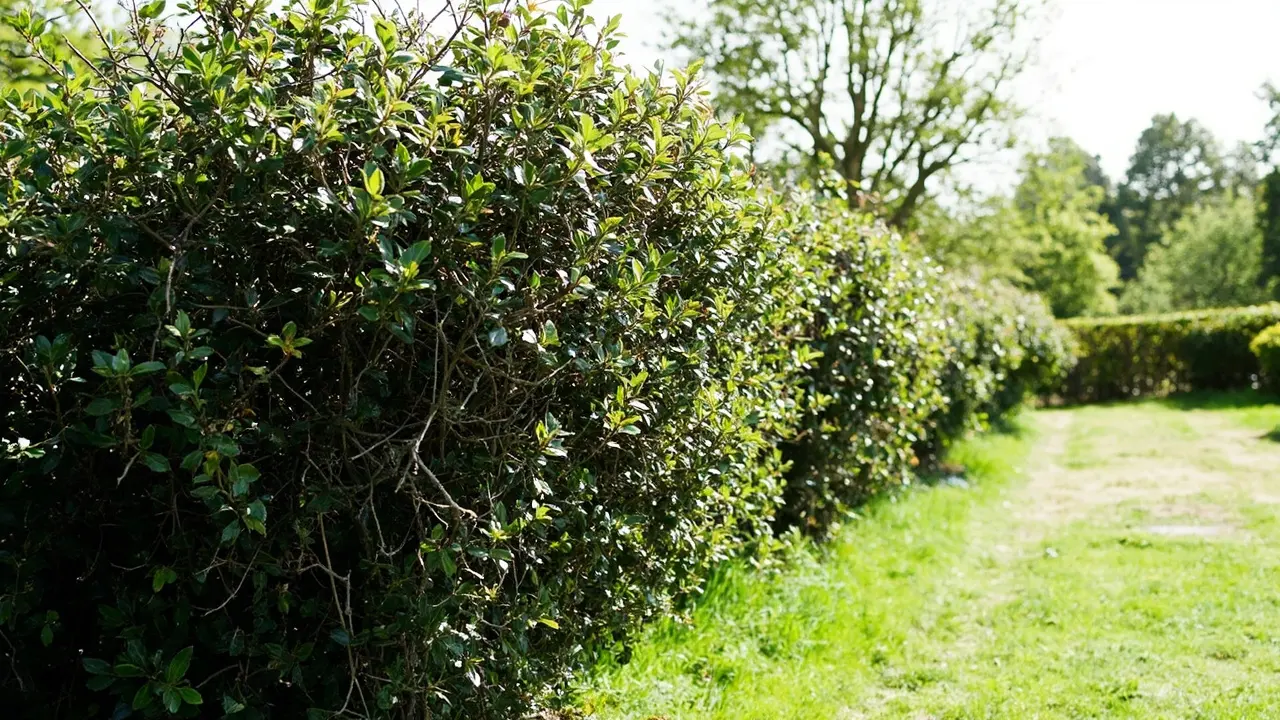
The RHS plant profile describes Forrest St John’s wort as a small, semi-evergreen, bushy shrub. It eventually reaches roughly 1–1.5 metres in height and spread, with that size typically achieved over five to ten years. “Semi-evergreen” is useful guidance rather than a guarantee that every leaf will remain through winter: local exposure, weather and growing conditions can influence how much foliage a plant retains.
Its manageable dimensions make the species useful where a full-sized shrub would be overpowering. It can contribute flower colour and structure to a mixed border, shrub planting or informal garden scheme. When positioning it, allow for its eventual width instead of judging the space from the size of a young nursery plant.
The linked plant record does not carry a confirmed RHS hardiness code for Hypericum forrestii. Choose a well-drained, sheltered position and check the current RHS profile or supplier's label before relying on a specific temperature rating. Avoid an exposed, persistently wet planting pocket while the shrub establishes.
Appearance
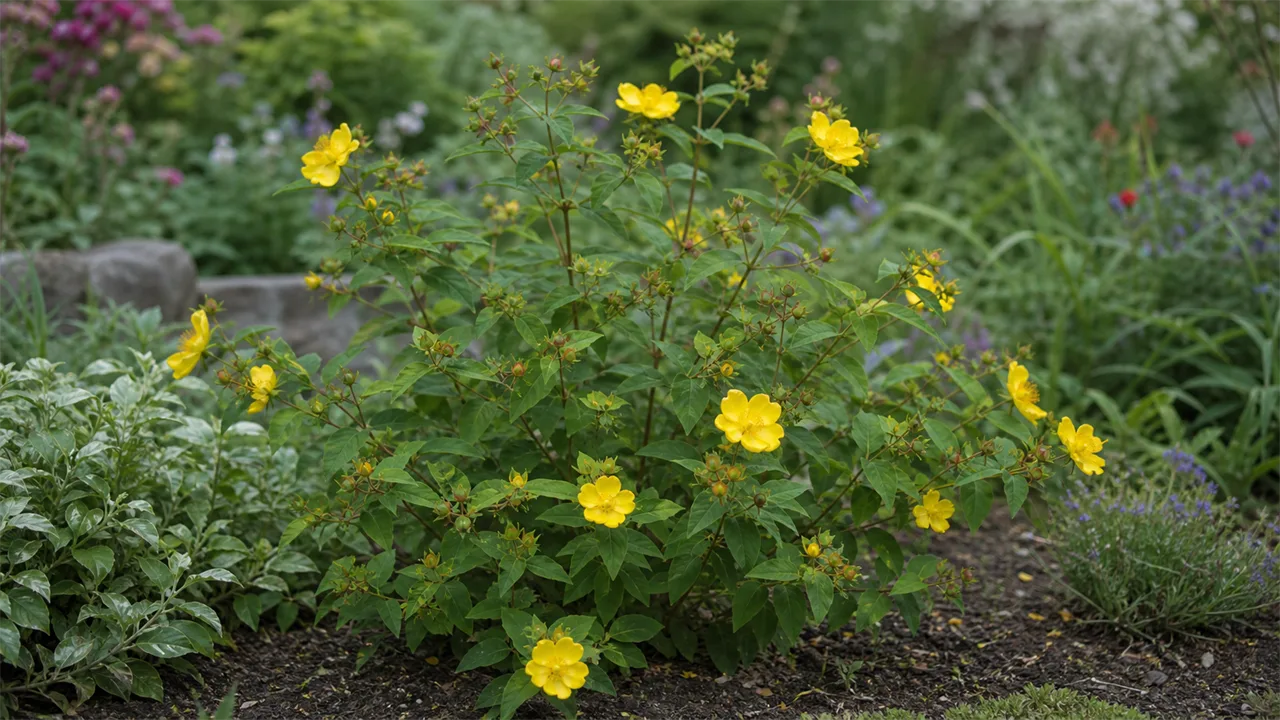
This is a naturally bushy shrub with a layered, slightly spreading character. Trees and Shrubs Online describes erect main stems carrying more horizontal or drooping branchlets. That combination gives an established plant substance in the centre while allowing the finer growth to soften its outline.
The leaves are short-stalked and range from lance-shaped to ovate. The RHS notes that they can turn orange and red in winter, while the specialist account also records attractive autumn colouring. The effect will inevitably vary with the plant’s condition and the season, but the foliage can extend its interest beyond flowering.
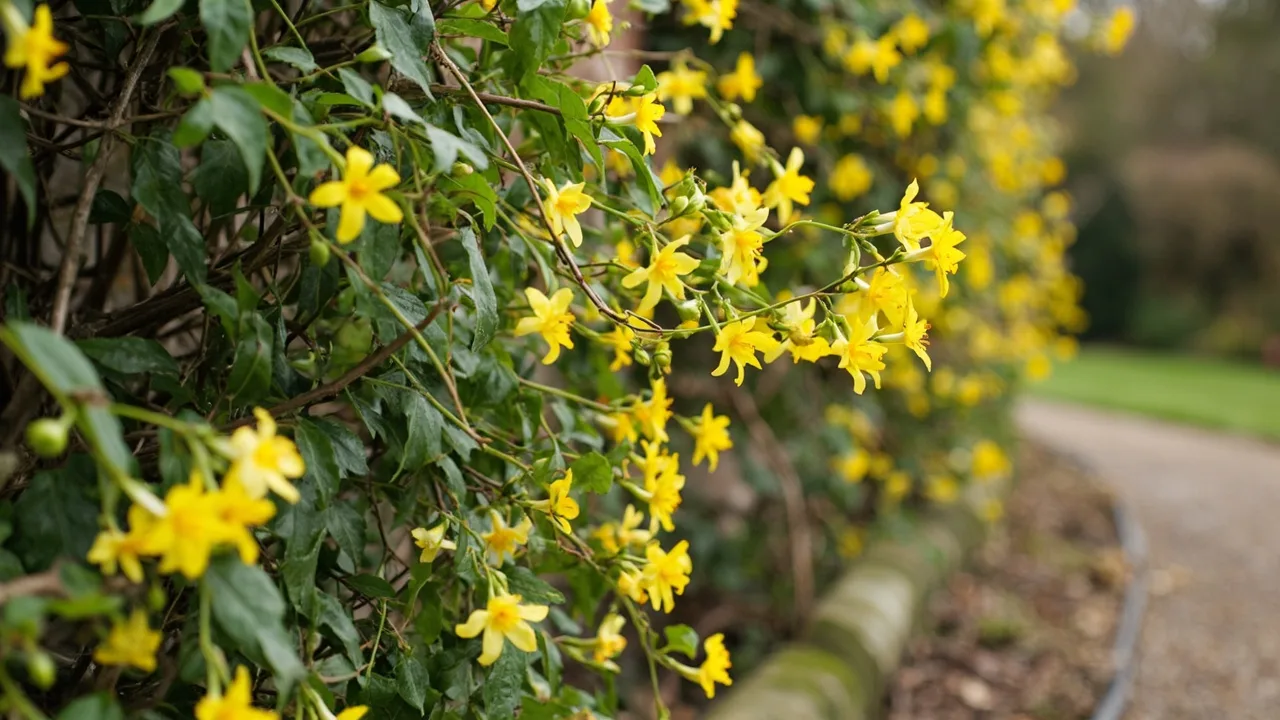
The flowers are clear to golden yellow and saucer-shaped. The RHS records blooms up to about 5 centimetres across. The wider Hypericum genus typically has five petals and conspicuous stamens, features that give the flowers their open, bright appearance. The specialist description says the flowers may be borne singly or in small cymes rather than in dense, heavy clusters.
Young fruits can develop bronzy-red colouring, adding another ornamental phase after the flowers. These fruits are decorative only. The RHS states that they are not to be eaten, so they should not be presented as an edible crop or used for home remedies.
For identification, look at the whole combination rather than relying on yellow flowers alone: a shrub around 1–1.5 metres at maturity, erect stems with more spreading or drooping side growth, short-stalked lanceolate to ovate leaves, open golden-yellow flowers and potentially bronzy young fruits. Many Hypericum plants share individual traits, so the accepted plant label and provenance remain important.
Growing Conditions
The RHS recommends full sun or partial shade. A position in sun or light partial shade is the practical first choice when good flowering is a priority. Its genus guidance warns that dense shade can reduce flowering and lead to leggy growth, so a deeply shaded corner is unlikely to show the plant at its best.
Soil chemistry is not especially restrictive. The RHS lists acid, neutral and alkaline conditions, and includes chalk, clay, loam and sand among suitable soil types. This breadth does not mean that every spot within those categories will work equally well. Moist-but-well-drained or well-drained soil is the important common requirement.
Drainage deserves particular attention because the RHS genus guidance associates poor drainage and waterlogging with root problems. Before planting, observe where water sits after prolonged rain. A low hollow that remains saturated is a poor choice even if the soil type otherwise appears suitable. On heavier ground, selecting the best-drained part of the site is more useful than assuming that the species’ tolerance of clay removes the need to assess conditions.
Conversely, “well-drained” should not be interpreted as “never watered”. A newly planted shrub has a limited root system and can need supplementary watering during dry spells while it establishes. Check the soil rather than following a rigid calendar: the aim is to prevent the root area from drying severely without keeping it constantly sodden.
When choosing a site, combine these requirements. Look for adequate light, enough room for a mature spread of up to about 1.5 metres, and soil through which excess water can escape. In a suitable position, it can be a realistic long-term shrub for many UK gardens, but gardeners in colder or exposed areas should check current authoritative guidance and local conditions before relying on it.
Planting and Care
Begin by confirming that the plant is correctly labelled Hypericum forrestii. This matters particularly when ‘Hidcote’ is nearby in a nursery or catalogue, because ‘Hidcote’ belongs to the distinct hybrid H. × hidcoteense. Keep the species identity on any garden record and retain the accepted botanical authority, (Chitt.) N.Robson, where a formal plant-record field is available.
Choose the planting position using the light and drainage checks above. Allow for the eventual height and width rather than crowding the shrub between vigorous neighbours. Prepare a planting area that lets the root system make contact with the surrounding soil, and set the plant at the same depth at which it was growing in its container. Water it in to settle the soil around the roots.
During establishment, inspect the root area through dry weather and water when necessary. Conditions differ between sandy soil, moisture-retentive clay, exposed gardens and sheltered plots, so observation is more reliable than an unsupported fixed interval. Once established, continue to watch for extremes: prolonged dryness can stress a plant, while a persistently wet root zone conflicts with the drainage guidance for the genus.
Routine pruning should be restrained and responsive to the shrub rather than based on an assumed annual hard cut. The RHS lists pruning groups 1 or 6 for this plant, but those alternatives do not establish one universal cut height or calendar for every specimen. In practice, begin with light, timing-aware work: remove dead or damaged material, and make modest adjustments where necessary to preserve a balanced framework. Before undertaking substantial renovation, consult the current RHS pruning guidance that matches the plant’s growth and condition.
The RHS recommends two propagation approaches. Seed can be sown in containers in autumn, while semi-ripe or semi-hardwood cuttings can be taken in summer. These are distinct methods with different needs. Seed-grown plants may be useful when raising the species, whereas cuttings are the appropriate route when the aim is to reproduce a particular individual vegetatively. Do not claim a named cultivar identity for the resulting plant unless its source and identity are independently established.
Wear gloves or other suitable protective equipment when handling the plant, following the RHS safety advice. Treat the ornamental fruits as non-edible and discourage pets from eating them. This is a practical handling and non-ingestion precaution; it is not a basis for making broader medicinal or species-specific toxicity claims that the available evidence does not support.
Common Problems
The RHS describes Hypericum forrestii as generally pest-free. That is reassuring, but it does not mean that every decline is caused by a rare disease. If flowering becomes poor or growth turns lanky, first reassess the ordinary growing conditions. Dense shade can reduce flowering and stretch growth, while waterlogging can contribute to root trouble. Recent planting, drought stress and competition from neighbouring plants are also practical points to examine before reaching a diagnosis.
Rust is listed by the RHS as a rare possible problem. If unfamiliar symptoms appear, compare them with current authoritative diagnostic guidance rather than treating speculatively. Good identification matters because damage, environmental stress and disease can produce superficially similar signs.
Honey fungus is also listed as a rare susceptibility. The RHS honey fungus guide explains that this is a root disease caused by Armillaria. Possible warning signs include declining top growth, dead or decaying roots, sheets of white fungal growth beneath bark and root-like rhizomorphs. Hypericum is among the genera only rarely recorded as affected, so it should not be described as either commonly attacked or immune.
Suspicious dieback deserves careful diagnosis, especially if other woody plants nearby are also declining. The RHS states that there is no chemical control for confirmed honey fungus and advises removal of infected root and stump material. Because that response is consequential, establish the diagnosis using the full RHS guidance rather than removing a plant on the strength of one vague symptom.
Prevention centres on giving the shrub conditions in which it can grow without avoidable root stress. Use a well-drained site, avoid a persistently wet hollow, provide adequate light and monitor new plants as they establish. These steps cannot guarantee freedom from every problem, but they address the cultivation issues most clearly supported by the available guidance.
Popular Varieties
No authoritative source used for this guide establishes named cultivars of Hypericum forrestii. Gardeners looking for this plant should therefore expect to encounter the straight species rather than a well-documented range of named selections. A seller’s descriptive wording or an unverified label should not be converted into a cultivar name.
‘Hidcote’ requires particular clarification because it is widely associated with shrubby St John’s worts. The RHS lists it as Hypericum × hidcoteense ‘Hidcote’, a distinct hybrid. Trees and Shrubs Online reports that it may be a garden-origin hybrid involving H. forrestii and H. calycinum. That possible relationship does not make ‘Hidcote’ a cultivar of H. forrestii, and characteristics or care claims attached to the hybrid should not automatically be transferred to the species.
For a collection, database or nursery record, create one plant entry for the accepted species Hypericum forrestii (Chitt.) N.Robson. The synonyms H. patulum var. forrestii and H. patulum f. forrestii can be retained for search and disambiguation. Keep H. × hidcoteense ‘Hidcote’ under its own hybrid record. This separation preserves botanical accuracy while helping gardeners find the plant whichever historical name they encounter.
Pests and Diseases
| Problem | Symptoms | Management |
|---|---|---|
| Honey fungus | General decline, wilting, and dieback of stems with possible white fungal growth at the base. | Improve drainage and avoid replanting in infected soil; remove affected plants carefully. |
| Rust | Orange or brown powdery pustules on the undersides of leaves causing yellowing. | Remove affected foliage to improve air circulation and apply a fungicide if severe. |
| Slugs and snails | Irregular holes chewed in young shoots and leaves, often accompanied by slime trails. | Use physical barriers like copper tape or apply iron phosphate-based pellets. |
| Powdery mildew | White powdery coating on leaves and stems, potentially causing distortion. | Ensure good air circulation and water at the base to keep foliage dry. |
| Root rot | Yellowing leaves and stunted growth due to waterlogged soil conditions. | Plant in well-drained soil and avoid overwatering, especially in winter. |
For step-by-step help, read Dealing with Slugs and Snails and Treating Powdery Mildew. Or browse the full plant problem solver to diagnose an issue by symptom.
Recommended Products
GardenWizz earns a commission from qualifying purchases made through affiliate links on this page (including links within the article) — as an Amazon Associate, and from Thompson & Morgan via the Awin network. This does not affect the price you pay. See our disclaimer for details.