Eastern Sowbread
Cyclamen coum · round-leaved cyclamen
The Gardening Year
Best months in UK gardens · full planting calendar →
🖨 Printable care card (PDF)At a Glance
| Botanical name | Cyclamen coum |
|---|---|
| Common name(s) | eastern sowbread, round-leaved cyclamen |
| Family | Primulaceae |
| Plant type | perennial (Hardy winter-flowering tuberous perennial, summer dormant) |
| Height × Spread | 5–10 cm × 8–15 cm |
| Position | Partial shade |
| Soil | Moderately fertile, humus-rich, well-drained soil; avoid waterlogging and excessive summer moisture |
| Flowering | January–March |
| Toxicity | Potentially harmful if eaten; ornamental tubers should not be eaten. Wear gloves when handling. |
| Native range | Bulgaria to the Caucasus and Israel |
Overview
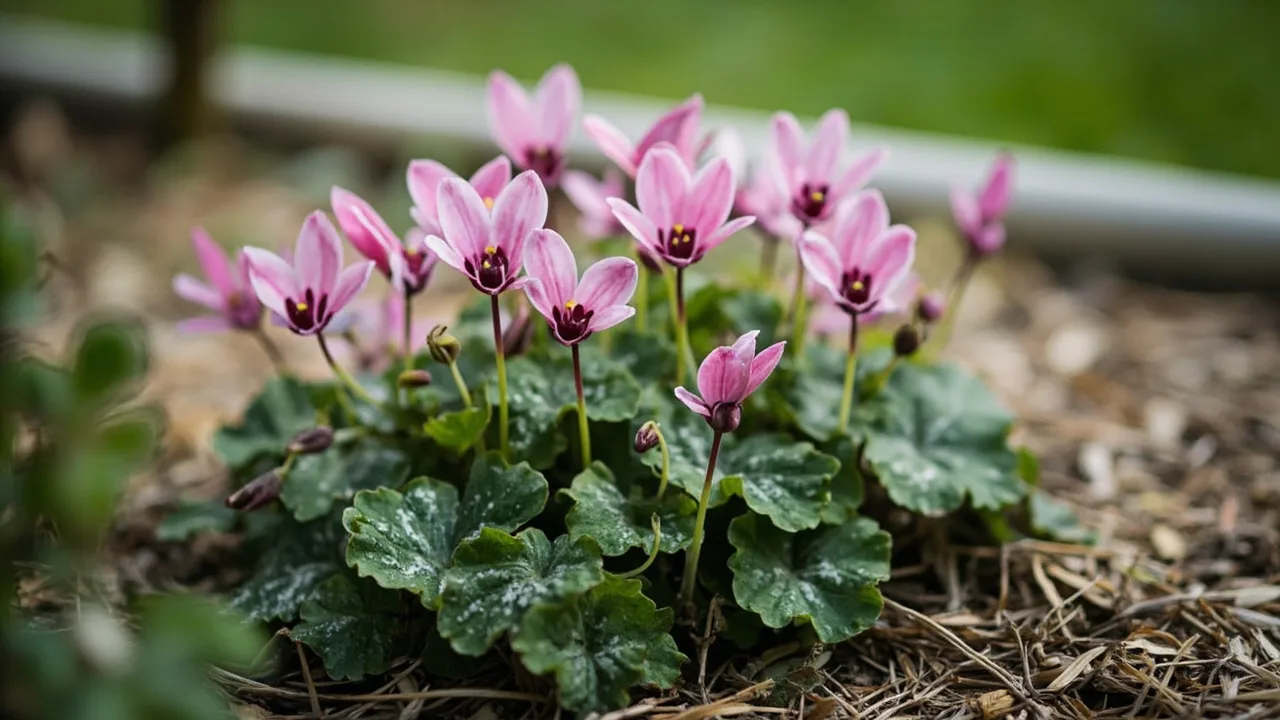
Cyclamen coum, the eastern sowbread, is the small winter- and early-spring-flowering tuber that lights up the floor of a British woodland garden from January through to March. Hardy across the whole of the UK and perfectly happy in heavy soil, it is one of the most reliable tuberous perennials for naturalising under deciduous shrubs or in a shaded rock garden, and it carries on flowering through frost, snow and the worst the British winter can throw at it. The round, kidney-shaped leaves appear in autumn, often with a silver wash or pewter marbling, and stay on the plant through winter before dying back as the small cyclamen seed heads ripen in early summer. The flowers come in shades of magenta, pink and pure white, each with the characteristic swept-back petals of the genus, and they sit on short stems just above the foliage. It is one of the two most commonly grown hardy cyclamen in the UK and is frequently confused with the autumn-flowering Cyclamen hederifolium; the two are easy to separate once you know what to look for.
Appearance
Cyclamen coum forms a low, slowly spreading colony of small tubers, each tuber sending up a single flush of leaves and flowers in the dormant-season gap when little else is in growth. The leaves are rounded or kidney-shaped, smooth-edged, dark green above and often marked with silver, pewter or pale jade marbling that fades as the leaves age through winter. Flowers are small — typically 1–2 cm across — with five swept-back petals in magenta-pink, with paler pink and pure white forms common in cultivation; the petal bases carry a small magenta blotch at the mouth. The whole plant rarely exceeds 8–10 cm in flower and the foliage reaches about 5 cm above the soil, which is why it works so well at the front of a border or threading through the bases of shrubs. By late spring the leaves yellow and the plant goes fully dormant, leaving no above-ground trace until the next autumn's new foliage appears.
Growing Conditions
Cyclamen coum is hardy across the entire UK and shrugs off the cold, damp winters that finish off many Mediterranean plants. It prefers light, well-drained soil with plenty of leaf mould, but is more tolerant of heavy clay than its looks suggest — established colonies thrive on slopes and banks where clay is mixed with grit, while flat clay that sits wet in winter is the one combination that does for it. Plant in partial shade under deciduous shrubs or trees, where the plant gets winter and early-spring light but summer shade when it is dormant; deep year-round shade under evergreens gives foliage but fewer flowers. Soil pH is not critical — neutral to slightly alkaline suits the species well, and it tolerates mildly acid soils without complaint. The plant will not survive being baked in full sun in summer-dry beds, so a cool, leafy spot is much better than a hot border.
Planting and Care
Plant dry Cyclamen coum tubers in late summer or early autumn, ideally as soon as they appear in garden-centre bags in July or August; the tubers should be set about 3–5 cm deep and 10–15 cm apart, with the smoother side down and any signs of last year's roots facing downwards. Soak the bed before planting if the soil is dry, and mulch thinly with leaf mould or compost after the first leaves appear. Once established, Cyclamen coum needs almost no routine care: no feeding, no staking, no pruning and no lifting. The tubers will self-seed gently into surrounding soil and a healthy colony slowly thickens year on year, so avoid disturbing the ground in late summer when the new roots are forming. If you want to extend the colony, lift and replant small seedlings in early autumn while they are still in growth, water them in, and let them settle without further intervention.
Common Problems
Winter waterlogging in flat clay beds is the most common cause of failure, and shows up as rotted tubers and an empty patch the following autumn; the remedy is to plant on a slope, in a raised bed, or in a pocket of gritty top-dressed soil so the tubers never sit in saturated ground for weeks at a stretch. Squirrels and mice can dig up and eat newly planted dry tubers before they root, so either plant them deeper (5–8 cm) or lay a small piece of chicken wire over the bed until the new leaves appear. Vine weevil is occasionally a problem in containers, where the grubs chew the tubers over winter; in open ground Cyclamen coum is largely unbothered. Botrytis grey mould can disfigure the flowers in a wet, mild winter, but it rarely damages the plant and is mostly cosmetic; remove affected leaves to reduce the spread. Above all, avoid the temptation to tidy the dormant patch in summer — the tubers are resting under the soil and digging them up then is the surest way to lose a colony.
Popular Varieties
The species itself, Cyclamen coum, is the form most widely sold in UK garden centres, and a single packet of seed or a handful of dry tubers will establish a colony in two or three seasons. The most popular named forms are the silver-leaved selections sold as Cyclamen coum subsp. caucasicum, whose pewter-marbled foliage rivals the flowers for ornamental value and which are particularly striking under winter sun. For pure white flowers, Cyclamen coum f. album (sometimes sold as 'Album') is a reliable, vigorous selection that mixes well with the magenta-pink forms and lights up shaded corners in late winter. The other half of the UK hardy-cyclamen pair is Cyclamen hederifolium, the ivy-leaved cyclamen, which has lobed, ivy-shaped leaves with small basal auricles, flowers in late summer and autumn rather than winter, and tolerates drier summer shade — gardeners often grow both for an unbroken cyclamen season from August through to March. As a planted partner in the same bed, /plants/scilla-allenii flowers at almost exactly the same time as Cyclamen coum and shares the same tolerance for damp shade, making the pair a textbook early-spring combination under deciduous shrubs.
Recommended Products
GardenWizz earns a commission from qualifying purchases made through affiliate links on this page (including links within the article) — as an Amazon Associate, and from Thompson & Morgan via the Awin network. This does not affect the price you pay. See our disclaimer for details.