Red-Barked Dogwood
Cornus alba · Tartarian dogwood · Siberian dogwood
The Gardening Year
Best months in UK gardens · full planting calendar →
🖨 Printable care card (PDF)At a Glance
| Botanical name | Cornus alba |
|---|---|
| Common name(s) | Red-barked dogwood, Tartarian dogwood, Siberian dogwood |
| Family | Cornaceae |
| Plant type | shrub (deciduous surculose (suckering) shrub that can be grown as a small tree) |
| Height × Spread | 2.5–3 m × 2.5–4 m |
| Position | Full sun, Partial shade |
| Soil | moist but well-drained or well-drained; clay, loam, sand; acid, alkaline, or neutral pH |
| Flowering | May–June |
| Toxicity | — |
| Native range | Siberia, northern China and Korea |
Cornus alba
Overview
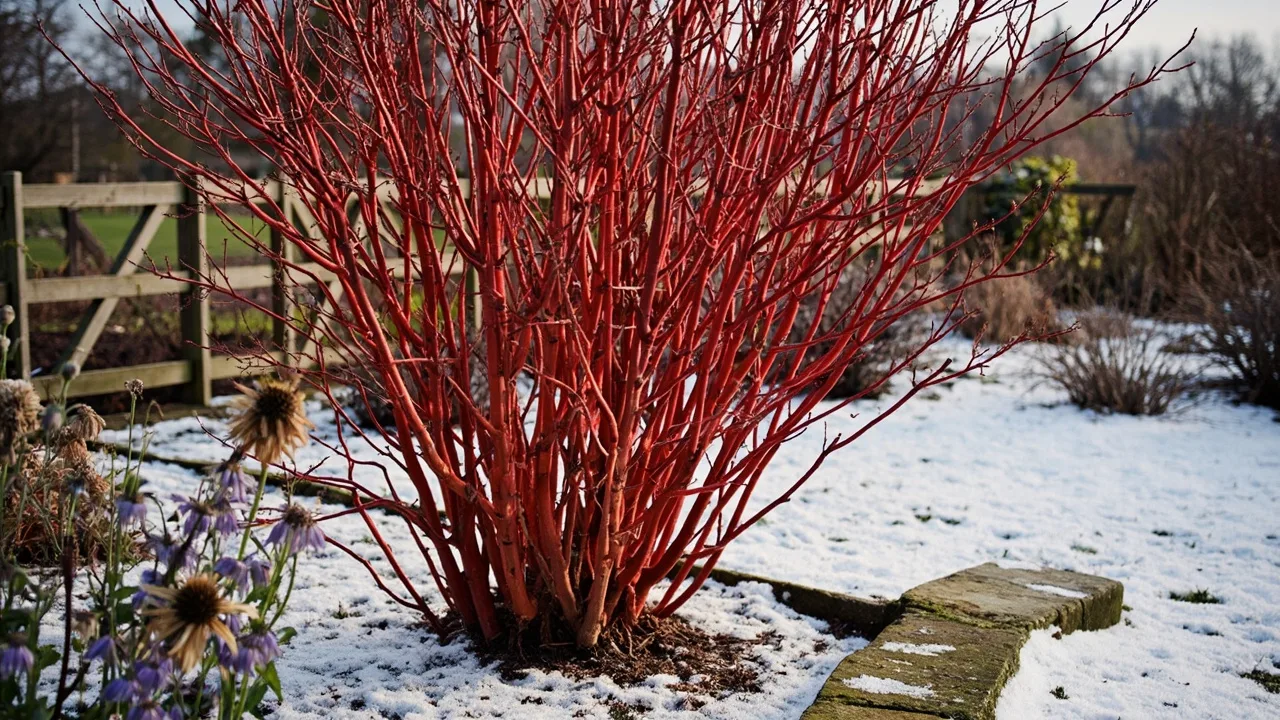
Cornus alba — widely sold as red-barked dogwood, Siberian dogwood, or white dogwood — is a vigorous, suckering deciduous shrub grown across the UK for one reason above all others: its winter stems. In midwinter, when much of the garden is bare, a mature Cornus alba carries a thicket of upright canes in coral-red, blood-red, or (in selected cultivars) deep purple-black, and against frost or low sun they are unmissable. The species is native to Siberia, northern China and Korea, which explains its tolerance of cold, wet ground — conditions that defeat many other flowering shrubs in British gardens. Many gardeners I speak to treat it as a structural plant, not a flowering one, and value it most when little else is performing between December and March.
Appearance
Cornus alba forms a dense thicket of straight, upright canes rather than a single trunk. An unpruned specimen typically reaches 2.5–4 m tall and wide, sending up new suckers each year from the base. Leaves are oval, 5–12 cm long, mid- to dark green above and glaucous beneath, turning yellow, orange and red before falling in October. The flowers appear in May and June as flat, 4–6 cm clusters of tiny cream-white florets, occasionally followed by small blue-white, slightly bitter berries. The flowers are modest on their own, but they sit well against the variegated foliage of named cultivars. I find the real show is the bark — it is the youngest wood that carries the strongest colour, which is why pruning makes such a difference.
Growing Conditions
Cornus alba is one of the easiest garden shrubs to place because it tolerates almost any reasonable soil — clay, loam, sandy, slightly acid or slightly alkaline — provided the ground does not dry out for long in summer. In my experience, the shrubs that perform worst are the ones planted into dry, free-draining soil at the base of a sunny wall, where summer drought suppresses new growth and dulls the bark colour. The best specimens I have seen are growing beside a pond, a stream, or a damp meadow edge.
Full sun is the most important site factor if you want vivid winter colour. The RHS dogwood guide notes that stems colour best in full sun and the plants prefer reliably moist soil to promote vigorous growth. Light dappled shade is acceptable, particularly for variegated cultivars whose leaves scorch less at noon in midsummer, but you will see noticeably paler stems in shade.
The species is fully hardy across the UK, including upland and northern gardens, and copes with exposed sites better than most flowering shrubs because the regrowth comes from the base each year rather than from a permanent framework of branches.
Planting and Care
Plant bare-root Cornus alba between November and March, or pot-grown specimens at any time the soil is workable. Dig a hole twice the width of the rootball and backfill with the original soil improved with a bucket of well-rotted garden compost per plant. Water in well and mulch with 5–7 cm of bark or compost. Space plants 1.2–1.5 m apart for a hedge or informal screen.
Watering. Water deeply once a week in dry spells for the first two seasons. Established plants need extra water only on free-draining soils during extended drought.
Feeding. A single annual mulch of garden compost in early spring is usually enough. On poor or sandy soil, add a balanced slow-release shrub fertiliser in March.
Pruning. This is the one job you must do for bright stems. The strongest colour comes from young wood. The RHS recommends pruning shrubby Cornus grown for stem colour from late March to mid-April, just as new growth is starting. The simplest method is to cut all stems down to 5–7 cm from the ground each spring (coppicing), which produces the longest, most vividly coloured new canes for the following winter. In a mixed border where summer foliage matters as much as winter stems, remove roughly one-third of the oldest, thickest canes at the base each year instead. Avoid pruning in summer or autumn: cuts made then bleed sap and encourage weak regrowth that gets frosted.
Propagation. Cornus alba is easy from hardwood cuttings taken between November and February. Cut pencil-thick stems into 20–25 cm lengths, push two-thirds deep into a trench of gritty compost or a sheltered bed, and leave them until the following autumn. Suckers with roots attached can also be lifted and replanted in autumn or early spring.
Seasonal care. Apart from the annual prune, the only regular work is weeding around the base in spring and topping up the mulch.
Common Problems
Cornus alba is largely trouble-free, which is one reason it remains popular in public plantings.
Die-back on older stems
Symptom: individual canes fail to leaf up in spring, or leaves emerge small and pale before the cane collapses. Cause: old, exhausted wood; the cause is rarely disease and is usually just that the cane has reached the end of its useful colour life. Fix: remove the affected cane at the base during the spring prune. In established plantings, this is what the annual thinning is designed to do.
Powdery mildew on foliage in late summer
Symptom: a white, dusty coating on leaves from late July onwards, sometimes followed by premature leaf drop. Cause: dry soil at the roots combined with humid still air — a recurring issue on light, sandy soils during hot, dry spells. Fix: improve watering so the soil stays moist, mulch thickly in spring, and clear fallen leaves in autumn. The RHS advises mulching and watering rather than fungicide treatment for ornamental dogwoods.
Anthracnose (spot anthracnose) on leaves
Symptom: tan or purple-bordered spots on the leaves, sometimes with leaf distortion. Cause: the fungal pathogen Discula, which affects several Cornus species in cool, damp springs. Fix: rake up and dispose of infected leaves in autumn, water at the base of the plant rather than overhead, and improve air circulation by thinning congested stems. Most established shrubs tolerate the disease without lasting damage.
Sucker spread beyond the intended bed
Symptom: new stems appearing 1–2 m away from the parent plant. Cause: the natural suckering habit of the species — useful for a hedge, less welcome in a formal border. Fix: mow or hoe off unwanted suckers during the growing season. In a lawn, set the mower to its highest cut.
Lack of stem colour in winter
Symptom: the bark looks dull orange-brown rather than the bright coral-red you expected. Cause: the most common cause is that the shrub has not been pruned — old wood loses its colour. The other cause is too much shade, or soil that has been allowed to dry out through summer. Fix: implement an annual March–April prune and water through dry spells. Move poorly placed plants in autumn.
Popular Varieties
Several well-known, widely available cultivars are grown in UK gardens. I have picked ones whose RHS profiles I have cross-checked; if a cultivar is not on this list, that does not mean it is poor, only that I cannot speak to it from a UK trial.
Cornus alba 'Sibirica' — the classic red-stemmed dogwood. Vigorous upright shrub to about 2.5 m, with vivid coral-red young stems that turn brighter as winter progresses. The most widely planted form in the UK.
Cornus alba 'Elegantissima' — a slightly less vigorous form with grey-green leaves edged in white, giving a luminous appearance in partial shade. Stems are paler red than 'Sibirica', and many gardeners find the in-leaf effect outweighs the winter difference. Typical height 2–2.5 m.
Cornus alba 'Spaethii' — a variegated cultivar with broader golden-yellow leaf margins and red young stems. The colouring is strongest in full sun; in shade the gold fades to green. Reaches about 2 m tall.
Cornus alba 'Aurea' — sold as the golden Tartarean dogwood. Soft yellow foliage in summer that greens in shade, with red stems in winter. A good choice for a damp border where the chartreuse leaf colour is wanted.
Cornus alba 'Kesselringii' — a less common but striking cultivar whose young stems are deep red in summer and turn almost blackish-purple in winter. Pairs well with red-stemmed forms for tonal contrast.
Cornus alba 'Baton Rouge' ('Minbat') — a more compact selection (typically to 2 m) marketed for stronger red stem colour. Worth seeking out if you have a smaller garden.
Sources & Further Reading
- RHS plant profile — Cornus alba L., https://www.rhs.org.uk/plants/4379/cornus-alba-l/details, accessed 2026-07-24.
- RHS, "Dogwoods (Cornus) for stem colour", https://www.rhs.org.uk/plants/cornus/for-stems, accessed 2026-07-24.
- RHS, "How to grow winter stem colour dogwoods", https://www.rhs.org.uk/plants/cornus/for-stems/growing-guide, accessed 2026-07-24.
- RHS, "Coppicing: A Guide to Regenerative Pruning", https://www.rhs.org.uk/plants/types/trees/coppicing, accessed 2026-07-24.
- Trees and Shrubs Online, Cornus alba L., https://www.treesandshrubsonline.org/articles/cornus/cornus-alba/, accessed 2026-07-24.
Pests and Diseases
| Problem | Symptoms | Management |
|---|---|---|
| Aphids | Clusters of small soft-bodied insects on new growth causing leaf curling and sticky honeydew. | Squash by hand or spray with a strong jet of water; introduce ladybirds if infestation persists. |
| Scale insects | Small immobile bumps on stems and leaves that may cause yellowing and stunted growth. | Scrape off manually or treat with horticultural oil during the dormant season. |
| Slugs and snails | Irregular holes chewed in young leaves and silvery slime trails on foliage and soil. | Use beer traps, copper tape barriers, or iron phosphate-based pellets to control populations. |
| Powdery mildew | White powdery fungal growth on leaves and shoots, potentially causing distortion. | Improve air circulation and water at the base; apply a sulphur-based fungicide if severe. |
| Vine weevil | Notched leaf margins above ground and root damage below, leading to wilting plants. | Apply nematodes to the soil in autumn or use systemic insecticides as a preventative measure. |
For step-by-step help, read Controlling Aphids Naturally, Dealing with Slugs and Snails and Treating Powdery Mildew. Or browse the full plant problem solver to diagnose an issue by symptom.
Recommended Products
GardenWizz earns a commission from qualifying purchases made through affiliate links on this page (including links within the article) — as an Amazon Associate, and from Thompson & Morgan via the Awin network. This does not affect the price you pay. See our disclaimer for details.