Purple Cranesbill
Geranium × magnificum
The Gardening Year
Best months in UK gardens · full planting calendar →
🖨 Printable care card (PDF)At a Glance
| Botanical name | Geranium × magnificum |
|---|---|
| Common name(s) | Purple cranesbill |
| Family | Geraniaceae |
| Plant type | perennial (herbaceous perennial, deciduous, hybrid between Geranium platypetalum and Geranium ibericum) |
| Height × Spread | 60–70 cm × 45–70 cm |
| Position | Full sun, Partial shade |
| Soil | moderately fertile, well-drained; tolerates most soils unless waterlogged; pH acid, alkaline or neutral |
| Flowering | June–August |
| Toxicity | — |
| Native range | — |
Purple cranesbill (Geranium x magnificum) forms a substantial, weed-suppressing clump and produces a concentrated display of richly veined violet-blue flowers in early summer. Give it sun or light shade, free-draining soil and room to spread, then divide established clumps when they become congested.
Overview
Geranium x magnificum is a vigorous perennial valued for a brief but impressive early-summer flower display and a dense mound of foliage that remains useful after flowering. The botanical multiplication sign identifies it as a hybrid, generally accepted as a cross between Geranium ibericum and Geranium platypetalum. Both parents originate in western Asia, and the hybrid is not native to Britain or Ireland.
Its common names include purple cranesbill, showy cranesbill and magnificent cranesbill. "Cranesbill" refers to the long, beak-like fruit characteristic of many hardy geraniums, although this particular hybrid is sterile and does not produce viable seed. It must therefore be propagated vegetatively, most reliably by division or basal cuttings.
This is a hardy geranium rather than the tender bedding pelargonium commonly called a geranium. It works especially well in cottage-garden borders, beneath open shrubs and roses, and among robust perennials such as lady's mantle, daylilies, catmint and ornamental salvias. A group planted 45-60 cm apart develops into effective ground cover, shading the soil and suppressing annual weeds once established.
The main limitation is its flowering pattern. Unlike long-flowering hybrids such as 'Rozanne', purple cranesbill normally gives one concentrated flush in June and July rather than repeating for months. Its value afterwards comes from the textured foliage, neat ground-covering habit and, in some selections, warm autumn colour.
Appearance
The plant emerges in spring as a low, expanding mound of softly hairy, mid-green leaves. Each leaf is deeply divided into five to seven broad lobes, creating a bold texture without looking coarse. Upright flowering stems then rise above the basal foliage, producing a mature clump commonly around 50-100 cm high and 45-60 cm across. Nursery selections may be shorter and more compact than unnamed plants.
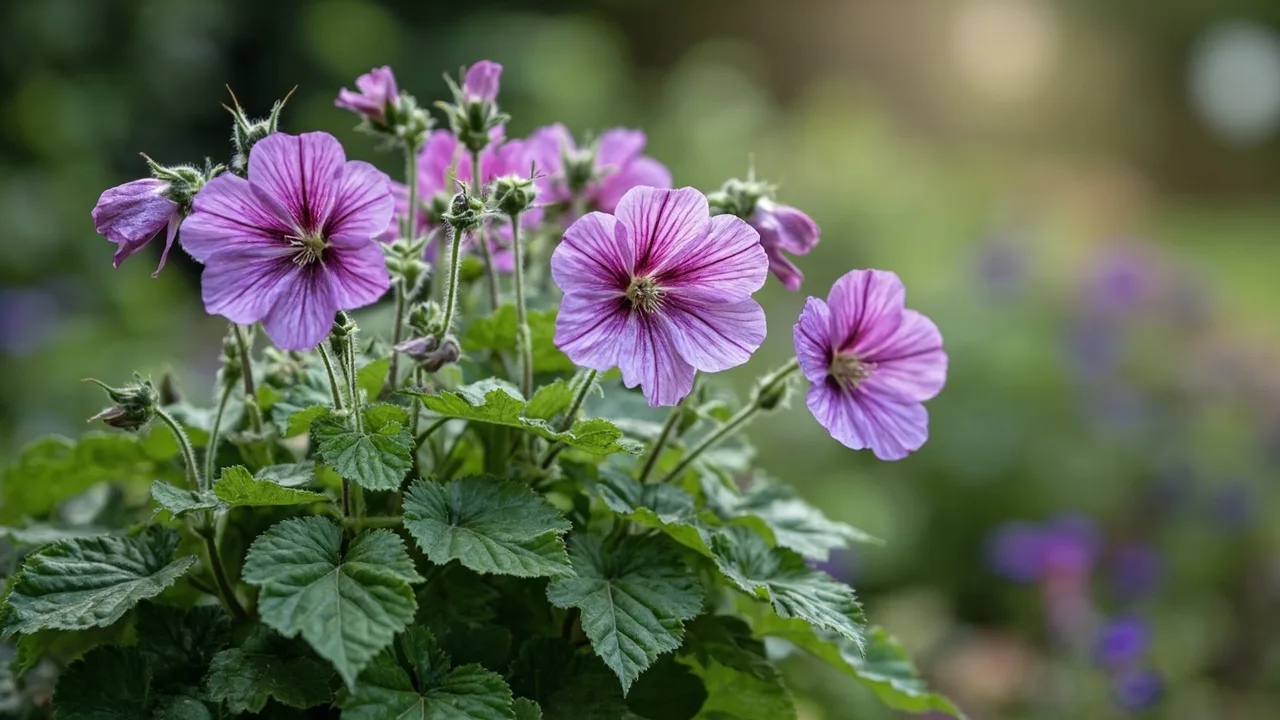
Flowers are broadly saucer-shaped and usually 4-5 cm across. Their colour ranges from rich violet-blue to deep purple-blue, with fine, darker veins radiating across each petal towards a small pale eye. The overlapping, slightly notched petals give the blooms a full appearance, while the open flower shape makes pollen accessible to bees and hoverflies.
The display usually peaks in June or early July. Flowering stems can lean outwards after rain or in very rich soil, but the basal foliage generally stays dense. Cutting finished stems back to the leaf mound restores a tidy outline and exposes the foliage rather than encouraging a dependable second flush.
Leaves remain attractive through much of summer when the plant is not allowed to dry severely. Some clones, particularly 'Rosemoor', develop orange and red tones in autumn before dying back. The old top growth then collapses around the crown and can be removed in late autumn or left until early spring to provide some habitat and winter cover.
Because the hybrid is sterile, it does not scatter seedlings around a border. Its clump gradually enlarges through vegetative growth but is not a running geranium. This controlled habit makes it suitable for planting between roses or at the middle and front of a border where self-seeding would be inconvenient.
Growing Conditions
Full sun produces the strongest stems and most generous flowering, but partial shade is also suitable. A position receiving at least half a day of direct light is a useful compromise in most UK gardens. Light shade from deciduous trees can work because the plant receives more light in spring before the canopy is fully developed. Deep, dry shade is likely to reduce flowering and create looser growth.
Purple cranesbill accepts loam, sandy soil and clay provided excess winter water can drain away. Moderately fertile soil enriched with organic matter supports a dense clump, while excessively rich ground can encourage tall, soft stems that flop. Incorporate garden compost into poor soil before planting, but avoid creating a moisture-retentive pocket in heavy clay. On wet sites, improve the wider planting area rather than filling a single hole with loose compost.
The ideal soil remains evenly moist while roots establish, then drains freely through autumn and winter. Established clumps cope with short dry periods, but prolonged summer drought may cause foliage to look tired or develop powdery mildew. A spring mulch helps conserve moisture and reduces competition from weeds; keep it clear of the crown so that dormant growth is not buried.
Plants perform well in many UK borders when given free-draining soil and a position protected from persistent winter wet. Exposed gardens may benefit from lower-growing selections and shelter from strong winds, especially where fertile soil encourages taller flower stems. In containers, roots experience greater fluctuations in moisture and temperature than they do in open ground, so a large pot, drainage holes and a loam-based peat-free compost are important.
Good companions should enjoy similar conditions without overwhelming the clump. Lady's mantle provides lime-green flowers beside the violet-blue blooms, while catmint and ornamental salvia extend the blue-purple theme. Daylilies and roses add later colour after the cranesbill's main flush. Leave enough space around new plants for air movement and eventual spread rather than crowding them immediately.
Planting and Care
Plant container-grown purple cranesbill in autumn, during mild spells in winter, or in spring. October to February allows roots to establish before summer where the soil is workable, but avoid frozen or waterlogged ground. Spring planting is preferable in cold, wet gardens. Dig a hole no deeper than the root ball, loosen circling roots, set the crown level with the surrounding soil and firm gently. Space plants 45-60 cm apart for a continuous group.
Water thoroughly after planting and during dry periods throughout the first growing season. Check the soil beneath the surface rather than watering automatically: it should be moist but not saturated. Once established, plants usually need additional water only during prolonged dry weather. Container plants require more regular checking, particularly when foliage and flower stems are at full size.
Apply a 3-5 cm mulch of well-rotted garden compost in spring, leaving a clear ring around the crown. On ordinary garden soil this is often sufficient feeding. Where growth is weak on poor soil, a modest application of balanced general fertiliser in spring is adequate. Heavy feeding is unnecessary and can result in lush foliage and stems that are less self-supporting.
Cut flowering stems back to the basal leaves when the main display finishes in mid-to-late July. This is a cutback rather than woody pruning and keeps the clump compact. In fertile soil or an exposed position, shortening stems by about one-third in late May can create sturdier growth and delay flowering slightly, though it also postpones the main display. Cut dead foliage to ground level in October or November, or leave it until late winter and clear it before new growth begins.
Divide mature clumps in autumn or early spring. Lift the plant with as much root as possible, split it using two forks back-to-back or a sharp spade, and replant vigorous outer pieces at their original depth. Discard an exhausted or woody centre. Water divisions well and keep them from drying out while roots re-establish. Division every three to five years can renew an old clump, control its width and provide genetically identical plants.
Basal cuttings offer another propagation method. In spring, remove short young shoots with a small piece of basal tissue, insert them into a free-draining peat-free cuttings compost and keep them humid but not waterlogged until rooted. Seed is not a viable propagation option because Geranium x magnificum is sterile. This also means named selections retain their characteristics only when propagated vegetatively.
Seasonal care is straightforward. Mulch and divide in spring where needed, water newly planted clumps during summer drought, cut back spent stems after flowering, and clear dead top growth in autumn or before spring growth starts. Staking is rarely required, but a discreet support installed early can help taller plants on exposed sites.
Common Problems
Purple cranesbill is generally dependable, and serious damage is uncommon. Healthy plants in suitable soil often need no treatment beyond removing damaged foliage and correcting the conditions that allowed a problem to develop.
Geranium sawfly: Greyish-green, caterpillar-like larvae chew irregular holes through hardy geranium leaves, commonly during May and sometimes again in September. Inspect leaf undersides and remove larvae by hand where practical. Established clumps usually tolerate limited feeding, so chemical treatment is rarely justified. Encourage natural predators and avoid removing all undamaged foliage merely for cosmetic reasons.
Powdery mildew: A pale, powdery coating develops on leaves, particularly when roots are dry but the air around congested growth is humid. Water deeply at soil level during prolonged drought, thin nearby plants to improve air movement and remove badly affected foliage. Avoid repeatedly wetting leaves late in the day. A plant that suffers every year may need division or relocation to a less crowded site.
Rust and other leaf spots: Yellow or brown marks on upper leaf surfaces may correspond with pustules beneath. Remove infected leaves promptly and put them in household or council green waste according to local guidance rather than retaining them beside the plant. Clear fallen material in autumn and avoid overhead watering. Persistent disease is more likely where clumps are crowded and foliage remains damp.
Vine weevil: Container-grown plants are at greater risk than those in borders. Adults notch leaf edges, while cream, C-shaped grubs feed on roots and can cause sudden wilting. Check potting compost when symptoms appear and use a biological nematode control at the temperature and season stated on the product. Repot severely affected plants into fresh compost after removing visible grubs.
Flopping: Tall stems may collapse after heavy rain, especially in rich soil or shade. Reduce high-nitrogen feeding, provide more light where possible and use low supports before stems elongate. A late-May cutback by one-third can produce shorter growth, but should be treated as an optional shaping technique because it delays flowering.
Poor flowering: Too much shade, recent division, drought during active growth or an over-rich feed can reduce the display. Allow a newly divided clump a season to establish, maintain even moisture and avoid fertilisers intended mainly to promote leafy growth. Remember that one early-summer flush is normal for this hybrid; failure to repeat-flower is not a sign of ill health.
Crown decline in wet soil: Soft, failing growth after winter often indicates poor drainage around the crown. Lift healthy outer sections, remove decayed material and replant in a better-drained position. Do not bury the crown beneath soil or a thick mulch. Improving drainage before replanting is more effective than repeatedly replacing plants in the same waterlogged pocket.
Popular Varieties
The number of clearly documented Geranium x magnificum cultivars in current UK horticulture is limited. Unnamed Geranium x magnificum remains widely grown and provides the characteristic violet-blue flowers, substantial leafy clump and June-to-July display. Where a named selection is important, buy from a specialist nursery and retain its label because this sterile hybrid cannot come true from seed.
- 'Rosemoor' is a well-established selection listed by the RHS and UK nurseries. It forms a clump around 60 cm tall and 45 cm wide, with heavily veined rich violet flowers in a concentrated midsummer display. Its deeply divided leaves can turn attractive orange and red shades in autumn.
- 'Blue Blood' is a compact, mound-forming selection listed by the RHS and offered by UK nurseries. It develops a dome of divided foliage with stems around 35 cm high and dark sapphire to indigo-blue flowers. Its smaller stature suits the front of a border and gardens where the unnamed hybrid would be too tall.
- Unnamed Geranium x magnificum is the standard garden form rather than a cultivar. It is included here because reliable sources do not consistently document a third distinct named cultivar in current UK trade. It normally reaches 50-100 cm, bears strongly veined violet-blue flowers and gives the robust, weed-suppressing habit for which the hybrid is grown.
Other famous blue hardy geraniums, including 'Rozanne', 'Johnson's Blue' and 'Brookside', are not cultivars of Geranium x magnificum and should not be sold or labelled as such. They may be useful alternatives where a longer flowering season or a different habit is wanted, but they do not belong in this hybrid's cultivar list.
Sources & Further Reading
- Royal Horticultural Society, Geranium x magnificum plant profile: https://www.rhs.org.uk/plants/95989/geranium-x-magnificum/details (accessed 2026-07-22).
- Royal Horticultural Society, Geranium x magnificum 'Rosemoor': https://www.rhs.org.uk/plants/151199/geranium-x-magnificum-rosemoor/details (accessed 2026-07-22).
- Royal Horticultural Society, Geranium x magnificum 'Blue Blood': https://www.rhs.org.uk/plants/237024/geranium-magnificum-blue-blood/details (accessed 2026-07-22).
- Royal Horticultural Society, geranium sawfly advice: https://www.rhs.org.uk/biodiversity/geranium-sawfly (accessed 2026-07-22).
- BBC Gardeners' World, how to grow hardy geraniums: https://www.gardenersworld.com/how-to/grow-plants/how-to-grow-hardy-geraniums/ (accessed 2026-07-22).
- Beth Chatto's Plants & Gardens, Geranium x magnificum: https://www.bethchatto.co.uk/conditions/plants-for-general-conditions/geranium-magnificum.htm (accessed 2026-07-22).
Pests and Diseases
| Problem | Symptoms | Management |
|---|---|---|
| Vine weevil larvae | Leaves wilt and yellow despite moist soil due to root damage by C-shaped larvae. | Apply nematodes in autumn or use a systemic insecticide drench. |
| Slugs and snails | Irregular holes chewed in leaves and stems, often with slimy trails visible. | Use slug pellets, beer traps, or hand-pick at night to reduce populations. |
| Powdery mildew | White, dusty fungal growth appears on leaves and stems, particularly in dry conditions. | Improve air circulation and spray with a fungicide or milk solution if severe. |
| Geranium sawfly larvae | Leaves are skeletonised or eaten away by green caterpillar-like larvae. | Hand-pick larvae or apply an insecticidal soap spray to control infestations. |
| Capsid bug | Small, pale spots on leaves and distorted new growth caused by sap-sucking insects. | Monitor regularly and treat with a broad-spectrum insecticide if damage is significant. |
For step-by-step help, read Dealing with Slugs and Snails and Treating Powdery Mildew. Or browse the full plant problem solver to diagnose an issue by symptom.
Recommended Products
GardenWizz earns a commission from qualifying purchases made through affiliate links on this page (including links within the article) — as an Amazon Associate, and from Thompson & Morgan via the Awin network. This does not affect the price you pay. See our disclaimer for details.