Garden Cosmos
Cosmos bipinnatus · Mexican aster · cosmea
The Gardening Year
Best months in UK gardens · full planting calendar →
🖨 Printable care card (PDF)At a Glance
| Botanical name | Cosmos bipinnatus |
|---|---|
| Common name(s) | garden cosmos, Mexican aster, cosmea |
| Family | Asteraceae |
| Plant type | annual (often considered half-hardy, although plants may reappear via self-sowing for several years) |
| Height × Spread | 0.6–2.8 m × 10–50 cm |
| Position | Full sun |
| Soil | moderately fertile, moist, but well-drained soil; pH between 6.0 and 8.5 |
| Flowering | June–November |
| Toxicity | No specific toxicity is listed by the RHS. This is not a guarantee of safety — check with a vet or the ASPCA before pets or children eat any plant. |
| Native range | Mexico |
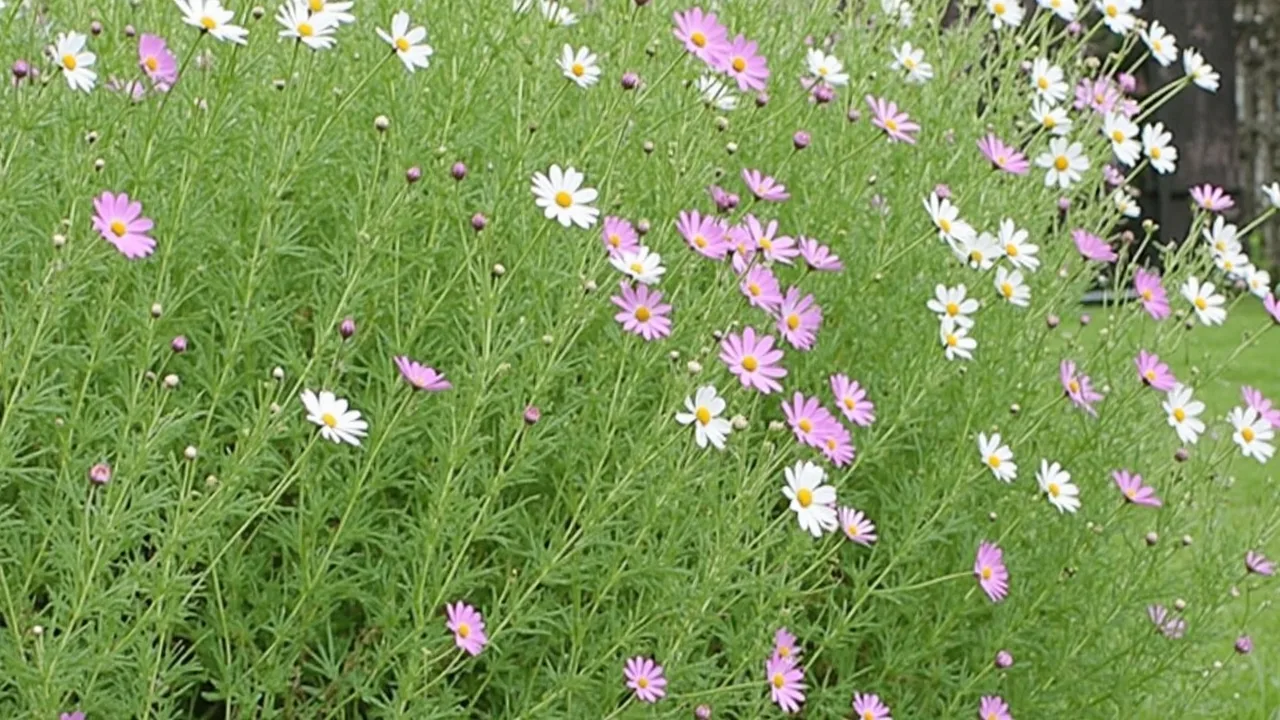
Garden cosmos is an annual flowering plant native to Mexico and a staple of British cottage-garden planting from midsummer until the first frosts. It is grown for its finely divided, feathery foliage and its simple, daisy-like blooms in white, pink, and shades of crimson. Reliable, undemanding, and prolific, it suits beds, borders, and cutting patches across most of the UK, though it is tender and treated as a half-hardy annual in colder regions.
Overview
Cosmos bipinnatus belongs to the Asteraceae family and is one of the most widely grown ornamental annuals in British gardens. It was introduced to European horticulture in the late eighteenth century and has since been developed into numerous cultivars ranging from compact patio forms to tall border varieties suited to the back of a herbaceous border. The plant is valued for its long flowering season, which in a typical UK summer extends from late June well into October, providing nectar for bees, hoverflies, and butterflies at a time when many early-summer perennials have finished.
The species is fully annual in the British climate. It completes its life cycle in a single season and is killed by the first hard frost. In mild southern and coastal areas it may self-sow modestly, but reliable display depends on fresh sowing each year. Cosmos is generally considered low-maintenance and forgiving of occasional neglect, making it a popular choice for novice gardeners and for large drifts in cutting gardens.
Appearance
Garden cosmos forms an upright, branching plant with a light, airy habit. Stems are slender, often tinted reddish where exposed to strong sun, and carry opposite leaves that are finely divided into thread-like segments, giving the foliage a feathery, almost fennel-like appearance. The overall effect is of an open, see-through plant that integrates well with neighbouring perennials rather than crowding them.
The flowers are borne singly on long stems and measure roughly 5 to 8 cm across. Each head consists of a ring of broad ray florets surrounding a central disc of small yellow florets. Wild-type Cosmos bipinnatus flowers are typically white or pale pink with a yellow centre, while cultivated varieties extend the range to deep rose, magenta, crimson, and bicoloured forms. Some cultivars, particularly those in the 'Double Click' and 'Sea Shells' series, have tubular or doubled ray florets that give the flowers a fuller, more ruffled outline.
Mature height varies markedly with cultivar. Tall cultivars such as 'Sensation Mixed' typically reach 1.2 to 1.5 m, while compact series such as 'Sonata' and 'Versailles' stay around 60 to 75 cm, making them more suitable for container planting or the front of a border.
Growing Conditions
Cosmos bipinnatus performs best in full sun, in a position that receives at least six hours of direct light per day. In shaded or partially shaded sites the plants become leggy, flower poorly, and are more susceptible to mildew late in the season. A sheltered spot is preferable in exposed northern and western gardens, where strong winds can snap the taller cultivars if they are not staked.
The ideal soil is moist but well-drained and of moderate fertility. Very rich soils produce abundant foliage at the expense of flowers, so additional manure or high-nitrogen feed should be avoided. Light, sandy soils are tolerated provided moisture is consistent during dry spells; heavy clay can be improved by incorporating grit and organic matter before sowing. The preferred soil pH is roughly neutral to slightly acidic, in the range of about 6.0 to 7.5, though the plant tolerates a wider range in practice.
Although cosmos is widely cultivated in the UK, it is not generally listed in the RHS hardiness ratings because it is treated as an annual rather than a perennial. In the mildest parts of Cornwall, the Channel Islands, and similar microclimates, self-sown seedlings may survive a typical winter, but this should not be relied upon for garden planning.
Planting and Care
Sowing can be carried out under cover in March or April, or directly outdoors once the soil has warmed in May. Indoor-sown seed is typically started in modules or small pots at about 18 to 21 °C, germinating within seven to fourteen days. Seedlings are pricked out once large enough to handle and grown on in cooler conditions until the last frost has passed, usually in late May or early June in most of the UK. Harden off before planting out at a spacing of roughly 30 to 45 cm for compact cultivars and 45 to 60 cm for tall ones.
Watering needs are moderate. Seedlings and young plants should not be allowed to dry out, but established cosmos is reasonably drought-tolerant. Deep watering once or twice a week in dry weather is preferable to frequent shallow watering, which encourages surface rooting. Container-grown plants require more regular watering, sometimes daily during hot spells.
Feeding should be light. A single application of a balanced, slow-release fertiliser at planting time is generally sufficient for border plants. Over-feeding, particularly with nitrogen-rich products, promotes leafy growth and reduces flowering. A high-potash liquid feed such as a tomato fertiliser can be used occasionally during summer to maintain blooming on container-grown specimens.
Pruning is limited to deadheading spent flowers to encourage continued production of new buds, and to removing damaged or dead stems. Pinching out the growing tips of young plants once they have produced two or three sets of leaves encourages bushier growth and more flowering stems, though it does delay the first blooms by a week or two.
Propagation is by seed. Cosmos bipinnatus does not come true from cuttings, and named cultivars in particular will not reproduce reliably from saved seed. Seed can be collected in autumn from dry seedheads on plants that have been allowed to finish flowering, and stored in a cool, dry place over winter.
Seasonal care is straightforward. In autumn, plants can be lifted and composted once flowering has finished and the foliage has been blackened by frost. In mild areas, leaving the cut stems in place over winter can provide some shelter for invertebrates, but most gardeners choose to clear the bed in preparation for the following season.
Common Problems
Cosmos is generally a healthy plant, but a few issues are encountered regularly in UK gardens. Powdery mildew is the most common late-summer complaint, particularly on plants grown in dry soil or partial shade. It appears as a white, powdery coating on the leaves and is best prevented by good spacing, watering at the base of the plant, and choosing a sunny site. Resistant cultivars exist, though no variety is immune in a bad year.
Aphids, particularly the black bean aphid, may colonise young growth in late spring. They rarely cause serious damage and are usually controlled by natural predators, but heavy infestations can be washed off with a strong jet of water or treated with a soap-based spray if necessary. Slugs may attack seedlings early in the season, especially in damp conditions.
Tall cultivars are prone to lodging, particularly after heavy rain or on exposed sites. Discrete stakes, pea sticks, or a frame of twiggy supports pushed in early in the season are usually sufficient to keep plants upright without spoiling their natural habit.
Cosmos bipinnatus is widely described in horticultural literature as non-toxic to humans, pets, and livestock, and it is not listed as a concern by major veterinary or horticultural advisory bodies. As with any garden plant, individual sensitivities can occur, but the species is not generally considered hazardous.
Popular Varieties
'Sensation Mixed' is a tall, traditional mixture producing single flowers in white, pink, and crimson on plants typically reaching 1.2 to 1.5 m, well suited to the back of a border.
'Purity' is a widely grown pure-white cultivar, often reaching around 90 cm to 1.2 m, prized by flower arrangers for its clean colour and long stems.
'Rubenza' is a deep crimson variety, sometimes described as ageing to a softer rose as the flowers mature, and is popular for its rich, warm tone in late-summer plantings.
'Sonata Mixed' is a compact series in white, pink, and carmine, generally staying around 60 to 75 cm, and is one of the most widely planted patio and container cosmos in the UK.
'Sea Shells Mixed' is a distinctive mixture in which the ray florets are rolled into tubes, giving a fluted, shell-like outline to the flowers. Heights are typically around 90 cm to 1.2 m.
'Double Click Cranberries' and similar doubled cultivars in the 'Double Click' range produce fuller, more ruffled blooms on tall plants. Note that some specific colour names within this series vary between seed merchants, so it is worth checking the current catalogue when ordering.
'Versailles Tetra' is a tetraploid strain with particularly large flowers on strong stems around 90 cm tall, often listed by UK seed suppliers for cutting garden use.
Cultivars and Varieties
| Cultivar | Height | Flower | Notes | AGM |
|---|---|---|---|---|
| 'Apollo Carmine' | — | — | agm | |
| 'Apollo Pink' | — | — | agm | |
| 'Apollo White' | — | — | agm | |
| 'Daydream' | — | pink inner ring on a white background | — | |
| 'Double Click Cranberries' | — | — | — | |
| 'Double Click Rose Bonbon' | — | — | — | |
| 'Double Click Snow Puff' | — | — | — | |
| 'Double Click Vari Extra' | — | — | — | |
| 'Rubenza' | — | — | RHS AGM (H3) | ✓ |
| 'Sensation Pinkie' | — | — | RHS AGM (H3) | ✓ |
| 'Velouette' | — | — | RHS AGM (H3) | ✓ |
Pests and Diseases
| Problem | Symptoms | Management |
|---|---|---|
| excessive rain | breakage of delicate stems | — |
| cold temperatures | — | — |
| snails and slugs | — | — |
| aphids | — | — |
For step-by-step help, read Controlling Aphids Naturally and Dealing with Slugs and Snails. Or browse the full plant problem solver to diagnose an issue by symptom.
Garden Cosmos in our guides
- The Cut Flower Garden Revival
- Five Reliable Plants to Sow in UK Gardens This June
- Gardeners urged to avoid a key mistake to help flowers grow
- It's bloomtime for the UK's flower industry
Recommended Products
GardenWizz earns a commission from qualifying purchases made through affiliate links on this page (including links within the article) — as an Amazon Associate, and from Thompson & Morgan via the Awin network. This does not affect the price you pay. See our disclaimer for details.