Radish
Raphanus sativus
The Gardening Year
Best months in UK gardens · full planting calendar →
🖨 Printable care card (PDF)At a Glance
| Botanical name | Raphanus sativus |
|---|---|
| Common name(s) | Radish |
| Family | Brassicaceae |
| Plant type | annual (Annual or biennial brassicaceous crop; cool-season crop.) |
| Height × Spread | 60 cm × 45 cm |
| Position | Full sun, Partial shade |
| Soil | Light, sandy loams; free-draining, humus-rich soil; clayey-loam for late-season crops. pH 6.5 to 7.0. |
| Flowering | May–August |
| Toxicity | — |
| Native range | Southeast Asia |
The radish is one of the quickest and most rewarding crops a UK gardener can grow. From sowing to harvest can take as little as four weeks for summer types, making it ideal for filling gaps between slower crops, introducing children to growing, and providing a steady supply of peppery roots from late spring through to the first hard frosts of winter. Cool-season by nature, it thrives in the British climate and tolerates light frost, while summer heat reliably makes roots hot and woody if moisture or sowing timing slip.
Overview
Raphanus sativus is an annual in the family Brassicaceae, closely related to cabbage, kale, mustard and horseradish. It is grown for its swollen hypocotyl — the crisp, peppery "root" eaten raw or cooked — and, in varieties such as 'Mooli', for its long white tap root used in Asian cookery. Seed leaves appear within a week of sowing in warm soil, and the plant bolts (runs to flower) once day length and heat pass its tolerance, after which the root becomes inedible.
The species divides into four horticultural groups: small summer radishes (the round red and bicolour types sold as "salad" radishes), winter radishes (larger, longer-storing, sown in late summer), rat's tail radishes (grown for their edible seed pods rather than roots), and oilseed radishes (a farm cover crop, not a kitchen vegetable). The first two are by far the most relevant to UK gardens.
Appearance
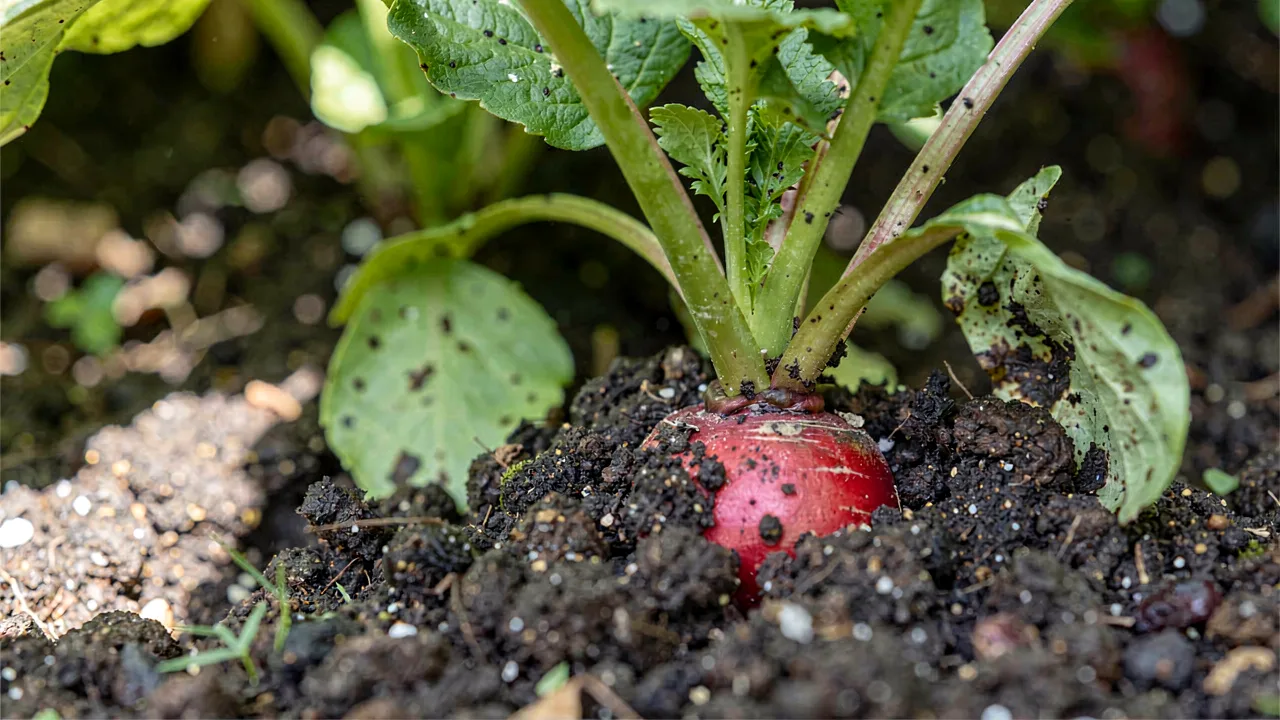
Summer radishes form a short, compact rosette of roughly oval, mid-green leaves with slightly toothed or lobed margins. The leaves are typically 10–20 cm long on slender, often pinkish petioles, and they sit close to the ground, casting only modest shade. Roots are round or short-oblong, 2–5 cm across, with smooth skin in shades of scarlet, deep pink, cherry red, white, or a contrasting pink-and-white bicolour. Flesh is white, crisp and moist.
Winter radishes and mooli are bulkier plants: the rosette is larger and more upright, with leaves reaching 30–60 cm, and the root can be 15–30 cm long and 5–8 cm across. Skin is generally black, purple, pink or pure white depending on cultivar, and the flesh is dense, white and noticeably hotter than summer types.
Flowers, which appear only on bolted plants, are typical of the cabbage family: four-petalled, pale lilac to white, often with darker veins, carried in loose terminal clusters on stems 30–80 cm tall. Seed pods are slender, fleshy and 5–10 cm long, containing rows of small, round, pale brown seeds.
Growing Conditions
Soil is the single biggest determinant of quality. Radishes need a fine, stone-free tilth so the root can swell evenly — clods and stones force it to fork or become distorted. Dig the bed in late winter or early spring, working in a generous layer of well-rotted garden compost or manure from the previous season. Fresh manure causes forking and lush leaf at the expense of root. Aim for a soil pH of roughly 6.0–7.0; very acid ground should be limed a few weeks before sowing.
Sunlight should be full for most of the day. A site that catches morning and midday sun produces faster, sweeter roots than a shaded corner, although a few hours of light shade is tolerated in midsummer. Avoid the root-shadow of large brassicas and beans, which will also out-compete the radish for moisture.
Water is critical. Radishes respond to moisture stress within days: roots become hot, pithy and slow to swell. The bed should never be allowed to dry to a crust; aim for steady, even moisture from germination through to harvest, which usually means watering once or twice a week in dry weather and more often on sandy soils.
Sowing windows in the UK are wide. Summer radishes can be sown under cloches or fleece from late February (mild districts) to early April, then in open ground every two to three weeks from April to early September for a continuous harvest. Winter radishes and mooli are sown once, between late June and early August, so they mature in the cool shortening days of autumn before heavy frost. The plant holds a UK hardiness rating consistent with a hardy annual — frost tolerance is sufficient for autumn cropping but it is not a perennial.
Planting and Care
Sowing. Direct sow where the crop is to grow — radishes transplant badly and the disturbance causes forking. Make a shallow drill 1–2 cm deep with the corner of a hoe, water the bottom of the drill, then space seeds about 2–3 cm apart for summer types and 10–15 cm for winter and mooli types. Cover, firm gently, and water in. Germination takes 5–10 days at 10–18 °C; colder or hotter soils slow it markedly.
Thinning. As soon as seedlings have two true leaves, thin summer radishes to 3–5 cm apart and winter types to 15–20 cm. Thinnings are edible — roots the size of a pea are a bonus crop. Crowded plants compete for light and moisture and produce thin, leafy tops with almost no root.
Watering. Keep the bed damp throughout growth. A thorough soak every three to five days is better than a daily sprinkle, which only wets the surface and encourages shallow roots. Mulching with a 2–3 cm layer of garden compost between rows helps conserve moisture and keep the soil cool in summer.
Feeding. Radishes are light feeders and rarely need supplementary fertiliser if the bed was prepared with compost. On poor or recently cultivated ground, a single drench with a dilute balanced liquid feed (such as seaweed or comfrey tea) at the two-true-leaf stage is enough. Avoid high-nitrogen feeds, which drive leaf growth at the expense of the root.
Weeding. Hand-weed only — hoeing close to the row easily severs the shallow tap root and stunts the crop. A close, even stand of radishes does most of the weeding itself by shading the soil.
Successional sowing. The single most important technique for summer radishes is to sow little and often. A short row every fortnight keeps a steady harvest on the table and avoids the glut-and-starve cycle that put many gardeners off the crop. Stop sowing summer types in early September; switch to winter radishes for the cold months.
Pest and disease watch. The main problems are detailed below in Common Problems. Briefly: fleece or mesh from sowing protects against flea beetle and cabbage root fly; rotating the bed away from previous brassica ground reduces clubroot risk.
Harvesting. Pull summer radishes as soon as they reach a usable size — typically 3–4 cm across, three to five weeks after sowing — without waiting for them to "fill out". Oversized summer radishes become woody and hot. Winter radishes are slower (eight to ten weeks) and can be left in the ground until needed, or lifted in late autumn and stored in trays of damp sand or old compost in a cool shed.
Seed saving. Leave a few plants of one open-pollinated variety to bolt, flower and set seed. The pods should be picked when brown and dry, then threshed. Radish crosses readily with neighbouring flowering radishes, so isolate by at least 800 m for pure seed, or hand-pollinate and bag the flowers.
Common Problems
Flea beetle (Phyllotreta spp.). Tiny black or striped beetles shot-hole the seedling leaves and can decimate a young stand in days. Symptoms: pin-prick holes across the cotyledons and first true leaves. Prevention: cover the bed with fine insect mesh or horticultural fleece from the day of sowing and keep it on until the roots are approaching harvest size; sow in moist conditions so germination is rapid; grow a "catch" row of radishes nearby and sacrifice it. Treatment: none really effective once established; rely on prevention next sowing.
Cabbage root fly (Delia radicum). Larvae tunnel into the root, leaving brown scarring and a soft, inedible core, especially in late summer sowings. Symptoms: wilting tops in dry weather; small white maggots inside the root when sliced. Prevention: brassica collars at the base of each plant (less practical for closely-sown radishes), fine mesh covers, and avoiding late sowings in known hotspot areas.
Clubroot (Plasmodiophora brassicae). A persistent soil-borne disease of the cabbage family that distorts roots into swollen, finger-like clubs and causes stunting. Symptoms: yellowing, wilting, and swollen lumpy roots. Prevention: long rotations (at least four years away from brassicas), liming the soil to pH 7.0–7.5, and resistant cultivars where available. Infected ground should not grow any brassica for at least seven years.
Bolting. Warm soil, dry conditions and lengthening days push the plant to flower at the expense of the root. Symptoms: a tall central stem with flower buds forming while the root is still small. Prevention: sow summer types only in cool months (March to early June, late August to September), keep the bed moist, and harvest promptly at a usable size.
Woody or hot roots. Almost always a sign of heat, drought, overcrowding or age in the ground. Prevention: steady moisture, prompt thinning, successional sowing, and harvest at the right size.
Slugs. Less of a problem than on most seedlings, but they will graze young radish leaves in damp summers. Standard beer traps, hand-picking and gritty mulches are sufficient.
Popular Varieties
'French Breakfast' — an oblong, blunt-tipped radish, scarlet above and white below, with a mild flavour and crisp texture. Sow March to September; ready in about 25 days. The classic UK salad radish.
'Cherry Belle' — a round, bright red, very fast summer radish. Reliable, uniform, and a good choice for beginners. Ready in 22–25 days; bolts later than most if kept moist.
'Scarlet Globe' — an older, widely-available round red type suited to early sowings under cloche. Slightly larger roots than 'Cherry Belle' with a hot, peppery bite.
'Mooli' (also sold as 'Daikon') — the long white winter radish, 25–40 cm long, used in Asian cookery. Sow June to August; harvest from October. Stores well in damp sand. 'Minowase Summer Cross' and 'April Cross' are reliable F1 types.
'Black Spanish Round' — a winter radish with rough black skin and dense, hot white flesh. Sow July; harvest from October and store. Splits into 'Round Black Spanish' (globe) and 'Long Black Spanish' (carrot-shaped).
'Watermelon' (Mantanghong) — a Chinese winter radish with pale green-and-pink skin and bright magenta flesh. Mild, sweet, and excellent sliced raw. Sow July to August; harvest October to November.
'Pink Beauty' — a round, soft-pink summer radish with mild, slightly sweet flesh. A useful alternative to the standard red types where flavour rather than heat is wanted.
'Rat's Tail' (Raphanus sativus 'Caudatus') — grown for its slender, fleshy seed pods rather than roots. Pods are eaten raw or pickled. Sow April to June; pick pods while young and tender, six to eight weeks after sowing.
Cultivars and Varieties
| Cultivar | Height | Flower | Notes | AGM |
|---|---|---|---|---|
| 'Amethyst' | — | — | RHS AGM (H2) | ✓ |
| 'Celesta' | — | — | RHS AGM (H2) | ✓ |
| 'Escala' | — | — | RHS AGM (H2) | ✓ |
| 'French Breakfast 4 Francis' | — | — | RHS AGM (H2) | ✓ |
| 'Pink Beauty' | — | — | RHS AGM (H2) | ✓ |
| 'Rudolf' | — | — | RHS AGM (H2) | ✓ |
| 'Scarlet Globe' | — | — | RHS AGM (H2) | ✓ |
| 'Sparkler' | — | — | RHS AGM (H2) | ✓ |
Pests and Diseases
| Problem | Symptoms | Management |
|---|---|---|
| Slugs and snails | Irregular holes chewed in leaves and young seedlings, often accompanied by silky trails. | Use physical barriers like copper tape or beer traps, and hand-pick at night. |
| Flea beetles | Small, shot-hole damage on leaves caused by jumping black beetles. | Protect young plants with fine insect-proof mesh until they are established. |
| Brassica downy mildew | Yellowing leaf patches with white, fuzzy fungal growth on the undersides. | Ensure good air circulation and avoid overhead watering to keep foliage dry. |
| Bolting | Plants send up flower stalks prematurely, resulting in small, woody roots. | Sow in succession during cool seasons and harvest promptly before heat stress. |
| Root splitting | Cracks or splits appear in the radish root as it matures. | Maintain consistent soil moisture by watering regularly during dry spells. |
For step-by-step help, read Dealing with Slugs and Snails and Treating Powdery Mildew. Or browse the full plant problem solver to diagnose an issue by symptom.
Radish in our guides
Recommended Products
GardenWizz earns a commission from qualifying purchases made through affiliate links on this page (including links within the article) — as an Amazon Associate, and from Thompson & Morgan via the Awin network. This does not affect the price you pay. See our disclaimer for details.