Wild Parsley
Aethusa cynapium
The Gardening Year
Best months in UK gardens · full planting calendar →
🖨 Printable care card (PDF)At a Glance
| Botanical name | Aethusa cynapium |
|---|---|
| Common name(s) | Wild Parsley |
| Family | Apiaceae |
| Plant type | annual (rarely biennial) |
| Height × Spread | 80 cm × 10–50 cm |
| Position | Full sun, Partial shade |
| Soil | Chalk, clay, loam or sand; moist but well-drained or well-drained |
| Flowering | June–August |
| Toxicity | poisonous when fresh; safe if dried |
| Native range | Europe, western Asia, and northwest Africa |
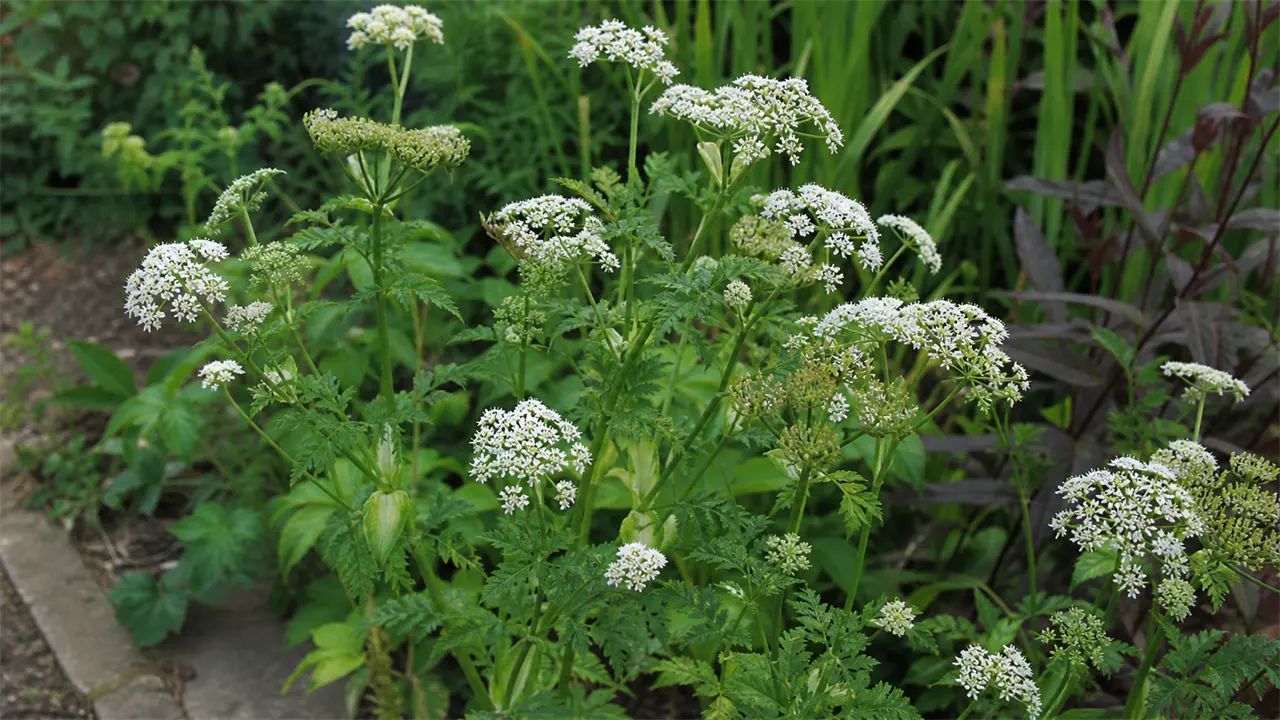
Wild Parsley (Aethusa cynapium) is an annual herbaceous plant of the carrot family (Apiaceae) and one of the most frequently misidentified British wildflowers. Common across roadsides, field margins and disturbed garden ground in England and Wales, it superficially resembles garden parsley, wild carrot and several other edible umbellifers, yet every part of it is poisonous. For this reason Wild Parsley is treated less as a horticultural subject and more as a plant that gardeners, foragers and parents need to recognise accurately in order to avoid it.
The plant is also widely known by the folk names Fool's Parsley and Poison Parsley, both of which refer to the long historical record of accidental poisoning, particularly of children who have mistaken it for cultivated parsley.
Overview
Wild Parsley belongs to the genus Aethusa, a small group of annuals within the Apiaceae. The species is native to Europe and western Asia and has been present in Britain for so long that it is treated as an archaeophyte, an ancient introduction that is now thoroughly naturalised. It is not a protected or rare species: in suitable disturbed habitat it can appear in considerable density within a single season.
The plant's ecological role is that of a pioneer annual. It exploits bare or recently turned soil, completes its life cycle in a single growing season, and replenishes the seed bank before the site is reclaimed by perennial vegetation. In a garden context this life strategy makes Wild Parsley a typical "weed of cultivation", appearing whenever beds are dug over, edges are recut, or builders' rubble and topsoil are imported. It is not invasive in the sense of displacing established perennials, but it can dominate bare ground for one season.
The defining feature of Wild Parsley, and the reason it merits inclusion in any horticultural reference, is its toxic chemistry. All parts of the plant contain polyacetylene compounds, principally aethusin and aethusa cynapiole, which produce severe gastrointestinal and neurological symptoms if ingested. There is no known safe culinary or medicinal use. GardenWizz includes the species primarily so that the public can recognise it confidently and distinguish it from genuinely useful umbellifers.
Appearance
Wild Parsley is a slender, erect annual that reaches between 30 cm on starved or trampled ground and up to 100 cm in fertile, undisturbed sites. The stem is round, hollow, finely ridged and almost completely hairless, often (though not always) flushed with purple or dull violet at the base. A faint, unpleasant parsnip-like odour is released when the stem or leaves are bruised, and this is one of the more reliable field characters.
The leaves are pinnately divided two or three times into triangular, toothed segments. At a casual glance they strongly resemble garden parsley (Petroselinum crispum), which is the source of the plant's common name, but they are generally a paler, more yellowish green and the segments are narrower and more sharply pointed. The lower leaves are carried on long stalks; the upper leaves are smaller and sit on noticeably inflated, membranous sheaths that clasp the stem. The sheaths are conspicuous enough to be useful in identification, particularly when the inflorescence is not yet present.
Flowering occurs from June to September. The inflorescence is a compound umbel typical of the carrot family, with five to fifteen rays radiating from a single point, each ray terminating in a smaller umbellet of tiny white flowers. The single most reliable diagnostic feature sits at the base of each umbel: three or four long, narrow, sharply pointed bracts that hang downwards on the outer side of the flower cluster. No other common British umbellifer carries this combination of long, pendulous bracts beneath a white umbel, and an observer who has learned this one character will rarely confuse Wild Parsley with anything else in the field.
The fruit is a small, ovoid, ribbed schizocarp about 3 mm long, pale green at first and ripening to dull brown. It splits at maturity into two single-seeded mericarps in the manner typical of the family.
Growing Conditions
In the wild, Wild Parsley is a plant of disturbed ground. It is most often seen on road verges, the edges of arable fields, building plots, allotments, waste ground, the bases of walls, and the corners of car parks. Within gardens it appears on freshly dug beds, along the lines of trenches where drains or cables have been laid, and on any imported topsoil.
Soil preference is for moist but well-drained loams, and the plant shows a marked liking for calcareous and slightly chalky ground, although it will grow on heavier clay soils provided they are not waterlogged. It tolerates a wide pH range, roughly from mildly acid to strongly alkaline, but performs best on neutral to alkaline substrates. Fertility requirements are modest: in over-rich garden soil the plant grows luxuriantly but does not necessarily flower or set seed any earlier than it would on poorer ground.
Climatically, Wild Parsley is fully at home in British conditions. It survives frost in the seedling and rosette stage, germinates readily in cool spring soils, and tolerates summer drought by completing its life cycle early. The species is widespread across lowland England and Wales, becomes noticeably scarcer in northern Scotland, and is thinly distributed across Ireland, with the highest concentrations in the south and east of both islands.
Sun exposure is flexible. Full sun produces the most floriferous plants on open waste ground, while semi-shaded locations on hedge bottoms and woodland edges are equally acceptable and often yield the tallest specimens.
Planting and Care
Wild Parsley is not a cultivated garden plant and there is no horticultural case for deliberately sowing it. The following guidance is therefore aimed at recognising the species, managing its presence, and removing it safely from places where children, pets or livestock might encounter it.
If the plant is to be removed from a garden, the most effective approach is hand pulling or hoeing before flowering. Once an umbel is open, the plant can begin setting seed within two or three weeks in warm weather, and a single plant is capable of producing several hundred seeds. Seed can remain viable in the soil for several years, so a single season of inattention can result in cohorts of seedlings appearing over multiple subsequent springs. Shallow cultivation with a hoe or a sharp spade, repeated at intervals through the growing season, will steadily exhaust the seed bank.
Protective clothing is sensible when handling large quantities of the plant: long sleeves and gloves prevent the mild skin irritation that some people experience from prolonged contact with the cut foliage. Cut material should not be left on the compost heap while still green; either allow it to wilt and dry thoroughly first, or dispose of it in green waste collections.
There is no recognised propagation routine for Wild Parsley. The plant reproduces itself from seed without intervention, and any gardener who wishes to encourage or study it need only leave one or two plants in an out-of-the-way corner to allow natural seed set. For most readers, however, the practical advice is the opposite: prevent seed set, and the species will disappear from a given bed within two or three seasons.
Common Problems
The most serious problem associated with Wild Parsley is its toxicity. All parts of the plant contain polyacetylene alkaloids, principally aethusin and related compounds, which act on the central nervous system. Ingestion produces symptoms that range from nausea, vomiting and abdominal pain to dizziness, muscle weakness and, in larger doses, convulsions and respiratory depression. Children are particularly at risk because of the visual similarity to garden parsley. Anyone who suspects that a child or pet has eaten any part of the plant should seek medical or veterinary advice promptly, and a sample of the plant should be retained for identification.
The second practical problem is identification confusion with other umbellifers. Wild Parsley is regularly mistaken for garden parsley (Petroselinum crispum), wild carrot (Daucus carota) and, occasionally, for the much more dangerous hemlock (Conium maculatum). A simple field key can separate the four: garden parsley has solid stems, a strong parsley scent and curled, darker leaves; wild carrot has a single stiff hairy bract directly beneath each umbel, and a dark purple floret in the centre of mature flower heads; hemlock has purple-blotched stems with a foul mousy smell when crushed and lacks the long drooping bracts of Wild Parsley. Wild Parsley itself, by contrast, carries the three or four pendulous bracts and an unpleasant parsnip odour on bruising.
In garden terms the plant is otherwise trouble-free. It does not host any notable invertebrate pests and is not a reservoir of disease for neighbouring ornamentals. The only ongoing management task is preventing it from setting seed.
Popular Varieties
Wild Parsley has no named cultivars, and no ornamental selections are listed in the RHS Plant Finder or in mainstream British horticultural trade. The species exists in the wild essentially as a single, uniform population across its British range. A small number of historical subspecies and synonyms have been described in the European botanical literature (for example Aethusa cynapium subsp. agrestis and subsp. cynapium, distinguished by minor differences in fruit size and bract length), but these are taxonomic conveniences for botanists rather than garden plants, and no British nursery currently lists them for sale.
For this reason the Popular Varieties section is short. Gardeners seeking an ornamental umbellifer with similar airy white flowers and a long season of interest should consider instead Anthriscus sylvestris 'Ravenswing' (a bronze-leaved form of cow parsley), Ammi majus, or Seseli gummiferum, all of which carry the architectural presence of a Wild Parsley without its toxicity. For those whose interest is specifically in identifying and avoiding Wild Parsley, the practical recommendation is to learn the single key character of the three pendulous bracts: it is faster, more reliable and considerably safer than relying on a name.
Pests and Diseases
| Problem | Symptoms | Management |
|---|---|---|
| Slugs and snails | Irregular holes in young leaves and seedlings, often accompanied by silky trails. | Use beer traps, copper tape barriers, or iron phosphate pellets to control populations. |
| Vine weevil | Notched leaf margins on seedlings and wilting due to root damage by grubs in the soil. | Check pots for grubs before planting and apply biological nematodes or systemic insecticides. |
| Aphids | Clusters of small soft-bodied insects on stems and undersides of leaves, causing curling. | Encourage natural predators like ladybirds or spray with a strong jet of water or insecticidal soap. |
| Powdery mildew | White powdery fungal growth on leaves and stems, particularly in humid conditions. | Improve air circulation and apply a sulphur-based fungicide if infection is severe. |
| Root rot | Yellowing foliage and wilting despite moist soil, caused by waterlogged conditions. | Ensure well-drained soil and avoid overwatering to prevent fungal attack on roots. |
For step-by-step help, read Controlling Aphids Naturally, Dealing with Slugs and Snails and Treating Powdery Mildew. Or browse the full plant problem solver to diagnose an issue by symptom.
Recommended Products
GardenWizz earns a commission from qualifying purchases made through affiliate links on this page (including links within the article) — as an Amazon Associate, and from Thompson & Morgan via the Awin network. This does not affect the price you pay. See our disclaimer for details.