Globe Artichoke
Cynara scolymus
The Gardening Year
Best months in UK gardens · full planting calendar →
🖨 Printable care card (PDF)At a Glance
| Botanical name | Cynara scolymus |
|---|---|
| Common name(s) | Globe Artichoke |
| Family | Asteraceae |
| Plant type | perennial (Perennial vegetable; not fully hardy in UK.) |
| Height × Spread | 1.5–2.5 m × 100–150 cm |
| Position | Full sun |
| Soil | fertile, well-drained |
| Flowering | July |
| Toxicity | — |
| Native range | Mediterranean region, the Middle East, northwestern Africa, and the Canary Islands |
Overview
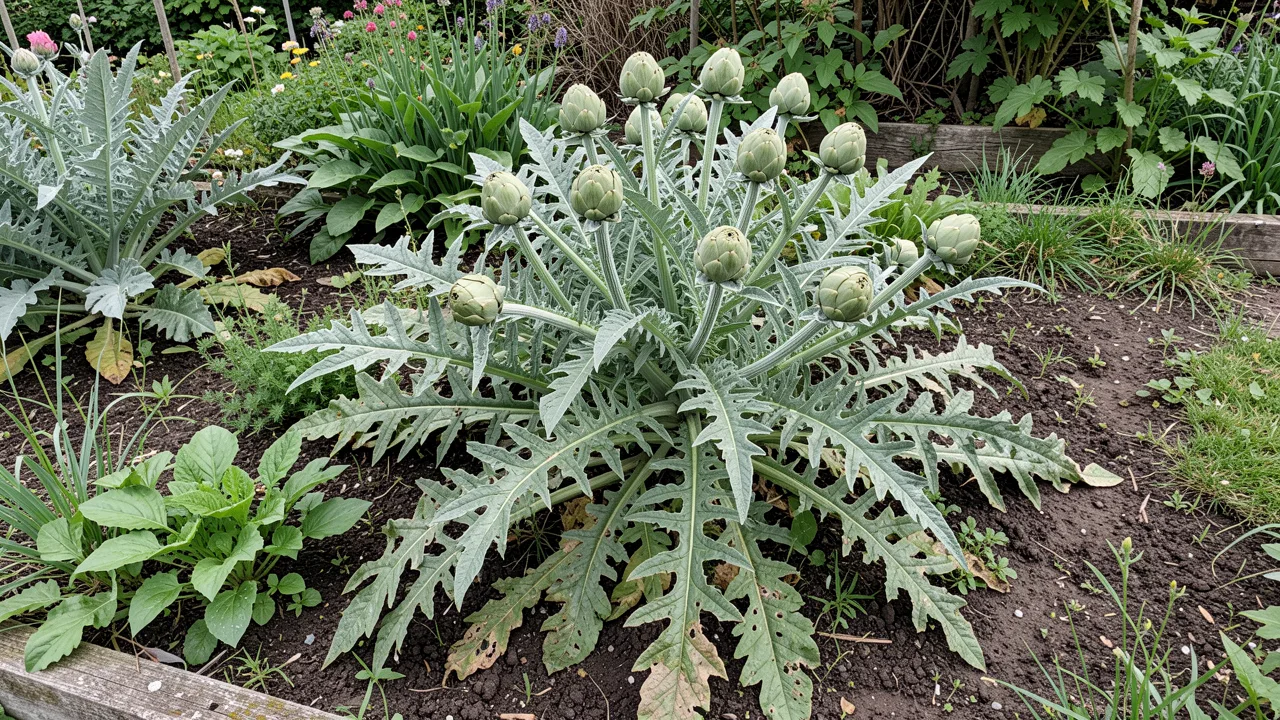
The globe artichoke (Cynara scolymus, now treated by the Royal Horticultural Society as Cynara cardunculus, Scolymus Group) is a substantial herbaceous perennial grown in British kitchen gardens for its immature flower heads. A mature plant forms a clump of deeply cut, silvery-green leaves 1–1.5 m tall, throwing up thick, ribbed flower stems in summer that carry the familiar scaly, globe-shaped buds. Left uncut, those buds open into large violet-purple thistle flowers that are highly attractive to bees and other pollinators.
Native to the western and central Mediterranean, the globe artichoke has been cultivated as a food plant since at least the time of the ancient Greeks and Romans. It reached British gardens in the sixteenth century, initially as a decorative and medicinal curiosity, and by the seventeenth century was established as a kitchen-garden crop in larger English estates. Today it is grown both as a productive vegetable and as a striking architectural plant in ornamental borders, where its bold foliage and statuesque flower stems earn it a place at the back of the border long after the last bud has been harvested.
A single well-settled plant will crop reliably for four to six years before yields decline, after which the clump should be renewed by division. With good siting and winter protection on colder sites, globe artichokes are a productive and handsome addition to most UK gardens south of the Scottish Highlands, and a worthwhile ornamental where space allows.
Appearance
Globe artichoke foliage is its most distinctive feature. The leaves are large — typically 50–80 cm long on a mature plant — pinnately lobed with broad, blunt-tipped segments, and covered in a fine silvery-grey down that gives the whole clump a pale, almost luminous appearance in low light. Each leaf has a conspicuous pale midrib, and the undersides carry the same silvery indumentum, which is the plant's main defence against summer drought in its native range.
The flower stems emerge from the centre of the clump in early summer and can reach 1.5–2 m in a strong-established plant, branching near the top. The "globes" are tightly packed clusters of fleshy green bracts (technically involucral bracts) arranged in a roughly spherical bud 7–12 cm across, sitting on a thick, fleshy receptacle. Left unharvested, the bracts reflex as the bud opens, revealing a mass of purple disc florets followed by the familiar thistle-down seed head.
Cardoons (C. cardunculus) are the closely related wild form; artichokes differ in having denser, fleshier, less spiny bracts. Modern cultivars vary in head size, bract colour (pale green through to purple-tipped), spininess, and earliness, but all share the same basic architecture. The plant is fully deciduous in UK winters, dying back to a stout crown at or just below ground level, from which new growth emerges in mid-spring.
Growing Conditions
Globe artichokes need a sunny, sheltered site and a deep, fertile, free-draining soil. They crop most heavily in mild maritime regions — the south and west of England and most of coastal Wales perform very well — and least reliably on cold, wet sites in northern England and central Scotland, where winter losses are common without protection. Plants tolerate a range of soil textures provided drainage is sound; on heavy clay the addition of coarse grit and well-rotted organic matter at planting time makes a substantial difference to survival through wet winters.
The plants are greedy feeders and respond strongly to soils with a high organic-matter content. Incorporate two or three bucketfuls of well-rotted manure or garden compost per square metre before planting, and top-dress established clumps each spring with a similar mulch. Soil pH between 6.5 and 7.5 suits them best; very acid soils should be limed in autumn before spring planting.
Sunlight is non-negotiable: globe artichokes need at least six hours of direct sun in midsummer to build the carbohydrate reserves that drive bud production. They dislike exposed, windswept sites, both because the tall flower stems snap in summer gales and because cold winter winds desiccate the crown. A position against a south- or west-facing wall gives a useful margin of warmth and shelter in inland and northern gardens, though the wall's shade at the edges of the canopy should be allowed for when spacing.
Plants are heavy drinkers in summer and will produce smaller, tighter buds if allowed to dry out at the roots in May and June, when the flower stems are extending. Where summers are reliably wet this is rarely a problem; in drier eastern and south-eastern districts, deep weekly soakings during dry spells are well worthwhile.
Planting and Care
Planting. Globe artichokes are most commonly bought as young container-grown plants in spring, or raised from offsets (see Propagation below). Plant out in mid- to late spring once the soil has warmed and the worst frosts are past, typically April in the south and May further north. Space plants 90 cm apart in each direction — they look small in their first season but a two-year-old clump can easily cover a square metre. Set the crown so the growing point sits at soil level, firm in well, and water thoroughly.
Watering. Water deeply at planting and again every seven to ten days through the first summer. Once established, supplementary watering is only needed during prolonged dry spells; overwatering on heavy ground in winter is a greater risk than summer drought on light soils.
Feeding. Each February or early March, mulch established clumps with a 5–7 cm layer of well-rotted manure or compost, taking care not to bury the crown. A top-dressing of a balanced organic fertiliser (such as a 5–5–5 or a seaweed-based pellet) in late spring, just as the flower stems are extending, increases head size and the number of side buds.
Cut back and division. In late autumn, after the last harvest and once the foliage has begun to yellow, cut the old stems down to within 15–20 cm of the crown and remove the largest of the older leaves to let air into the clump. In colder regions, pile a loose mulch of bracken, straw, or dry leaves over the crown for winter, pulling it away in early March. Every three to four years, in early spring as new growth begins, lift the clump with a fork and divide it into offsets each carrying one or two strong buds and a share of root; replant the best divisions 90 cm apart in refreshed soil and discard the woody centre of the old clump.
Propagation. Named cultivars must be propagated vegetatively to come true. The standard method is division of offsets, as above. Crown cuttings — sections of root with a dormant bud — can also be taken in late winter and started under cover. Seed-raised plants are variable and tend to be smaller and less productive; the seed strain 'Vert de Provence' is the main exception and is widely grown on the Continent.
Seasonal care. Spring: mulch and feed; check for slug damage on emerging shoots. Summer: harvest buds promptly while still tight; water in dry spells. Autumn: cut back old growth, lift and store offsets if taking indoor winter cuttings, apply winter mulch in cold districts. Winter: keep the crown free of standing water; in very exposed sites, an inverted pot or pile of dry straw over the crown reduces frost damage.
Common Problems
Aphids. Black bean aphid (Aphis fabae) is the most frequent summer pest, clustering on flower stems and under bracts. A strong jet of water, encouragement of natural predators, and, in severe cases, a fatty-acid or pyrethrum spray are the usual controls.
Slugs and snails. Young spring growth is highly attractive to slugs, particularly on damp sites. Standard slug controls — night-time hand-picking, beer traps, ferric phosphate pellets — are effective; check newly planted offsets particularly closely.
Botrytis (grey mould). A risk in damp, poorly ventilated sites, especially on heavy soils in mild winters. Symptoms include grey, fuzzy mould on the crown and lower leaves. Improve drainage, avoid overwinter mulches that stay wet, and remove affected material promptly.
Fungal leaf spot. Ramularia and other leaf-spot fungi cause pale brown blotches on the foliage in wet summers; they are rarely serious enough to warrant treatment, but affected leaves should be removed and disposed of (not composted) at the end of the season.
Failure to crop. Small or absent buds in the second and third years usually point to insufficient sun, drought at the flower-stem-extension stage, or winter damage to the crown. Plants moved or divided late in the season also commonly miss a year while they re-establish.
Winter loss. On cold, wet sites the crown can rot out over winter. Improving drainage, applying a dry autumn mulch, and avoiding late-season nitrogen feeds (which keep the plant growing into the cold months) all reduce losses.
Popular Varieties
'Green Globe'. The most widely grown cultivar in the UK and the default choice for a reliable, large green bud. Vigorous, mid-season, with heavy crops on established plants. Tolerates a range of soils and is the variety most often offered as pot-grown plants in garden centres.
'Purple Globe' (also sold as 'Violetta'). A heritage Italian type with distinctive purple-flushed bracts and a slightly smaller, more elongated bud. Considered by many growers to have the finest flavour of the green-and-purple types; a useful change for colour in the kitchen and on the plate. Hardier than 'Green Globe' in cold districts.
'Romanesco'. A large-headed Italian variety with tightly packed, fleshy bracts and a particularly meaty base. Mid- to late-season; needs a long warm summer to crop at its best, so performs most reliably in southern and central England.
'Vert de Provence'. A seed-raised strain, mainly of interest where offsets are not available. Smaller plants and buds than the vegetatively propagated cultivars but much cheaper to raise in quantity, and a useful first-try option for new growers.
'Gros Vert de Laon'. A traditional French cultivar producing large, late-cropping heads; appreciated on allotments where the extended harvest matters more than earliness. Less widely stocked in British nurseries but available from specialist seed savers.
Pests and Diseases
| Problem | Symptoms | Management |
|---|---|---|
| Slugs and snails | Irregular holes chewed in young leaves and stems, often accompanied by slimy trails. | Use physical barriers like copper tape or beer traps, and hand-pick at night. |
| Blackfly (black aphid) | Clusters of small black insects on new growth causing leaf curling and sticky honeydew. | Spray off with a strong jet of water or apply insecticidal soap for heavy infestations. |
| Root rot | Yellowing, wilting foliage and soft, mushy base despite adequate moisture. | Ensure well-drained soil and avoid overwatering; remove affected plants immediately. |
| Winter freeze damage | Blackened, collapsed leaves and stems after severe frost exposure. | Apply a thick dry mulch of straw or bark around the base in late autumn. |
For step-by-step help, read Controlling Aphids Naturally and Dealing with Slugs and Snails. Or browse the full plant problem solver to diagnose an issue by symptom.
Recommended Products
GardenWizz earns a commission from qualifying purchases made through affiliate links on this page (including links within the article) — as an Amazon Associate, and from Thompson & Morgan via the Awin network. This does not affect the price you pay. See our disclaimer for details.