Wood Spurge
Euphorbia amygdaloides
The Gardening Year
Best months in UK gardens · full planting calendar →
🖨 Printable care card (PDF)At a Glance
| Botanical name | Euphorbia amygdaloides |
|---|---|
| Common name(s) | wood spurge |
| Family | Euphorbiaceae |
| Plant type | perennial |
| Height × Spread | 80 cm × 30–60 cm |
| Position | Partial shade |
| Soil | Moist but well–drained |
| Flowering | May–June |
| Toxicity | Toxic; milky latex causes irritation on contact with skin |
| Native range | Europe, Turkey and the Caucasus |
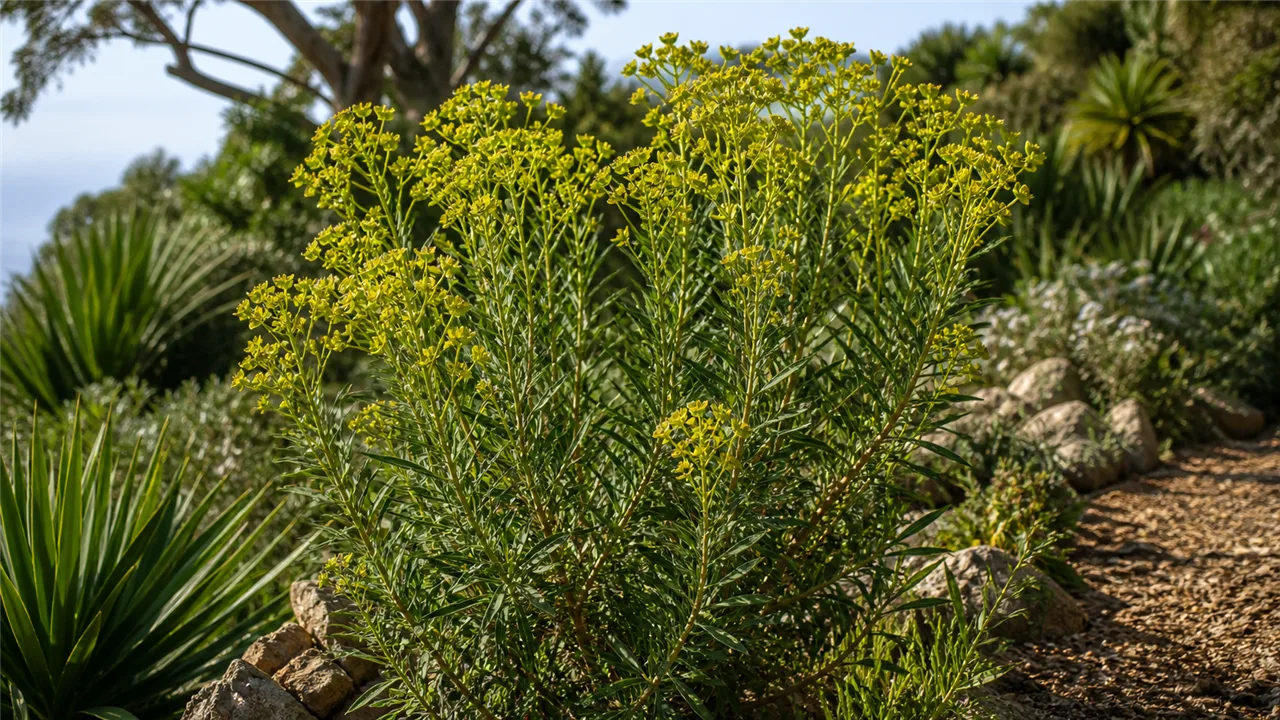
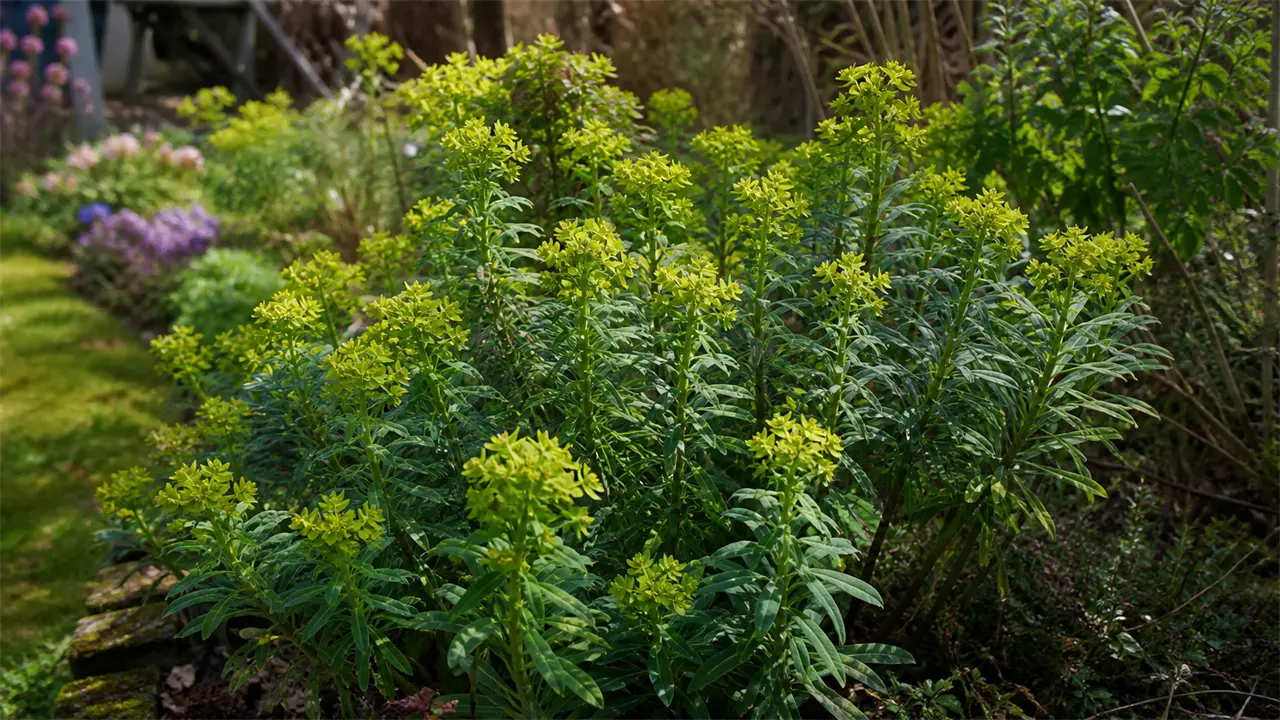
Euphorbia amygdaloides, widely known as wood spurge, is a shade-loving evergreen perennial that brings reliable structure and early colour to UK gardens. Native to woodlands across England and Wales, it forms neat clumps of dark green foliage and produces distinctive yellow-green flower heads in spring, well before most border perennials get going. Its tolerance of dry shade, deer resistance and ability to naturalise under trees have made it a mainstay of naturalistic planting schemes.
Overview
Wood spurge is one of the most useful evergreen perennials for tricky dry-shade spots beneath deciduous trees, alongside plants such as ivy, hart's tongue fern and epimediums. Although it is technically herbaceous, the woody basal crown and overwintering rosettes of leaves mean the plant holds its form through winter rather than dying back to the ground like many border perennials. In early spring the upright stems lengthen and carry the lime-yellow inflorescences that gardeners value.
The species is native to the UK, where it grows wild in woodland edges, hedgerows and scrub on calcareous to neutral soils, chiefly across England and Wales. It belongs to the large Euphorbiaceae family, whose members are characterised by a milky, irritant latex sap. Always wear gloves when handling any part of the plant, and keep it well away from pets and children who might brush against cut stems.
Wood spurge has earned the Royal Horticultural Society's Award of Garden Merit, reflecting its reliability in British conditions. It works as ground cover in larger plantings and as a feature clump in smaller shaded borders, and it is invaluable for early-season pollinators when little else is in flower.
Appearance
Euphorbia amygdaloides forms an upright, clumping plant typically 50–80 cm tall with a spread of 60–90 cm once established. Over time it spreads by short rhizomes to form colonies, so a single plant can become a substantial drift within a few seasons. The stems are dark green and sturdy, with a woody base and softer, herbaceous growth above.
The leaves are oval to elliptic, around 4–8 cm long, and arranged in a loose rosette along the upper portion of the stems. They are a deep, slightly glossy green on the upper surface, often paler beneath, and they remain on the plant through winter. As the flowering stems extend in spring, the upper leaves become smaller and more bract-like, framing the inflorescence.
What looks like a single flower is in fact a cyathium — a cup-shaped structure unique to euphorbias. Each cyathium contains reduced male flowers surrounding a single female flower, with prominent nectar glands around the rim that are the showy yellow-green "petals" most gardeners notice. True petals are absent. The overall effect is a loose, branching spray of chrome-yellow that lights up shaded corners from March into May.
After flowering, the pollinated heads develop into small, three-lobed seed capsules roughly 4–5 mm across. As these ripen through summer they dry and split, ejecting seed some distance from the parent plant. Deadheading promptly after flowering both tidies the clump and limits unwanted self-seeding.
Growing Conditions
Wood spurge performs best in partial shade, ideally the dappled light found at the edge of deciduous woodland or on the north or east side of buildings. It will tolerate deeper shade, though flowering is more prolific where some spring light reaches the foliage. Full sun is generally too harsh except in reliably moist, cool northern gardens.
The ideal soil is moist but well-drained and reasonably fertile, with plenty of organic matter. Soils derived from leaf litter in established woodland suit it perfectly. Once the plant is settled it copes well with drier conditions, and this drought tolerance — combined with its dislike of waterlogging — is one reason it thrives where many other woodlanders struggle. Heavy, wet clay should be improved with grit and well-rotted compost before planting to prevent winter rot.
It is hardy across the whole of the UK (its RHS hardiness rating is shown on the plant badge). Native populations occur on both calcareous and mildly acidic substrates, so a soil pH from roughly neutral to moderately alkaline is fine. Avoid very acidic peat beds.
In UK gardens it is most often used in shaded mixed borders, woodland gardens, underplanting of shrubs and roses, and wildlife-friendly corners where early nectar is welcome. It associates well with ferns, brunnera, pulmonarias, hostas and epimediums, and the acid-yellow flowers contrast strikingly with deep purple foliage plants such as Actaea simplex 'Brunette' or Ophiopogon planiscapus 'Nigrescens'.
Planting and Care
When to plant. Autumn or early spring is ideal, when the soil is workable and moisture levels are reliable. Container-grown plants from garden centres can go in at any time the ground is not frozen or parched, with autumn and spring still preferred.
Spacing and technique. Space plants 40–60 cm apart to allow for the eventual spread. Dig a hole a little wider than the rootball, set the plant so the crown sits at the same depth as in the pot, backfill with the excavated soil enriched with a forkful of garden compost, firm in gently and water thoroughly.
Watering. Water well during the first growing season to help the plant establish a deep root system. After that, supplementary watering is rarely needed except in prolonged summer drought, particularly on light soils under tree canopies.
Feeding. Wood spurge is not a heavy feeder. An annual mulch of well-rotted garden compost or leaf mould in autumn will maintain soil structure and fertility around the crown. Avoid high-nitrogen feeds, which encourage soft leafy growth at the expense of flowering.
Pruning and cutting back. Cut back the flowered stems to just above the basal rosette of leaves once the display has finished, typically in late May or June. This keeps the clump compact, encourages a fresh flush of foliage and prevents excessive self-seeding. Always wear gloves, long sleeves and eye protection: the milky sap that bleeds from cut stems is a severe irritant to skin and eyes.
Dividing. Mature clumps can be lifted and divided in spring or autumn to maintain vigour or to make new plants. Replant the outer, vigorous sections and discard the tired woody centre. As with pruning, sap is hazardous, so wash tools and skin promptly after handling.
Propagation. Division is the simplest method. Basal cuttings of new shoots taken in early summer also root readily in a gritty compost under cover. Wear gloves throughout and rinse any sap off skin immediately.
Seasonal care. Little routine work is needed beyond the annual cut-back and an autumn mulch. In cold gardens the previous year's foliage may be blackened by hard frosts; trim damaged leaves in late winter to make way for new growth.
Common Problems
Wood spurge is generally trouble-free, but a small number of issues are worth knowing about.
Sap irritation. Every part of the plant contains a white latex sap that causes severe skin and eye irritation in sensitive individuals and is toxic if ingested. Always wear sturdy gloves when pruning, dividing or even cutting flowers for the house, and consider eye protection. Wash tools, gloves and any exposed skin thoroughly afterwards. Gardeners with known latex sensitivities should handle wood spurge with extra caution or avoid it altogether.
Euphorbia aphid (Aphis euphorbiae). This yellow-green aphid is specific to euphorbias and clusters on young shoots and flower buds in spring. Heavy infestations distort new growth. A firm spray with water, insecticidal soap or a soft soap solution usually controls them; encouraging natural predators such as ladybirds and hoverflies is the longer-term answer.
Grey mould (Botrytis cinerea). In damp, poorly ventilated sites — particularly on overcrowded clumps — grey mould can blemish foliage and flowers late in the season. Improve airflow by thinning or dividing congested clumps in spring, and clear away affected material in autumn.
Root and crown rot. Waterlogged soils encourage Phytophthora and other root-rot fungi, which can quickly kill established plants. Improve drainage before planting on heavy ground, and avoid sites that lie wet in winter. Raised beds or mounded planting are useful solutions in difficult clay.
Self-seeding and spread. The seed capsules throw seed a metre or more from the parent. In small gardens, deadhead promptly after flowering to keep clumps in bounds and remove unwanted seedlings early. Rhizomatous spread is slower but worth monitoring at the edges of drifts.
Toxicity to pets and livestock. The sap is irritant to most animals and can cause vomiting if eaten. Cats, dogs and grazing animals tend to leave euphorbias alone because of the bitter taste, but it is wise to position plants away from pets' regular routes and to clear prunings out of reach.
Popular Varieties
Several cultivars of Euphorbia amygdaloides are widely available in UK nurseries, mostly variations on leaf colour and variegation. Choose named forms where possible, as unlabelled seedlings vary considerably.
Euphorbia amygdaloides 'Purpurea'. One of the best-known cultivars, with leaves flushed deep purple-bronze, especially through winter and in cooler weather. The spring flower heads take on a warmer, more orange tone against the dark foliage. Height and spread are similar to the species. Excellent for pairing with silver-leaved neighbours or for brightening a shady corner.
Euphorbia amygdaloides var. robbiae. Often sold as Mrs Robb's bonnet, this variety differs from the species in spreading more vigorously by rhizome and tolerating deeper, drier shade, even under established trees and shrubs. It is evergreen, with glossy dark green rosettes and the same yellow-green spring flowers. It can be invasive in small gardens, so plant where its spread can be contained or appreciated — for example, in a wilder woodland patch or a large shaded bank.
Euphorbia amygdaloides 'Ruby Glow'. A relatively recent selection with foliage emerging ruby-red in spring and maturing to deep green. The young shoots contrast strongly with the lime-yellow cyathia. Less vigorous than var. robbiae, making it a better choice for smaller borders.
Euphorbia amygdaloides 'Walenburg's Glorie'. A compact, upright form with particularly bright, well-held flower heads and tidy dark green foliage. Useful where a neater, more architectural silhouette is wanted than the slightly looser species provides.
Euphorbia amygdaloides 'Craigieburn'. Variegated form with leaves edged and splashed cream, combining well with other shade foliage plants. Slightly less vigorous than plain-leaved forms and best in soils that do not dry out completely in summer.
Note on cultivar names: there is some confusion in the trade between 'Rubra', 'Purpurea' and similar purple-leaved forms, and plants offered under several names may be effectively the same selection. Where the specific cultivar name is critical to a planting scheme, it is worth ordering from a specialist nursery that propagates by division rather than seed.
Pests and Diseases
| Problem | Symptoms | Management |
|---|---|---|
| Aphids | Clusters of small insects on new growth causing leaf distortion and sticky honeydew. | Squash by hand or spray with a plant-based insecticide if infestations are severe. |
| Grey mould (Botrytis) | Fuzzy grey fungal growth on stems and flowers, particularly in damp, humid conditions. | Improve air circulation and remove affected plant parts to prevent spread. |
| Powdery mildew | White powdery coating appears on leaves and flower bracts. | Ensure good airflow and water at the base to keep foliage dry. |
| Root rot | Plant wilts and collapses despite moist soil, often with blackened roots. | Plant in well-drained soil and avoid waterlogging, especially in winter. |
| Slugs and snails | Irregular holes chewed into young leaves and seedlings. | Use physical barriers or organic slug pellets to protect emerging growth. |
For step-by-step help, read Controlling Aphids Naturally, Dealing with Slugs and Snails and Treating Powdery Mildew. Or browse the full plant problem solver to diagnose an issue by symptom.
Recommended Products
GardenWizz earns a commission from qualifying purchases made through affiliate links on this page (including links within the article) — as an Amazon Associate, and from Thompson & Morgan via the Awin network. This does not affect the price you pay. See our disclaimer for details.