Copper Iris
Iris fulva
The Gardening Year
Best months in UK gardens · full planting calendar →
🖨 Printable care card (PDF)At a Glance
| Botanical name | Iris fulva |
|---|---|
| Common name(s) | Copper Iris |
| Family | Iridaceae |
| Plant type | perennial |
| Height × Spread | 45–80 cm × 1–2 m |
| Position | Full sun, Partial shade |
| Soil | damp, humus-rich soil, or in up to 15cm of standing water. Loam Clay Moisture Poorly–drained pH Neutral, Acid |
| Flowering | April–June |
| Toxicity | Harmful if eaten. Wear gloves and other protective equipment when handling. |
| Native range | southern and central United States |
The Copper Iris is a distinctive beardless iris from the lower Mississippi basin, prized in UK gardens for its unusual terracotta flowers and its tolerance of damp ground where many other irises fail. It belongs to the Louisiana iris group — a series of North American species that hybridise readily with each other and bring warm, sunset colours into a genus otherwise dominated by blues, purples and whites. Grown in moist borders, bog gardens, or along pond margins, it offers British gardeners something genuinely different within the iris family.
Overview
Iris fulva is a herbaceous perennial growing from a thick, creeping rhizome. In the wild it colonises wet meadows, ditches, swamp margins and the banks of slow-moving water across Louisiana, Mississippi, Arkansas and adjacent states. It is the reddest of all wild irises, with a coppery-orange flower colour rarely seen elsewhere in the genus, and it has been used extensively in Louisiana iris hybridising programmes to pass that colour on to its progeny.
In the United Kingdom it sits at the edge of comfortable hardiness. Established clumps survive most British winters in well-drained soil with a mulch, but in cold inland districts or in wet, frozen ground it can be lost. The plant responds strongly to warmth in summer, flowering most freely after a hot July and August the previous year. Gardeners in mild southern and western counties, or those with a sheltered urban garden, will get the best results; those in cold northern or exposed eastern sites should be prepared to lift and protect, or to grow it in a container that can be moved under cover in winter.
Appearance
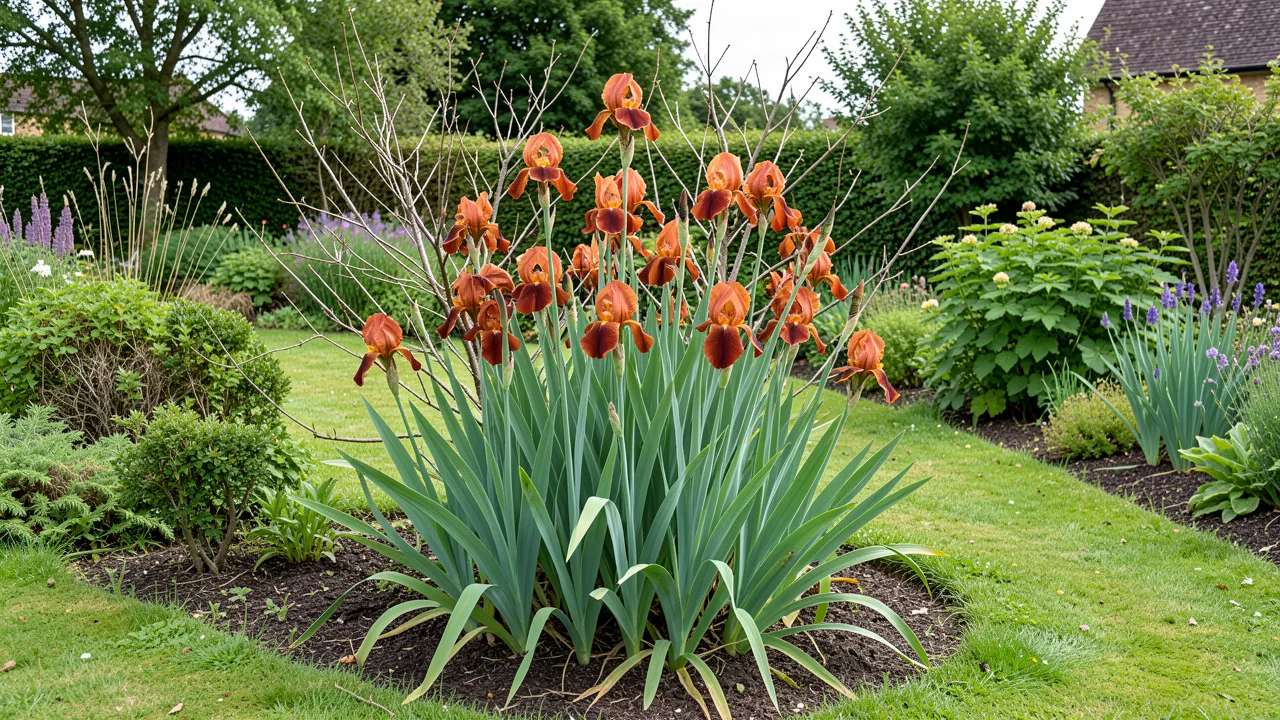
Iris fulva forms a clump of upright to slightly arching, sword-shaped leaves 60–90 cm tall, mid-green with a paler midrib. The leaves die back in winter, leaving only the rhizome at or just below the soil surface.
The flower stem carries two to four blooms, each 8–10 cm across when fully open. The colour is the plant's signature: a warm copper-orange to terracotta, sometimes shading to brick-red or rusty salmon, occasionally yellow-toned in some wild populations. Unlike the bearded irises, Iris fulva has no beard or signal patch on the falls. Instead, each fall carries a small, lance-shaped yellow or greenish-yellow signal at its throat. The three falls droop downwards and curve in slightly at the tip; the three standards are smaller than the falls, more upright and often somewhat twisted. This beardless form, with pendant falls and modest standards, is characteristic of the Louisiana group and gives the flower a distinctly different silhouette from the showy German bearded irises.
Mature clumps reach 60–90 cm in height when in flower, with a similar spread. The rhizomes branch freely, so a single plant will form a sizeable colony within four or five years if left undisturbed.
Growing Conditions
Sunlight. Full sun produces the strongest growth and the most abundant flowering. Light dappled shade for part of the day is tolerated, particularly in warmer southern gardens, but deep shade suppresses flowering.
Soil type. Moist to wet, humus-rich soil is ideal. Unlike bearded irises, which demand sharp drainage, Iris fulva tolerates and indeed prefers ground that remains damp through the growing season. It grows well in heavy clay provided the clay does not dry to concrete in summer. Soil pH should sit in the slightly acid to neutral range; very alkaline soils may lead to chlorotic foliage.
Moisture. Consistent moisture from spring through to early autumn is the single most important cultural requirement. The plant will grow in shallow standing water at the edge of a pond (with the rhizome below the waterline in summer), and it is a strong candidate for a bog garden. Drought stress during the growing season halts flowering and may cause the clump to go dormant early.
Hardiness. A hardiness rating applies to this plant and is shown in the badge above. In practical UK terms it is borderline-hardy — safe in mild areas, requiring siting and winter care elsewhere. Gardeners in cold districts should grow it against a south- or west-facing wall, mulch the crown heavily in November, or lift and pot the rhizomes for an unheated greenhouse over winter.
UK suitability. Suitable for most of lowland England and Wales, the milder Scottish coastal belt, and most of Ireland. Less reliable in cold inland districts, the Scottish Highlands, and exposed northern sites without winter protection.
Planting and Care
Planting. Plant bare rhizomes in early autumn (September to October) or in early spring (March to April). Set the rhizome 2–3 cm below the soil surface, with the roots spread out beneath. Space plants 30–45 cm apart; they will fill in within two seasons. Water in well and keep the ground moist until established.
Watering. From April to September, water generously during dry spells. A 5 cm mulch of garden compost or leaf mould in late spring helps conserve moisture and keeps the roots cool. Container-grown plants should sit in a deep saucer of water through the summer.
Feeding. Apply a general-purpose fertiliser such as blood, fish and bone in early spring as new growth emerges, and a second dose of low-nitrogen, high-potash feed (similar to a tomato fertiliser) after flowering to support rhizome development for the following year. Avoid heavy nitrogen applications, which produce lush leaf at the expense of flower.
Pruning. Routine annual pruning is not required for this herbaceous perennial. Deadhead spent flowers by snapping off the old bloom at the top of the stem, and remove the entire stem once flowering has finished if seed is not wanted. See the calendar below for end-of-season cut-back timing.
Cut back. Cut the foliage down to within 10–15 cm of the ground in late autumn once it has yellowed and died back naturally (typically October to November). In colder districts, leave the cut foliage in place over winter as additional crown protection, removing it in early spring before new growth emerges.
Propagation. Divide congested clumps in late summer after flowering has finished (August to September is the ideal window). Lift the clump with a fork, shake off the soil, and pull or cut the rhizomes apart so that each division has at least one strong fan of leaves and a healthy section of rhizome with visible roots. Replant immediately at the same depth, water in, and trim the leaves back by half to reduce water loss while the roots re-establish. Seed can be sown fresh in autumn, but named cultivars will not come true from seed.
Seasonal care. In spring, clear away any winter mulch and cut back any remaining old foliage before new shoots push through. In summer, maintain moisture and watch for aphids on the flower buds. In autumn, cut back the dying foliage and apply a fresh mulch around (not over) the crown. In winter, in cold districts, heap bracken or bark over the crown for frost protection.
Common Problems
Aphids. Colonies of black or green aphids can build up on flower stems and buds in late spring, distorting the blooms and transmitting virus. Treat promptly with a strong jet of water or, if persistent, an insecticidal soap approved for ornamental use.
Iris sawfly. The larvae of Rhadinoceraea micans can skeletonise iris foliage in late spring and early summer, working from the leaf tips downwards. Pick off by hand or spray with a contact insecticide while the larvae are small.
Rhizome rot. In waterlogged, cold, or poorly aerated soils the rhizomes can rot, particularly over winter. Improve drainage, lift and replant into fresh soil, and destroy badly affected material. Avoid burying the rhizome too deeply when planting.
Leaf spot. Fungal leaf spot (caused by Didymellina or Mycosphaerella species) shows as small brown spots with yellow halos. Remove and dispose of affected leaves, improve air circulation around the clump, and avoid overhead watering.
Lack of flower. Most commonly caused by insufficient sun, drought during the previous summer, overcrowding, or planting the rhizome too deeply. Lift, divide, and replant at the correct depth in a sunnier, moister position.
Winter loss. In cold districts the rhizome can be killed by prolonged frost, particularly in saturated soil. Mulch heavily in autumn, or grow in a container that can be moved to an unheated greenhouse for the worst of the winter.
Popular Varieties
Iris fulva itself is the wild type and is sometimes offered by specialist nurseries under that name. Most garden plants sold as "Copper Iris" in the UK are seedlings or selected forms of the species rather than named cultivars, but the following Louisiana iris cultivars (which carry I. fulva in their parentage and inherit its colour range) are widely available and grow well in British conditions:
- 'Ann Chowning' — a vigorous Louisiana iris with bright cherry-red flowers and a prominent yellow signal; one of the most reliable reds for UK gardens, reaching 80–90 cm.
- 'Clara Goula' — a softer salmon-pink cultivar bred from I. fulva, with broad falls and a creamy yellow signal; 70–80 cm tall.
- 'Dixie Deb' — a compact cultivar with warm yellow flowers flushed apricot, useful for smaller plantings; 50–60 cm.
- 'Searocket' — a deep rusty-red selection with strong substance to the petals and a long flowering period; 75–85 cm.
- 'Louisiana Sunset' — a blended orange-and-pink cultivar typical of modern Louisiana iris breeding, showing the influence of I. fulva in its colour palette; 70–80 cm.
Pure I. fulva seedlings can also be raised from seed sourced from reputable British or European specialist nurseries, and these often perform better in UK conditions than plants imported from warmer continental climates.
Pests and Diseases
| Problem | Symptoms | Management |
|---|---|---|
| Slugs and snails | Irregular holes chewed in leaves and flowers, often accompanied by silky trails. | Use physical barriers like copper tape or hand-pick at night; avoid excessive mulch near crowns. |
| Sawfly larvae | Leaves are skeletonised or completely defoliated by green, slug-like caterpillars. | Hand-pick larvae into soapy water or apply a biological control like nematodes. |
| Bacterial soft rot | Rhizomes become mushy, blackened, and emit a foul odour, causing the plant to collapse. | Ensure excellent drainage and avoid waterlogging; remove and destroy infected rhizomes immediately. |
| Grey mould (Botrytis) | Fuzzy grey fungal growth on leaves and flowers, particularly in humid or damp conditions. | Improve air circulation around plants and remove dead foliage to reduce humidity at the base. |
| Iris leaf spot | Small, water-soaked spots on leaves that turn brown with yellow halos, eventually causing leaves to die back. | Remove and dispose of infected leaves; avoid wetting foliage when watering. |
For step-by-step help, read Dealing with Slugs and Snails. Or browse the full plant problem solver to diagnose an issue by symptom.
Recommended Products
GardenWizz earns a commission from qualifying purchases made through affiliate links on this page (including links within the article) — as an Amazon Associate, and from Thompson & Morgan via the Awin network. This does not affect the price you pay. See our disclaimer for details.