Korean Rhododendron
Rhododendron mucronulatum
The Gardening Year
Best months in UK gardens · full planting calendar →
🖨 Printable care card (PDF)At a Glance
| Botanical name | Rhododendron mucronulatum |
|---|---|
| Common name(s) | Korean rhododendron |
| Family | Ericaceae |
| Plant type | shrub (deciduous) |
| Height × Spread | 1–2 m × 1.5–2.5 m |
| Position | Full sun, Partial shade |
| Soil | moist but well-drained, humus rich, acidic soil |
| Flowering | February–March |
| Toxicity | Harmful if eaten |
| Native range | Korea, Mongolia, Russia, and parts of northern China |
Rhododendron mucronulatum, the Korean rhododendron, is one of the earliest flowering shrubs available to British gardeners. A deciduous rhododendron native to Korea, northeastern China, Mongolia and parts of the Russian Far East, it produces its rose-purple flowers on bare stems in late winter, often weeks before the leaves emerge and ahead of almost any other woody plant in the garden. Where most rhododendrons are evergreen and valued for foliage as much as flower, R. mucronulatum offers colour at a time when little else is performing, followed by fresh green summer leaves and reliable yellow-orange autumn tints before leaf fall. It is a hardy, undemanding shrub for acidic soils and is among the most rewarding of the early-flowering rhododendrons for UK gardens.
Overview
Rhododendron mucronulatum belongs to the family Ericaceae and the large genus Rhododendron, which contains several hundred species of evergreen and deciduous shrubs and small trees distributed across the northern hemisphere. Within the genus it sits in subsection Rhododendron (the scaly-leaved rhododendrons, formerly known as lepidote rhododendrons), making it a close relative of R. dauricum, R. minus and R. carolinianum rather than the large-leaved evergreen hybrids (R. × *catawbiense and similar) more commonly seen in older British gardens.
The species was introduced to western horticulture from Korea in the early twentieth century and has been grown in British collections ever since, both for its botanical interest and for its extraordinarily early flowering season. It is fully hardy across most of the UK and tolerates the colder winters of northern England, lowland Scotland and most of Northern Ireland, provided it is given acidic soil and shelter from late frosts which can damage open flowers. In the warmer, drier south-east it can struggle in thin chalky soils and benefits from cool root conditions and shade during the hottest part of the day.
It is a useful landscape plant for woodland edges, shrub borders and the foot of east-facing walls, where its late-winter colour can be appreciated at close quarters. Because it is deciduous it does not suffer from the winter scorch that affects some evergreen rhododendrons in cold, windy sites, and it is generally undemanding once established.
Appearance
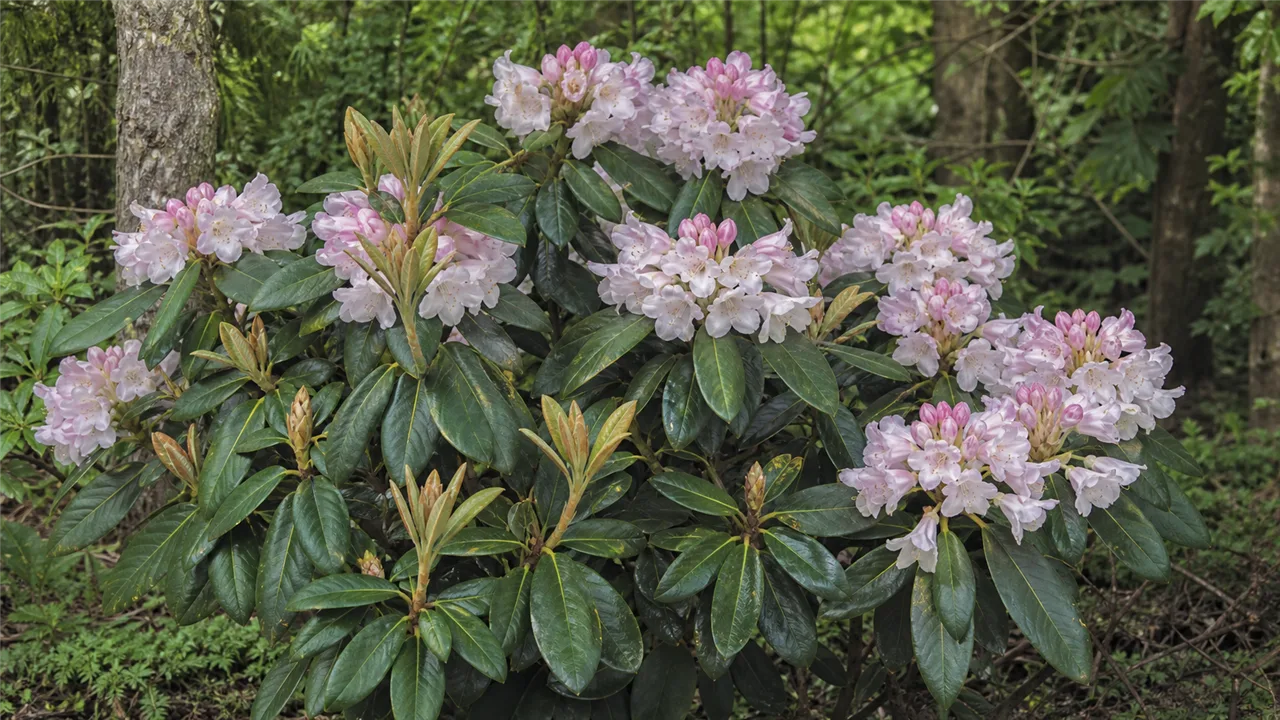
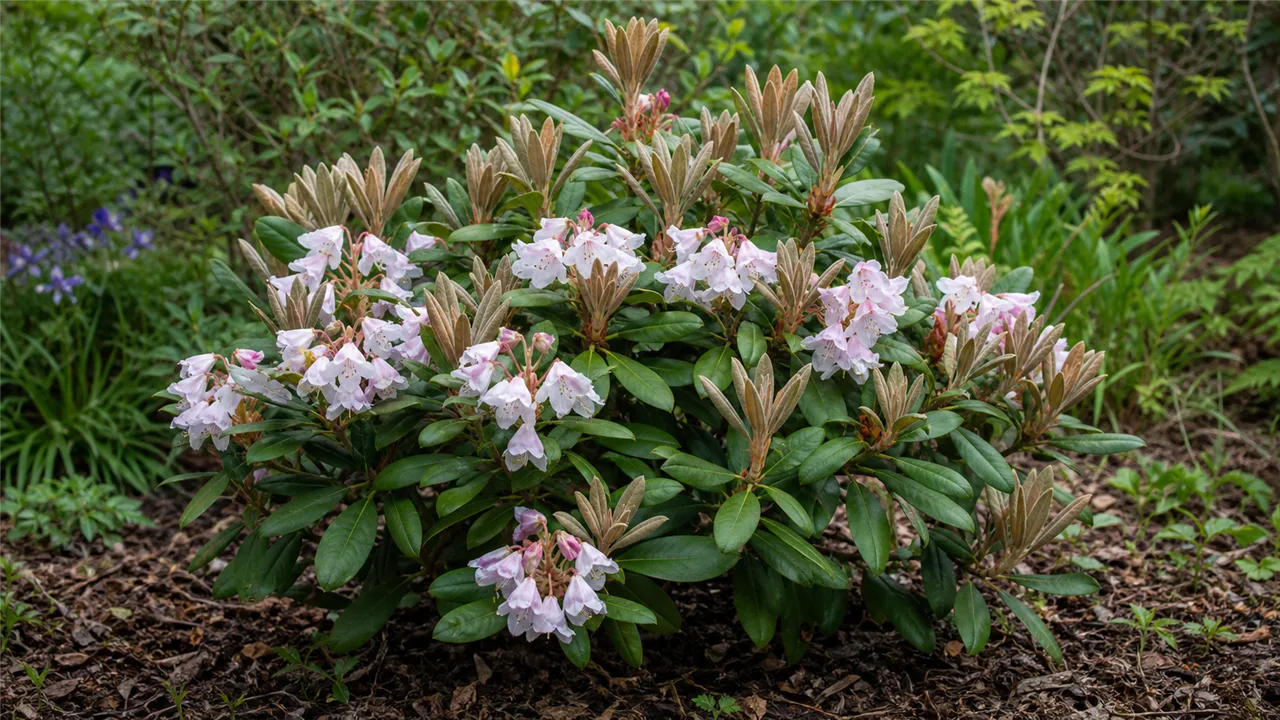
Rhododendron mucronulatum forms an upright, loosely branched shrub typically reaching 1.5–2.5 m in height and a similar spread over ten to fifteen years. Old specimens in favourable sites can exceed 3 m, but the plant is more often seen as a rounded, somewhat open shrub of around 2 m. The branches are slender and slightly arching, carrying clusters of flower buds at their tips through the winter.
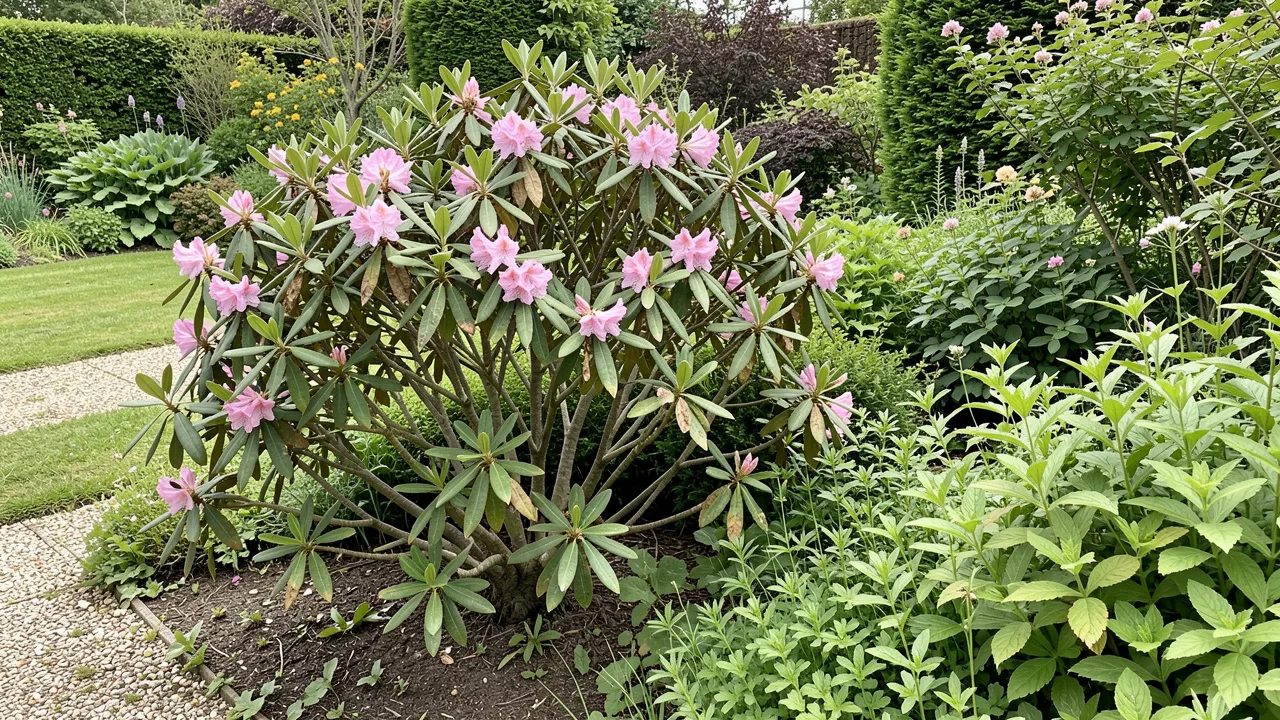
The flowers are the main feature. They are funnel-shaped, around 3–5 cm across, with five lobes and a short tube, and open from late January or February through into March, depending on site and season. In a mild winter in the south they may be open by the second week of February; in a cold year in the north they can hold back into early April. The colour in the typical wild form is a clear rose-purple to lilac-pink, though paler and white-flowered variants exist in cultivation and several named cultivars are available (see Popular Varieties). Each truss carries only a few flowers — usually three to six — rather than the large compact trusses of the evergreen hybrids, but their appearance on bare stems is striking.
The leaves follow flowering, emerging as the flowers fade. They are lance-shaped (lanceolate), 5–12 cm long and 1.5–3 cm wide, bright mid-green when fresh, with the small resin dots typical of scaly rhododendrons visible on the underside. Unlike evergreen rhododendrons, the leaves turn colour in autumn — clear yellows and soft oranges, occasionally with red — before falling, giving the plant a second season of interest.
Growing Conditions
Rhododendron mucronulatum needs acidic, moisture-retentive but free-draining soil. The ideal is a sandy or loamy ericaceous soil with a pH between 4.5 and 6.0; on neutral or alkaline ground the plant becomes chlorotic, the leaves yellowing between the veins, and growth is thin and stunted. It will not tolerate chalk or limestone, and on heavy clay it must be planted either in raised beds filled with ericaceous compost or on a shallow mound to keep the crown clear of winter wet. The species is much more tolerant of cold than of drought or waterlogging at the roots.
Light is best as partial shade — dappled shade under deciduous trees or an east- or north-east-facing wall suits it well. It will tolerate more sun, particularly in the cooler and wetter north and west, provided the soil does not dry out. Avoid deep shade against a north wall, which reduces flowering, and avoid hot south- or west-facing walls where early flowers can be scorched and summer drought stress is likely.
Because it flowers so early, siting matters. A sheltered east- or south-east-facing position protects the flowers from the worst of the north and east winds and gives the shrub a slightly warmer microclimate, encouraging earlier bloom. Equally, a position that is open enough to avoid late frost pockets is important; a shrub tucked under an overhanging roof or against a building can miss hard frosts that would damage open flowers in the open garden. In colder parts of the UK, planting against a wall adds one or two weeks of bloom security.
Hardiness is good across most of the UK; the species carries a published hardiness rating (held in the structured record rather than stated here) suitable for most lowland and many upland areas. The principal winter risk is not cold but root desiccation in frozen soil combined with bright sun — a problem best avoided with a generous autumn mulch.
Planting and Care
Plant container-grown stock in autumn or early spring, when the soil is moist and the plant is not in active growth. Bare-root plants, occasionally available from specialist nurseries, must be planted in autumn only. Prepare a planting hole at least twice as wide as the rootball and the same depth, and work ericaceous compost, leaf mould or well-rotted pine bark into the backfill. The shrub must not be planted deeper than it sat in the pot — burying the stem encourages Phytophthora root rot. Water in thoroughly and apply a 5–8 cm mulch of pine bark or leaf mould over the root area, keeping it clear of the stems.
Watering is the single most important part of aftercare. R. mucronulatum has relatively fine roots close to the surface and will not tolerate drying out. Water deeply during dry spells in the first two summers after planting, and in any prolonged summer drought thereafter, especially on lighter soils. A thick organic mulch applied each spring dramatically reduces the need for supplementary watering.
Feeding should be modest. Apply a slow-release ericaceous fertiliser in late March or early April, scattered over the root area and watered in. Avoid lime-based or general-purpose feeds, which raise pH and lock out micronutrients. Mulching annually with pine bark or leaf compost both feeds the soil and maintains acidity as the bark breaks down.
Pruning is minimal. As a member of the deadhead-only group of shrubs (along with camellias, magnolias and pieris), R. mucronulatum is not pruned annually on a schedule. The only routine work is to remove spent flower trusses immediately after flowering, taking care not to damage the new shoots beneath them, and to cut out any dead, damaged or crossing wood at the same time. Hard pruning into old wood is tolerated if necessary — the plant will regrow from the base — but is rarely required and forfeits one season of flower.
Propagation is straightforward. Take semi-hardwood cuttings of 8–10 cm from current-season growth in July or August, wound the base lightly, dip in a rooting hormone and root in a 50:50 mix of peat-free ericaceous compost and perlite under a propagator lid in a shaded cold frame. Layering is also reliable: peg a low branch into the soil in autumn, sever it from the parent a year later once rooted.
Common Problems
Rhododendron mucronulatum is generally a healthy plant when grown in suitable conditions, but a small number of problems recur on less suitable sites.
Powdery mildew appears as a white, dusty coating on the leaves in late summer, particularly on plants in dry shade or where air circulation is poor. It is largely cosmetic but indicates the plant is under stress; improve watering and mulch, and thin surrounding growth if congestion is severe.
Rhododendron leaf spot causes brown or purple spots on the leaves, sometimes coalescing and falling to give a shot-hole effect. It is usually cosmetic and is best managed by clearing fallen leaves in autumn (which carry the overwintering spores) and avoiding overhead watering.
Bud blast causes flower buds to turn brown and remain closed, with small black bristle-like fungal fruiting bodies developing on their surface. Pick off and destroy affected buds to reduce the spore load, and avoid heavy nitrogen feeding which produces soft, susceptible growth.
Aphids colonise the young shoots in spring, distorting new growth and excreting sticky honeydew. They are easily controlled by hand on a small plant, by encouraging natural predators, or with an insecticidal soap if numbers build.
Root rot (Phytophthora) is the most serious problem and almost always traces back to waterlogged or compacted soil. Affected plants wilt, the leaves go dull and bronze, and the plant collapses. There is no cure; prevention is everything — good drainage, correct planting depth, and avoiding heavy mulches piled against the stems.
Leaf drop in summer is almost always drought-related on this species and is best addressed by deeper, less frequent watering and a refreshed mulch.
Popular Varieties
The wild R. mucronulatum with its rose-purple flowers is itself worth growing, but several named cultivars offer useful variation in colour, size and habit.
`Cornell Pink` is the best-known cultivar and arguably the most garden-worthy. Selected at Cornell University from Korean seed in the mid twentieth century, it carries clear, soft pink flowers rather than the rose-purple of the type, and is widely considered more flattering in the garden landscape. It grows to a similar 2 m or so, with the same upright habit and autumn colour. It is the default choice where a softer colour is preferred.
`Crater's Edge` is a compact selection, slower growing and more mounded in habit, reaching around 1–1.5 m in height with a wider spread. It is useful where space is limited, in the front of a shrub border or in a larger container kept moist, and it flowers freely at a young age.
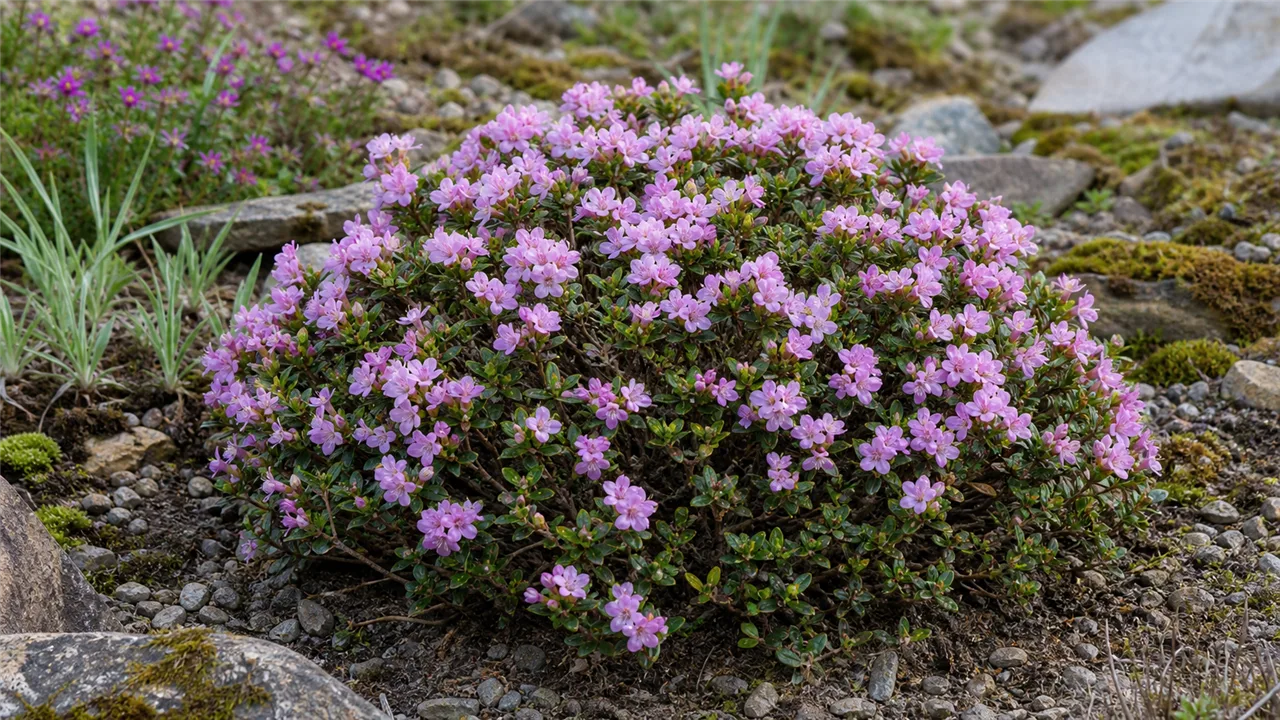
`Pink Pancake` is a very low, almost prostrate form, typically reaching only 30–60 cm in height but spreading to a metre or more. It is a useful groundcover or rock-garden plant for acidic soil, flowering at the same time as the taller forms and offering the same early-season colour at a scale that suits smaller gardens and the edges of paths.
In addition to these named cultivars, several pale and white-flowered seedlings are sold under colour-form labels rather than cultivar names; these are equally garden-worthy but tend to be variable in performance from seed. Whichever form is chosen, the key requirements are the same — acidic soil, even moisture, light shade and a sheltered position away from the worst of the late winter winds.
Cultivars and Varieties
| Cultivar | Height | Flower | Notes | AGM |
|---|---|---|---|---|
| 'Cornell Pink' | — | — | RHS AGM (H6) | ✓ |
Pests and Diseases
| Problem | Symptoms | Management |
|---|---|---|
| Vine weevil | Semi-circular notches on leaf margins and wilting or collapse of the plant due to root damage. | Apply nematodes in autumn or use a systemic insecticide drench for potted plants. |
| Powdery mildew | White, powdery fungal growth on leaves, buds, and shoots, potentially causing distortion. | Improve air circulation and apply a fungicide if infection is severe; otherwise tolerate. |
| Bud blast | Flower buds turn brown, shrivel, and fail to open, often due to late frost or fungal attack. | Remove and destroy infected buds promptly if practical to prevent spread. |
| Rhododendron leafhopper | Leaves become speckled with white spots and may curl or distort as sap is sucked. | Encourage natural predators like ladybirds; use insecticidal soap for heavy infestations. |
| Pieris lacebug | Upper leaf surfaces show silvery-white speckling and lower surfaces have dark frass spots. | Prune out heavily infested shoots and apply horticultural oil or insecticide if necessary. |
| Silver leaf | Wood beneath the bark appears silvery, and leaves may show silvering on the underside. | Cut out and burn infected branches well below the visible symptoms; remove severely affected plants. |
For step-by-step help, read Treating Powdery Mildew. Or browse the full plant problem solver to diagnose an issue by symptom.
Recommended Products
GardenWizz earns a commission from qualifying purchases made through affiliate links on this page (including links within the article) — as an Amazon Associate, and from Thompson & Morgan via the Awin network. This does not affect the price you pay. See our disclaimer for details.