Leek
Allium porrum
The Gardening Year
Best months in UK gardens · full planting calendar →
🖨 Printable care card (PDF)At a Glance
| Botanical name | Allium porrum |
|---|---|
| Common name(s) | Leek |
| Family | Amaryllidaceae |
| Plant type | bulb (Herbaceous perennials usually grown as annual vegetables) |
| Height × Spread | 10–180 cm × 10–50 cm |
| Position | Full sun |
| Pet safety | Toxic to cats and dogs (alliums) (ASPCA). |
| Soil | well-drained soil |
| Flowering | June–August |
| Toxicity | Edible to people (an onion-family vegetable); like all alliums it is toxic to cats and dogs. |
| Native range | southern Europe, southwestern Asia and North Africa |
The leek is a staple of the British vegetable garden and one of the few crops that can be lifted fresh from the ground in the depths of winter. Hardy, reliable and undemanding once established, it is grown across the UK from Shetland to the Channel Islands and rewards even the most inexperienced gardener with a generous harvest. A member of the onion family, the leek has been cultivated in Britain since at least the Saxon period and features as the national emblem of Wales, where it is worn on St David's Day.
Overview
Allium ampeloprasum — the garden leek — is a biennial vegetable grown as an annual for its blanched pseudostem. It belongs to the family Amaryllidaceae, alongside onions, garlic and shallots, and shares their preference for an open, sunny site and a fertile, well-drained soil. Unlike the bulb onion, the leek is harvested for its shanked stem rather than for any swollen storage organ, and a single sowing in spring can provide leeks for the kitchen from autumn through to the following March.
In the UK, leeks suit both the allotment and the smaller kitchen garden. They tolerate frost well, occupy the ground productively through winter when little else is cropping, and store in situ until needed — a forkful lifted on a cold morning is the essence of winter horticulture. They are also popular on the show bench, where exhibition cultivars are grown to impressive lengths through careful blanching.
Appearance
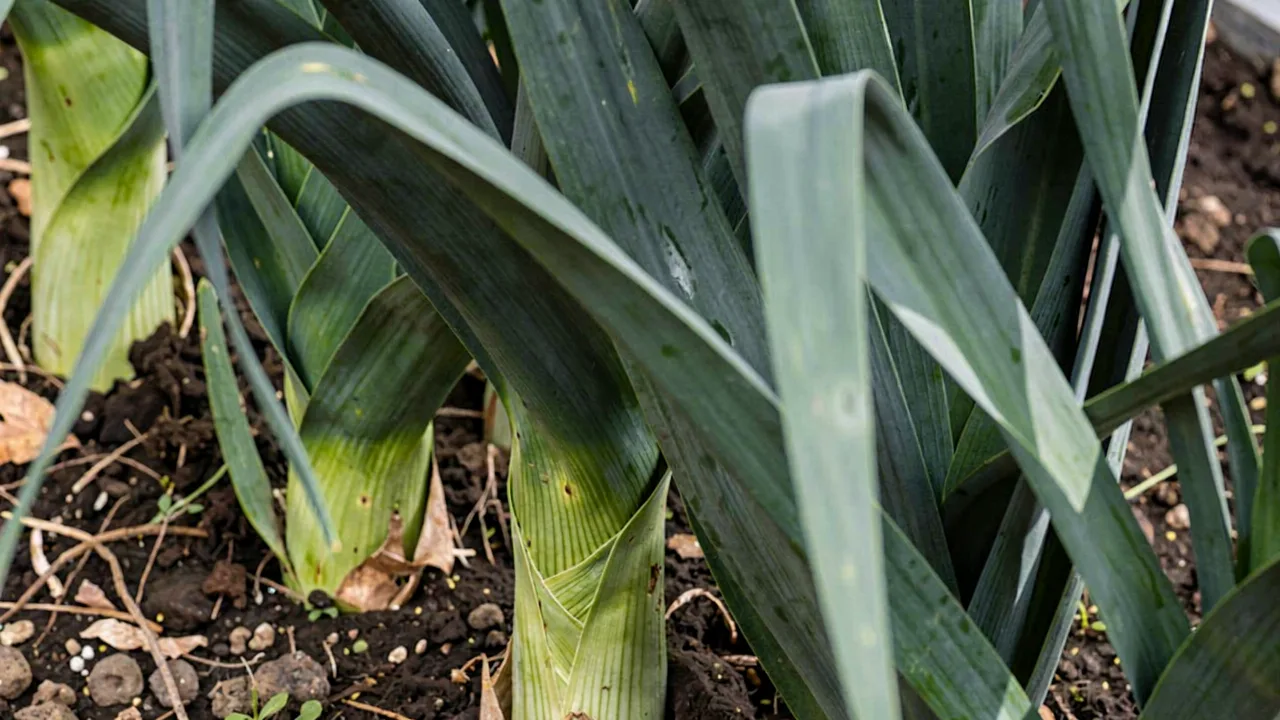
The edible portion of the leek is the pseudostem — a cylinder of tightly wrapped, blanched leaf bases that sits above the roots and below the green foliage. Mature plants reach 40–60 cm in overall height, with the white shank typically 15–25 cm long and 5–8 cm in diameter at its thickest. Above the shank, the leaves fan out in a flat, strap-like sheaf; they are a distinctive blue-green to glaucous grey-green, arranged in a flattened V, and sheath around one another at the base.
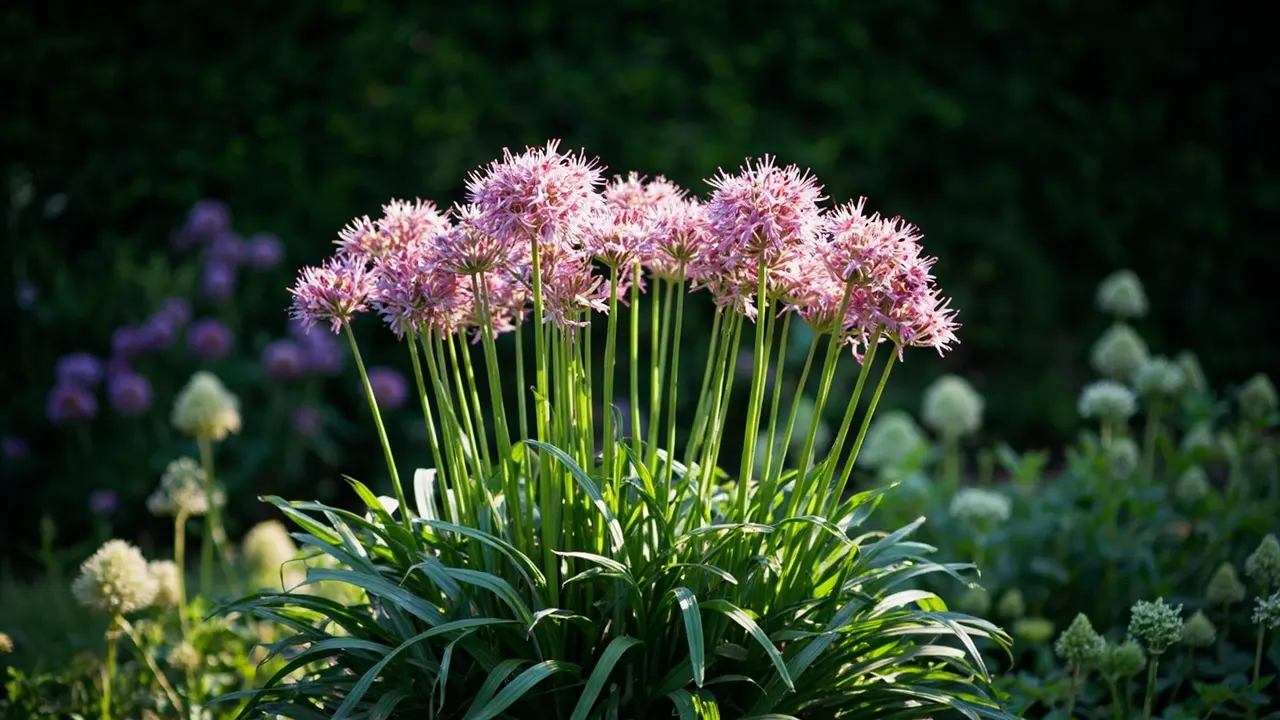
The true stem is a small compressed disc at ground level, from which a dense mat of fibrous roots descends. Left in the ground for a second season, a leek will send up a tall flower stalk — sometimes reaching 1.5 m — carrying a globular umbel of small purple-white flowers in summer, followed by black seed. Culinary crops are lifted before this stage, as the shank becomes tough and fibrous once flowering begins.
Growing Conditions
Sunlight: Leeks grow best in full sun but tolerate light, dappled shade, particularly in the warmer south of England. Avoid deep shade from buildings or overhanging trees, which produces thin, weak shanks.
Soil: The ideal soil is deep, fertile, moisture-retentive yet free-draining. Leeks prefer a slightly alkaline to neutral pH of around 6.5–7.5 and respond well to ground prepared the previous autumn with plenty of well-rotted manure or garden compost. Heavy clay can be improved with grit and organic matter; light sandy soils will need consistent irrigation and steady feeding to produce sizeable shanks. Leeks will not tolerate waterlogged ground, which rots the base.
Aspect and position: An open or lightly sheltered site is ideal. Leeks are tolerant of exposed positions in the north of England and Scotland, although very exposed coastal sites can scorch the foliage in winter gales.
Hardiness: The leek holds a hardiness rating under the Royal Horticultural Society's classification, displayed in the badge for this page. It is one of the hardiest vegetables in the British garden and crops reliably through the worst of the UK winter. Cultivars vary; check the specific rating of the variety you intend to grow.
Crop rotation: As with alliums, leeks benefit from a four-year rotation. Do not follow onions, garlic, shallots or previous leek crops, as this encourages the build-up of soil-borne diseases such as white rot and fusarium.
Planting and Care
Sowing. Leeks are usually raised in a seedbed or module tray and transplanted, rather than sown direct. For an autumn and winter harvest, sow indoors in modules or a propagator from January to February at 10–15 °C; germination takes 10–14 days. A second sowing can be made outdoors in a prepared seedbed from March to April for later transplanting. Prick out indoor-raised seedlings into individual cells or small pots once they are about 5 cm tall.
Transplanting. Plant out from April to May, when seedlings are roughly 20 cm tall and pencil-thick. The traditional method is to make holes 15 cm deep with a dibber, drop the seedling in so that the roots sit at the bottom of the hole, and water in well — do not backfill with soil. Space plants 15–30 cm apart in rows 30 cm apart, depending on the size of the cultivar. Larger exhibition varieties need the wider spacing.
Blanching. The length of white shank depends on excluding light from the stem. Earth up the plants gradually as they grow, drawing soil up around the shank in 5 cm stages every two to three weeks from mid-summer onwards. Alternatively, slip a cardboard collar or a length of black plastic pipe over each plant at transplanting.
Watering. Consistent moisture through the growing season produces the largest, most tender shanks. Water deeply during dry spells in June, July and August; a fortnight without rain in mid-summer can check growth noticeably.
Feeding. Leeks are moderate feeders. Top-dress the planting bed with a balanced general fertiliser such as Growmore at planting time, and apply a liquid feed every three to four weeks through the main growing season for pot-grown or hungry specimens. Avoid fresh manure at planting, which can scorch the roots.
Propagation and saving seed. Leeks are biennial; to save seed, leave a few of the best plants in the ground over winter and allow them to flower in their second summer. The globular flower heads will ripen by late summer, and the seed can be collected and dried for sowing the following spring. Cross-pollination occurs readily between leeks and other flowering alliums within a kilometre, so home-saved seed will not always come true.
Seasonal care. Little active care is needed once the leeks are established. Keep the bed weeded through summer, water in dry periods, and complete earthing up by early autumn. In the coldest parts of the UK, throw a layer of horticultural fleece over the row in January and February if hard frost threatens to lift plants out of the ground.
Common Problems
Leek rust (Puccinia porri). Orange-brown pustules appear on the outer leaves in humid weather, particularly in late summer and early autumn. Remove and destroy affected foliage; do not compost it. Improve air circulation by widening spacing, and avoid overhead watering. Some cultivars carry useful resistance.
Leek moth (Acrolepiopsis assectella). An increasing problem in southern and central England. The caterpillars mine into the leaves and shank, causing windows of translucent tissue and white frass. Cover crops with fine insect mesh from June onwards and inspect plants regularly through summer.
Onion fly (Delia antiqua). Larvae bore into the base of the shank, causing yellowing, wilting and eventual collapse. Rotate crops, avoid sowing into ground recently occupied by other alliums, and use fleece or mesh barriers from late spring.
Thrips (Thrips tabaci). Silvery scarring on the outer leaves, worst in dry summers. Keep plants well watered and maintain humidity around the row; biological controls are available for protected crops.
Downy mildew (Peronospora destructor). Pale yellow patches on the leaves with a greyish downy growth in damp conditions. Improve drainage and airflow, remove affected foliage, and avoid working among wet plants.
White rot (Sclerotium cepivorum). A serious soil-borne disease of all alliums. Affected plants yellow and the base of the shank becomes coated in a white fluffy mould with small black resting bodies. There is no cure; rotate crops and avoid ground known to be infected for at least eight years.
Popular Varieties
The following cultivars are widely grown in the UK and can be relied on for flavour, vigour and winter hardiness. The list below is not exhaustive; check seed catalogues for current availability.
- `Musselburgh` — a Scottish heirloom dating from the 1830s and one of the most widely grown leeks in Britain. Thick, stocky shanks, very hardy, reliable on heavy soils and in cold districts.
- `Autumn Giant 2 Porvite` — a mid-season type producing long, heavy shanks with a high proportion of white. Good exhibition quality and a dependable garden cropper.
- `Lyon` (also sold as `Lyon Prizetaker`) — a long-shafted, traditional exhibition variety reaching 30 cm or more of blanched stem. Best in rich, deeply dug soil.
- `Carlton` — an F1 hybrid with good resistance to leek rust and strong, uniform shanks. A modern favourite for the kitchen garden.
- `Bandit` — a very hardy late-season cultivar bred for northern UK conditions. Holds well in the ground from November to April.
- `Oarsman` — a tall, vigorous F1 hybrid with dark blue-green foliage and clean white shanks. Good rust tolerance and a popular show-bench variety.
- `Pandora` — an early-maturing leek ready to lift from late summer onwards, useful for extending the harvest at the front end of the season.
Pests and Diseases
| Problem | Symptoms | Management |
|---|---|---|
| Slugs and snails | Irregular holes chewed in young leaves and seedlings, often accompanied by slimy trails. | Use physical barriers like copper tape or crushed eggshells, and hand-pick pests at night. |
| Onion white rot | Plants turn yellow and wilt; bulbs show white, cottony fungal growth and decay. | Remove infected plants immediately and avoid growing alliums in that soil for at least 10 years. |
| Leek rust | Small, raised orange-brown pustules appear on leaves, eventually causing them to yellow. | Improve air circulation and remove severely affected leaves; rotate crops annually. |
| Downy mildew | Yellowish patches on leaves with a fuzzy grey-purple growth on the underside. | Ensure good drainage and avoid overhead watering to keep foliage dry. |
| Leek moth | White larvae bore into stems and bulbs, causing twisting, distortion, and secondary rot. | Protect plants with fine insect-proof mesh during peak adult activity in spring and autumn. |
For step-by-step help, read Dealing with Slugs and Snails and Treating Powdery Mildew. Or browse the full plant problem solver to diagnose an issue by symptom.
Leek in our guides
- Crop Rotation Explained for UK Vegetable Gardens
- How to Grow Cabbage in the UK: A Complete Guide
- How to Grow Kale in the UK: A Complete Guide
- How to Grow Leeks in the UK: A Complete Guide
- How to Grow Leeks: Sowing to Harvest
- How to Grow Shallots
Recommended Products
GardenWizz earns a commission from qualifying purchases made through affiliate links on this page (including links within the article) — as an Amazon Associate, and from Thompson & Morgan via the Awin network. This does not affect the price you pay. See our disclaimer for details.