Wild Garlic
Allium ursinum
The Gardening Year
Best months in UK gardens · full planting calendar →
🖨 Printable care card (PDF)At a Glance
| Botanical name | Allium ursinum |
|---|---|
| Common name(s) | Wild Garlic |
| Family | Amaryllidaceae |
| Plant type | bulb (Bulbous perennial herbaceous monocot; leaves die back after flowering and regrow the following spring.) |
| Height × Spread | 50 cm × 10 cm |
| Position | Full shade, Partial shade |
| Soil | Moist, well-drained, moderately fertile, humus-rich; tolerates acidic conditions and heavier soils. |
| Flowering | April–June |
| Toxicity | No specific toxicity is listed by the RHS. This is not a guarantee of safety — check with a vet or the ASPCA before pets or children eat any plant. |
| Native range | Eurasia (Europe and Asia) |
A perennial bulbous herb of the onion family, wild garlic (Allium ampeloprasum) is prized in British gardens for its pungent foliage, generous spring flowering and reliable performance in shaded, woodland-style plantings. The species is fully hardy throughout the UK, easy to establish where conditions suit it, and increasingly popular as both a culinary crop and an ornamental ground-cover.
Note on naming: the common name "wild garlic" is also used in the UK for Allium ursinum (ramsons), a different woodland species with broader, softer leaves. A. ampeloprasum is the broadleaf perennial sometimes sold as "ramp" or "wild leek", and is the species covered here.
Overview
Allium ampeloprasum is a long-lived perennial belonging to the Amaryllidaceae family, the same family as onions, garlic and chives. In the wild it occurs across southern and western Europe, including Britain, where it grows on damp woodland margins, along shaded road-verges and on hedge-banks. The plant develops a stout underground bulb that persists from year to year, producing fresh strap-shaped leaves in early spring and a tall flowering stem in late spring.
In cultivation it serves three overlapping roles. Ornamentally, the dense white to pale-pink flower umbels provide a useful vertical accent in shaded borders, and the bright green foliage covers bare ground beneath deciduous trees. In the kitchen, both the leaves and the bulbs carry a strong but pleasant garlic-onion flavour and can be used as a punchier substitute for chives or spring onions. Ecologically, the flowers are an early-season nectar source for bees and hoverflies at a time of year when little else is in bloom.
The species is undemanding once established. Given a moist, shaded site and a little patience during the first growing season, it forms an enlarging clump that returns reliably each year, with little need for routine feeding or pruning.
Appearance
The plant grows from a clumping, slightly elongated white bulb, typically 2–5 cm long, which multiplies slowly to form a tight colony. In early spring each bulb pushes up a fan of smooth, strap-shaped leaves. These leaves are bright, slightly grey-green, and reach 20–50 cm tall; they are flat rather than hollow, distinguishing them from the tubular leaves of chives.
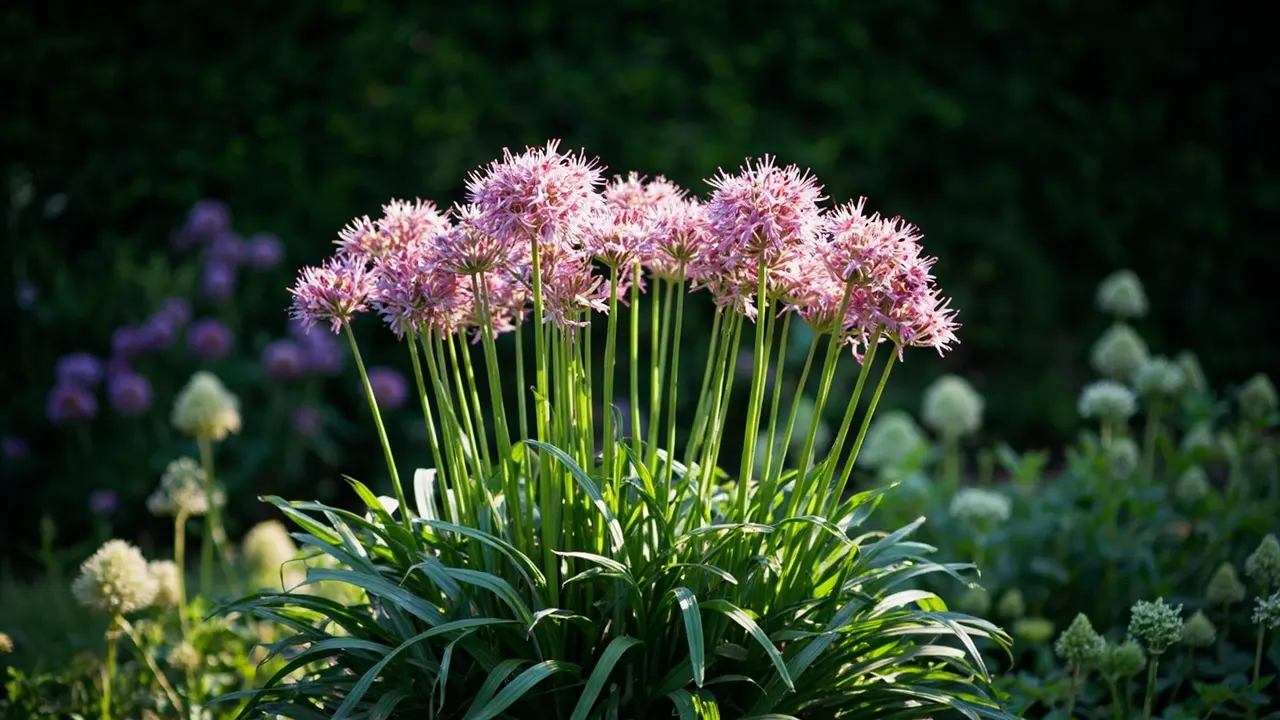
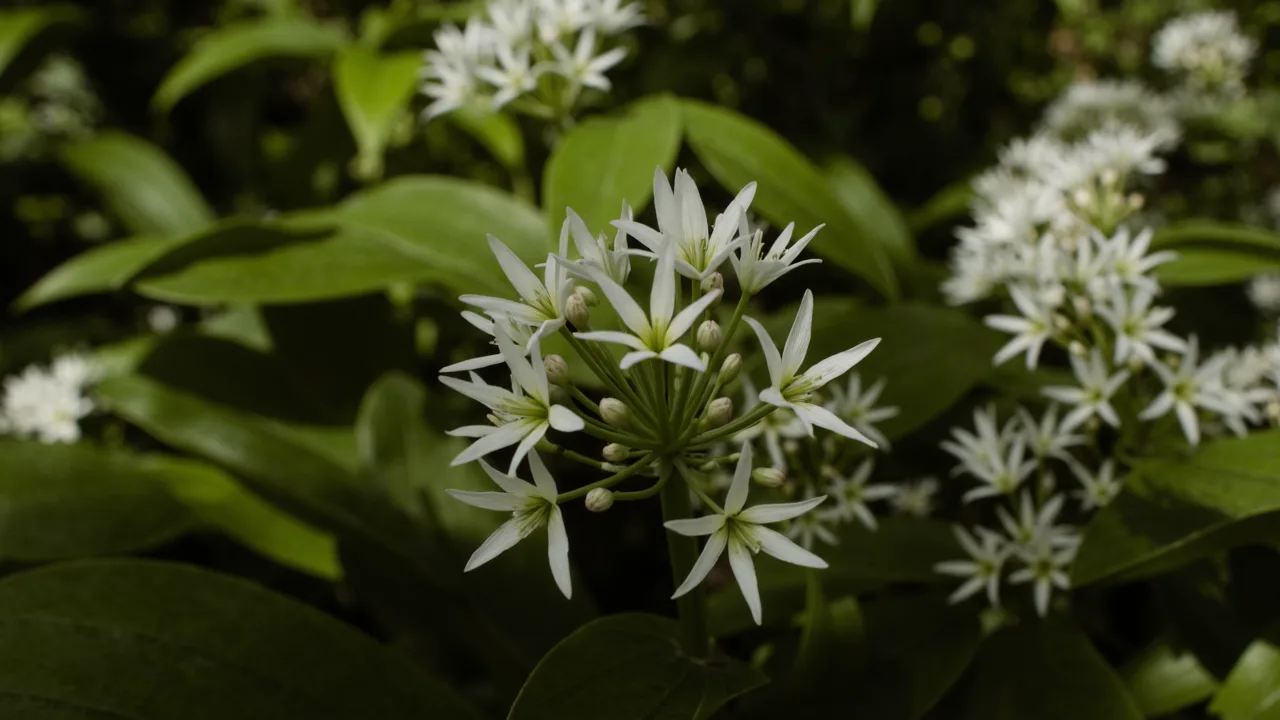
From the centre of the leaf rosette a stout, smooth flowering stem emerges in late spring, usually between 40 cm and 90 cm tall depending on soil fertility and moisture. The stem carries a single, dense, spherical umbel 5–10 cm across, made up of 30 to 50 or more small star-shaped flowers. The flowers are typically white to pale pink, each on a short stalk, and open in succession over several weeks.
The leaves die back naturally by mid to late summer once the bulb has finished flowering and set seed. Mature clumps reach 30–35 cm across at the base before flowering. Seedheads, if left in place, are decorative in their own right and persist as pale straw-coloured spheres well into autumn.
Growing Conditions
Allium ampeloprasum performs best in conditions that mimic its native woodland-edge habitat. The key requirements are shade, moisture and a soil rich in organic matter.
Light. Partial to full shade is ideal. A position beneath deciduous trees or on the north or east side of a building suits it well. Brief morning sun is tolerated; harsh midday or afternoon sun scorches the foliage and shortens the growing season.
Soil. The plant prefers a loamy or sandy loam that has been improved with garden compost or leaf mould. Drainage should be reasonable — the bulbs dislike sitting in cold, waterlogged ground in winter — but the soil must retain moisture during the spring growing period. A slightly acidic to neutral pH of around 5.5 to 7.0 is ideal, though the plant tolerates a wider range.
Moisture. Consistent moisture through spring is important. In drier soils, particularly under large trees, a thick autumn mulch of leaf mould helps both feed the soil and conserve winter and spring moisture.
Climate. The species is reliably hardy across the whole of the UK, including Scotland and upland areas. Winter cold and late frosts are not a problem once the bulbs are established, and the foliage re-emerges reliably each spring.
Natural habitat. In Britain, A. ampeloprasum occurs as a wild or naturalised plant along shaded road-verges, in hedge bottoms and at the edges of deciduous woodland. Established garden colonies can be allowed to naturalise in similar locations.
Planting and Care
Planting. Bulbs are best planted in autumn, from late September through November, at a depth of about 5–8 cm and 10–15 cm apart. Container-grown plants from garden centres can be put in at any time from autumn to early spring, provided the ground is not frozen or waterlogged. Water in well after planting.
Watering. During the first spring and summer after planting, water during dry spells to keep the soil moist. Established colonies in suitably shaded, humus-rich ground rarely need supplementary watering.
Feeding. A single annual mulch of garden compost or well-rotted leaf mould applied in autumn is usually sufficient. Avoid high-nitrogen fertilisers, which encourage lush leaf growth at the expense of flowers and can lead to soft, disease-prone foliage.
Propagation. The simplest method is division of established clumps in autumn, every three to four years, as the bulbs multiply and begin to compete with each other. Lift a clump, separate the offsets and replant them immediately at the same depth. Plants also set viable seed, which can be sown fresh in autumn; seedlings reach flowering size in their second or third year.
Pruning and seasonal care. No routine pruning is needed. Remove spent flower stems if self-seeding is not wanted, or leave them in place for winter structural interest and as a modest food source for birds. Tidy away yellowing foliage in mid to late summer once it has died back naturally — do not cut the leaves while still green.
Containers. The plant can be grown in large containers (at least 25 cm deep) in a loam-based compost such as John Innes No. 2, kept shaded and reliably moist. Container-grown plants benefit from division and fresh compost every two to three years.
Harvesting. Leaves can be cut sparingly from established clumps from March to May, before flowering. Bulbs are best lifted in late summer after the foliage has died back, though taking bulbs means sacrificing next year's display.
Common Problems
Rust (Puccinia allii). Orange-brown pustules on the leaves in warm, damp weather. Remove and destroy affected foliage, avoid overhead watering, and improve air circulation by thinning congested clumps.
Onion fly and leek moth. Larvae of both pests may tunnel into leaves and bulbs in some seasons. Fine insect netting placed over the planting from late spring provides effective protection in vegetable-style plantings.
Slugs and snails. Young spring foliage is attractive to slugs, particularly in damp, shaded sites. Damage is usually cosmetic on established plants, but on small or newly planted colonies organic slug controls such as ferric phosphate pellets or beer traps may be needed.
Powdery mildew. A whitish coating on the leaves in hot, dry summers. Mulch to maintain soil moisture and water at the base rather than over the foliage.
Overcrowding. Clumps left undisturbed for many years become congested and flower less freely. Lift and divide every three to four years in autumn.
Invasive tendency. In ideal shaded, moist conditions, A. ampeloprasum self-seeds freely and can spread beyond its intended area. Deadhead spent flowers where this is a concern, or remove unwanted seedlings in autumn.
Popular Varieties
Most plants sold in the UK are offered simply as Allium ampeloprasum or under the general headings "wild leek", "broadleaf wild leek" or "ramp", without a cultivar name. Within the broader species complex, several distinct forms are recognised by botanists and growers, though named selections available in British nurseries are limited.
The following groupings are the ones most commonly encountered, and each is widely accepted as reliably hardy and easy to grow in UK conditions:
- Wild form (unselected). Seed-raised stock typical of naturalised European and British populations; the standard choice for wildlife-style and woodland plantings.
- Large-bulbed form. Sometimes sold as "elephant garlic" (A. ampeloprasum var. ampeloprasum), this is a much larger-bulbed variant grown primarily for its mild, garlic-flavoured bulbs rather than its flowers.
- Ornamental selection. Forms with particularly large or pink-flushed flower umbels are occasionally offered by specialist bulb nurseries under variable names; availability changes year to year.
Because named cultivar lists for this species shift frequently and stock at general garden centres is usually unnamed, gardeners wanting a specific type are best served by ordering from specialist bulb nurseries in late summer or by growing on their own seed-raised plants. Where no name is given, the plants offered are reliably hardy and well suited to ordinary British garden conditions.
🌿 Wild species. Grown as the true native plant, not as named garden cultivars — so there is no cultivar list here by design, not for want of data.
Pests and Diseases
| Problem | Symptoms | Management |
|---|---|---|
| Onion white rot | Leaves turn yellow and wilt while bulbs become soft and covered in white fungal growth. | Remove affected plants immediately and avoid replanting alliums in that soil for many years. |
| Downy mildew | Yellowish patches appear on leaves with a fuzzy grey-green mould developing underneath. | Improve air circulation and remove infected foliage to reduce humidity around the plants. |
| Slugs and snails | Irregular holes are eaten in young emerging leaves, often accompanied by slimy trails. | Use beer traps or iron phosphate pellets to protect tender new growth in spring. |
| Vine weevil | Notched edges on leaves above ground and wilting plants due to root damage below. | Check roots for grubs when planting and apply biological nematodes if infestation is found. |
| Excessive spreading | Dense carpets of foliage form, crowding out other plants and becoming difficult to control. | Install root barriers or regularly dig up new bulbils to restrict expansion into unwanted areas. |
For step-by-step help, read Dealing with Slugs and Snails and Treating Powdery Mildew. Or browse the full plant problem solver to diagnose an issue by symptom.
Wild Garlic in our guides
Recommended Products
GardenWizz earns a commission from qualifying purchases made through affiliate links on this page (including links within the article) — as an Amazon Associate, and from Thompson & Morgan via the Awin network. This does not affect the price you pay. See our disclaimer for details.