Yunnan Iris
Iris forrestii
The Gardening Year
Best months in UK gardens · full planting calendar →
🖨 Printable care card (PDF)At a Glance
| Botanical name | Iris forrestii |
|---|---|
| Common name(s) | Yunnan iris |
| Family | Iridaceae |
| Plant type | perennial |
| Height × Spread | 15–45 cm × 10–50 cm |
| Position | Full sun, Partial shade |
| Soil | Moist but well-drained |
| Flowering | May–June |
| Toxicity | Harmful if eaten |
| Native range | China (including Tibet) and Burma |
Overview
Iris forrestii is a slender, rhizomatous herbaceous perennial in the family Iridaceae, native to the mountain meadows, stream banks and woodland margins of south-western China (Sichuan and Yunnan) and adjacent Tibet. It was first described in 1910 from material collected by the Scottish plant hunter George Forrest during one of his Yunnan expeditions, and it is named in his honour. In the United Kingdom it sits firmly in the specialist-iris category — a moisture-loving, summer-flowering species for damp borders, bog gardens and the margins of ponds and streams, rather than the dry, sunny conditions most gardeners associate with bearded irises.
Despite being introduced over a century ago, I. forrestii remains uncommon in British cultivation. It is prized by collectors for its combination of refined, pale-yellow flowers marked with an orange or brown signal on the falls, its elegant upright habit, and its willingness to grow in the kind of damp, partly shaded site that defeats many other irises. Given a cool root run and a humus-rich soil that does not dry out, it is a reliable, long-lived clump-former in most of the UK, including the wetter north and west.
Appearance
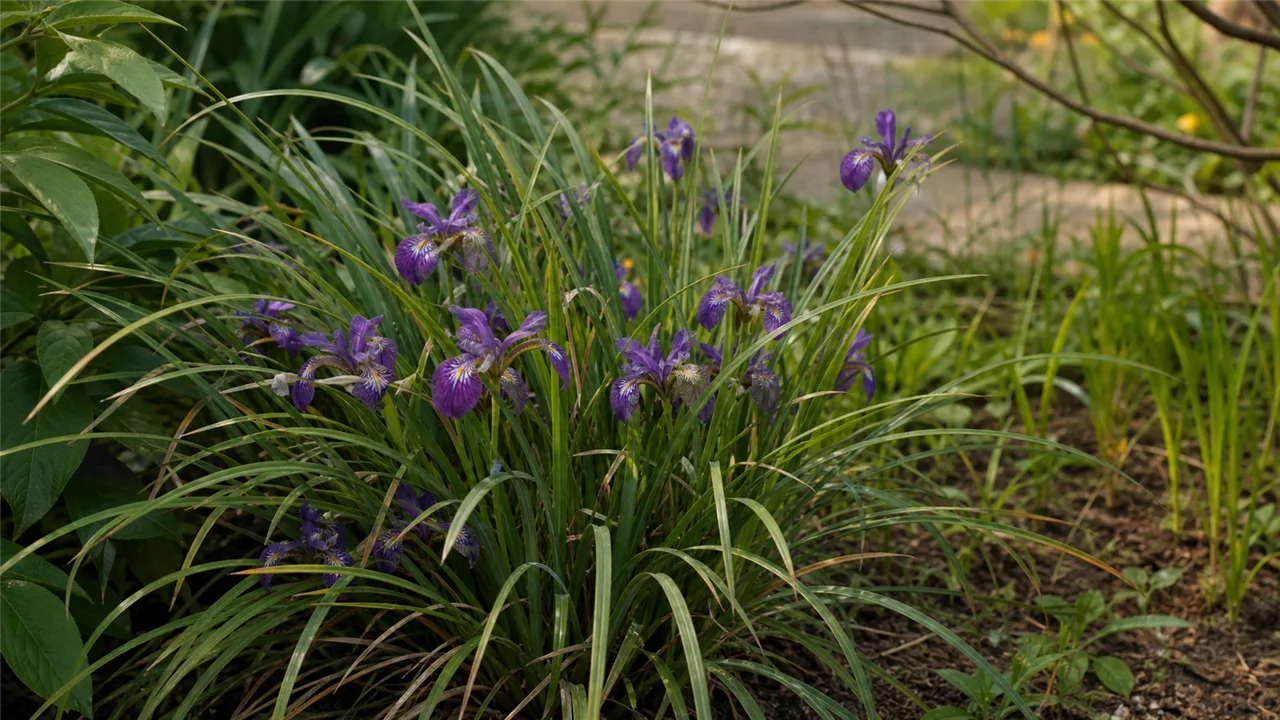
Iris forrestii forms a compact, clumping plant from a slender, creeping rhizome that sits at or just below the soil surface. Established plants reach 30–60 cm in height, with taller flowering stems rising above the leaves.
The leaves are narrowly sword-shaped, mid-green on the upper surface and slightly glaucous (bluish-green) on the reverse, giving the clump a soft, two-toned appearance when the wind catches the foliage. Each leaf is roughly 20–45 cm long and 1–2 cm wide, arching gently outwards from the rhizome. The foliage dies back in late autumn and is replaced by fresh growth from the rhizome in spring.
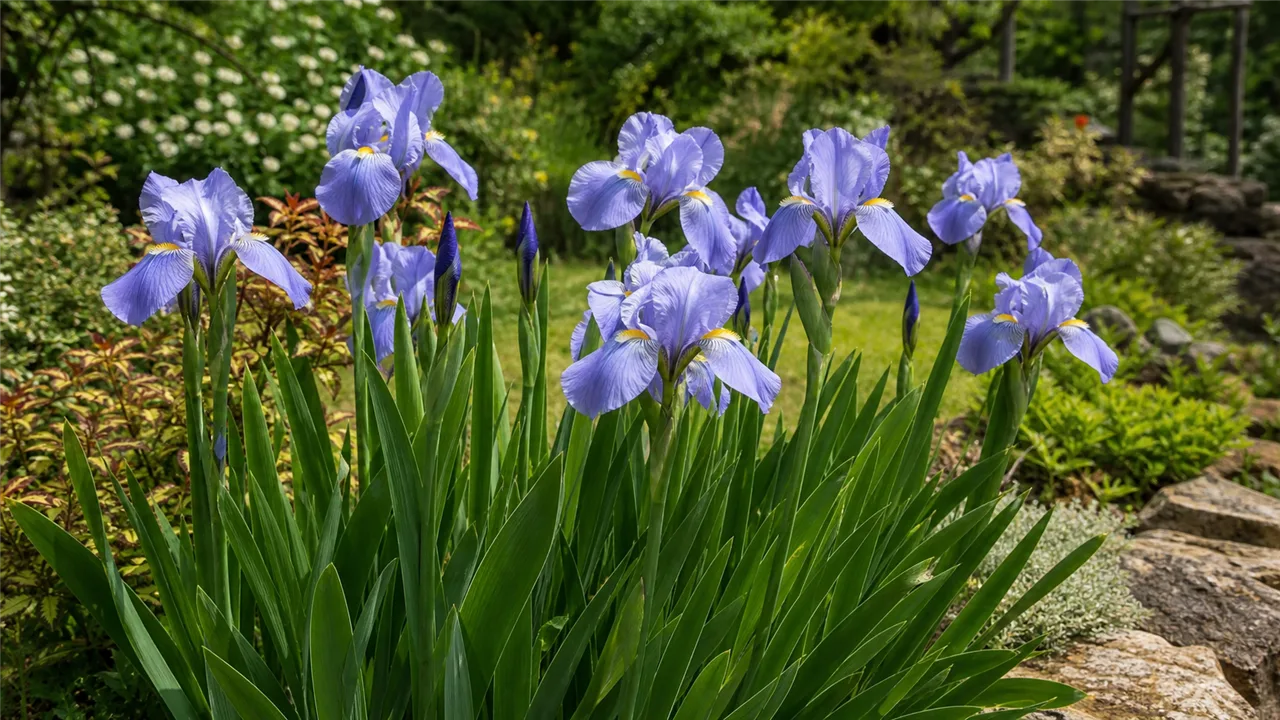
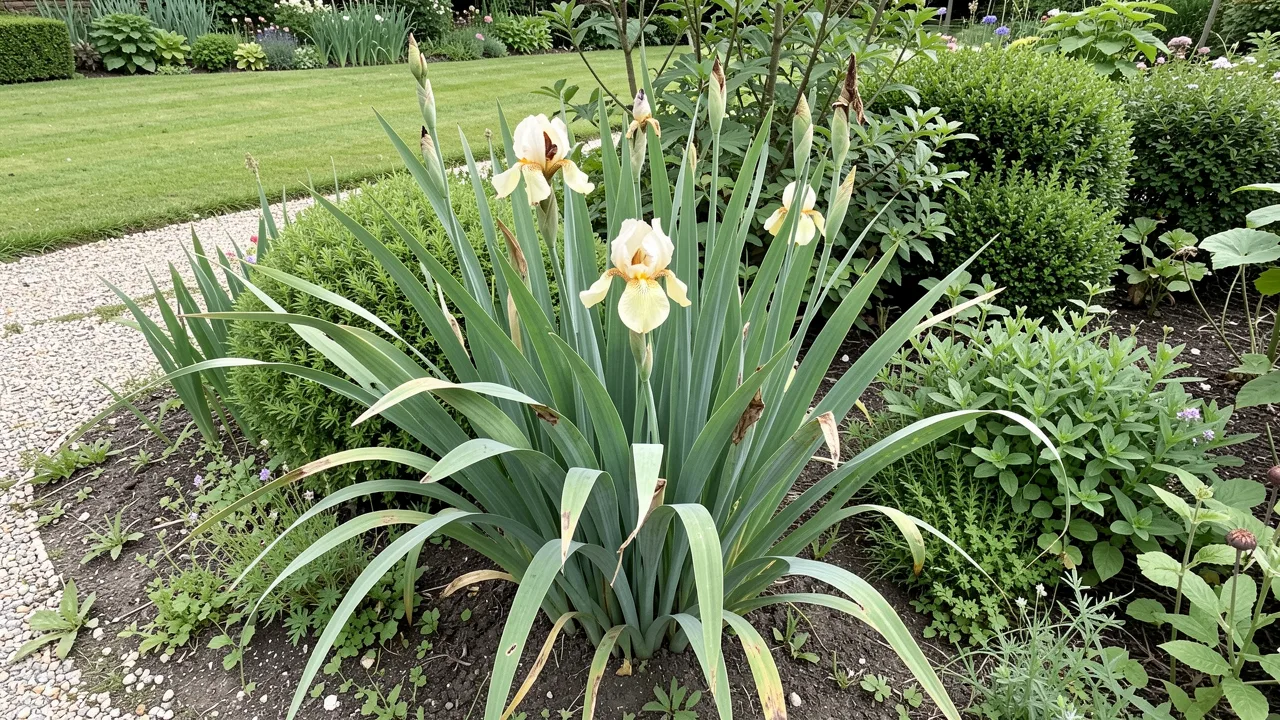
Flowering stems are slender, unbranched or once-branched, and carry one to three flowers 8–10 cm across, held well clear of the foliage. Like all irises, each flower is built from six perianth segments in two whorls. The three outer segments — the falls — are spreading, broadly lance-shaped and pale to mid-yellow, marked with a bold orange or brown signal patch and fine purple or violet veining at the base around the beard. The falls of I. forrestii are essentially beardless, distinguishing it at a glance from the familiar bearded irises. The three inner segments — the standards — are smaller, narrower and held almost vertical; they are typically a paler, cleaner yellow than the falls.
The fruit is a three-angled, oval capsule 3–5 cm long, green ripening to brown, that splits to release numerous pale brown, winged seeds. Seed is produced freely in warm summers but is rarely self-sown in UK gardens; the plant is most often increased by division of the rhizome.
Growing Conditions
Iris forrestii is a cool-climate, moisture-loving species that performs best in the UK when its requirements for damp soil, dappled light and a slightly acidic substrate are met. It is not a plant for a hot, dry south-facing border; in those conditions the leaves scorch and the rhizome tends to rot in any prolonged wet weather.
Soil. A moist, humus-rich loam with a slightly acidic to near-neutral pH (around 5.5–6.5) is ideal. Soils enriched with leaf mould, well-rotted garden compost or other organic matter hold the moisture the plant needs through the growing season without becoming stagnant. Heavy clay can be improved by working in coarse organic matter and sharp grit, but the goal is moisture retention, not sharp drainage; this is not an iris for a Mediterranean gravel bed.
Light. Dappled shade through to part sun suits I. forrestii best in British conditions. An east- or north-facing border, or a position beneath an open-canopy tree where the plant receives morning sun and is shaded from the hottest afternoon sun, is ideal. In Scotland, the north of England and Northern Ireland, it can take more sun; in the south, south-east and East Anglia, shade from midday and afternoon sun is important to keep the rhizome cool.
Moisture. Consistent moisture through the growing season — roughly March to September — is the single most important condition. The plant thrives at the margin of a stream or pond, in a bog garden, or in a damp border that is watered in dry spells. It tolerates short periods of summer drought once established but flowers poorly and the foliage browns at the tips if the soil dries out repeatedly.
Cold. The rhizome is less tolerant of prolonged winter waterlogging combined with hard frost than many of its bearded relatives, so drainage in the colder months matters as much as summer moisture. Planting on a shallow mound or at the edge (not the base) of a slope, or in raised beds in heavy ground, helps the rhizome stay firm through a wet British winter.
UK suitability. I. forrestii is well suited to much of the UK, particularly the wetter regions — Wales, the West Country, the Pennines, the Lake District, most of Scotland, and Northern Ireland. In the drier south-east it is more demanding and needs shade and supplementary watering in summer. Coastal gardens in mild areas, where the soil does not freeze deeply, are also good locations.
Planting and Care
Planting. Plant rhizomes in spring (March to May) or in early autumn (September to early October), when the soil is moist and warm enough for quick root establishment. Set the rhizome shallowly, so that the top sits at or just below the soil surface and the roots are spread out beneath — deep planting is a common cause of rot. Space plants 30–45 cm apart in groups of three or five for the best visual effect. Water in well at planting and keep the soil moist for the first growing season.
Watering. Water regularly through the first summer and during any subsequent dry spell. Established plants benefit from a deep soak every week to ten days in dry weather; a brief daily sprinkle does not reach the rhizome and is largely wasted. Where the plant is growing at the edge of a pond or stream, supplementary watering is rarely needed.
Feeding. On reasonably good, humus-rich soil no routine feeding is essential. On leaner ground, a light top-dressing of a general-purpose fertiliser in early spring, followed by a mulch of leaf mould or well-rotted garden compost, supports strong growth and flowering. Avoid high-nitrogen feeds, which produce soft, leafy growth prone to rot and to slug damage.
Mulching. Apply a 5–7 cm mulch of leaf mould, well-rotted compost or bark around the clump each spring, taking care to keep the mulch off the top of the rhizome itself. The mulch conserves moisture, keeps the rhizome cool, and suppresses annual weeds.
Cutting back. No routine pruning is needed for Iris forrestii. In autumn, after the foliage has yellowed and died back, cut the old leaves down to within a few centimetres of the rhizome and clear them away. This is hygienic as well as tidy: it removes overwintering spores of iris leaf spot and reduces slug and snail shelter over winter. Do not cut the foliage back while it is still green; the leaves are feeding the rhizome for the following year's flowers.
Propagation. Divide established clumps every three to five years, immediately after flowering in late June or July, or in early autumn. Lift the clump with a fork, wash the soil from the rhizomes, and cut the young, healthy outer sections free from the older, often hollow centre. Discard the spent central rhizome and any soft, discoloured or diseased pieces. Replant the divisions shallowly, water in well, and label — newly divided I. forrestii often skips a flowering season while it re-establishes. Plants raised from seed are slower and slower to flower (typically three to four years from a spring sowing) and will not come true to a particularly good form, so division is the preferred method for the gardener who wants to keep a named clone.
Seasonal care. In March, top-dress with compost and check for slug damage on new shoots. In May and June, watch for aphid colonies on flower stems and rinse them off with water or treat with a biological control if heavy. In July, after flowering, divide any overgrown clumps and keep watering during dry spells. In October and November, cut back the dying foliage and clear the area of debris before the winter wet sets in.
Common Problems
Iris forrestii is not particularly prone to problems in UK gardens, but a handful of issues are worth knowing about.
Iris leaf spot (Mycosphaerella macrospora). The most common foliage disease, producing small brown spots with yellow halos on the leaves, usually from mid-summer onwards. Badly affected leaves should be cut off and destroyed (not composted) in autumn. Avoid overhead watering, and thin congested clumps to improve air movement.
Rhizome rot. Caused by poor drainage, deep planting, or a combination of cold and waterlogged winter soil. The rhizome turns soft, brown and foul-smelling, and the leaves yellow and collapse. Prevention — shallow planting on a freedraining but moisture-retentive soil, and keeping the rhizome clear of heavy winter mulches — is far easier than cure. Affected plants should be lifted, the rotted tissue cut back to firm white rhizome, and the healthy portions replanted in improved soil.
Slugs and snails. Particularly damaging to young spring growth and to the flower buds. In damp gardens where I. forrestii thrives, slug and snail populations are usually high; biological control (Phasmarhabditis hermaphrodita), night-time hand-picking, or proprietary organic pellets based on ferric phosphate are the standard controls.
Aphids. Colonies of aphids sometimes build up on the flower stems and the developing seed pods in May and June. They rarely do serious harm and are usually controlled naturally by ladybirds, hoverflies and lacewings; a strong jet of water dislodges heavy infestations.
Iris borer. Rare in the UK but occasionally recorded on iris collections. The larvae tunnel into the rhizome, causing the foliage to yellow and the plant to collapse. If a stem breaks off easily at the base, slice the rhizome open and check for a pinkish caterpillar. Destroy affected material and watch neighbouring plants.
Vine weevil. In containers, the C-shaped white grubs of vine weevil can chew the rhizome; otherwise a minor issue. Pots can be treated with a biological control (Steinernema kraussei) or a drench of imidacloprid in late summer.
Popular Varieties
Iris forrestii is a species rather than a hybrid, and the range of named selections in general UK cultivation is narrow compared with the bearded irises. Most plants sold under the name are raised from seed, either from Forrest's original collections or from later re-introductions from Yunnan and Sichuan, and the plant comes reasonably true to type from careful seed-raised batches. The finest forms are selected by specialist growers and propagated by division, but trade names in mainstream UK nurseries are limited.
In practice, the gardener is usually choosing between the following forms, each selected for vigour, flower size or signal colour rather than as a distinct cultivar in the commercial sense:
- Type form — the standard pale-yellow-flowered plant, with a soft orange or brown signal on the falls and a slightly glaucous reverse to the leaves. This is the form most commonly sold and is the safest choice for first-time growers.
- Large-flowered Yunnan form — seed-raised plants from more recent Yunnan collections, typically with larger flowers and slightly taller stems than the older cultivated stock. Variable in colour but generally an improvement on the average type in vigour and flower size.
- Deep-signal form — selections with a more saturated orange or brownish blaze on the falls, contrasting more strongly with the paler yellow ground. Slower to bulk up and often passed between collectors rather than sold commercially.
A small number of hybrids between I. forrestii and related moisture-loving species such as I. clarkei and I. wilsonii exist in specialist collections, and several modern beardless hybrids from UK and European breeders carry I. forrestii in the parentage, offering a forrestii-type flower on a more vigorous, easier plant. Gardeners wanting to broaden a damp-border display should ask specialist iris nurseries and plant-fair growers about current named selections; the cultivar picture changes year on year as new seed-raised batches are selected, and a named form from a reputable specialist is always preferable to a generic seedling batch of unknown parentage.
Pests and Diseases
| Problem | Symptoms | Management |
|---|---|---|
| Iris leaf spot | Small, circular purple or brown spots appear on the leaves, often merging to cause yellowing. | Remove and dispose of affected foliage at the end of the season and avoid wetting leaves when watering. |
| Iris rust | Orange or brown powdery pustules develop on the undersides of leaves, causing them to yellow and die. | Pick off lightly infected leaves early in the season and ensure good air circulation around plants. |
| Bacterial soft rot | The base of the plant and rhizomes become mushy, dark, and emit a foul odor. | Ensure well-drained soil and avoid overwatering; remove and destroy severely infected plants immediately. |
| Slugs and snails | Irregular holes are chewed in leaves and flowers, often accompanied by slimy trails. | Use physical barriers like copper tape or apply iron phosphate-based pellets around the base of plants. |
| Vine weevil | Notched edges on leaves above ground and root damage below, leading to wilting in potted specimens. | Apply systemic insecticides or biological controls like nematodes to the soil during warm months. |
For step-by-step help, read Dealing with Slugs and Snails. Or browse the full plant problem solver to diagnose an issue by symptom.
Recommended Products
GardenWizz earns a commission from qualifying purchases made through affiliate links on this page (including links within the article) — as an Amazon Associate, and from Thompson & Morgan via the Awin network. This does not affect the price you pay. See our disclaimer for details.