Flaky Juniper
Juniperus squamata
The Gardening Year
Best months in UK gardens · full planting calendar →
🖨 Printable care card (PDF)At a Glance
| Botanical name | Juniperus squamata |
|---|---|
| Common name(s) | Flaky Juniper |
| Family | Cupressaceae |
| Plant type | shrub (Evergreen shrub (rarely a small tree)) |
| Height × Spread | 2–15 m × 1.5–2.5 m |
| Position | Full sun, Partial shade |
| Soil | well-drained soil |
| Flowering | — |
| Toxicity | Harmful if eaten/skin allergen |
| Native range | northeastern Afghanistan east to western Yunnan in southwestern China, with disjunct populations north to western Gansu, east to Fujian, and Taiwan |
Overview
Flaky juniper (Juniperus squamata) is a slow-growing, evergreen coniferous shrub native to mountainous regions of Afghanistan, the western Himalayas, and parts of western China. It is grown in the UK primarily as an ornamental specimen for its distinctive peeling, reddish-brown bark and its awl-shaped, glaucous blue-green needles, which give the foliage an almost metallic sheen. The species was introduced into British cultivation in the nineteenth century and has remained a fixture of rock gardens, heather beds, and gravel plantings ever since, particularly the prostrate or low-spreading cultivars that hold an Award of Garden Merit from the Royal Horticultural Society.
In British gardens flaky juniper is valued for its tolerance of thin, hungry soils and exposed sites where less robust conifers sulk. It does not demand lime-free ground and performs reliably on chalk, making it more versatile than many ericaceous companions. Mature plants develop a thick, sinuous framework of branches whose bark exfoliates in thin vertical flakes — the trait that gives the species its common name — and the overall effect is of a sculptural, weathered plant well suited to year-round structure.
Appearance
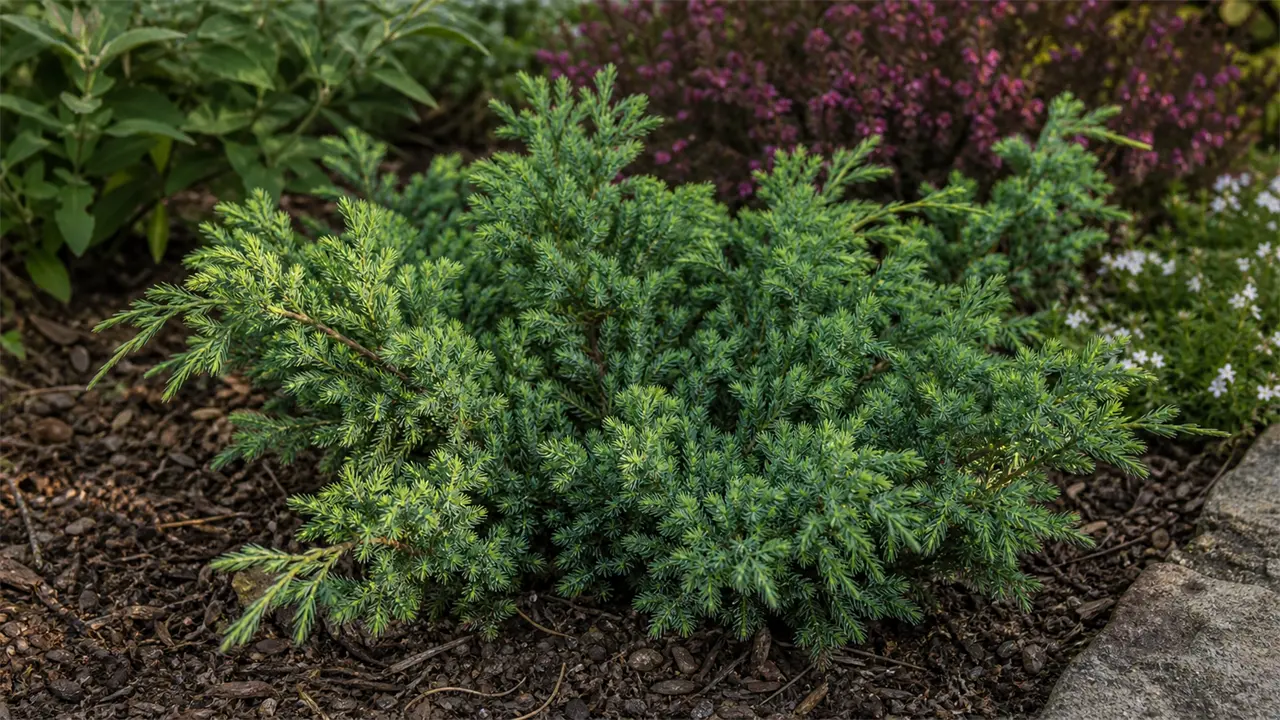
Flaky juniper is a monoecious, usually low-spreading or prostrate shrub, though upright forms exist. In the wild it may reach 3–10 m in height, but almost all commercially available forms in the UK are grafted selections held below 1.5 m, often much lower, with a horizontal spread greater than the height. The growth habit is dense, with branches radiating from a central crown and arching gently downwards at their tips under their own weight.
The foliage is borne in two juvenile forms, both awl-shaped rather than scale-like: the leaves are needle-like, 3–8 mm long, arranged in whorls of three, and pressed closely along the shoots. Their colour is the most distinctive feature of the species: a steely grey-green to bright glaucous blue, often described as silver-blue. In cold winters the foliage can take on a faint purplish-bronze cast, particularly on exposed specimens, but it greens up again in spring.
The bark is smooth and reddish-brown on young wood, becoming grey-brown with age and peeling off in vertical, papery flakes — hence "flaky" juniper. This exfoliation is most visible on older, established specimens in mid- to late summer when the outer bark loosens. The species is dioecious in its cone production: female plants bear small, rounded, fleshy berry-like cones (juniper "berries") that ripen over 18 months from green through blue-grey to dark purplish-black when fully mature. In British cultivation, however, the named cultivars are predominantly male clones selected for foliage, and berry production is uncommon.
Growing Conditions
Flaky juniper is a hardy, sun-loving conifer that performs best in an open, unshaded position where the foliage can dry quickly after rain. It is notably intolerant of shade and of stagnant, poorly drained soil, both of which encourage fungal dieback and lower-branch loss. In the UK it tolerates exposure well, including cold easterly winds and salt-laden coastal gales, making it a sound choice for exposed coastal and hill gardens where many other evergreens fail.
Soil type is flexible. Flaky juniper accepts loam, sandy loam, and even quite thin, stony ground over chalk or limestone, provided drainage is free. It dislikes being planted in heavy clay that holds water around the rootball in winter, and it will not tolerate waterlogged ground at any time of year. The species is tolerant of a wide pH range, including alkaline conditions, which distinguishes it from acid-loving conifers such as Picea glauca var. albertiana or most Rhododendron. Once established, plants are notably drought-tolerant and cope well with the dry summers increasingly common in southern and eastern England.
A hardy rating is held in the structured plant record; the species and its widely grown cultivars are reliably hardy throughout the UK including upland and northern areas. Container-grown specimens in small pots are more vulnerable to root freeze-thaw than plants in open ground, and benefit from being moved against a sheltered wall or into an unheated cold greenhouse during the worst winter weather in colder districts.
Planting and Care
When to plant
Container-grown flaky juniper can be planted at any time of year when soil and weather allow, but the best results come from autumn or early spring planting. Autumn planting (September to November) lets the root system establish while the soil is still warm, giving the plant a full season's root development before its first summer. Spring planting (March to April) is preferable on cold, wet, heavy soils where winter waterlogging is a risk.
Site preparation and planting
Choose a site in full sun with sharp drainage. Dig a hole roughly twice the width of the rootball and the same depth. On heavy clay, either improve the subsoil by forking in coarse grit and organic matter across a wide area, or plant slightly high so that the top of the rootball sits a couple of centimetres above the surrounding soil, grading a shallow collar out to the edges to shed water. Water the rootball thoroughly before planting, tease out any circling roots on pot-bound specimens, set the plant so the top of the rootball is level with the surrounding soil, backfill, firm gently, and water in well. A 5–8 cm mulch of bark or gravel over the rooting area, kept clear of the trunk, helps conserve moisture and suppress weeds during the first couple of seasons.
Watering
For the first full growing season after planting, water thoroughly during any dry spell of more than two or three weeks, soaking the rootball rather than sprinkling the surface. After establishment, flaky juniper is highly drought-tolerant and additional irrigation is rarely needed except on the very lightest, most free-draining soils in long summer droughts.
Feeding
Flaky juniper is a light feeder. A single annual application of a balanced slow-release fertiliser in early spring, or a top-dressing of well-rotted garden compost or leafmould spread over the rooting area, is sufficient. Avoid heavy nitrogen feeds that produce soft, late growth vulnerable to winter damage and to Phomopsis blight.
Pruning
Junipers do not respond well to hard pruning into old wood that has no green growth, so shaping should be done while the plant is young and the cuts can be kept within leafy growth. Light, formative pruning to shorten wayward shoots and maintain a tidy outline can be carried out in late spring or early summer, once the new flush of growth has begun to firm up. Do not shear with hedge clippers, which will brown the cut foliage; instead, use secateurs or short-handled shears to make selective cuts back to a side-shoot. Dead or damaged branches can be removed at any time of year.
Propagation
Named cultivars are propagated commercially by semi-ripe cuttings in late summer, or by grafting on to seedling Juniperus chinensis rootstocks. Home propagation from cuttings is possible but slow: take 8–10 cm heel cuttings from current-season growth in August or September, wound the base lightly, dip in a rooting hormone, and insert into a 50:50 mix of peat-free compost and perlite under a closed propagator with bottom heat at 18–21°C. Rooting typically takes 8–12 weeks; pot on individually once rooted and overwinter in a cold frame.
Seasonal care
In winter, watch for snow loading on prostrate cultivars, whose low, spreading habit can accumulate heavy drifts that snap branches. Brush heavy snow off promptly with a broom rather than knocking it free, which can split the framework. In mid-spring, a light top-dressing of general-purpose fertiliser and a refresh of mulch sets the plant up for the season. Container-grown specimens will need regular watering in high summer; ground-planted specimens should not need supplementary irrigation except in sustained drought. Junipers require no division, lifting, or hard annual cutting back.
Common Problems
Phomopsis and Kabatina tip blight
The two most serious fungal problems of juniper are Phomopsis juniperovora and Kabatina juniperi, both of which cause shoot tips to turn brown and die back, typically in late spring or after wet weather. Phomopsis attacks current-season growth; Kabatina tends to affect slightly older shoots. Improve air circulation around the plant, avoid overhead watering, and prune out and destroy affected shoots back into healthy wood. Fungicides are available but cultural control is more reliable long term.
Root rot in wet soils
Wet, poorly drained ground allows Phytophthora and other root-rotting fungi to colonise the root system, causing general yellowing and dieback. There is no cure once the rootball is heavily infected; prevention through sharp drainage is the only effective measure.
Pests
Flaky juniper is largely free of insect pests in the UK. Occasionally juniper scale (Carulaspis juniperi) appears on congested, neglected specimens, appearing as small white or greyish scales along the shoots; treat with horticultural oil in late spring if infestation is severe. Webbing from juniper web-spinning sawfly larvae can defoliate branches in early summer in some districts; pick off colonies by hand or use a contact insecticide.
Winter bronzing and snow damage
Foliage on exposed specimens can take on a bronze or purplish tint during severe cold spells. This is a normal physiological response and the plant greens up again in spring. Heavy wet snow can splay the branches of prostrate forms; remove promptly.
Toxicity
Juniper cones ("berries") of related species are used as a culinary flavouring, but the foliage and stems of Juniperus species are not considered edible and may cause mild gastric upset if consumed in quantity. Gardeners should not assume any part of the plant is safe to eat, and foraging references should be checked species by species; the same caution applies to pets, who may show mild digestive signs if they chew significant quantities of foliage.
Popular Varieties
Several cultivars of Juniperus squamata are widely available in the UK, almost all propagated as grafted low-spreaders or ground-hugging forms. The following are real, established selections that can be sourced from British nurseries including those holding RHS Plant Finder listings.
'Blue Carpet' is one of the most widely planted prostrate forms, with a flat, dense habit and bright silver-blue foliage. It typically reaches around 30–50 cm in height with a spread of 1.5–2 m and has held an Award of Garden Merit from the RHS. It is the standard choice for covering banks, the fronts of shrub borders, and gravel gardens.
'Blue Star' is a compact, bun-shaped selection of slower growth, with intense steel-blue foliage and a mounded habit that reaches roughly 40–60 cm tall and slightly wider at maturity. It is well suited to rock gardens, troughs, and containers, and has also received an Award of Garden Merit.
'Meyeri' is one of the older, more vigorous cultivars, with strongly arching branches and bright glaucous blue foliage. It is a larger, more upright plant than 'Blue Carpet' or 'Blue Star', eventually forming a sprawling shrub of around 2–3 m tall and wide if left unpruned, and it is the form in which the characteristic flaky bark is most easily seen at eye level.
'Holger' is a low, spreading cultivar whose new growth emerges a striking sulphur-yellow against the older blue foliage, giving a two-tone effect through late spring and early summer before the new shoots mature to the usual silver-blue. It reaches roughly 50–80 cm in height with a wider spread.
'Loderi' is an older slow-growing form, more upright and narrowly conical in habit, with blue-grey foliage; it is useful where a small, columnar juniper is wanted without resorting to the larger Juniperus chinensis cultivars.
Other selections such as 'Dream Joy', 'Chinese Silver', and 'Filborna' appear from time to time in RHS Plant Finder, though availability is more restricted. Cultivar names should always be checked against current Plant Finder records when sourcing, as some older names have been superseded.
Cultivars and Varieties
| Cultivar | Height | Flower | Notes | AGM |
|---|---|---|---|---|
| 'Blue Carpet' | — | — | RHS AGM (H7) | ✓ |
| 'Blue Star' | — | — | RHS AGM (H7) | ✓ |
| 'Holger' | — | — | RHS AGM (H7) | ✓ |
Pests and Diseases
| Problem | Symptoms | Management |
|---|---|---|
| Phytophthora root rot | Foliage turns brown and wilts rapidly due to waterlogged, poorly drained soil. | Plant in free-draining soil and avoid overwatering to prevent fungal infection. |
| Juniper scale insects | Small, immobile bumps appear on stems and needles, often accompanied by sticky honeydew. | Prune out heavily infested branches or treat with horticultural oil in early spring. |
| Conifer red spider mite | Foliage becomes dull, bronzed, or speckled with fine webbing visible on dry days. | Water the base of the plant regularly to increase humidity and deter mites. |
| Aphids | Clusters of soft-bodied insects cluster on new growth, causing distorted shoots. | Encourage natural predators like ladybirds or use a strong jet of water to dislodge them. |
| Canker | Sunken, discoloured lesions form on stems, leading to dieback of branches. | Prune out affected wood well below the lesion during dry weather. |
For step-by-step help, read Controlling Aphids Naturally. Or browse the full plant problem solver to diagnose an issue by symptom.
Recommended Products
GardenWizz earns a commission from qualifying purchases made through affiliate links on this page (including links within the article) — as an Amazon Associate, and from Thompson & Morgan via the Awin network. This does not affect the price you pay. See our disclaimer for details.