Narrow-Leaved Crocus
Crocus angustifolius
The Gardening Year
Best months in UK gardens · full planting calendar →
🖨 Printable care card (PDF)At a Glance
| Botanical name | Crocus angustifolius |
|---|---|
| Common name(s) | Narrow-leaved Crocus |
| Family | Iridaceae |
| Plant type | bulb (herbaceous perennial geophyte growing from a corm) |
| Height × Spread | 5–10 cm × 5–10 cm |
| Position | Full sun |
| Soil | gritty, poor to moderately fertile soil |
| Flowering | February–March |
| Toxicity | Potentially harmful Ornamental bulbs - not to be eaten |
| Native range | southern Ukraine and Armenia |
Crocus angustifolius, commonly known as the narrow-leaved crocus or cloth-of-gold crocus, is one of the earliest spring bulbs to flower in UK gardens. A diminutive member of the Iridaceae family native to the Caucasus, Turkey and northern Iran, it has been grown in British gardens since at least the late sixteenth century and remains a favourite for naturalising in short grass, rock gardens and alpine troughs. Its golden-yellow flowers, often flushed bronze on the outer petals, open low to the ground in late winter or early spring and reward gardeners willing to give it sharp drainage and a sunny position.
Overview
Crocus angustifolius is a cormous perennial in the Iridaceae family. Hardy across most of the UK when grown in well-drained soil, it is among the earliest crocuses to flower, often opening in February in mild southern districts and continuing through April further north or in cooler seasons. The species is botanically distinct from the more familiar Dutch crocus hybrids (Crocus vernus cultivars) and from the autumn-flowering Crocus sativus, and retains a wild character that suits informal plantings.
The plant's small stature — flowers typically reach only 6–10 cm above the soil — makes it ideal for the front of borders, raised beds, gravel gardens and containers. It naturalises readily where conditions suit, gradually forming larger colonies through corm offsets and, occasionally, self-seeding. Because it completes most of its growth cycle before deciduous shrubs leaf out, it is also well suited to underplanting.
It performs reliably in sheltered gardens south of a line from the Mersey to the Humber, and with care in cooler regions such as upland Wales, northern England and central Scotland. Bulbs that sit in cold wet soil through summer are the most common cause of failure, so drainage is the single most important factor in growing this species successfully in the British climate.
Appearance
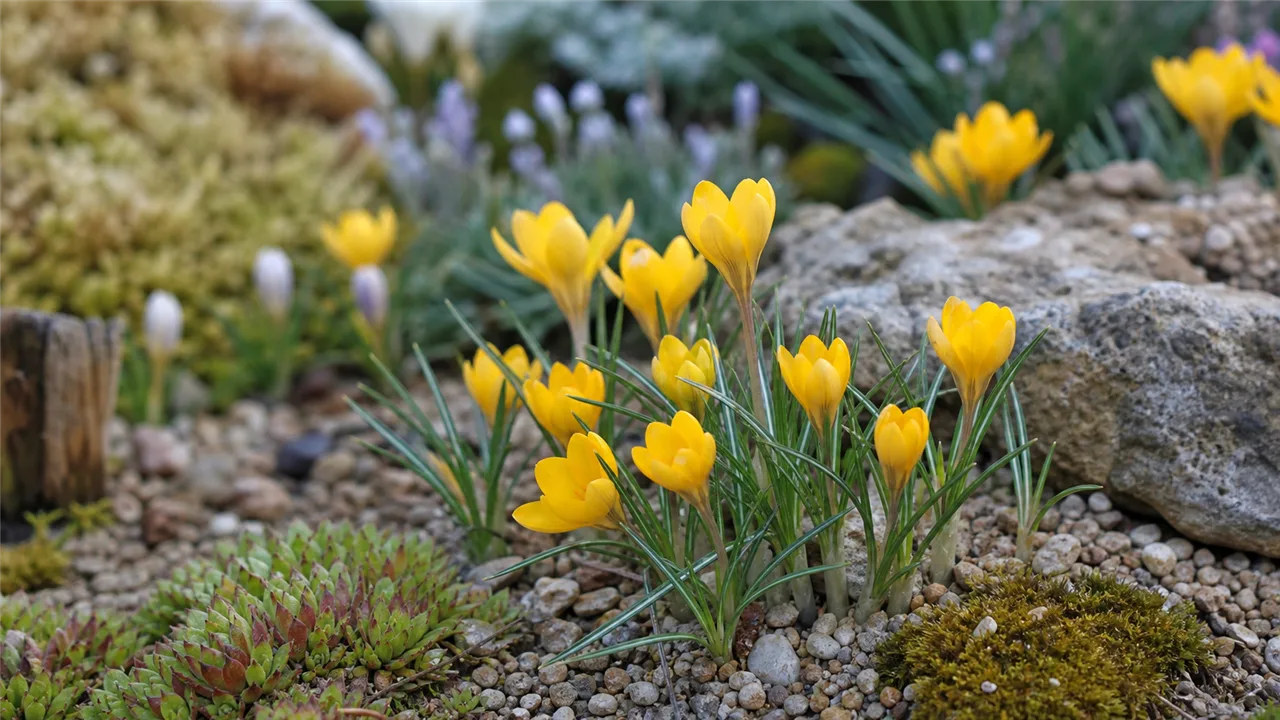
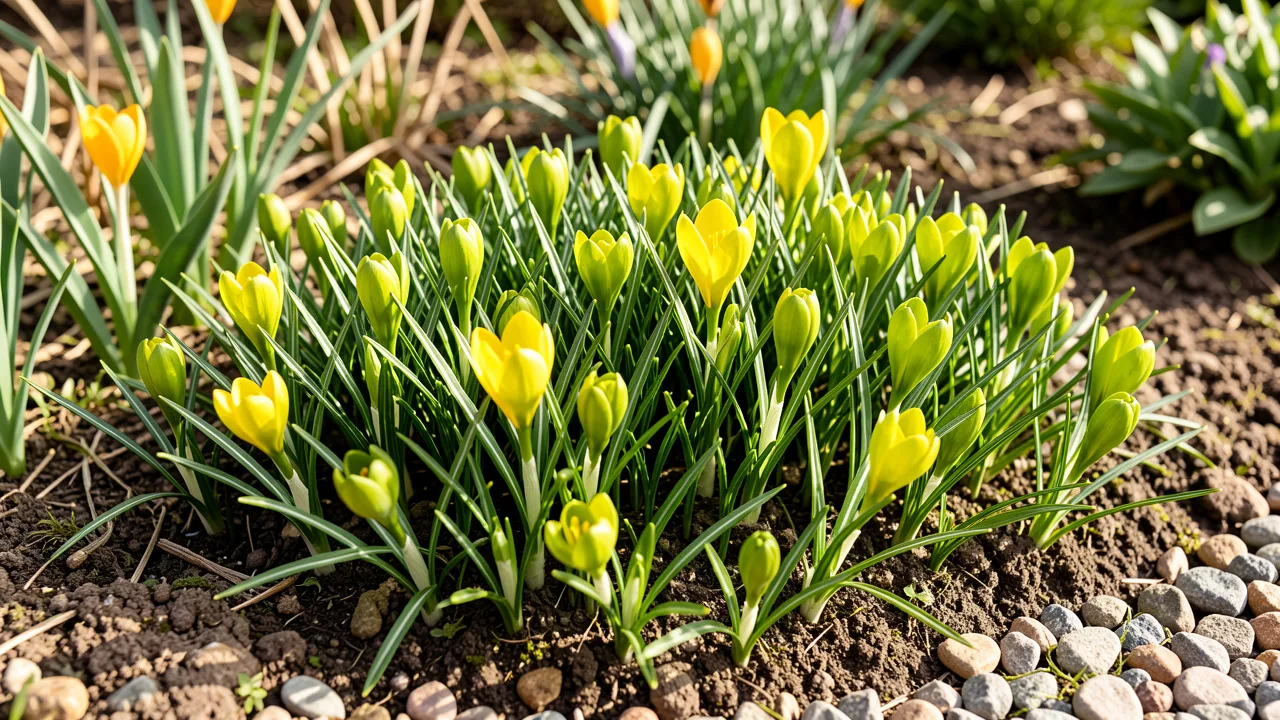
Crocus angustifolius is a compact, clump-forming geophyte reaching 6–10 cm in height when in flower. Each corm typically produces one to three flowers alongside a small tuft of leaves. The blooms are goblet-shaped and roughly 4–5 cm across when fully open, displaying a rich golden-yellow interior with a bright orange-yellow style branched into several feathery stigmas. The outer tepals carry a distinctive bronze, purple or mahogany suffusion, often appearing almost burnished in low spring sunlight, and this two-tone effect is one of the species' most recognisable features.
The leaves are narrow and grass-like, dark green with a conspicuous silvery-white central vein running their length. They appear at or shortly after the flowers and continue to grow for several weeks after the blooms fade, before yellowing and dying back in late spring or early summer. Unlike the broader foliage of Crocus vernus hybrids, the leaves of C. angustifolius are distinctly linear, giving the plant its common name.
The corm itself is small, flattened and tunicate, typically 1–1.5 cm in diameter, with a fibrous outer skin. In summer the plant enters full dormancy, with no above-ground growth visible until late winter when new shoots push through the soil.
Growing Conditions
Crocus angustifolius performs best in full sun, where the flowers open fully and reveal their inner colour. In dappled shade beneath deciduous shrubs the species still flowers reliably because the canopy is bare when the crocuses are in growth, but deeper year-round shade reduces flowering over time.
Soil must be free-draining. The species tolerates sandy loam to gritty clay loam provided surplus water drains away freely through summer and autumn. It prefers neutral to slightly alkaline pH, roughly 6.5–8.0, and tolerates chalky substrates — useful on the limy soils common across much of southern and eastern England. Wet, humus-rich or acidic ground should be improved with sharp sand, fine gravel or horticultural grit before planting, and on heavy clay it is often simpler to raise the bed or grow in containers.
In aspect, south-, west- or east-facing sites are all suitable. North-facing borders are usually too cold and shaded for reliable flowering, although the species will persist in such positions if the soil is gritty and competition from larger perennials is kept in check. Good air movement around the foliage helps the leaves dry quickly after rain, reducing the risk of fungal problems.
The plant has an assigned hardiness rating, displayed by the plant profile badge; the rating confirms its suitability for outdoor cultivation throughout most of the UK, but in practice the limiting factor for British gardeners is more often summer wetness than winter cold.
Planting and Care
Crocus angustifolius is planted as dry dormant corms in late summer or early autumn, ideally between late August and late September while the soil is still warm. This allows the corms to develop roots before winter and flower at their natural time the following spring. Corms offered for sale later in autumn will still establish, but flowering in their first spring may be reduced. Corms should be planted 8–10 cm deep, measured from the base of the corm to the soil surface, with the pointed growing tip uppermost. Spacing of 5–8 cm gives an immediate group effect and allows space for offsets to develop over the following years. Plant in drifts of at least 10–25 corms rather than as single specimens for visual impact.
Watering is rarely needed once established. Natural rainfall in autumn and spring is sufficient across most of the UK; additional irrigation should be avoided during summer dormancy because it encourages corm rot. In containers, pots dry out faster and should be kept just moist from autumn through late spring, then moved to a shaded spot and allowed to dry off in summer to mimic the plant's natural cycle.
Feeding is light. A small handful of bonemeal or a low-nitrogen bulb fertiliser worked into the soil at planting time is usually adequate for the first two seasons. In subsequent years, a light top-dressing of the same fertiliser, or a sprinkle of wood ash in late winter, supports flowering. High-nitrogen lawn feeds should be kept away from naturalised drifts, as lush leaf growth at the expense of flowers is the usual result.
Pruning is not applicable to this species — the foliage must be allowed to die back naturally over a minimum of six weeks after flowering to replenish the corm for the following year. Tying, braiding or cutting the leaves while still green will weaken the corms and reduce flowering in subsequent seasons. If the plants are naturalised in grass, the first cut should be delayed until at least six weeks after the flowers fade, and ideally longer.
Propagation is straightforward by division of established clumps. Lift congested clumps in summer, once the foliage has fully died back, separate the corms and replant the largest immediately at the same depth. Smaller offsets can be grown on in a nursery bed for a further year. Crocus angustifolius can also be raised from seed, although seed-raised plants take three to four years to reach flowering size and will not come true to type where several crocus species are grown in proximity.
Seasonal care in the UK is largely hands-off. In autumn, mulch lightly with gravel or coarse sand rather than organic compost, which can retain too much moisture around the corms. In spring, watch for slug damage on emerging shoots in damp seasons. After flowering, leave the plants undisturbed until the foliage has yellowed completely.
Common Problems
Corm rot, caused by Fusarium and Penicillium species, is the most frequent problem in UK gardens and almost always traces back to poor drainage or damaged planting stock. Affected corms become soft, discoloured and develop a white or pinkish fungal growth. Prevention is more effective than cure: improve drainage, plant only firm healthy corms and avoid sites where summer water collects.
Crocus fire, caused by the smut fungus Ustilago violacea, produces distorted leafless flower spikes carrying masses of dark spores. It is uncommon but occasionally seen in long-established plantings. Infected plants should be lifted and destroyed, not composted, and the area should not be replanted with crocuses for at least two seasons.
Aphids may colonise young shoots and flower buds in mild springs, distorting growth and transmitting virus diseases. A sharp spray of water or insecticidal soap is usually sufficient. Persistent infestations in container-grown stock may warrant replacing the compost and corms.
Mice and voles excavate and eat corms in autumn and winter, particularly in rural gardens. Where damage has occurred previously, plant corms within a wire-mesh cage or line the planting hole with fine-gauge mesh. Squirrels also dig up freshly planted corms while caching, so covering the area with chicken wire until foliage emerges in spring is a sensible precaution.
Sparrows and other small birds occasionally peck at flowers in cold weather, sometimes damaging them significantly. This is a minor and largely cosmetic problem and rarely justifies intervention.
Popular Varieties
Crocus angustifolius has a smaller named-cultivar range than many popular garden bulbs, but several distinct selections are commercially available and a small number of closely related taxa are commonly grouped with it in catalogues. The Royal Horticultural Society lists a handful of formally registered cultivar names.
'Bronze Beauty' is a selected form with a particularly pronounced mahogany-bronze suffusion on the outer tepals, deepening the two-tone effect for which the species is prized. It is otherwise identical to the species in habit and cultivation, and is the most widely grown named selection in UK bulb lists.
'Berlin Gold' was raised from Crimean-collected seed and is noted for producing larger, more uniformly deep-yellow flowers than typical wild stock, with the bronze outer flush reduced to a faint ghosting rather than the more usual bold banding.
'Minor' is a dwarf selection, with flowers and foliage roughly two-thirds the size of the species. It is well suited to alpine troughs, raised beds and other small-scale plantings where the full-size plant would look out of proportion, and it flowers a few days earlier than typical C. angustifolius.
'Alionka' is a modern Latvian selection named by bulb breeder Jānis Rukšāns. It carries slightly paler, lemon-yellow blooms with a clear silvery sheen on the outer tepals and has proved a reliable garden plant on well-drained soils.
'Oreanda' is another Rukšāns introduction, selected from wild stock collected near Oreanda in Crimea. It is a robust, free-flowering form with particularly dark bronze outer markings and is among the more widely available named cultivars in specialist bulb lists.
Crocus angustifolius var. floribundus produces a slightly larger and more prolific flower, often carrying two or three blooms per corm rather than the more typical one to two. It is a useful choice for naturalising where a more substantial display is desired.
Crocus × luteus 'Golden Yellow', the cloth-of-gold crocus, is a long-established hybrid between C. angustifolius and C. flavus and is sometimes listed under either parent. It carries large, uniform deep-yellow flowers without the bronze outer flush, and naturalises vigorously in well-drained British gardens.
Crocus olivieri subsp. balansae is a closely related species sometimes grouped with C. angustifolius in older catalogues. It produces smaller, more intensely orange-yellow flowers and is worth growing in an alpine house or bulb frame where its delicate constitution can be appreciated.
Pests and Diseases
| Problem | Symptoms | Management |
|---|---|---|
| Vine weevil | Irregular notches on leaf margins from adults; sudden wilting and death caused by larvae eating roots. | Hand-pick adults at night or apply biological nematodes to the soil in late summer. |
| Powdery mildew | White powdery mould appears on leaves, stems, and buds, particularly affecting young growth. | Ensure good air circulation and avoid dry roots with damp stagnant air around the foliage. |
| Slugs and snails | Irregular holes chewed in leaves and flowers, often accompanied by slimy trails. | Use physical barriers like copper tape or apply iron phosphate-based pellets to control populations. |
| Corm rot | Corms become soft, mushy, and discoloured, often leading to plant failure to emerge. | Plant in well-drained soil and avoid waterlogging, especially during the dormant period. |
| Aphids | Clusters of small soft-bodied insects on new growth, potentially causing distorted leaves. | Encourage natural predators like ladybirds or use a strong jet of water to dislodge them. |
For step-by-step help, read Controlling Aphids Naturally, Dealing with Slugs and Snails and Treating Powdery Mildew. Or browse the full plant problem solver to diagnose an issue by symptom.
Recommended Products
GardenWizz earns a commission from qualifying purchases made through affiliate links on this page (including links within the article) — as an Amazon Associate, and from Thompson & Morgan via the Awin network. This does not affect the price you pay. See our disclaimer for details.