Bukhara Iris
Iris bucharica
The Gardening Year
Best months in UK gardens · full planting calendar →
🖨 Printable care card (PDF)At a Glance
| Botanical name | Iris bucharica |
|---|---|
| Common name(s) | Bukhara Iris |
| Family | Iridaceae |
| Plant type | bulb (Herbaceous perennial) |
| Height × Spread | 20–40 cm × — |
| Position | Full sun |
| Soil | Well-drained neutral or slightly alkaline soil |
| Flowering | March–May |
| Toxicity | Harmful if eaten |
| Native range | Afghanistan, Tajikistan and Uzbekistan |
Iris bucharica, commonly known as the Juno iris or Bukhara iris, is a bulbous perennial in the family Iridaceae. Native to the rocky slopes of Central Asia — including the Pamir-Alay range, parts of Uzbekistan, Tajikistan and northern Afghanistan — it has become a valued early-spring flowering subject in UK gardens, where its tolerance of cold winters and dry summers suits the typical British climate surprisingly well. It holds the Royal Horticultural Society's Award of Garden Merit (AGM), reflecting its reliable performance in British conditions.
Overview
Iris bucharica belongs to the subgenus Juno, a group of irises distinguished by their bulbous storage organs (rather than rhizomes), fleshy storage roots and channeled, distichous leaves arranged like a fan. Unlike the more familiar bearded or Siberian irises, Junos are uncommon in British gardens and prized by collectors for their unusual growth habit and early, often delicate flowers. I. bucharica is among the easier and most widely grown members of its subgenus, and remains the most reliable Juno iris for general garden cultivation in the UK.
In British gardens the plant behaves as a winter-grower: bulbs root down in autumn, foliage emerges in late winter, flowers appear in mid-spring, and the entire plant goes dormant by midsummer. This rhythm matches the natural wet/dry cycle of much of the UK — cool moist springs followed by drier summers — and is the principal reason it succeeds here.
Appearance
Iris bucharica grows 30–45 cm tall at flowering, with bright green, glossy, lance-shaped leaves arranged in two opposing ranks along a short stem. The leaves are deeply channeled, somewhat fleshy and noticeably broader than those of typical bearded irises. They remain attractive throughout spring and die back naturally as the plant enters summer dormancy; in very mild winters in southern or western Britain a small rosette may persist into the new year.
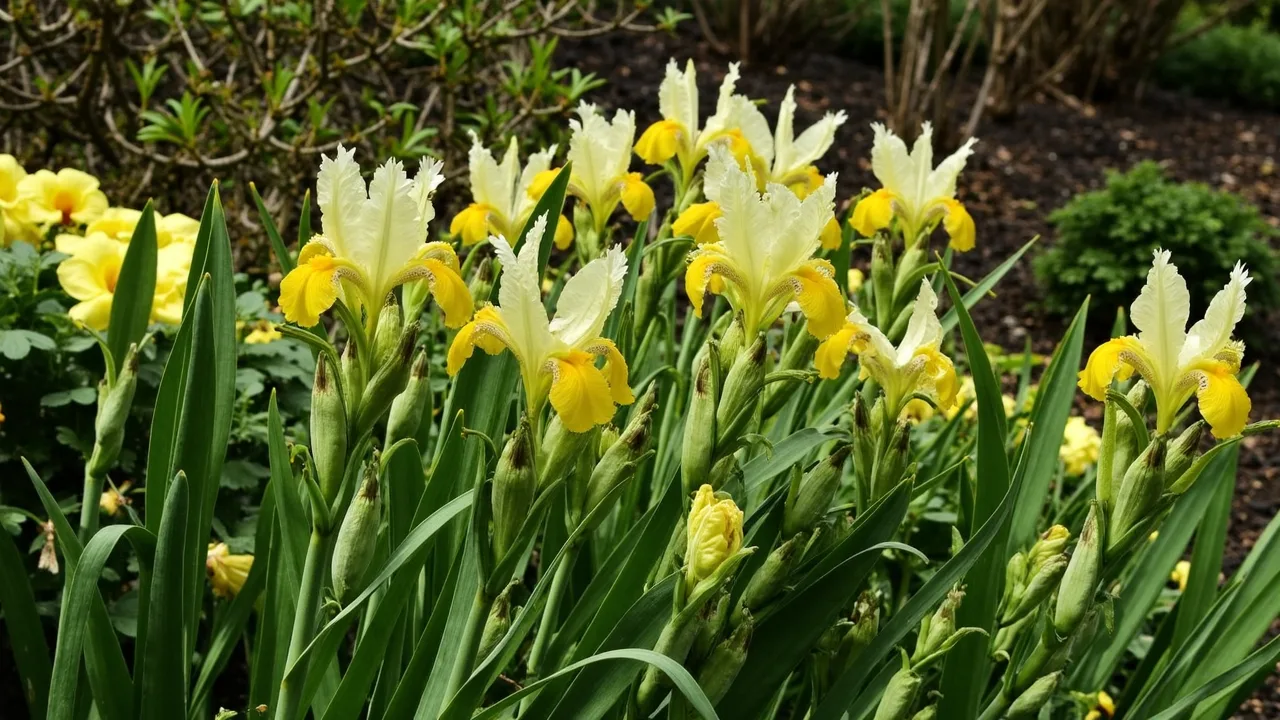
Flowers appear in April or May, with two to four carried per stem. The structure is typical of Juno irises but inverted in emphasis compared with bearded irises: the falls (outer tepals) are large, broad and showy, while the standards (inner tepals) are much reduced, narrow and often horizontal or drooping, giving the bloom a distinctively open, slightly untidy silhouette. Colour in the type form is creamy white to pale primrose, with a vivid golden-yellow central blaze on each fall. A faint, sweet fragrance is present in warm conditions.
Beneath the soil the plant forms a tunicate bulb with thick, fleshy contractile roots that pull the bulb deeper as it matures. These roots are easily damaged when plants are lifted or divided, which is why established clumps resent disturbance. Offsets form around the mother bulb, allowing slow colonisation of an undisturbed site over several years.
Growing Conditions
Iris bucharica is grown successfully in many UK gardens, but the linked plant record does not carry a confirmed RHS hardiness code. Give it a sunny, sharply drained position and check the current RHS profile for the latest rating. In colder inland or upland gardens, a dry mulch of straw or bracken can be applied once the ground has frozen.
The plant demands sharp drainage. In its native habitat it grows on stony hillsides and scree, where meltwater passes quickly through the root zone and summer drought is severe. In cultivation the closest equivalents are rock gardens, raised beds, gravel gardens, sunny berms and the front edge of well-drained borders. Sandy or gritty loam is ideal; heavy clay is unsuitable unless dramatically improved with coarse grit and organic matter, or replaced wholesale in a raised bed.
Aspect should be open and sunny for at least half the day. Light dappled shade, as found under deciduous shrubs before they leaf out, is tolerated and can extend the flowering display slightly. Soil pH is not critical, though neutral to slightly alkaline conditions suit it best. The plant is notably drought-tolerant once established, particularly during its summer dormancy, and will not survive waterlogged conditions at any time of year.
In garden design terms, I. bucharica is well suited to Mediterranean- or steppe-style plantings alongside other drought-tolerant bulbs and perennials — crocuses, tulips of the Tulipa sylvestris group, Eryngium, Stipa and silver-leaved Artemisia — and to troughs and containers where drainage can be precisely controlled.
Planting and Care
Planting time and depth. Bulbs are best planted in late summer or early autumn, ideally August to September, so they can establish roots before the first hard frost. Plant bulbs 10–12 cm deep, measured from the base of the bulb to the soil surface, and 10–15 cm apart. In heavier soils, plant slightly more shallowly (around 8–10 cm) and add a generous layer of coarse grit beneath and around each bulb to assist drainage.
Watering. Once planted, water in well to settle the soil. Through autumn and winter, natural rainfall is usually sufficient. During active growth in spring, water sparingly only if the soil becomes genuinely dry — overwatering at this stage can rot the fleshy roots. Once foliage begins to yellow in late spring or early summer, withhold water entirely and allow the plant to dry out; this rest period is essential for reliable flowering the following year.
Feeding. Apply a light top-dressing of balanced granular fertiliser, or a slow-release bulb fertiliser low in nitrogen, in early spring as growth begins. High-nitrogen feeds should be avoided as they encourage soft, leafy growth at the expense of flowers and increase susceptibility to rot.
Propagation. The simplest method is division of established clumps every four to five years, carried out in late summer when the bulbs are fully dormant. Lift the clump carefully, retaining as much of the fleshy root system as possible, separate offsets by hand, and replant immediately at the correct depth. Seed can be sown in autumn in a free-draining loam-based compost; germination is erratic and may take one to two seasons, with flowering size typically reached in three to four years.
Pruning and seasonal care. No routine pruning is required. Remove spent flower stems once flowering is finished to prevent seed set (unless seed is wanted) and allow foliage to die back naturally — do not tie, braid or cut it while still green, as this prevents the bulb from rebuilding its reserves. In very exposed or cold gardens, a light dry mulch after the ground has frozen helps buffer extreme temperature swings.
Container cultivation. I. bucharica grows well in deep terracotta or stone containers, provided drainage holes are generous and a freedraining loam-based mix with added grit is used. Lift containers onto pot feet during wet winters to ensure free drainage, and move them to a sheltered spot if prolonged freezing rain is forecast.
Common Problems
The most serious threat to Iris bucharica in British gardens is bulb rot, almost always caused by excessive soil moisture around the dormant bulb in summer or waterlogged conditions in winter. The first symptom is usually yellowing and collapse of foliage in spring, followed by soft, brown bulbs when lifted. Prevention is straightforward: site the plant in sharply drained soil and avoid irrigation during dormancy.
Iris borer (Macronoctua onusta) is recorded on Junos, though it is much less common in the UK than on bearded irises. Caterpillars tunnel into leaves and down into the bulb, causing wilting and rot. Affected foliage should be removed and destroyed; in heavy infestations, lifting and inspection of bulbs in late summer is justified.
Leaf spot caused by Heteropatella umbilicata produces oval brown lesions on the leaves during cool, damp springs. It is rarely fatal but disfigures plants and can weaken bulbs over time. Improve air circulation by avoiding overcrowding, remove and destroy affected leaves, and clear old foliage from around the clump at the end of the season.
Slugs and snails can damage emerging shoots and partially open flowers in damp springs. Standard controls — beer traps, ferrous-phosphate pellets, night-time hand collection — are usually sufficient in well-drained sites where populations tend to be lower.
Mosaic virus, indicated by pale streaking or mottling of the leaves and reduced vigour, has been recorded in cultivated Junos. There is no cure; affected plants should be lifted and destroyed, and tools washed between clumps to limit spread. Aphid control helps reduce transmission.
Popular Varieties
Named cultivars of Iris bucharica are scarce in general cultivation, and the species itself is overwhelmingly the form most widely grown and the form awarded the AGM. Commercial UK bulb lists typically offer the species only, and growers seeking variation should generally look to the wider Juno group rather than expect named selections of I. bucharica specifically.
Where named forms do appear in specialist Iris nursery catalogues, they are usually raised from wild-collected Central Asian seed and given clonal names; their availability is seasonal and their naming inconsistent across European suppliers. Gardeners are advised to treat cultivar descriptions with caution and to favour bulbs obtained from established specialist growers, where provenance is documented. The RHS Plant Finder remains the most reliable source for current UK availability of both the species and any Juno selections.
For gardeners wanting greater flower size, alternative colour tones or a longer flowering period, the closest Juno relatives — Iris graeberiana (deeper blue-violet falls with a white blade), Iris warleyensis (pale lilac-blue and white) and Iris magnifica (white to pale lilac on taller stems) — are excellent companions in the same well-drained border or rock garden setting. All three share the winter-growing, summer-dormant rhythm that suits British gardens, though their individual hardiness and any AGM status should be checked against current RHS guidance before planting in colder inland sites.
Pests and Diseases
| Problem | Symptoms | Management |
|---|---|---|
| Bulb rot (Fusarium/Penicillium) | Bulbs become soft, mushy, and may show white or grey fungal growth. | Ensure well-drained soil and avoid waterlogging; discard infected bulbs. |
| Leaf spot (Cladosporium iridis) | Small, circular brown spots appear on leaves, potentially causing yellowing. | Remove affected foliage and improve air circulation around plants. |
| Slugs and snails | Irregular holes chewed in leaves and flowers, often with slimy trails. | Use physical barriers like copper tape or apply iron phosphate pellets. |
| Vine weevil | Notched leaf margins and damaged roots causing plant wilting. | Apply systemic insecticide drenches to soil in autumn and spring. |
| Powdery mildew | White, powdery fungal growth on leaves and stems. | Spray with a fungicide or milk solution; ensure good airflow. |
For step-by-step help, read Dealing with Slugs and Snails and Treating Powdery Mildew. Or browse the full plant problem solver to diagnose an issue by symptom.
Recommended Products
GardenWizz earns a commission from qualifying purchases made through affiliate links on this page (including links within the article) — as an Amazon Associate, and from Thompson & Morgan via the Awin network. This does not affect the price you pay. See our disclaimer for details.