Orchid Iris
Iris histrioides
The Gardening Year
Best months in UK gardens · full planting calendar →
🖨 Printable care card (PDF)At a Glance
| Botanical name | Iris histrioides |
|---|---|
| Common name(s) | Orchid Iris |
| Family | Iridaceae |
| Plant type | bulb |
| Height × Spread | 15–85 cm × 10–50 cm |
| Position | Full sun, Partial shade |
| Soil | well-drained neutral or slightly alkaline soil |
| Flowering | January–February |
| Toxicity | Harmful if eaten. Wear gloves and other protective equipment when handling. |
| Native range | Turkey |
Overview
Iris histrioides is a low-growing bulbous iris native to the rocky slopes and pinewoods of north-central Turkey, where it grows at altitudes of roughly 1,000–1,500 m. It belongs to the subgenus Hermodactyloides (the reticulate or "Reticulata" irises), a group of small, early-flowering species that push up through winter cold on short stems and complete their above-ground cycle before the trees leaf out. Of all the species in this group, I. histrioides is the largest-flowered and, in many ways, the most rewarding for UK gardens, producing flowers that open reliably in late winter even when planted in ordinary garden soil in the open border.
Botanically it was separated from the closely related Iris reticulata by the wider standards (the three inner petals), larger falls (the three outer petals) and a preference for damper summer conditions than its drier-steppe relatives. For British gardeners the practical distinction matters less than the habit: a clump of histrioides gives richly coloured, broad-petalled blooms in February and March, on stems only 10–15 cm tall, with grassy leaves that elongate after flowering and die down by late spring. It is one of the first true flowers of the calendar year in many parts of the UK.
The species is fully suitable for UK cultivation, particularly in colder districts where its winter chilling requirement is met naturally. It is tolerant of clay, lime, partial shade and short grass, and naturalises modestly where it is happy. Its main requirement is sharp drainage during the dormant summer, a condition normally met by planting beneath deciduous shrubs or in well-drained border soil.
Appearance
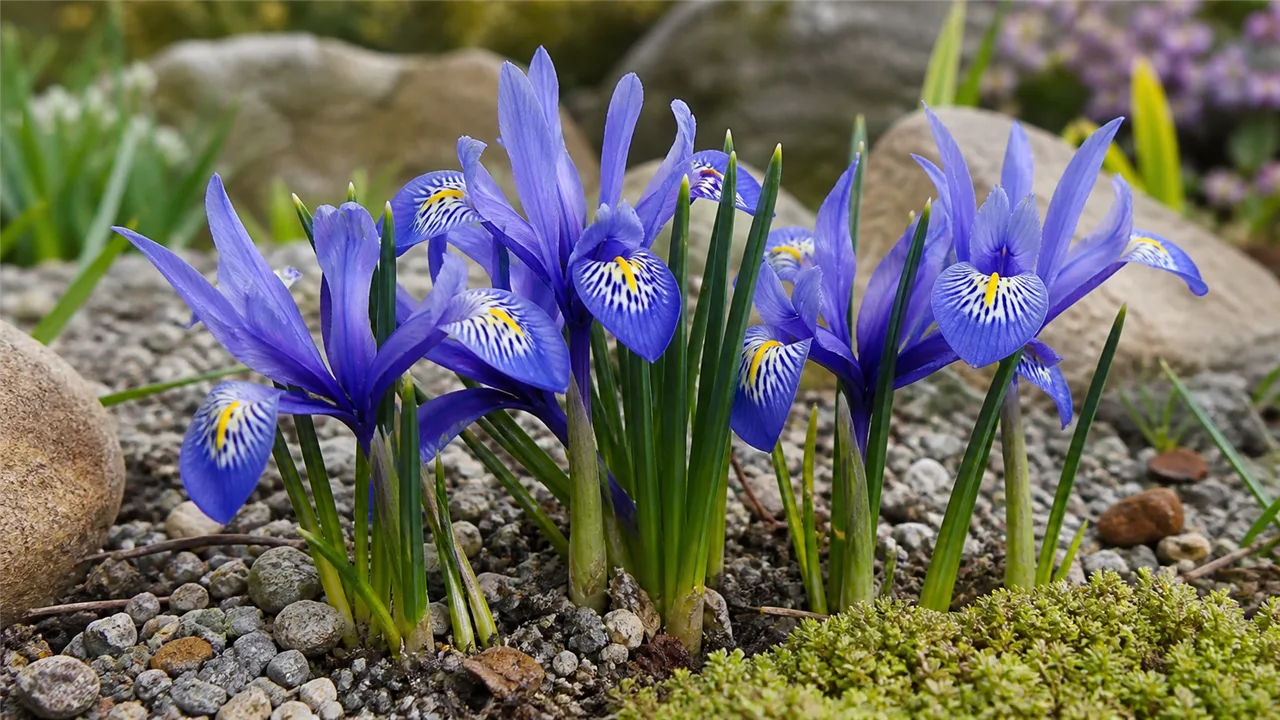
Iris histrioides forms a small bulb covered in a fine, netted (reticulate) tunic — the feature that gives the broader group its common name. Each bulb produces one or two leaves and a single flower stem. The flower is large for the genus, typically 6–8 cm across, carried flat or slightly nodding on a stem that is held above the foliage at the moment of opening.
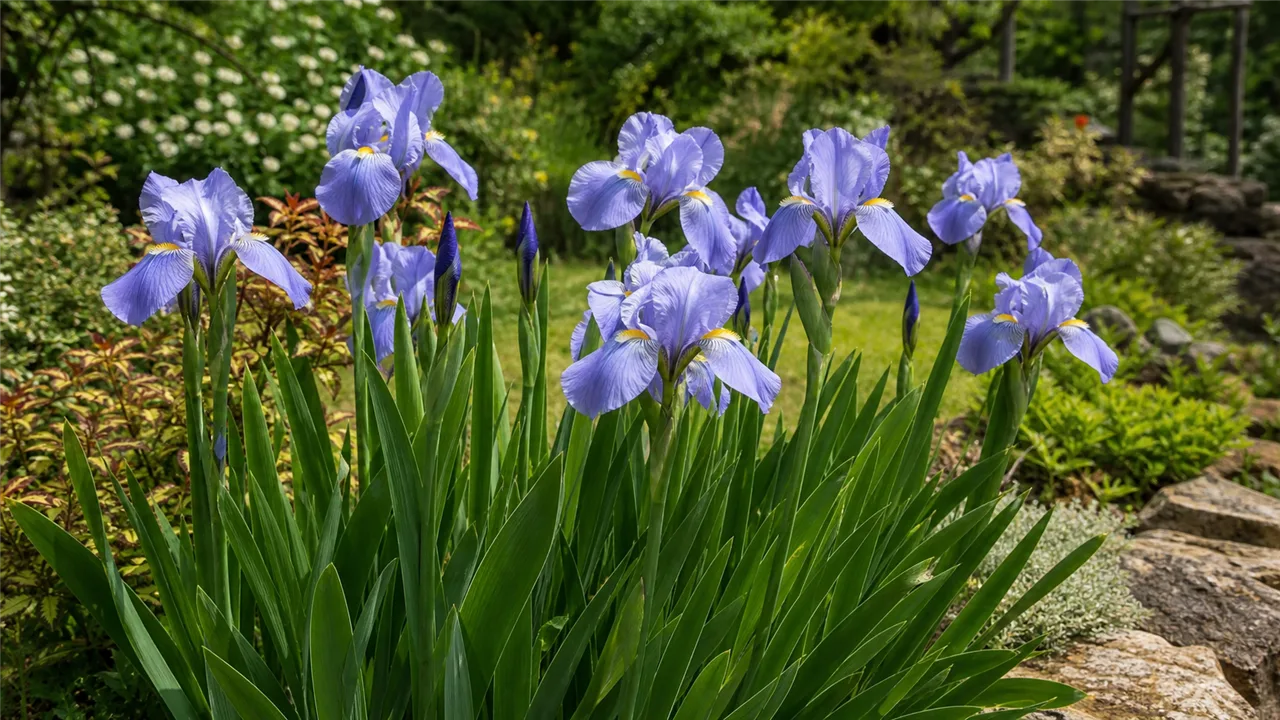
The falls are broad and rounded, often markedly ruffled at the margins, in a saturated mid-blue to violet-blue. The standards, rather than being reduced to tiny upturned bristles as in Iris reticulata, are held open and almost as large as the falls, which gives the flower a fuller, more "open-faced" appearance than its smaller cousins. The signal patch — a contrasting blotch at the tip of each fall — is white, edged and streaked with darker blue or violet. A short yellow ridge runs along the centre of the fall.
The leaves are quadrangular (four-angled) in cross-section, a diagnostic character of the reticulate irises, and emerge with the flowers. They elongate as the seedpods form and reach 20–30 cm before ripening and yellowing in May or June. The plant then goes fully dormant through summer, regenerating fresh roots in late summer from the same bulb before the next year's shoot pushes up.
Mature flowering-size bulbs are roughly 2–3 cm in diameter and produce offsets from the base, eventually forming a small cluster. Plants raised from seed take three to four years to reach flowering size.
Growing Conditions
Iris histrioides is undemanding provided its main requirement is met: a well-drained but moisture-retentive position through autumn, winter and early spring, followed by a relatively dry summer rest. In the UK this is achieved most easily by planting beneath deciduous shrubs, at the foot of a sunny wall, or in a rock garden in gritty, loam-based soil. The species tolerates a wide pH range and grows equally well in slightly acidic, neutral and distinctly chalky soils.
The bulbs prefer a position in full sun while in leaf — from late January through to May in most British gardens — and tolerate light, dappled shade from emerging tree canopies. Avoid deep shade under evergreens or in densely planted herbaceous borders, where the dormant bulbs may be over-watered by summer irrigation.
For soil, an ordinary well-cultivated garden loam is ideal; heavy clay should be improved with coarse grit and well-rotted organic matter at planting, and very sandy soils benefit from the addition of leaf-mould or compost to keep the bulbs cool in late winter. As with all reticulate irises, the bulbs resent sitting in waterlogged ground during their summer dormancy, so raised beds, slopes, or the naturally drier soil at the base of a south-facing wall are particularly suitable.
Within the UK, the species performs reliably in all regions except the very wettest western extremities of Scotland, Wales and Cornwall, where excessive summer rainfall can rot the bulbs. Cold hardiness is not a concern: the plant shrugs off hard frosts once established and the flowers tolerate light snow, opening again as it thaws.
Planting and Care
Planting
Plant bulbs in autumn, ideally from mid-September through to early November, while the soil still holds some warmth and the bulbs have time to root before winter. Set them 8–10 cm deep, measured from the base of the bulb, and 5–8 cm apart, in groups of at least ten for visual impact. For naturalising in short grass, scatter the bulbs informally and plant each one where it falls. A handful of coarse grit placed beneath each bulb helps drainage on heavier soils.
Watering and feeding
Through the growing season the soil should be kept lightly moist but never saturated. Rainfall is normally sufficient in most British winters and springs; supplemental watering is rarely needed except for container-grown bulbs, which should be kept just moist from January until the foliage starts to yellow. Once dormant, container bulbs should be allowed to dry out almost completely.
A single low-nitrogen feed in late winter — a pinch of bone meal or a slow-release fertiliser worked into the soil surface — supports strong flower production the following year. Over-feeding, particularly with high-nitrogen lawn feeds, produces lush leaves at the expense of flowers.
Seasonal care
Allow the foliage to die down naturally after flowering. Do not tie, braid or cut the leaves while they are still green, as the bulb needs to photosynthesise for several weeks after the flowers fade to rebuild for the next year's display. Deadhead spent blooms if seed-set is not wanted, but leave the stems intact until they yellow.
Propagation
Iris histrioides increases naturally by offsets and can be lifted and divided every three to four years, immediately after the foliage has died back in late May or June. Lift the clumps carefully with a fork, separate the offsets from the mother bulbs, and replant the larger bulbs immediately at the same depth. The smallest offsets can be grown on in a nursery bed for a further season or two until they reach flowering size.
Seed propagation is straightforward but slow: sow fresh seed in late summer in a gritty seed compost, keep cool and shaded, and expect germination the following spring. Seedlings are variable and will not come true to any named cultivar, so seed is useful only for the species or for adventurous hybridisers.
Common Problems
The reticulate irises are remarkably free of serious pests, but several problems do occur, particularly on heavy or wet soils.
Bulb rot is the most common cause of failure. Caused by Fusarium or Penicillium moulds, it turns bulbs soft and brown, often with white or bluish fungal growth. Prevention is by far the best cure: improve drainage, lift and discard affected bulbs, and avoid summer irrigation. Dusting stored bulbs with sulphur before replanting offers some protection.
Leaf spot — small, dark brown blotches on the leaves — can occur in wet springs but rarely affects flowering performance. Remove and bin affected foliage and avoid overhead watering.
Slugs and snails graze the emerging shoots in mild winters, sometimes reducing flower stems to tattered stubs. Standard organic controls (night collection, ferrous-phosphate pellets, copper rings) are effective.
Failure to flower in established clumps is most often due to overcrowding, premature foliage removal, or summer waterlogging. Lifting, dividing and replanting into fresh soil usually restores flowering the following season.
Bird damage is sporadic: blackbirds and thrushes occasionally peck at the blooms in hard weather. Lightly draped fleece or fine mesh discourages them where persistent.
Popular Varieties
The species itself remains the most widely grown form, but several distinct cultivars are available in the UK trade. Hybrid forms between Iris histrioides and Iris reticulata are sometimes marketed under either parent name.
'Lady Beatrix Stanley' is the best-known cultivar, distinguished by its lilac-lavender falls and paler standards. It is vigorous, increases well and has been grown in British gardens for over a century. Award of Garden Merit.
'George' has deeper, richer violet-blue flowers with a strong gold signal on the fall and a particularly large, broad shape. It is slightly later to flower than the species and is useful for extending the display by a week.
'Katherine Hodgkin' is a popular inter-specific hybrid between I. histrioides and I. winogradowii. Its flowers are pale, washed blue with intricate veining and a yellow signal. It requires sharper drainage than the pure species and is best grown in an alpine house or very gritty rock-garden pocket.
'Pauline' is a violet-purple selection with a contrasting white blotch on the fall; it closely resembles the species but is more uniform in colour when raised from offsets.
'Sheila Ann Germaney' is one of the finest pale forms, with French-grey falls and a strong orange-yellow signal; it holds its colour well in cool, dull weather.
Cultivars and Varieties
| Cultivar | Height | Flower | Notes | AGM |
|---|---|---|---|---|
| 'Lady Beatrix Stanley' | — | — | RHS AGM (H7) | ✓ |
Pests and Diseases
| Problem | Symptoms | Management |
|---|---|---|
| Bulb rot | Bulbs become soft, mushy and may emit a foul odour, often leading to plant collapse. | Ensure well-drained soil and avoid overwatering; remove and discard affected bulbs immediately. |
| Slugs and snails | Irregular holes chewed in leaves and flowers, often accompanied by slimy trails. | Use physical barriers like copper tape or apply iron phosphate-based pellets around the base. |
| Aphids | Clusters of small green or black insects on new growth and flower buds, causing distortion. | Spray off with a strong jet of water or treat with insecticidal soap if infestations are heavy. |
| Leaf spots | Small brown or purple spots appear on leaves, which may enlarge and cause yellowing. | Improve air circulation and remove affected foliage to prevent fungal spread. |
| Thrips | Silvering or bronzing of petals and leaves with tiny black specks of excrement. | Hang blue sticky traps nearby or apply a suitable insecticide during peak activity. |
For step-by-step help, read Controlling Aphids Naturally and Dealing with Slugs and Snails. Or browse the full plant problem solver to diagnose an issue by symptom.
Recommended Products
GardenWizz earns a commission from qualifying purchases made through affiliate links on this page (including links within the article) — as an Amazon Associate, and from Thompson & Morgan via the Awin network. This does not affect the price you pay. See our disclaimer for details.