Grass-Leaved Flag
Iris graminea
The Gardening Year
Best months in UK gardens · full planting calendar →
🖨 Printable care card (PDF)At a Glance
| Botanical name | Iris graminea |
|---|---|
| Common name(s) | Grass-Leaved Flag |
| Family | Iridaceae |
| Plant type | perennial |
| Height × Spread | 30–100 cm × 10–50 cm |
| Position | Full sun, Partial shade |
| Soil | well-drained neutral to slightly acid loam; tolerates clay, sand, dry or heavy soils if well-drained |
| Flowering | May–June |
| Toxicity | Harmful if eaten |
| Native range | Europe and Asia (Spain to Russia, Caucasus, Turkey) |
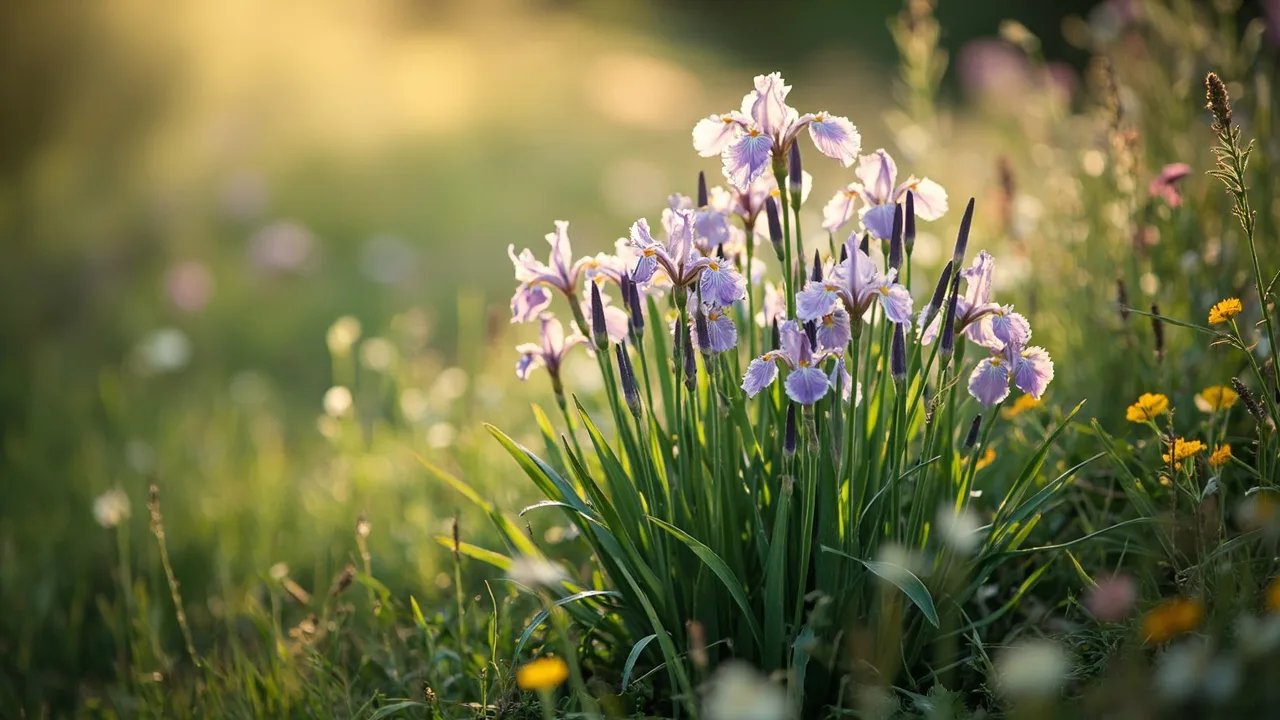
The grassy-leaved iris is a quietly distinctive European beardless species that earns its place in UK gardens not for show-stopping flowers but for the warm, ripe-plum fragrance its violet blooms release in late spring. Compact, drought-tolerant once settled, and happy in ordinary well-drained border soil, Iris graminea is the kind of plant that rewards gardeners who notice scent rather than spectacle. It is widely grown across Britain, suits sunny herbaceous and gravel plantings, and asks for very little in return beyond a periodic lift and division.
Overview
Iris graminea is a herbaceous perennial in the family Iridaceae, native to a broad sweep of central and southern Europe — from the Pyrenees eastwards through the Alps, the Balkans, the Caucasus and into Turkey, with outlying populations as far east as Iran. It grows from shallow, creeping rhizomes and forms dense, leafy clumps of narrow, grass-like foliage that remains tidy through most of the growing season. The plant has been cultivated in British gardens since at least the late sixteenth century and was already being recommended for "open airy places" in the borders by the early nineteenth century.
Its chief ornamental draw is its perfume. The flowers themselves are modest in size compared with the blowsy blooms of bearded iris hybrids, but they carry an unusually strong, fruity scent — variously likened to ripe greengage plums, sweet sherry and warm hay — that is detectable from several feet away on a still evening. This combination of grass-like leaves and unexpectedly aromatic flowers is what distinguishes the species from almost every other hardy iris, and it is the reason the plant has persisted in cultivation when so many other minor European species have faded from nursery catalogues.
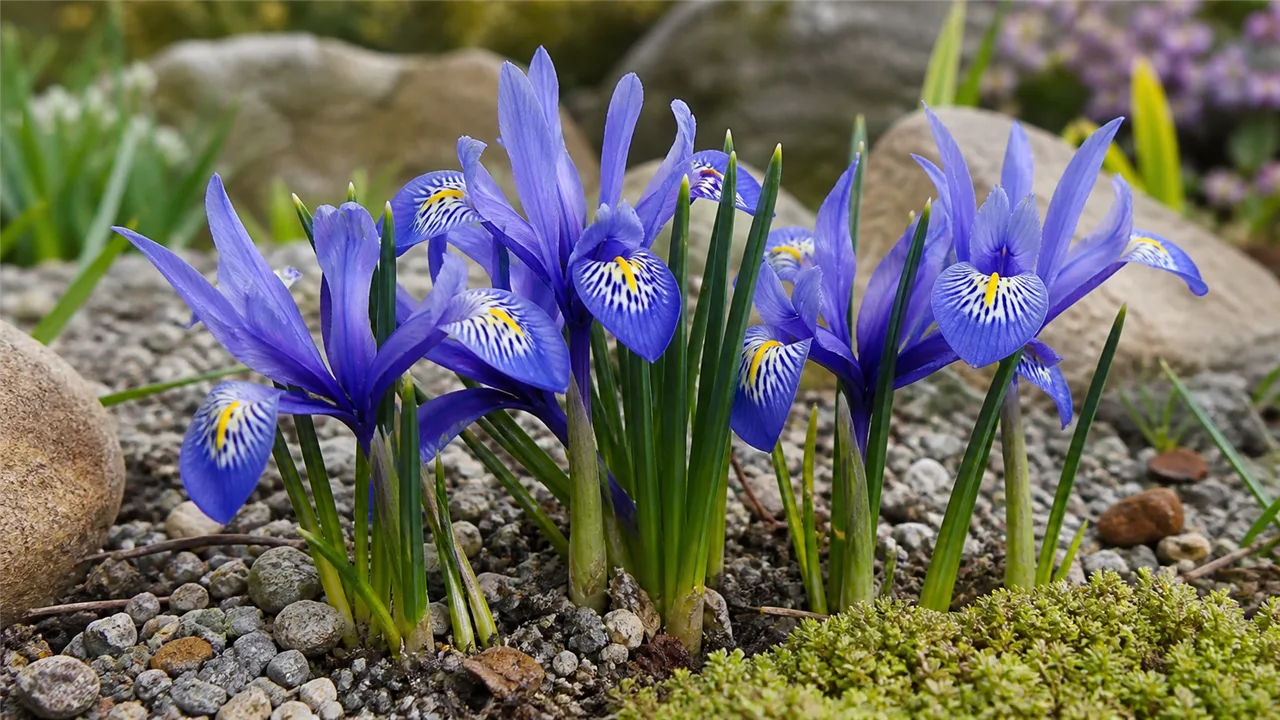
In garden use it works well at the front of sunny herbaceous borders, in rock garden pockets, in gravel gardens and in Mediterranean-style plantings alongside silver-leaved foliage plants. It is also one of the more reliable bearded-type irises for partially shaded sites, provided drainage is sharp and the rhizomes are not buried too deeply.
Appearance
The foliage is the most diagnostic feature. Leaves emerge in spring as narrow, linear, bright to mid-green blades, weakly channelled and slightly glossy, arching gently outwards from the rhizome. They reach roughly 40–60 cm at full extension on established clumps but stay narrow — typically no more than 1–1.5 cm across — giving the whole plant the air of a generous tuft of ornamental grass when out of flower. Unlike many bearded iris leaves, they do not normally die back untidily in summer; instead they remain green until cut back in late winter.
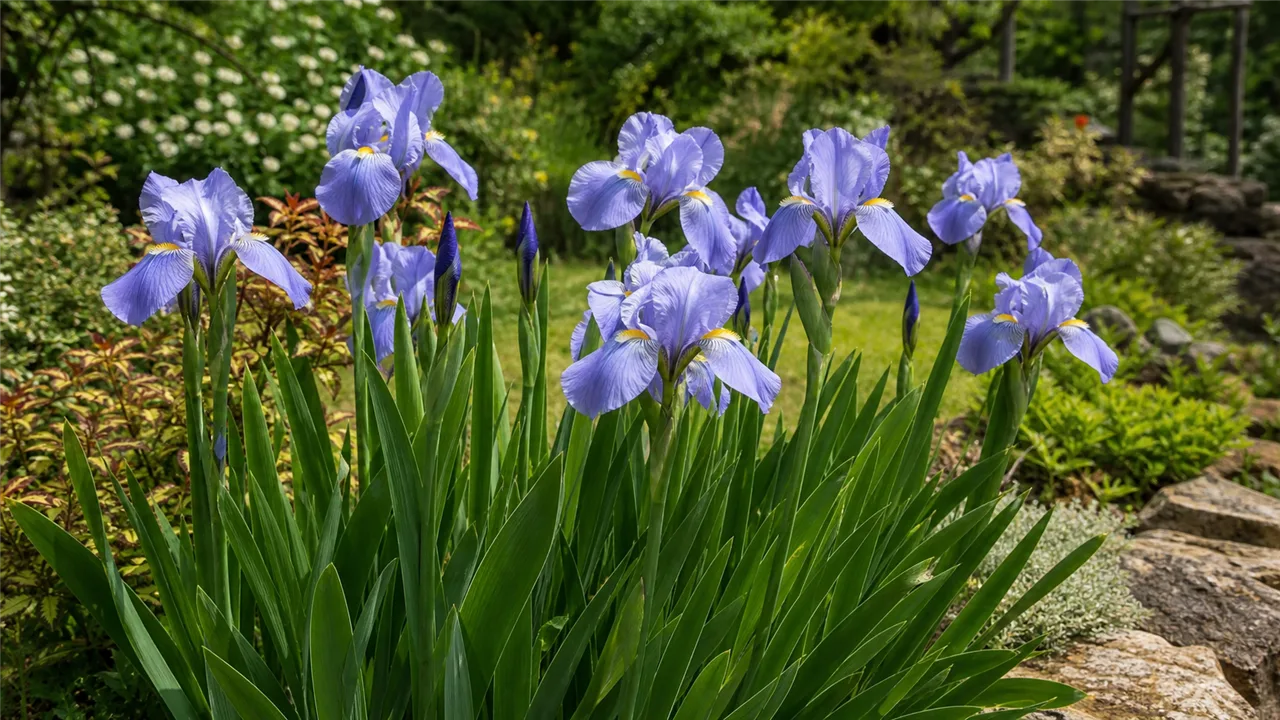
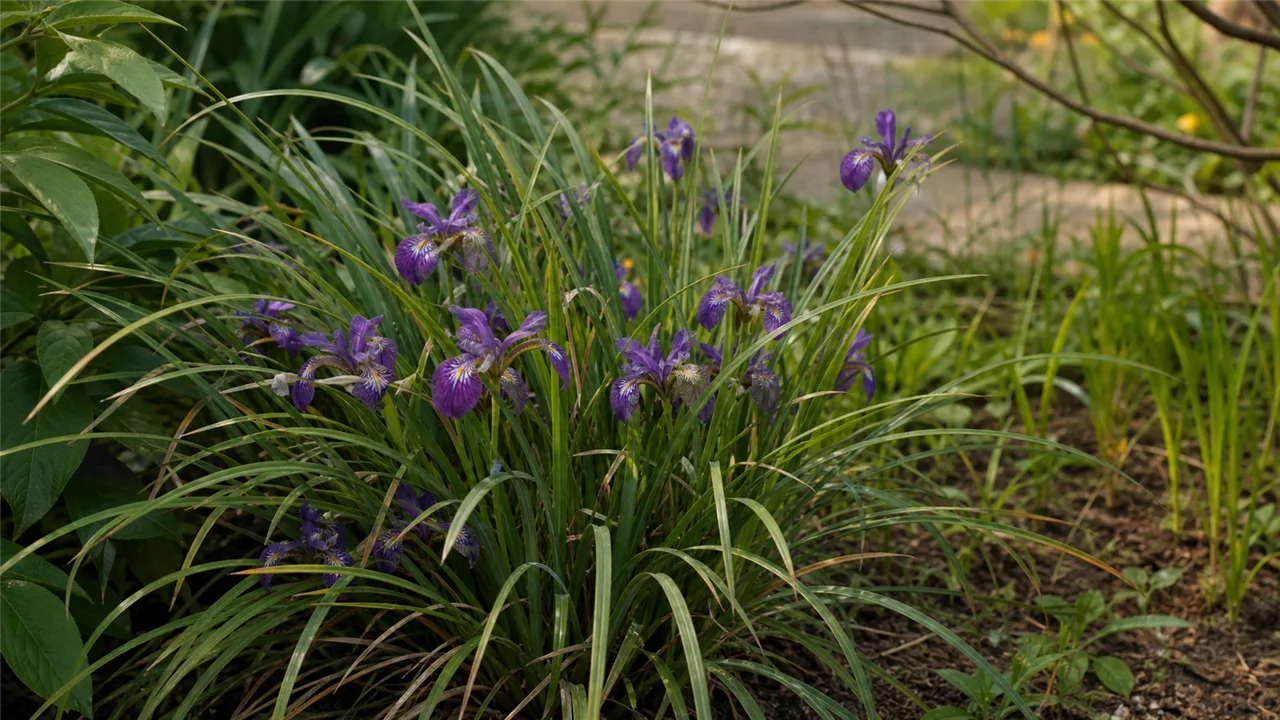
Flowering stems are shorter than the foliage, usually 20–35 cm, sometimes pressed almost flat among the leaves so that the blooms sit at foliage level rather than being held aloft. Each stem carries one or, more commonly, two flowers enclosed in a thin, herbaceous spathhe that becomes papery and translucent as the buds open. The blooms are around 6–9 cm across, with the typical iris structure of three outer "falls" and three smaller, more erect inner "standards".
Colour in the wild type is a deep violet-blue to plum-purple, with the falls veined in a slightly darker tone and a small white or pale yellow signal patch at the throat. A fine, soft beard runs along the centre of each fall. Both violet-plum and paler lilac forms occur in cultivation. The flowers are relatively short-lived individually — usually two to three days each — but a well-grown clump produces them in succession over a three- to four-week window.
The rhizomes are slender and creeping, sitting at or just below the soil surface, and they spread slowly outward to form a tight, non-invasive clump rather than the thick, hungry rootstocks of larger bearded iris cultivars. Seed capsules are oblong and triangular in section; they rarely set in quantity in UK gardens unless the weather is warm and dry at flowering time, and most propagation is done vegetatively by division.
Growing Conditions
Iris graminea is one of the easier beardless iris species for British conditions. It tolerates a wide range of soils provided drainage is adequate, and it accepts everything from a lean, gritty scree mix in a rock garden pocket to a deeper, loamy border soil that has been improved with coarse grit at planting time. It is not fussy about pH, succeeding in neutral to moderately acidic conditions and tolerating mildly alkaline substrates, although strongly alkaline clay tends to keep it too wet in winter.
The plant prefers an open, sunny site but copes well with light or partial shade, particularly where the shade is cast by midday or afternoon sun rather than deep shade under trees. South- or west-facing positions suit it best; east-facing sites that catch harsh, late frosts in April and early May can scorch the emerging flower buds. Soil moisture should be sharp-draining year-round. Wet, slow-draining ground in winter is the single most common cause of losses, because the shallow rhizomes rot quickly when they sit cold and saturated for prolonged periods. Where the native garden soil is heavy clay, building up a raised bed or planting on a south-facing slope makes a significant difference. Once established the plant tolerates summer drought very well — a useful trait in the drier southern and eastern parts of England — and the grassy foliage is moderately resistant to wind scorch.
Planting and Care
Planting is best done in autumn (September to November) or in early spring (March to early April), when the soil is workable but neither cold-saturated nor hot-dry. Container-grown plants from nurseries can go in at almost any time the ground is not frozen or parched, but autumn planting gives the rhizomes a full cool season to settle before the first summer's flowering.
Set the rhizomes very shallowly, so that the top of the rhizome and the base of the leaf fans are at or just below the soil surface — roughly 2–4 cm deep at most, with the upper surface often still visible. Deep planting is the most frequent cause of failure: rhizomes buried under 8–10 cm of soil, particularly in heavier ground, rot and fail to flower. Space clumps about 25–30 cm apart if planting in drifts; individual specimens in a rock garden can be set a little closer.
Watering is largely a first-year matter. Soak newly planted rhizomes thoroughly at planting and then water moderately during dry spells through their first full growing season to encourage deep rooting. Established clumps are essentially drought-tolerant and need no supplemental irrigation in most UK summers except during extended hot, dry periods when foliage may flag. Avoid watering directly onto the rhizome crowns during cool weather; always water around the perimeter of the clump.
Feeding should be modest and biased towards potassium rather than nitrogen. A light top-dressing of bone meal or a general-purpose fertiliser in early spring, just as new growth emerges, is ample. High-nitrogen lawn or rose feeds produce lush leaves at the expense of flowers and can encourage soft, rot-prone growth. Gardeners on very poor, hungry soils can apply a second, lighter feed immediately after flowering finishes.
Cut back old foliage in late winter (February), once the worst of the winter weather has passed but before new shoots have pushed hard. Cut the leaves cleanly to about 5–8 cm from the ground and remove all cut material from the site; do not compost it if there is any sign of leaf spot. Deadhead spent flower stems by cutting them back to the base of the stem as soon as the last bloom on a stem has faded, to keep the clump tidy.
Divide established clumps every three to five years, ideally in late summer (July to September) after flowering has finished and the current season's rhizome growth has hardened. Lift the entire clump with a fork, shake off loose soil, and either pull the rhizomes apart by hand or cut them with a clean knife into sections each carrying one or two leaf fans and a healthy length of rhizome. Discard the oldest, woodiest central portions and replant only the vigorous outer sections. Reset the divisions at the same shallow depth as before and water them in to settle the soil around the roots.
Propagation is almost always by division. Seed can be sown in autumn in a cold frame, but germination is slow and erratic, and named variants will not come true.
Seasonal care through the year is light. Mulching is best done with a thin layer of grit or fine bark rather than moisture-retaining compost, which can keep the rhizome crowns too damp in winter.
Common Problems
The biggest cause of trouble in Iris graminea is rhizome rot caused by saturated soil or deep planting, where the bacterial soft rot organisms (Erwinia carotovora and related species) turn healthy rhizomes into foul-smelling mush. Prevention — sharp drainage, shallow planting, and avoiding late-autumn mulches of dense organic matter — is far more effective than any treatment once rot has taken hold. Affected rhizomes should be lifted, cut back to clean white tissue, and replanted in improved drainage or discarded entirely.
Ink disease, caused by the fungus Mystrosporium adrustum, shows as black, ink-like spots that start on the leaves and travel down into the rhizome. It is far less common in the UK than in warmer, wetter parts of Europe, but isolated outbreaks occur in damp, crowded plantings. Prompt removal of affected foliage and improving air circulation around the clump usually check it.
Leaf spot (Aspergillus and Didymellina species) produces small brown spots with yellow halos on the foliage, particularly in warm, humid weather. It is largely cosmetic on a small clump and can be left; on larger drifts, cutting back the worst-affected leaves at the end of summer and clearing all debris helps reduce carry-over into the next year.
Botrytis (grey mould) can affect flowers and buds during cool, damp springs, blasting buds before they open. Improving air movement and removing affected blooms quickly limits its spread.
Rust (Puccinia iridis) appears as orange pustules on the leaves during warm, humid spells in late summer. It rarely damages established plants severely but is unsightly and worth managing by removing infected leaves at the end of the season.
Mosaic virus produces yellow streaking and mottling on the leaves and stunted, distorted flowering. There is no cure, and affected clumps should be lifted and destroyed (not composted) to prevent transmission by aphids to neighbouring healthy stock.
Of the pests, slugs and snails are the most damaging in British gardens, shredding young shoots in spring and disfiguring flower buds. Standard control measures — night-time hand-picking, beer traps, biological nematodes, or ferric phosphate slug pellets used according to the manufacturer's instructions — are all effective.
Aphids can colonise young shoots in late spring, particularly during warm, dry spells. They rarely cause serious damage but can transmit mosaic virus, so they are worth washing off or treating with a soft soap spray on stock plants.
Iris borer (Macronoctua onusta) is a more serious pest in North America than in the UK, where it is uncommon to rare, but it does occur on isolated sites. Caterpillars tunnel into the rhizome, allowing secondary rot to set in. Regular division and the prompt removal of any flagging clumps are the recommended responses.
Failure to bloom is usually cultural: too much shade, rhizomes buried too deep, or clumps that have become overcrowded and exhausted. Lifting, dividing and replanting shallowly in a sunnier position normally restores flowering within a season.
Popular Varieties
The species is most often grown true to type, and most named selections are subtle refinements of flower colour or form rather than dramatically different plants.
Iris graminea itself is the deep violet-blue wild type with a paler throat signal and a pronounced plum fragrance. It is the form most commonly sold and the one to plant for reliable performance.
A paler, lilac-tinted form circulates among specialist iris growers under informal names such as I. graminea 'Lilac Pink' or simply the pale form. Plants offered under these names tend to be weaker growers than the type and are not always true to name on later re-flowering.
White-flowered and very dark purple-flowered seedlings have been raised from time to time by enthusiasts and occasionally appear in nursery lists, but they are not widely available and can be difficult to source outside specialist plant society seed exchanges.
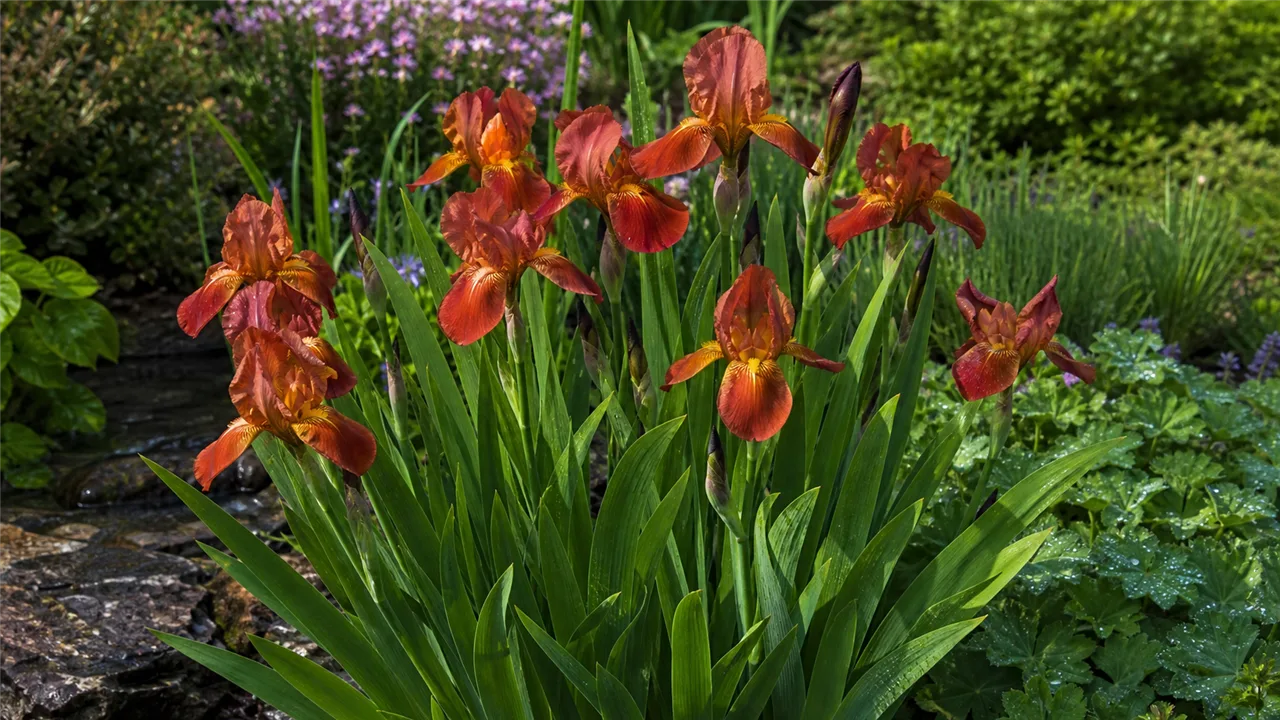
Hybrids between I. graminea and other small bearded irises — sometimes placed under the umbrella name Iris × prichardii — combine the grassy foliage and scent of the species with a wider colour range, including dusky pinks and pale blues. These crosses are charming but generally only available through specialist bearded iris nurseries and are not in mainstream garden-centre production.
For most British gardeners the species itself remains the best choice: vigorous, scented, well-behaved and reliably hardy, with no cultivar having yet displaced it as the form most worth planting.
Pests and Diseases
| Problem | Symptoms | Management |
|---|---|---|
| Bacterial soft rot | The base of the plant and rhizome become mushy, slimy, and emit a foul odour. | Cut away affected tissue with a disinfected knife, allow to dry, and ensure well-drained soil. |
| Slugs and snails | Irregular holes are chewed in leaves and flowers, often accompanied by silky trails. | Use physical barriers like copper tape or apply iron phosphate pellets to control populations. |
| Iris leaf spot | Small, dark brown or purple spots appear on the foliage, eventually causing leaves to yellow and die. | Remove and dispose of infected leaves and clear all debris at the end of the season. |
| Grey mould (Botrytis) | A fuzzy grey fungal growth appears on flowers, buds, or foliage, particularly in damp conditions. | Improve air circulation around plants and remove any dead or decaying plant material promptly. |
| Thrips | Tiny insects cause silvering, distortion, or black speckling on leaves and flower petals. | Inspect plants regularly and use blue sticky traps to monitor and reduce adult populations. |
For step-by-step help, read Dealing with Slugs and Snails. Or browse the full plant problem solver to diagnose an issue by symptom.
Recommended Products
GardenWizz earns a commission from qualifying purchases made through affiliate links on this page (including links within the article) — as an Amazon Associate, and from Thompson & Morgan via the Awin network. This does not affect the price you pay. See our disclaimer for details.