Shrubby Rock-Roses
Cistus
The Gardening Year
Best months in UK gardens · full planting calendar →
🖨 Printable care card (PDF)At a Glance
| Botanical name | Cistus |
|---|---|
| Common name(s) | Shrubby Rock-roses |
| Family | Cistaceae |
| Plant type | shrub |
| Height × Spread | 0.5–2 m × — |
| Position | Full sun |
| Soil | well-drained; poor, stony; neutral, slightly acidic or slightly alkaline |
| Flowering | May–July |
| Toxicity | No reported toxicity |
| Native range | Mediterranean region, from Morocco, Spain, Italy, Greece, through to the Middle East, and also on the Canary Islands |
Cistus, commonly called rock rose, is a genus of sun-loving evergreen shrubs grown for papery flowers and aromatic foliage. Its ability to flourish in dry, lean ground makes it especially valuable in gravel gardens, coastal plots and warm UK borders where many thirstier shrubs struggle.
Overview
The genus Cistus belongs to the rock-rose family, Cistaceae, and comprises about 20 species as well as many garden hybrids and cultivars. Most originate around the Mediterranean basin, with others native to the Canary Islands and nearby regions. They are adapted to bright sun, dry summers and thin, freely draining soils. In gardens they form low, spreading mats, rounded bushes or loose, upright shrubs.
Rock roses are particularly useful where heat and drought make conventional border planting difficult. They fit naturally into gravel and Mediterranean-style gardens, sunny banks, dry front gardens and the foot of a warm wall. Their tolerance of salt-laden air also makes many selections useful near the coast, provided they are not exposed to the strongest winds. Compact forms can grow in large containers, while broader shrubs work as informal specimens or low, loose hedges.
In the UK, success depends less on fertile soil than on choosing the right microclimate. Cistus generally performs well in mild, sunny districts and in sheltered gardens elsewhere. A south- or west-facing position helps the wood ripen and encourages abundant bloom. Winter wet is often more damaging than cold alone, so drainage and shelter are fundamental. Individual selections differ in their tolerance of exposed or colder sites; use the plant's displayed hardiness rating when matching it to a garden.
Although the plants are evergreen, they are not necessarily permanent features. Older specimens can become open and woody, and their reluctance to regrow from bare stems makes renovation difficult. Taking occasional cuttings provides useful replacements. This relatively short garden lifespan is balanced by quick establishment, low routine maintenance and a long succession of flowers.
Appearance
Cistus foliage is simple and arranged in opposite pairs. Leaf shape ranges from narrow and lance-like to oval or softly rounded. Colour varies from deep green to grey-green and silvery grey, while the surface may be smooth, softly hairy or coated in a sticky aromatic resin. The resinous scent of species such as Cistus ladanifer becomes more noticeable on warm days. Dense foliage gives younger plants a substantial evergreen presence even outside flowering time.
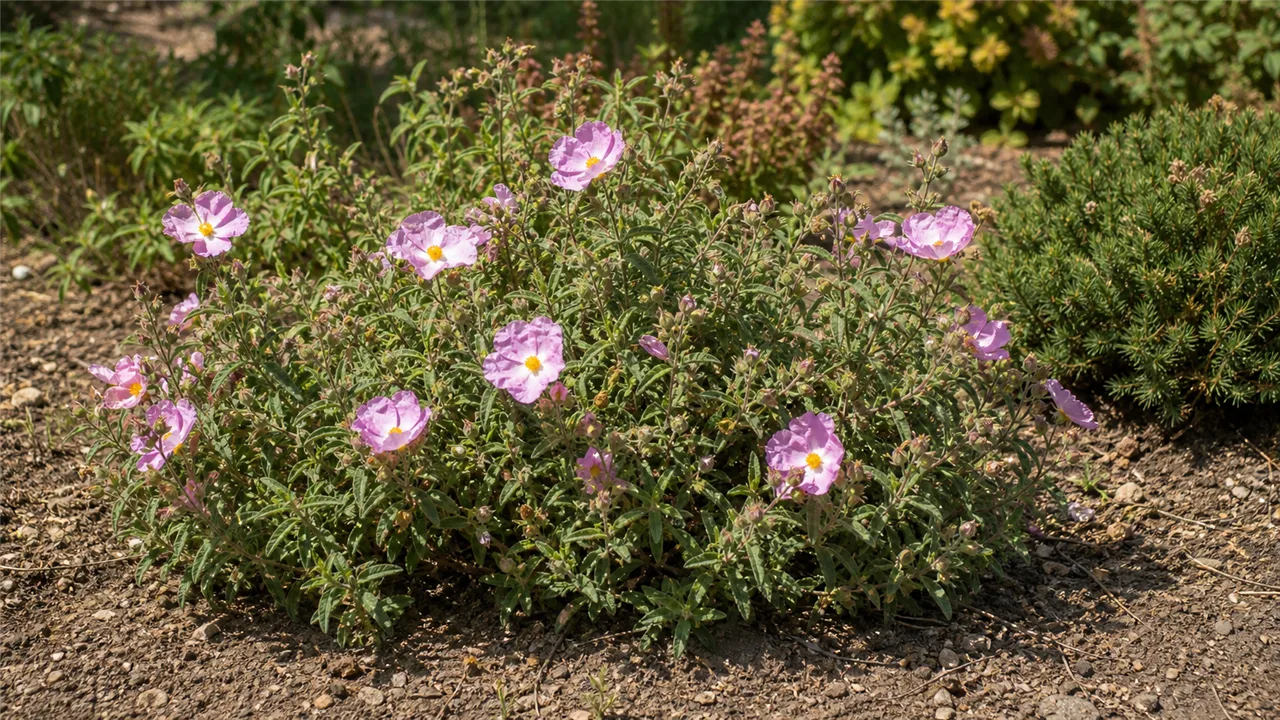
The flowers are instantly recognisable. Five broad petals form an open bowl around a conspicuous centre of golden-yellow stamens. Their crumpled texture resembles tissue paper, but the delicacy is deceptive: each flower commonly lasts only a day, then drops cleanly. Numerous buds open in sequence, producing an extended display from late spring through summer rather than a single brief flush.
Flower colour includes pure white, blush pink, clear rose, purplish pink and deeper reddish tones. Some species and hybrids carry a dark crimson or maroon mark at the base of every petal, forming a bold ring around the stamens. Flowers range from small clusters on low plants to solitary blooms around 8-10cm across on larger species. Pollinating insects visit the pollen-rich centres, and the flowers are followed by dry capsules holding many small seeds.
Habit varies considerably. Low selections may remain below 50cm while spreading close to a metre, making them effective at the front of a border or over a retaining wall. Larger species can reach around 2m and form an airy, irregular framework. The shallow-rooted branches may be vulnerable to strong wind or heavy snow, so size alone should not determine placement.
Growing Conditions
Give Cistus the sunniest available site. At least six hours of direct summer sun promotes dense growth and plentiful flowers; shade produces fewer blooms and can leave stems thin and open. A warm south- or west-facing wall is valuable in cooler regions, but an open gravel garden works well in milder districts. Avoid frost pockets, exposed hilltops and places where cold winds funnel between buildings.
Drainage is the decisive soil requirement. Sandy, gritty, stony and gravelly soils closely resemble the genus's natural conditions. A slope or raised bed is useful because excess rain moves away from the crown. Most cistus accept neutral to alkaline soil, and several tolerate chalk, but preferences differ. Cistus ladanifer and its cultivars can develop yellow foliage on strongly chalky ground, so a selection known to accept alkaline conditions is a better choice there.
Heavy clay presents the greatest challenge. Adding a little grit to one planting hole does not correct the wider drainage problem and may create a sump. Instead, plant above the surrounding level on a broad mound, use a raised bed, or choose a container. Soil should be poor to moderately fertile: rich manure and high-nitrogen fertiliser encourage lush, soft shoots that flower less freely and are more easily damaged in winter.
Established plants are notably drought tolerant. They combine well with lavender, rosemary, santolina, phlomis, sage and drought-tolerant ornamental grasses because all prefer similar conditions. Allow air and light to reach the whole shrub; stems shaded by vigorous neighbours may die back and are unlikely to refill from old wood.
For container growing, choose a substantial frost-resistant pot with generous drainage holes. A peat-free loam-based compost mixed with horticultural grit provides stability without remaining saturated. Raise the container on feet through wet weather and never leave it standing in a saucer of water. Pot-grown roots dry faster than those in open ground, so containers require more attentive summer watering despite the plant's drought tolerance.
Planting and Care
Plant Cistus in spring, ideally from March to May once the soil is workable. Spring planting gives roots a full growing season to spread before their first winter. Dig a hole no deeper than the root ball and roughly twice as wide, loosen the surrounding soil, then set the plant at the same depth as it grew in its pot. Firm gently, water thoroughly and apply a thin gravel mulch without burying the stem base. Choose the final position carefully because established plants dislike disturbance.
Water regularly through dry spells during the first growing season, allowing the surface to begin drying between waterings. The aim is steady root establishment, not constantly damp soil. Once established in open ground, plants usually need additional water only during prolonged drought. Container plants should be checked frequently in warm weather and watered deeply when the upper compost feels dry. Reduce watering sharply in autumn and winter.
Feeding should be restrained. Plants in garden soil normally need no fertiliser. If container growth weakens, apply a modest dose of balanced slow-release feed in spring rather than repeated high-nitrogen applications. Renew the top layer of compost each spring and move a congested plant into the next pot size only when necessary.
Cistus cannot be treated like a shrub that readily reshoots after renovation. In March or April, once obvious winter damage can be assessed, remove dead or broken material back only to healthy green growth. After flowering, usually between June and August, lightly pinch or trim the current season's leafy shoots to encourage a compact outline. Never cut hard into thick, bare wood. If a mature shrub becomes badly leggy or outgrows its space, replacement is more reliable than severe pruning.
Propagate named cultivars and hybrids vegetatively to preserve their characteristics. In July or August, take non-flowering semi-ripe shoots about 7-10cm long, remove the lowest leaves and insert the cuttings around the edge of a pot filled with a free-draining propagation mix. Keep them humid but not waterlogged in bright, indirect light. Rooted cuttings can be potted separately and protected during their first winter. Species may also be raised from seed, but seedlings from hybrids or cultivars are variable and should not be expected to match the parent.
Seasonal care is simple. Check for wind-rock and damaged shoots in early spring, water newly planted shrubs from spring through their first summer, and take cuttings in midsummer. Light trimming follows flowering, not winter. In autumn, clear fallen material from around the crown and confirm that pots and beds drain freely before persistent rain. Do not wrap the plant in moisture-trapping material; a dry, sheltered position is the more effective protection.
Common Problems
Cistus is generally free from serious pest trouble when grown in appropriate conditions. Poor drainage is responsible for most failures. Root or collar rot causes yellowing, wilting and progressive dieback while the soil remains wet. The stem base may darken and roots can become brown and soft. There is no dependable way to restore a badly rotted plant. Remove it, correct the drainage and avoid immediately planting another cistus in the same waterlogged pocket.
Honey fungus may occasionally attack, particularly where infected woody roots or stumps remain in the soil. Warning signs include decline that cannot be explained by drought, white fungal material beneath the bark near ground level, or honey-coloured mushrooms nearby in autumn. Remove affected plants and as much infected root material as practical; replacement planting should follow current garden hygiene guidance.
Winter damage appears as scorched foliage, split branches or dead shoot tips. Cold, wet weather, exposed positions and soft late growth increase the risk. Wait until spring before deciding which stems are dead, then cut them back to living leafy tissue. Do not respond with an indiscriminate hard prune, as bare old wood may not reshoot. Brush heavy snow gently from spreading branches where it can be done without snapping them.
Yellow leaves may indicate waterlogging, but on chalky soil they can also reflect poor nutrient availability in a lime-sensitive selection. Check drainage first. If the soil remains freely drained but chlorosis persists, replace the shrub with a cistus better suited to alkaline ground rather than repeatedly adding fertiliser. Sparse flowering usually results from insufficient sun, rich soil or overfeeding.
Crowding creates another form of dieback. When neighbouring plants shade the lower framework, leaves are lost and the exposed stems remain bare. Maintain adequate spacing from the outset and trim companions before they engulf the shrub. Aphids or other sap-feeding insects may appear occasionally on soft young growth, but natural predators usually keep them below damaging levels; routine pesticide treatment is rarely justified.
Popular Varieties
Cistus × purpureus is a compact, bushy evergreen hybrid, generally about 0.5-1m high and wide. Its summer flowers are purplish pink, up to about 8cm across, with a deep red blotch at the base of each petal. It suits sunny banks, gravel gardens and the front or middle of a sheltered border.
Cistus × pulverulentus 'Sunset' is a low, spreading choice with wavy grey-green leaves. Clusters of rose-pink, yellow-centred flowers cover a plant typically 0.3-0.5m high and 0.5-1m wide. Its broad habit is useful for edging paths, clothing a bank or spilling over a low wall.
Cistus × purpureus 'Alan Fradd' is a compact, rounded cultivar reaching about 1m high and wide. Its tissue-thin white flowers have a crimson blotch at the base of each petal and a centre of golden anthers. Plant it in full sun on sharply drained soil, where its restrained size suits a sheltered UK courtyard, gravel garden or warm mixed border.
Cistus ladanifer is the common gum cistus, a larger, loosely upright species with narrow, sticky, aromatic leaves. Large white flowers carry a dark red blotch at the base of each petal. It can reach approximately 1.5-2.5m in height and is best given a warm, sheltered position and soil that is not strongly alkaline.
Cistus ladanifer var. sulcatus is a more compact form with narrow, resinous leaves and large white flowers. It usually reaches around 1-1.5m high and wide. The foliage releases a particularly noticeable aroma in warm weather, making it effective beside a sunny path or seating area.
Cistus × dansereaui 'Decumbens' is a low, spreading hybrid, usually 0.5-1m high and potentially broader than tall. It produces white flowers marked with dark crimson near the petal bases and works well on a dry bank or at the front of a sunny border.
When choosing among them, compare final spread as carefully as flower colour. A selection that fits its allotted space can be maintained with light trimming, whereas an overlarge plant cannot safely be reduced by hard pruning. Local exposure, soil reaction and the plant's displayed hardiness rating should complete the choice.
Cultivars and Varieties
| Cultivar | Height | Flower | Notes | AGM |
|---|---|---|---|---|
| 'Gordon Cooper' | — | — | RHS AGM (H4) | ✓ |
| 'Snow Fire' | — | — | RHS AGM (H4) | ✓ |
Pests and Diseases
| Problem | Symptoms | Management |
|---|---|---|
| Root rot | Foliage turns yellow or brown and wilts despite moist soil, often leading to plant collapse. | Plant in very free-draining soil and avoid heavy, waterlogged conditions. |
| Chlorosis | Leaves turn yellow while veins remain green, particularly in acid-loving species grown on alkaline soils. | Choose lime-tolerant species for chalky soils or amend soil acidity for sensitive varieties. |
| Frost damage | New growth and stems blacken or die back after exposure to cold temperatures in frost pockets. | Site plants in sheltered positions away from frost pockets and choose hardier species for colder regions. |
| Wind damage | Shallow roots are exposed or the shrub is physically damaged by strong winds. | Provide a sheltered location to protect shallow-rooted plants from exposure. |
Or browse the full plant problem solver to diagnose an issue by symptom.
Recommended Products
GardenWizz earns a commission from qualifying purchases made through affiliate links on this page (including links within the article) — as an Amazon Associate, and from Thompson & Morgan via the Awin network. This does not affect the price you pay. See our disclaimer for details.