Cardinal Sage
Salvia fulgens · Mexican scarlet sage
The Gardening Year
Best months in UK gardens · full planting calendar →
🖨 Printable care card (PDF)At a Glance
| Botanical name | Salvia fulgens |
|---|---|
| Common name(s) | Cardinal sage, Mexican scarlet sage |
| Family | Lamiaceae |
| Plant type | shrub (Tender, short-lived perennial with a woody base; usually grown seasonally or overwintered frost-free in the UK.) |
| Height × Spread | 50–100 cm × 40–90 cm |
| Position | Full sun |
| Soil | Fertile, humus-rich, moist but well-drained soil. |
| Flowering | July–October |
| Toxicity | — |
| Native range | Mexican mountains adjacent to the state of Puebla |
Salvia fulgens, commonly known as Mexican scarlet sage or cardinal sage, is a compact, woody-based ornamental salvia from Mexico. Its brilliant scarlet flowers bring strong colour to sheltered borders and containers, particularly late in the growing season, but UK gardeners should plan carefully for winter.
Overview
Salvia fulgens is a member of the mint family, Lamiaceae, and is an accepted species rather than a hybrid. Its natural range extends through parts of central, north-eastern and south-western Mexico, where it grows as a shrub in a subtropical biome. The species has long been cultivated in Britain and has received the Royal Horticultural Society's Award of Garden Merit.
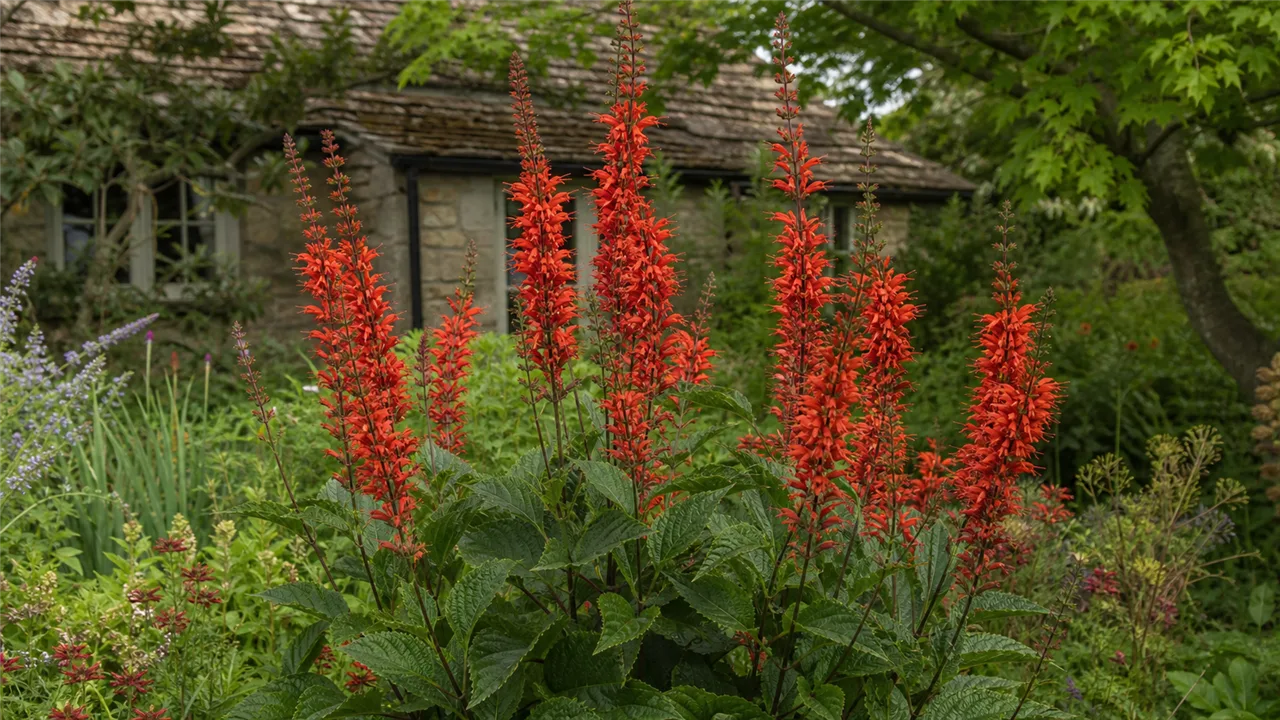
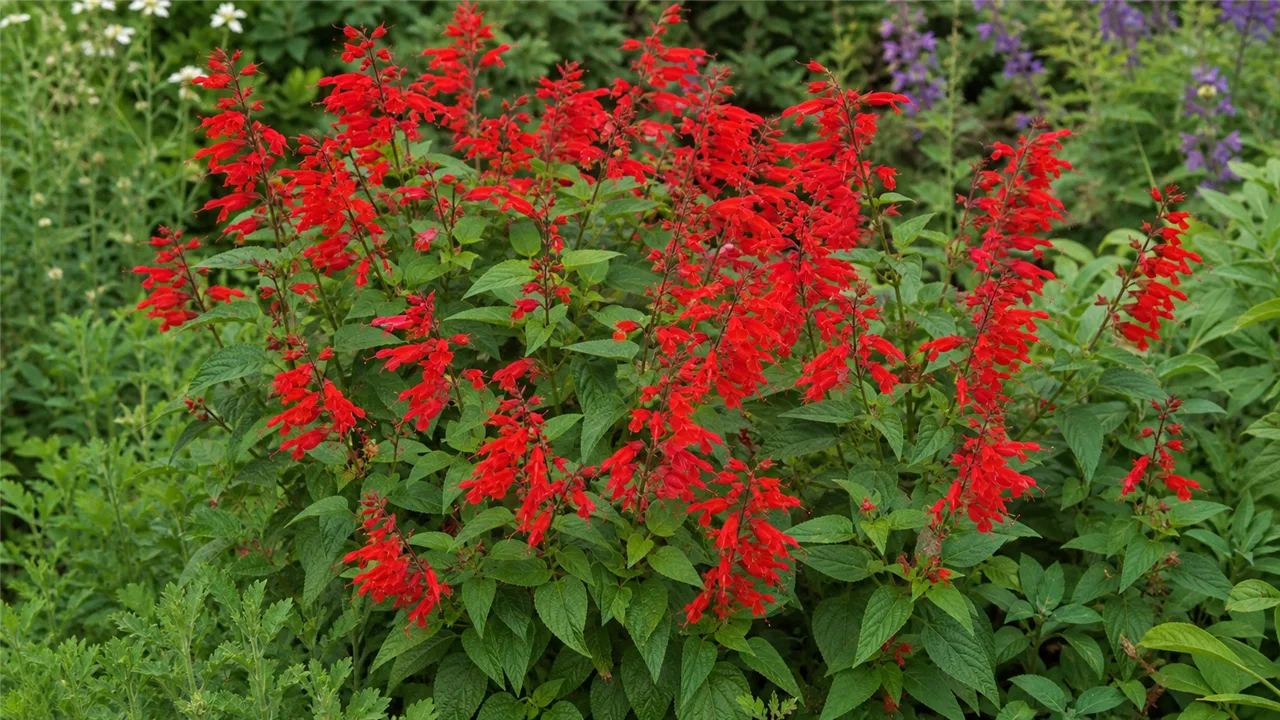
The plant's garden value lies in its unusually vivid, velvety flowers. Strong upright stems carry bright red blooms above fresh green leaves, making it useful as a focal plant among ornamental grasses, late-flowering perennials and foliage plants. The flower colour is especially effective beside deep blue, purple or white planting, while the upright racemes add vertical structure without the rigid appearance of a formal shrub.
Although sometimes called a sage, this is an ornamental species and should not be confused with culinary sage, Salvia officinalis. It is best treated as a flowering subshrub. In much of the UK, a container or a stock of overwintered cuttings provides a more dependable way to retain it than relying on an exposed border plant from year to year. In very mild, sheltered gardens with freely draining soil, established plants may persist outdoors, but local conditions and the plant's structured hardiness guidance should determine the level of protection.
Use S. fulgens in a sheltered courtyard, a sunny wall-side border, a gravel garden with moisture-retentive soil beneath the surface, or a substantial patio pot. It also suits exotic-style schemes, where its saturated red flowers complement cannas, dahlias and bold foliage. The tubular flowers provide nectar for visiting pollinators. Place the plant where its late display can be seen at close range, as the fine hairs on the flower tubes and the contrasting calyces reward inspection.
Appearance
This is an erect, bushy subshrub with branching stems arising from a woody base. Young growth fills out into a rounded or loosely upright plant rather than a narrow spike. Typical cultivated plants mature at about 0.5–1m in height and spread, although growing conditions and provenance influence final size. Particularly vigorous collected forms can reach roughly 1.2m in a favourable season. Plants confined to smaller pots, pinched repeatedly or grown as seasonal bedding are generally more compact.
The leaves are arranged in opposite pairs along the stems, a characteristic shared by many members of the mint family. They are light to mid-green, softly hairy and oval to broadly heart-shaped, with toothed margins and a slightly textured surface. Individual leaves are commonly about 3–8cm long. The foliage creates a dense green background for the flowers and may release an aromatic scent when brushed or handled, but the plant is grown for display rather than kitchen use.
Flowering stems carry well-spaced whorls that combine into racemes, which may reach about 45cm long. Each flower is around 3cm in length, tubular and distinctly two-lipped. The scarlet corolla has a velvety or hairy surface, especially around the upper lip, and projects from a red-tinged to reddish-brown calyx. That calyx can remain attractive after the corolla falls, extending the colour and texture of the spike. The loose spacing prevents the raceme from looking heavy and gives each flower a clear outline.
Flowering can run from summer into autumn in the UK when plants are raised under protection and established early. Plants that have survived outdoors may begin later because they must rebuild their framework. Strong light, steady moisture and regular removal of spent spikes help maintain the display. A specimen grown in shade, dry soil or an undersized pot is likely to develop fewer flowers and weaker, more open growth.
Growing Conditions
Choose a sheltered position in full sun for compact growth and generous flowering. A south-, east- or west-facing site can work, provided strong, cold or drying winds are filtered by a wall, fence or neighbouring plants. Light partial shade is acceptable in a warm garden and can reduce stress during hot, dry spells, but dense shade encourages soft growth and a poorer display. Good air movement is still important, so avoid pressing the plant into a stagnant corner.
The ideal soil is moderately fertile, humus-rich and moist but well drained. Loam, sandy soil and workable chalk-based soil are all suitable when their structure allows surplus water to escape. The species tolerates a broad soil reaction, so drainage and moisture balance matter more than fine adjustment of pH. Improve light, hungry ground with well-rotted organic matter. On heavy soil, use a raised bed or container rather than creating a planting pocket that holds water around the crown.
For container growing, select a stable pot with generous drainage holes. Use fresh peat-free compost with enough loam or other structural material to remain open through repeated watering. Do not leave the pot standing permanently in a water-filled saucer. A container gives control over moisture and makes seasonal protection practical, but roots in pots dry faster than those in borders and need closer attention during warm weather.
The species combines a need for regular moisture in active growth with a dislike of saturated winter conditions. Water deeply enough to wet the root ball, then allow excess water to drain. A surface mulch can conserve moisture in a border, but keep it clear of the crown and stems. The plant copes better with a brief dry period once established than with continuous waterlogging, yet prolonged drought shortens flower spikes and may encourage powdery mildew.
Planting and Care
Plant a well-rooted specimen only when outdoor conditions are settled and the chosen site is suitable. Set it at the same depth at which it grew in its nursery pot, firm gently and water thoroughly. Allow about 0.5–1m between plants, depending on the expected size, so branches can develop without crowding. In an exposed garden, position discreet stakes early and tie stems loosely before the flower racemes become top-heavy.
Water regularly during establishment and whenever the upper layer of compost begins to dry during active growth. Border plants need extra water in extended dry spells; containers may require checking every day in hot weather. Avoid repeated light sprinkling, which wets foliage without reaching the full root ball. Reduce watering when growth slows, keeping protected plants only lightly moist rather than wet.
In fertile border soil, an annual spring mulch may provide sufficient nutrition. Container plants exhaust nutrients more quickly, so apply a balanced liquid fertiliser monthly while they are growing strongly. Follow the product rate rather than feeding concentrated doses, as lush, soft growth is more vulnerable to pests and wind damage. Refresh or replace exhausted potting compost when roots become congested.
Pinch the tips of young shoots to encourage branching if a bushier plant is wanted. Remove faded flower spikes back to a healthy pair of leaves to keep the plant tidy and encourage further flowering. Pruning should preserve living framework rather than cutting indiscriminately into old, bare wood. Where growth has been damaged, wait until healthy renewal is evident before removing dead material. Clean secateurs between plants, especially if wilt or stem disease is suspected.
Propagation by cuttings is usually the most reliable way to keep a valued plant. Take non-flowering softwood shoot tips during active growth, remove the lower leaves and insert them around the edge of a small pot of free-draining propagation compost. Keep them humid but not saturated, in bright light out of strong sun. Softwood cuttings can be taken from April to September; earlier cuttings make larger plants, while later ones occupy less overwintering space. Semi-ripe cuttings can also be rooted later in the season with gentle bottom heat. Seed is possible, but seedlings may vary and should not be relied on to preserve a distinctive collected form.
Seasonal care depends on location and the hardiness information attached to the plant record. Before damaging weather, move container plants or rooted cuttings into a bright, protected place if the badge indicates that protection is appropriate. Check occasionally for whitefly, aphids and mites, remove fallen leaves and ventilate on mild days. Do not overwater dormant or slow-growing plants. Return protected plants to outdoor conditions gradually when weather settles, first hardening them off in a sheltered position.
Common Problems
Slugs and snails can remove tender new shoots, particularly from recently planted specimens. Inspect around pots, supports and dense ground cover after damp nights, and use barriers, traps or other integrated controls where damage is persistent. Keep the immediate area clear enough to inspect without leaving the soil bare and dry.
Sage leafhopper and other leafhoppers create pale mottling where they feed. Capsid bugs may leave distorted shoot tips or ragged holes as damaged leaves expand, while aphids cluster on soft growth and around flower buds. Rosemary beetle can also feed on salvias. Check leaf undersides and shoot tips frequently, encourage natural predators and remove small infestations by hand or with a firm jet of water where practical.
Protected plants may attract whitefly or glasshouse red spider mite. Whitefly adults rise when foliage is disturbed, while mite damage appears as fine pale speckling and, in severe cases, delicate webbing. Both are easier to manage when noticed early. Quarantine affected pots, improve ventilation without exposing plants to cold draughts, and use an appropriate biological control where conditions allow.
Powdery mildew produces a dusty white coating and is favoured by dry roots combined with crowded foliage. Maintain even soil moisture, increase spacing and remove badly affected leaves. Grey mould causes soft, fuzzy decay on dead flowers and congested growth, especially under cool, humid cover. Prompt deadheading, clean staging and ventilation reduce the amount of material on which it can establish.
Foot and root rots are a greater risk in waterlogged soil or exhausted, compacted compost. Symptoms include yellowing, wilting despite wet roots, darkened stem bases and collapse. Prevention through sound drainage is more effective than treatment. Verticillium wilt may cause sudden wilting or one-sided dieback; remove and dispose of seriously affected plants and avoid moving contaminated soil. Honey fungus is reported only rarely, but unexplained decline near infected woody plants warrants inspection of the roots and surrounding site.
Popular Varieties
Named cultivars of Salvia fulgens are scarce in UK commerce, and the straight species is the form most often listed. This section therefore distinguishes documented forms without presenting uncertain nursery names as settled cultivars.
- The straight species, Salvia fulgens is the dependable reference form: a compact, bushy subshrub with light green leaves, scarlet hairy flowers and widely spaced whorls. It is the form recognised by the RHS Award of Garden Merit.
- The Mount Popocatépetl collection is a documented collected form grown by specialist salvia enthusiasts. It is noted for large bracts or calyces around orange-red flowers and can reach about 1.2m in favourable UK conditions. It is a provenance form rather than a formally named cultivar.
- Salvia ‘Red Dragon’ is a nursery selection associated with New Zealand and is often treated as a form of S. fulgens or its synonym S. cardinalis. It has a notably hairy, relatively long flower tube and large bracts, but published specialist accounts acknowledge uncertainty over its precise identity. Buy it from a knowledgeable source and keep the supplied label rather than assuming it is identical to every plant sold as S. fulgens.
This limited selection makes provenance more important than cultivar count. Compare mature height, flower form and overwintering requirements when buying from a specialist nursery, and propagate the chosen plant vegetatively if its particular characters are to be retained.
Pests and Diseases
| Problem | Symptoms | Management |
|---|---|---|
| Aphids | Clusters of small soft-bodied insects on new growth causing distorted leaves and sticky honeydew. | Squash by hand or spray with a strong jet of water; use insecticidal soap if infestation is severe. |
| Powdery mildew | White powdery fungal growth on leaves and stems, often in humid conditions with poor air circulation. | Improve air circulation, avoid overhead watering, and apply a fungicide if necessary. |
| Slugs and snails | Irregular holes chewed in leaves and silvery slime trails on foliage and soil surface. | Use physical barriers like copper tape or crushed eggshells, or apply slug pellets sparingly. |
| Root rot | Wilting, yellowing leaves, and stunted growth despite adequate moisture due to waterlogged soil. | Ensure well-draining soil and avoid overwatering; repot if necessary with fresh compost. |
| Vine weevil | Notched leaf edges during the day and larvae feeding on roots at night, leading to plant decline. | Inspect pots regularly and use nematodes or biological controls to target larvae in the soil. |
For step-by-step help, read Controlling Aphids Naturally, Dealing with Slugs and Snails and Treating Powdery Mildew. Or browse the full plant problem solver to diagnose an issue by symptom.
Recommended Products
GardenWizz earns a commission from qualifying purchases made through affiliate links on this page (including links within the article) — as an Amazon Associate, and from Thompson & Morgan via the Awin network. This does not affect the price you pay. See our disclaimer for details.