Corrugated Sage
Salvia corrugata
The Gardening Year
Best months in UK gardens · full planting calendar →
🖨 Printable care card (PDF)At a Glance
| Botanical name | Salvia corrugata |
|---|---|
| Common name(s) | Corrugated Sage |
| Family | Lamiaceae |
| Plant type | shrub |
| Height × Spread | 1.5–2.7 m × 50–100 cm |
| Position | Full sun, Partial shade |
| Soil | moderately fertile and moist but well-drained; Chalk Loam Sand; Acid or Alkaline or Neutral pH |
| Flowering | June–October |
| Toxicity | — |
| Native range | Colombia, Peru, and Ecuador |
Overview
Salvia corrugata is an evergreen perennial subshrub from the mint family (Lamiaceae), grown in British gardens chiefly for its deeply textured, puckered foliage and long display of vivid blue to violet flower spikes in late summer. It is sometimes sold under the common names corrugated sage or cresthead sage, both referring to the unusually quilted surface of the leaves. The plant forms an upright, clump-forming mound roughly 60 to 90 cm tall when in flower, with the dark, leathery leaves held year-round in mild winters and a long succession of whorled, two-lipped blooms from midsummer into early autumn.
The following quick-care table summarises the essentials for UK growers; the full article below covers each in detail.
For UK gardeners, S. corrugata sits between the fully hardy culinary sage (Salvia officinalis) and the much more tender Andean salvias such as S. patens. It will tolerate short, light frosts and mild coastal winters but is best treated as a half-hardy subject in most of the country. Given a sunny, sheltered site and free-draining soil it is a dependable late-summer performer; in colder areas it is most safely grown as a container plant that can be brought under cover for winter. The plant is valued as much for the texture of its leaves as for its flowers: the puckered, almost quilted surface catches light in a way few other salvias achieve, giving borders a structural presence well outside the flowering months.
Appearance
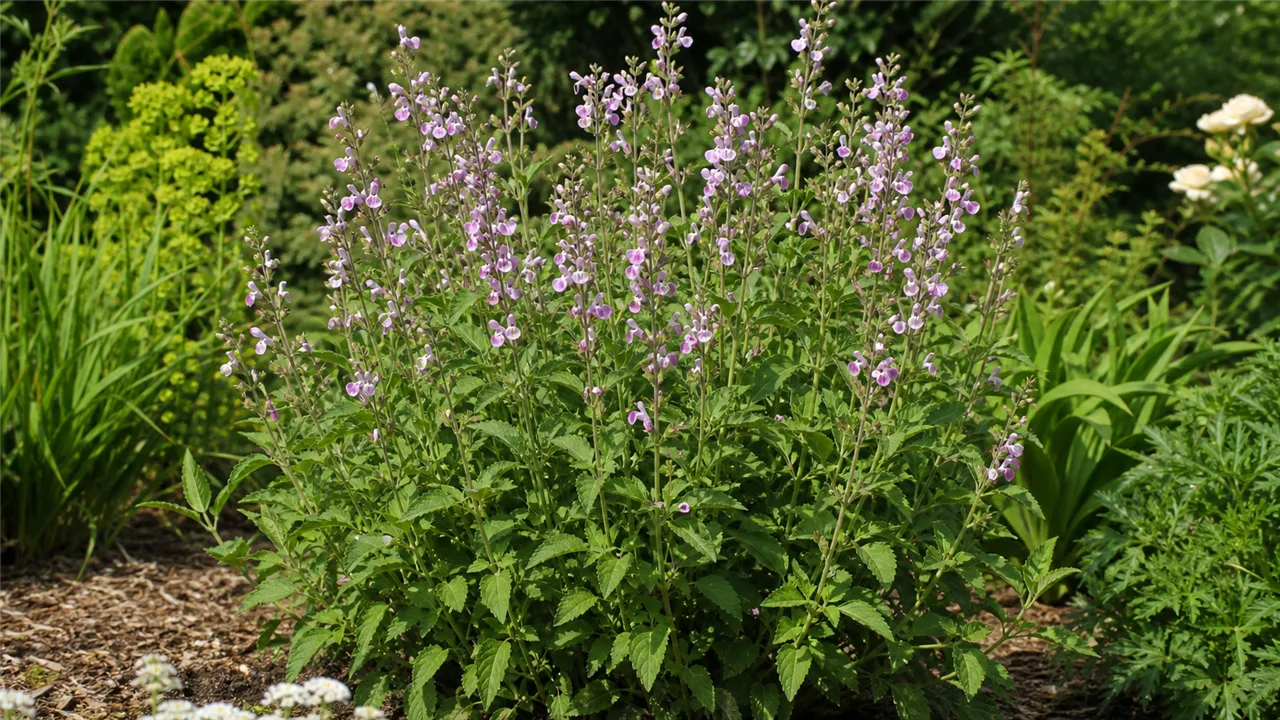
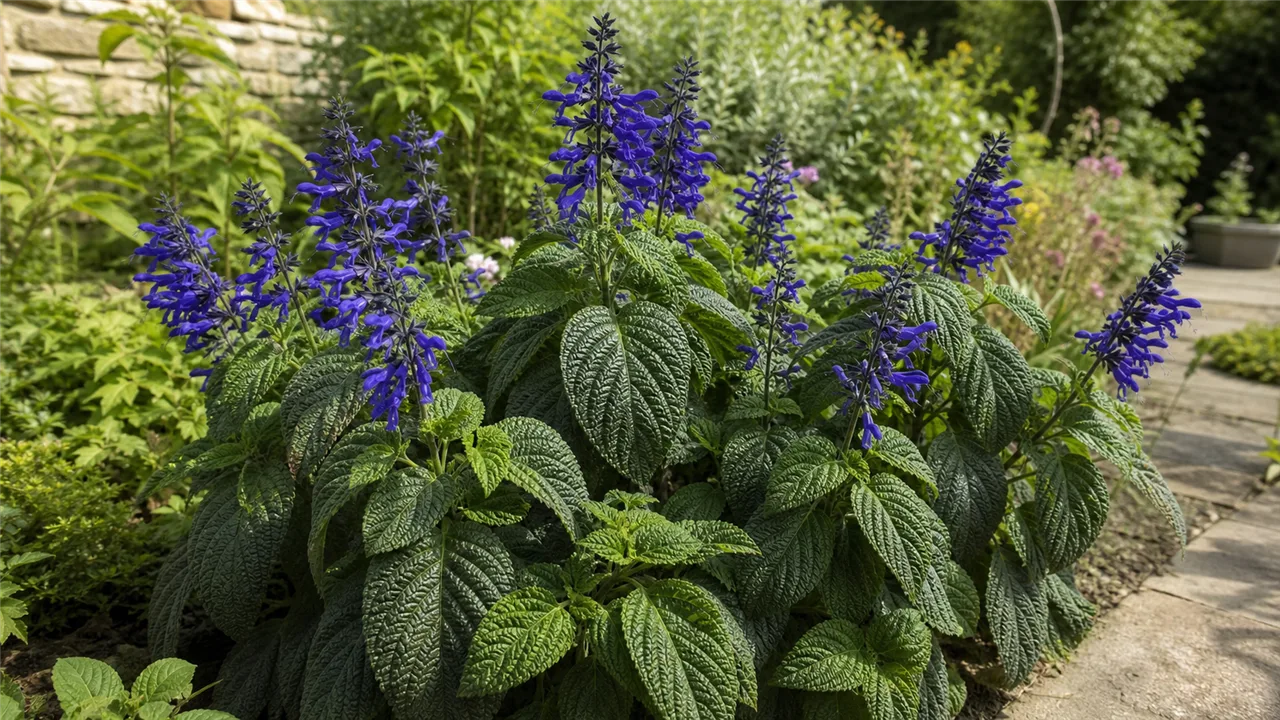
Salvia corrugata has a distinct, easily recognised look. The stems are upright to gently arching, square in cross-section as is typical of the mint family, and carry opposite pairs of leathery, ovate to lanceolate leaves. The leaves are the defining feature: roughly 6 to 12 cm long, dark matt green above and paler beneath, with a strongly corrugated or bullate surface — the tissue between the veins rises in a series of puckers, giving each leaf a quilted appearance. This texture persists throughout the year in mild weather and is the source of both the botanical epithet corrugata and the common name corrugated sage.
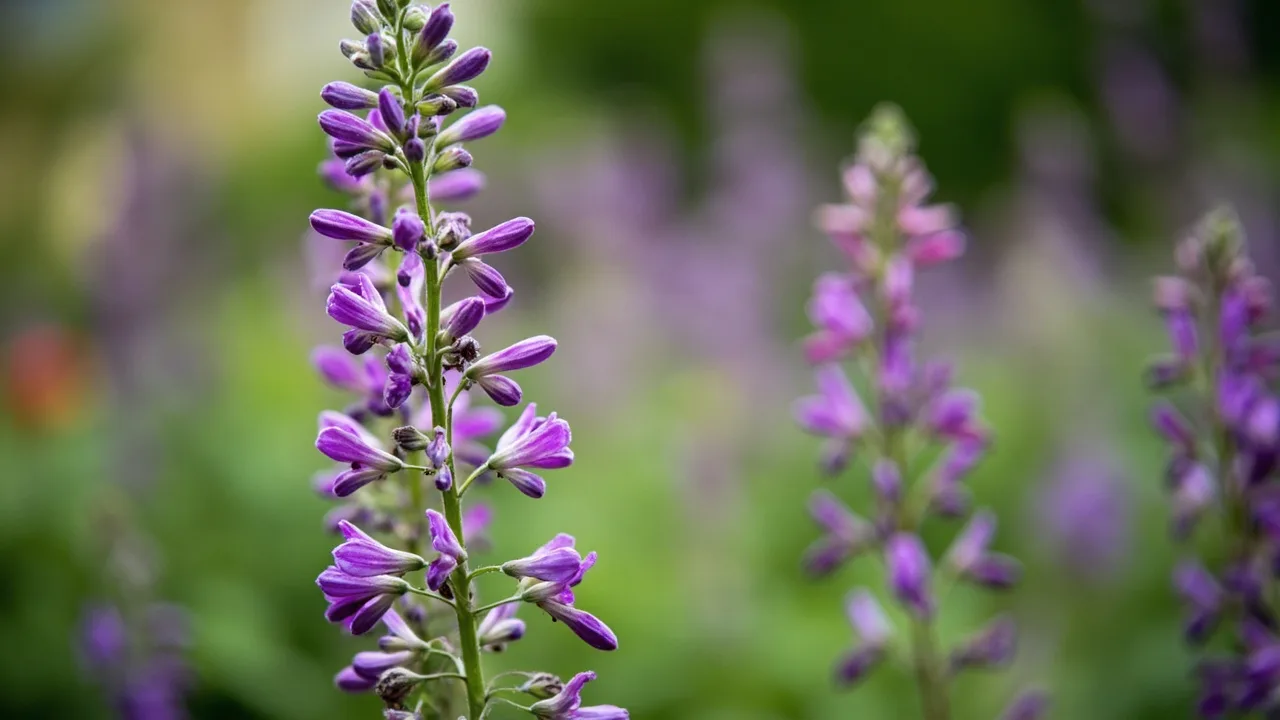
From midsummer, usually peaking in July and August and continuing well into September, the plant sends up flowering stems that rise 15 to 30 cm above the leafy mound. The inflorescence is an elongated spike of closely set whorls (verticillasters), each whorl carrying several small, two-lipped flowers in a rich, deep blue to violet-blue. The calyces that hold each flower are darkly veined and remain on the spike after the corollas drop, so the display continues as a decorative seed-head structure for several weeks. Deadheading promptly after the first main flush can encourage a second, lighter flush into early autumn.
The overall habit is clump-forming rather than sprawling: the plant builds a woody base slowly and produces new shoots from low down each year. Mature specimens in UK gardens typically reach about 60 cm of leafy growth and push to around 90 cm in full flower, broadening with age to form a rounded subshrub roughly 45 to 60 cm across. The root system is moderately fibrous, not deep, which makes container cultivation straightforward but also means the plant is sensitive to disturbance at the root once established.
Growing Conditions
Salvia corrugata performs best in full sun, where flowering is most prolific and the leaf texture develops its strongest puckering. Light, dappled shade is tolerated for part of the day, but in heavier shade the plant becomes leggy, flowers sparsely and the leaves lose some of their characteristic quilted appearance. A south- or west-facing border, the base of a warm wall, or a sunny courtyard are all good UK sites; in more exposed gardens, a position sheltered from cold winter winds is helpful.
Soil must be free-draining. The plant tolerates a wide range of soil textures provided the ground does not sit wet through the cooler months; wet roots in winter are the most common cause of failure. A moderately fertile loam at neutral to slightly acidic pH (about 6.0 to 7.0) is ideal, though the plant also performs well in poorer, grittier soils so long as drainage is sharp. On heavy clay, plant on a shallow mound or in a raised bed, and work coarse grit into the planting hole; on shallow chalk, add organic matter to retain a little summer moisture.
The plant carries a UK hardiness rating and should be regarded as half-hardy in most of the country. In the milder south and west, the south coast, London and similar urban heat islands, and in coastal Cornwall and the Channel Islands, established plants in well-drained soil often come through a typical winter with only top-growth scorch. Elsewhere in the UK, particularly inland northern England, the Midlands at altitude, most of Scotland and Northern Ireland, hard frosts will cut the top back to the base or kill the plant outright if left exposed. In these areas, growing in containers and moving to a frost-free greenhouse, conservatory or cold frame for winter is the most reliable approach. Mulching the crown with a thick, dry layer of coarse bark or straw, set over a collar of bracken or horticultural fleece, helps in marginal sites; the aim is to keep the crown dry and the soil around the roots from freezing solid for prolonged periods.
Planting and Care
Plant out container-grown specimens in late spring once hard frost has passed, typically from late May into early June across most of the UK. Space plants 45 to 60 cm apart, and dig the planting hole no deeper than the rootball and a little wider. Backfill with the original soil improved with a forkful of garden compost, and water in thoroughly. For container culture, use a loam-based compost such as John Innes No. 2 with an extra handful of grit, and choose a pot at least 30 cm across. Raise the pot on pot feet so excess water drains freely through winter.
Water moderately through the first growing season. Once settled, S. corrugata is notably drought-tolerant and prefers the soil to dry out between waterings; it comes from seasonally dry upland habitats and resents damp compost. During prolonged UK summer droughts, a deep soak every week or ten days is better than light daily watering. Feed sparingly: a single application of balanced slow-release fertiliser in spring, or a top-dressing of garden compost, is enough; overfed plants produce soft growth that is more vulnerable to winter damage.
Light pruning keeps the plant tidy. After the main flush fades in late summer, deadhead or shear back lightly to a strong pair of leaves to encourage a second flush into early autumn. In spring, usually from mid-March into April, cut back frost-damaged or leggy stems to healthy growth just above the lowest live buds and remove dead wood at the base. Avoid cutting hard into old wood below the leafy zone; like many Mediterranean subshrubs, S. corrugata regenerates slowly from very old stems and may not recover.
Propagation is straightforward from softwood cuttings taken in late spring or early summer, when new shoots are 8 to 12 cm long and still flexible. Trim below a leaf joint, remove the lower leaves, and root in a 50:50 mix of peat-free multipurpose compost and perlite or coarse grit, kept lightly moist and shaded. Cuttings usually root in three to four weeks and can be potted on individually before overwintering under cover. Mature clumps can be divided in spring, though the woody base of older plants makes this harder than for purely herbaceous salvias.
Common Problems
Frost damage is by far the most common cause of loss in the UK. Symptoms appear in late winter or early spring as the upper stems blackening or collapsing, and in severe cases the whole top of the plant dies back to the crown. Plants in free-draining soil in a sheltered site usually regenerate from the base; plants in cold, wet soil often do not. The remedy is prevention: choose a sheltered site, improve drainage, mulch the crown in autumn, or move container plants under cover for the winter.
Root rot follows persistently waterlogged conditions. The foliage yellows, growth becomes soft and the plant may wilt even when the soil is damp. Once root rot takes hold there is little to be done; replace the plant and address the drainage before replanting. Powdery mildew can affect the leaves in late summer during warm, humid spells, particularly where air circulation is poor; thin out congested growth and avoid overhead watering to reduce the risk.
Aphids frequently colonise the young flower stems and buds in early summer; they rarely cause lasting damage but can be washed off with a strong jet of water or treated with a soap-based spray if persistent. Slugs and snails attack the soft new shoots in spring, especially in damp seasons, and can be deterred with the usual barriers or night-time hand-picking. Glasshouse whitefly is a particular nuisance for container plants overwintered indoors; yellow sticky traps and the parasitic wasp Encarsia formosa are effective controls in a greenhouse setting.
The plant is not considered toxic to humans, dogs or cats, and it is rarely browsed by deer or rabbits.
Popular Varieties
Named cultivars of Salvia corrugata are scarce in UK horticulture, and the species is most often sold and grown true to type from seed or cutting-raised stock. The species itself, with strongly corrugated dark leaves and deep blue-violet flower spikes from July to September, is the most widely available and dependable form.
For gardeners seeking a slightly different scale or colour, two closely related evergreen salvias are worth considering alongside S. corrugata. Salvia guarantica is a taller, looser-habited relative with rich blue flowers from late summer into autumn, and Salvia uliginosa (bog sage) carries clear sky-blue flowers on taller stems and tolerates damper ground. These are distinct species rather than cultivars, but they fill a similar late-season role in the same UK planting schemes. A white- or pale-flowered selection of S. corrugata appears occasionally in specialist catalogues, though availability is inconsistent and plants should be checked in flower before purchase.
Given the limited named-cultivar range, the practical advice is to buy S. corrugata in flower from a reputable nursery or specialist salvia grower, choose plants with the strongest leaf corrugation and deepest flower colour, and propagate from cuttings once a desirable form is established.
Pests and Diseases
| Problem | Symptoms | Management |
|---|---|---|
| Powdery mildew | White, dusty fungal growth appears on leaves and stems, potentially causing distortion. | Improve air circulation and apply a suitable fungicide if infection is severe. |
| Root rot | Leaves turn yellow or brown and wilt despite moist soil due to waterlogged roots. | Ensure well-drained soil and avoid overwatering, especially in winter. |
| Verticillium wilt | Lower leaves yellow and drop off while upper foliage may show wilting or stunting. | Remove and destroy infected plants to prevent spread; do not compost. |
| Honey fungus | Plant decline with white fungal growth under bark and black fan-shaped fruiting bodies at base. | Excavate and remove infected roots and soil; replant only after thorough cleanup. |
| Slugs and snails | Irregular holes in leaves and silvery slime trails on foliage and surrounding soil. | Use physical barriers, copper tape, or approved slug pellets to protect young growth. |
For step-by-step help, read Dealing with Slugs and Snails and Treating Powdery Mildew. Or browse the full plant problem solver to diagnose an issue by symptom.
Recommended Products
GardenWizz earns a commission from qualifying purchases made through affiliate links on this page (including links within the article) — as an Amazon Associate, and from Thompson & Morgan via the Awin network. This does not affect the price you pay. See our disclaimer for details.