Tropical Sage
Salvia coccinea
The Gardening Year
Best months in UK gardens · full planting calendar →
🖨 Printable care card (PDF)At a Glance
| Botanical name | Salvia coccinea |
|---|---|
| Common name(s) | Tropical sage |
| Family | Lamiaceae |
| Plant type | perennial (Commonly grown as an annual species.) |
| Height × Spread | 61–122 cm × 76 cm |
| Position | Full sun, Partial shade |
| Soil | moderately fertile, light, well-drained, slightly acid, sandy soil |
| Flowering | June–November |
| Toxicity | — |
| Native range | Southeastern United States, Mexico, Central America, the Caribbean, and northern South America (Colombia, Peru, and Brazil) |
Salvia coccinea, commonly known as scarlet sage or tropical sage, is a vivid, long-flowering member of the Lamiaceae family native to the southeastern United States, Mexico and parts of Central and South America. Although it is a short-lived perennial in its native range, in most of the UK it is grown as a half-hardy annual, prized for its brilliant scarlet tubular flowers and its exceptionally long flowering season. It is one of the most rewarding salvias for UK gardeners seeking reliable colour from midsummer through to the first autumn frosts, and it is exceptionally attractive to pollinators, particularly bees and butterflies.
Overview
Salvia coccinea is an erect, bushy plant that brings a tropical intensity to UK gardens well beyond what most half-hardy annuals can offer. Its tolerance of heat and humidity, combined with its willingness to flower continuously from early summer through to the first frost, makes it a mainstay of late-season bedding schemes, container plantings, and cottage-garden borders. Unlike its close relative Salvia splendens (the common bedding salvia), S. coccinea has a softer, more naturalistic appearance and is significantly more attractive to bees and butterflies.
In the UK, the plant is best treated as an annual. It completes its life cycle within a single growing season and is killed by the first hard frost. Gardeners in very mild coastal or urban microclimates, particularly in the south-west, may occasionally find self-sown seedlings the following spring, but this is the exception rather than the rule. For most UK growers, fresh seed is sown under cover each year.
Appearance
Salvia coccinea forms an upright, branching clump typically reaching 45–90 cm in height with a spread of 30–45 cm. The stems are square, a characteristic of the Lamiaceae family, and may carry a fine downy hair. The leaves are ovate to triangular-ovate, with softly toothed margins, and they are slightly hairy to the touch. When brushed or crushed, the foliage releases a mild, somewhat sage-like aroma, though it is less pungent than that of culinary Salvia officinalis.
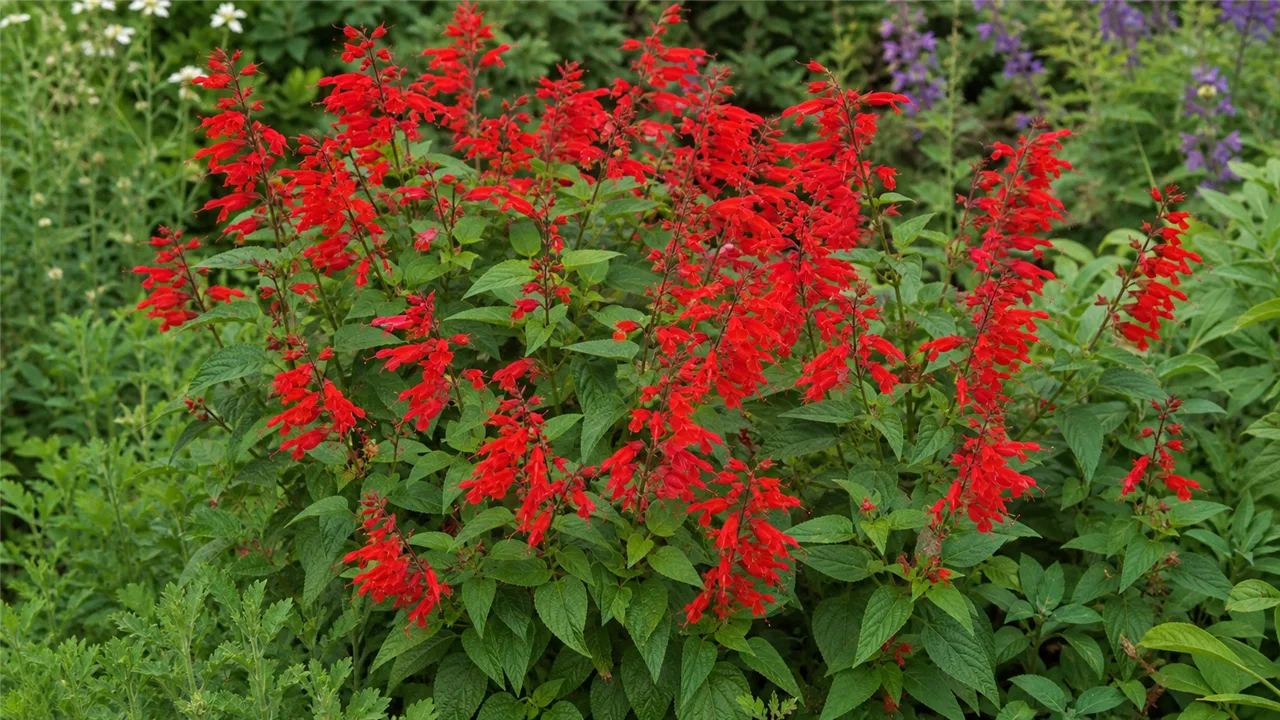
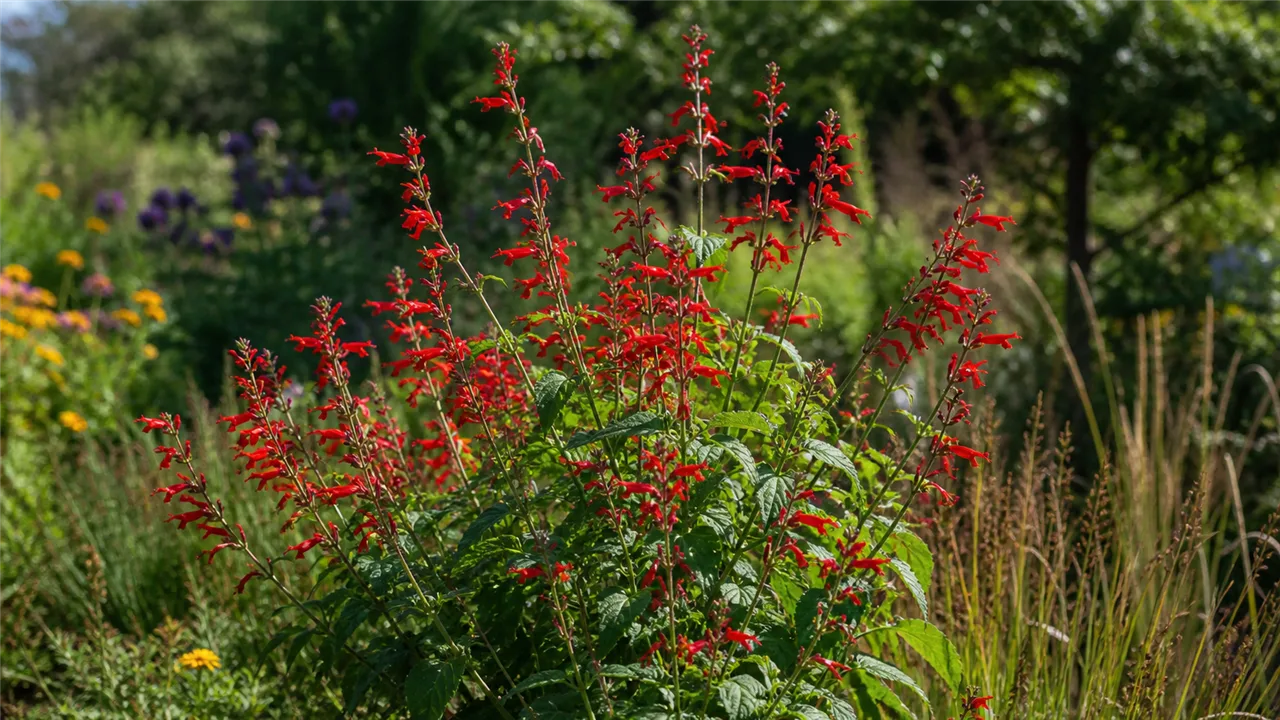
The flowers are the plant's chief asset. They are tubular and bi-labiate (two-lipped), held in loose whorls along slender terminal spikes that rise above the foliage. The classic flower colour is a brilliant scarlet-red, but pink, salmon, and pure white forms also occur and are widely available as seed. Individual flowers are roughly 2–3 cm long and are held clear of the leaves, giving the spike an airy, see-through quality rather than the dense, solid appearance of Salvia splendens. Flowering begins in June or early July, depending on sowing date and the season, and continues without interruption until the first autumn frost cuts the plant down. Deadheading spent spikes encourages further flushes and helps to keep the display tidy.
Growing Conditions
Salvia coccinea thrives in full sun and rewards the warmest, brightest spot a UK garden can offer. In partial shade, the plants become leggy, flower poorly, and are more susceptible to fungal disease. A sheltered position is also beneficial: although the stems are reasonably stout, exposed sites can damage the taller flower spikes in summer storms.
The soil should be well-drained and moderately fertile. Salvia coccinea tolerates a wide pH range but performs best in neutral to slightly alkaline conditions, the typical profile of most UK garden soils. It is notably tolerant of poor, even stony soils, provided drainage is adequate, and it copes far better with dry conditions than waterlogged ones.
Hardiness is the main limitation for UK growers. The plant is half-hardy, meaning it is killed by frost and cannot be overwintered outdoors except in very mild, frost-free microclimates. In most British gardens it should be treated as an annual and replaced each year, either by raising new plants from seed or by purchasing fresh stock in late spring.
Planting and Care
Sowing is the main route into cultivation in the UK. Seed should be sown under cover in late winter or early spring, typically February to March, at a temperature of 18–21°C. The seed is small and should be surface-sown or covered only very lightly with compost, as it requires light for germination. Sow into modules or small pots of peat-free seed compost, water gently from below, and cover with a thin layer of vermiculite or a sheet of glass to retain humidity. Seedlings usually appear within 10–21 days and should be grown on in a bright, frost-free position, ideally at 15–18°C, until they can be transplanted after all risk of frost has passed, usually in late May or early June. Pinch out the growing tips of young plants once they have formed two or three pairs of true leaves; this encourages branching and produces a sturdier, more floriferous plant. Gardeners in warmer parts of the south and west may also direct sow in April or May once the soil has warmed, although indoor sowing gives a longer flowering season and is the more reliable option in cooler regions.
Plants should be hardened off gradually over 7–10 days before being moved outside. Begin by placing trays in a sheltered outdoor spot for a few hours during the warmest part of the day, increasing the duration each day and reducing watering slightly to toughen the foliage. Plant out at a spacing of 30–45 cm in well-prepared ground, or one plant per 20–25 cm pot for container displays. Use a loam-based potting compost such as John Innes No. 2 for containers, and ensure pots drain freely. Water in well and keep moist until established, then reduce watering as the roots begin to find their own moisture.
In containers, Salvia coccinea performs particularly well when grouped with other sun-loving, late-season performers such as Cosmos bipinnatus, Tagetes, or the larger Penstemon cultivars. The plants tolerate the restricted root volume of a pot well provided they are watered regularly during dry spells and fed occasionally with a high-potash liquid feed (such as tomato feed) at half strength every fortnight from July onwards to support continuous flowering.
Once growing, Salvia coccinea is undemanding. Watering should be moderate: the plant is reasonably drought tolerant once its root system is developed, but it flowers more freely with regular watering during prolonged dry spells. Feeding should be light; a single application of a balanced general-purpose fertiliser at planting time is usually sufficient, and high-nitrogen feeds should be avoided as they promote leafy growth at the expense of flowers.
Deadheading is the single most useful task for extending the display. Spent flower spikes should be removed regularly, ideally before they set seed, and the plant will respond by producing fresh spikes within a couple of weeks. Late in the season, allowing a few spikes to set seed may produce volunteer seedlings in mild gardens.
Propagation is almost exclusively by seed. The species comes true from saved seed in the classic scarlet form, although named cultivars may not. Cuttings are possible from non-flowering side shoots in late summer, but most UK gardeners simply raise a fresh batch each spring.
Common Problems
Salvia coccinea is generally trouble-free, but a few issues are worth noting.
Frost damage is the principal cause of plant loss in the UK. The first hard frost of autumn blackens the foliage and kills the plant. Late spring frosts can also damage young plants put out too early; keep an eye on the forecast in May and protect with fleece if cold nights are predicted.
Powdery mildew can affect the foliage in late summer, particularly in humid weather or where air circulation is poor. Spacing plants adequately and avoiding overhead watering help to reduce the risk. Removing affected leaves promptly limits spread.
Aphids occasionally colonise the soft shoot tips and the undersides of young leaves. They are easily controlled by a strong jet of water, by encouraging natural predators such as ladybirds and hoverflies, or by treating with insecticidal soap if numbers build up.
Slugs and snails can damage young seedlings and tender new growth, particularly in damp spring weather. Standard control measures — night-time hand-picking, beer traps, ferric phosphate pellets, or copper collars around pot-grown plants — are all effective.
Root rot may occur in heavy, poorly drained soils, especially after prolonged wet weather. Planting in well-drained ground, or in raised beds or containers, prevents this.
Leggy, weak growth with few flowers usually indicates insufficient light. Move container-grown plants to a sunnier position and cut back leggy specimens to encourage bushier regrowth.
Popular Varieties
Several forms of Salvia coccinea are widely available to UK gardeners, both as seed and as young plants from nurseries.
The classic form is the unnamed scarlet species itself, sold simply as Salvia coccinea. It produces the intense red flowers most gardeners picture when they think of the plant, and it remains the most widely grown.
'Lady in Red' is a particularly vigorous scarlet selection, awarded an All-America Selections gold medal at its introduction. It flowers freely from seed in its first year and reaches around 60 cm.
'Coral Nymph' (sometimes sold as 'Coral') is a popular bicolour form, with flowers in shades of coral-pink and salmon. It grows to about 60 cm and is especially effective in pastel planting schemes.
'Snow Nymph' is the white-flowered counterpart to 'Coral Nymph', with pure creamy-white blooms on plants of similar stature. It combines well with the scarlet form and with pink salvias such as Salvia nemorosa cultivars.
'Brenthurst' is a soft salmon-pink selection, less commonly encountered but valued for its gentler colour in subtle plantings.
Seed mixes sold as 'Summer Jewel' or similar blends offer a range of colours, including scarlet, pink, and white, from a single packet and are a convenient way to grow a mixed display.
Cultivars and Varieties
| Cultivar | Height | Flower | Notes | AGM |
|---|---|---|---|---|
| 'Lady in Red' | — | — | RHS AGM (H1c) | ✓ |
Pests and Diseases
| Problem | Symptoms | Management |
|---|---|---|
| Slugs and snails | Irregular holes in leaves and stems, often accompanied by silky slime trails. | Use physical barriers like copper tape or apply iron phosphate-based pellets around the base. |
| Powdery mildew | White, dusty fungal growth on leaves and stems, potentially causing distortion. | Improve air circulation and spray with a sulphur-based fungicide if severe. |
| Leafhoppers | Small yellow or white speckling on leaves and sticky honeydew residue. | Encourage natural predators like ladybirds or use insecticidal soap for heavy infestations. |
| Root rot | Wilting, yellowing foliage, and blackened, mushy roots despite moist soil. | Ensure well-drained soil and avoid overwatering; remove affected plants immediately. |
| Verticillium wilt | Sudden wilting and browning of leaves on one side of the plant, often with internal stem discoloration. | Remove and destroy infected plants; avoid replanting salvias in the same spot for several years. |
For step-by-step help, read Dealing with Slugs and Snails and Treating Powdery Mildew. Or browse the full plant problem solver to diagnose an issue by symptom.
Recommended Products
GardenWizz earns a commission from qualifying purchases made through affiliate links on this page (including links within the article) — as an Amazon Associate, and from Thompson & Morgan via the Awin network. This does not affect the price you pay. See our disclaimer for details.