Alma-Ata Iris
Iris hoogiana
The Gardening Year
Best months in UK gardens · full planting calendar →
🖨 Printable care card (PDF)At a Glance
| Botanical name | Iris hoogiana |
|---|---|
| Common name(s) | Alma-Ata Iris |
| Family | Iridaceae |
| Plant type | perennial |
| Height × Spread | 40–60 cm × 10–50 cm |
| Position | Full sun |
| Soil | very well-drained soil |
| Flowering | April–June |
| Toxicity | Harmful if eaten |
| Native range | Turkestan, Tadzhikistan, Uzbekistan |
Iris hoogiana is a small bulbous iris belonging to the Juno group (subgenus Scorpiris) of the genus Iris, in the family Iridaceae. It was described by the Dutch botanist and nurseryman J. B. Hoog in 1901 after collections from the mountains of Central Asia, where it grows on dry, stony slopes in the eastern Caucasus, northern Iran, Turkmenistan and the mountains of Tien Shan and Pamir-Altai. In the UK it sits firmly in the specialist's collection: an alpine-house or raised-bed plant rather than a general garden perennial, but one that rewards careful cultivation with some of the most striking flowers of the entire Juno group.
Its appeal is twofold. The flowers, borne one or two to a short stem in late spring, are large in proportion to the plant and come in shades that range from pale milky blue and white through to a saturated violet-purple, almost always with a contrasting yellow or brownish fall and a raised signal crest down the centre of each fall. The early-spring foliage — broad, channelled, glossy green and arranged in a neat shuttle — is itself handsome for several weeks before flowering. For gardeners who already grow snowdrops, crocuses or early dwarf narcissi, I. hoogiana slots into the same seasonal niche, only with a more exotic, orchid-like flower.
Overview
Iris hoogiana is deciduous, dying back to its bulb by mid- to late summer, and is grown primarily for its late-spring display. It is a long-lived bulb when sited correctly, increasing slowly by offsets rather than running, and unlike many of its Juno relatives it tolerates a wider range of UK conditions provided the drainage is right. It is unsuited to heavy clay, to waterlogged ground and to shade, and these are the conditions that account for almost every failure reported by British gardeners.
Appearance
Iris hoogiana grows from a small, fleshy bulb with thick, store-like roots that are replaced each year. New roots are produced in autumn as the bulb breaks dormancy, and they double as anchors, contracting to pull the bulb down to its working depth. Established bulbs sit 8–10 cm below the surface and rarely need lifting.
Foliage. Each bulb pushes up three to five lance-shaped leaves in early spring, arranged in a flattened, alternate fan. The leaves are 1.5–3 cm wide, channelled, glossy mid-green and slightly glaucous when young, and they arch gently at the tips. Height in full leaf is typically 15–30 cm. Foliage begins to yellow from the tip downwards from late June onwards, and the plant is fully dormant by late July or early August in most UK sites.
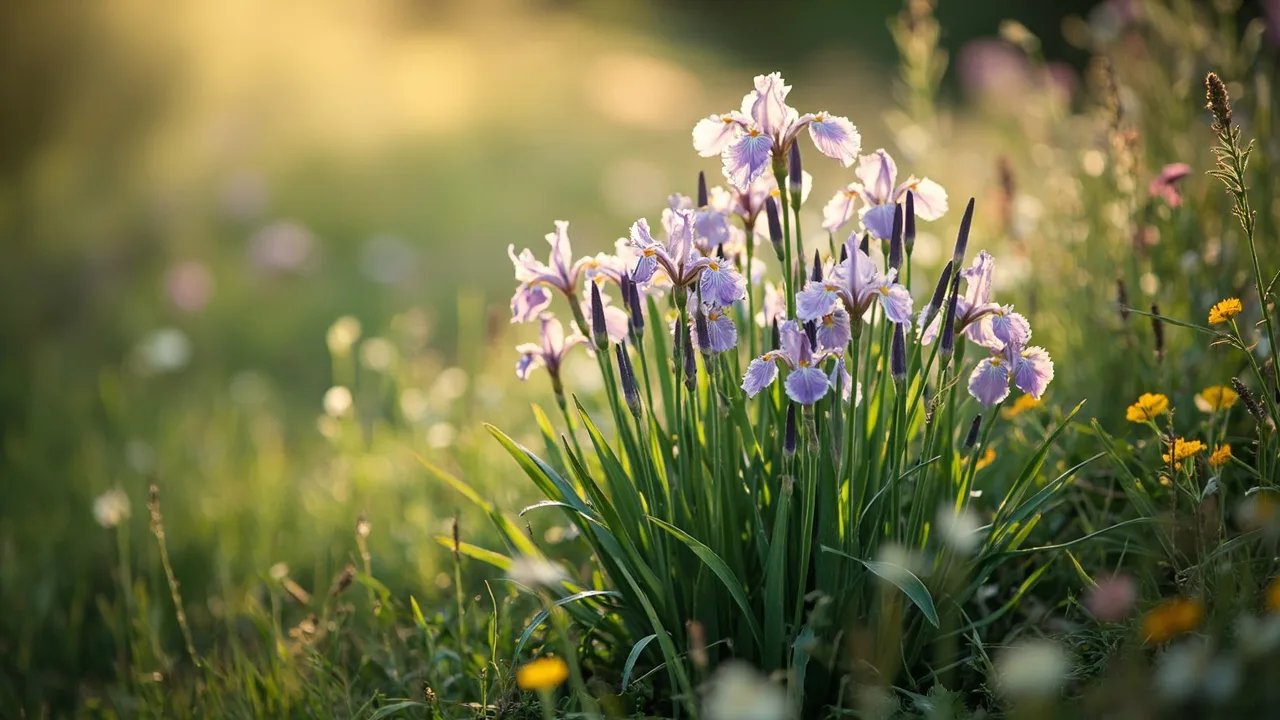
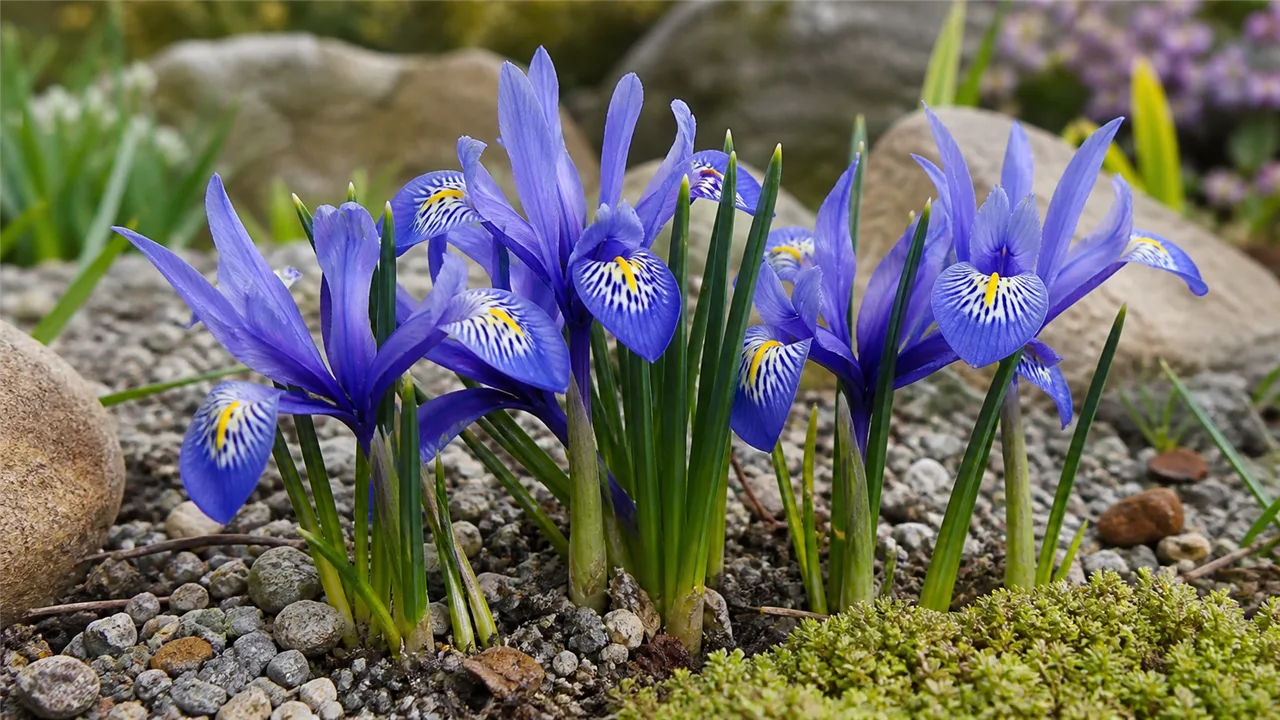
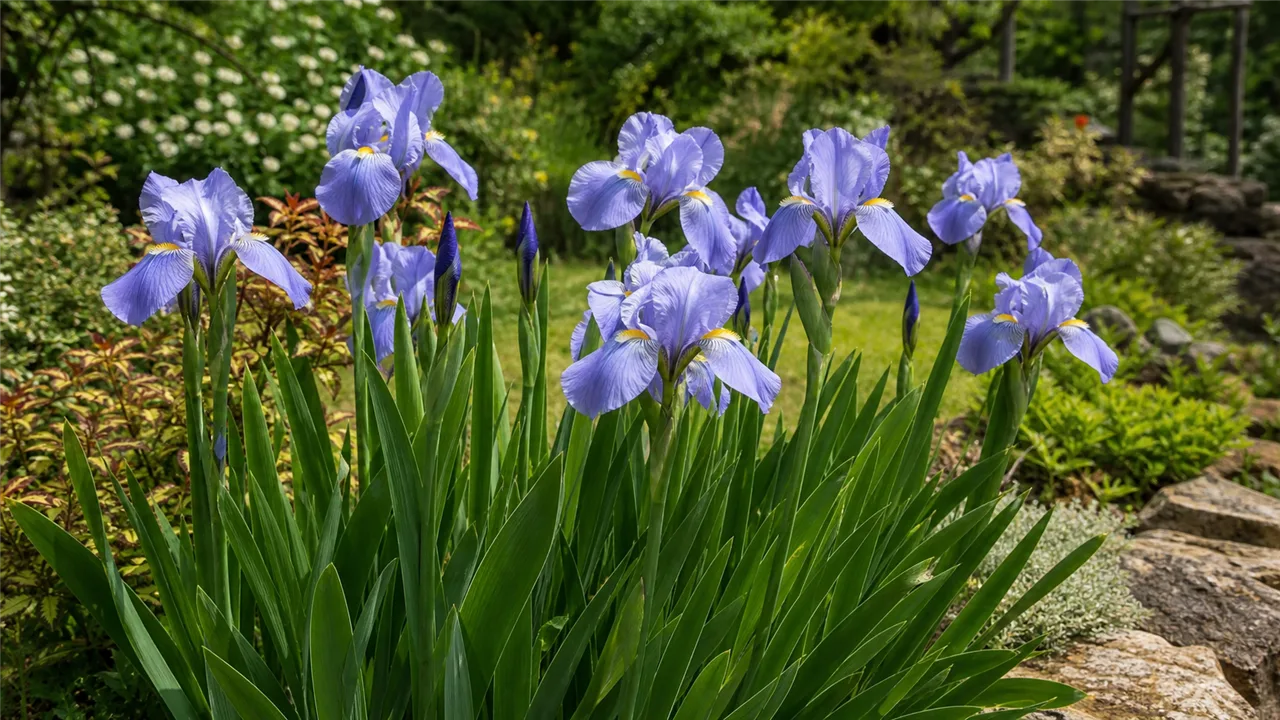
Flowers. The inflorescence appears in mid- to late May, slightly later in the north and at altitude. Each bulb sends up one or occasionally two stems, 20–40 cm tall, carrying one flower (rarely two) above a small pair of spathes. The perianth is divided into the typical iris form of three upright standards and three broader, pendent falls. Standards are usually held more or less horizontally, the falls are obovate and spreading. Colour is the most variable feature. Typical wild forms are a soft, slightly greyish lilac-blue, but cultivated forms include clean white, pale yellow, deep violet and bicolours where the standards and falls differ in shade. The falls carry a raised, frilled signal crest in contrasting white, yellow or pale orange, and a darker veining runs from the throat outwards. Flowers are 6–8 cm across when fully open, and last four to six days in cool weather.
Bulb. Mature bulbs are 2–3 cm in diameter, ovoid, with a pale, papery tunic. New offsets form at the base of the parent bulb and reach flowering size in two to three seasons.
Growing Conditions
Aspect and shelter. Full sun is essential. The Juno irises flower poorly and grow weakly in anything less than six hours of direct sun, and a south- or west-facing aspect is the only reliable choice in the UK. A position that is also sheltered from the prevailing wind reduces mechanical damage to the tall flower stems and keeps the broad leaves from being torn. An open alpine bed at the foot of a south-facing wall, or a raised bed in a sunny courtyard, is ideal. The species is intolerant of root competition from larger shrubs and herbaceous plants and dislikes being overshadowed in summer, when the dormant bulb prefers to be baked.
Soil. Soil type is the single most important practical consideration. I. hoogiana needs a very sharply drained, gritty medium, neutral to slightly alkaline (roughly pH 6.5–8.0), and will not survive a wet winter in heavy clay. A loam-based mix amended with 30–50% by volume of coarse grit, sharp sand or fine pumice suits it well. In garden ground, work a generous layer of grit into the top 20–25 cm and, on heavier soils, plant on a low mound or in a raised bed so that the bulb sits well above the surrounding water table. The species is moderately tolerant of low fertility; rich soils encourage soft growth and increase the risk of basal rot.
Hardiness. I. hoogiana is grown successfully outdoors across most of lowland and central UK, given good drainage. In colder districts, the north of England, upland Wales and much of Scotland, cultivation is more reliable in an alpine house, cold frame or bulb frame, where winter wet can be kept off the dormant bulbs. The precise hardiness rating is shown in the structured field beside this article; the prose does not give a value.
Containers. The species is one of the most satisfactory Juno irises for pot culture. Use a 15–20 cm deep terracotta or stone pot, a free-draining loam-based mix with at least 30% grit, and plunge the pot in an outdoor bed over winter for temperature buffering. Move it under cover only in the wettest parts of the country, or where the pot would otherwise sit in standing water.
Planting and Care
When to plant. Bulbs are sold dry in late summer and should be in the ground by mid-October at the latest. Earlier planting (September) is preferable, allowing the new fleshy roots to establish before the worst of the winter weather. Bulbs resent drying out, so plant them within a day or two of receipt; do not let them sit on a shelf for weeks as you might with a daffodil.
Planting depth and spacing. Plant 8–10 cm deep, measured from the top of the bulb to the soil surface. Set each bulb on a 1–2 cm layer of coarse grit in the bottom of the planting hole to give an extra drainage buffer immediately beneath the basal plate. Space bulbs 10–15 cm apart in groups of five or more for a reasonable display; a single bulb always looks lost.
Watering. Outdoors in the ground, rainfall is sufficient for almost the entire year. Water in dry spells from late February until the foliage dies back, then withhold water entirely. In pots, water moderately during active growth in spring and stop once the leaves have yellowed. Junos rot quickly in damp, warm, stagnant compost.
Feeding. Apply a light top-dressing of a low-nitrogen, high-potash fertiliser (a tomato or rose feed at half strength is fine) in late February or early March as growth begins. A second, lighter application immediately after flowering helps the bulb to recharge. Avoid high-nitrogen lawn or general feeds, which push soft growth and increase rot risk.
Deadheading and tidying. Snap off spent flower stems at the base as soon as the blooms fade. This is not a hard prune — it is a finger-and-thumb job done once a year, immediately after flowering. There is no routine cutting back of foliage during the growing season. The old leaves should be allowed to die back naturally and can be tidied away in late summer once they have yellowed completely.
Propagation. Lift and divide only when clumps are visibly congested, which for this species is every four to six years. Do it immediately after flowering, replant the largest bulbs at the correct depth with a grit layer, and water in. Juno irises resent disturbance more than most bulbs, and broken or dried-out offsets are slow to recover. Seed can be sown in autumn in a gritty, loam-based mix and kept cool and moist through the winter; germination typically occurs the following spring, and seedlings reach flowering size in three to four years. Named cultivars do not come true from seed.
Seasonal care summary. September–October: plant bulbs. Late February–March: top-dress and start watering pots. May–June: flowering, deadhead as blooms fade. Late June–July: foliage yellows; withhold water. August: tidy dead leaves. Do not lift bulbs in winter in well-drained soils; in cold or wet regions, an open-ended cloche over outdoor clumps or a move into a cold frame is sufficient protection.
Common Problems
Basal rot and bulb rot. The single most common reason for losing I. hoogiana in the UK is bulb rot caused by waterlogged soil. The bulb turns soft and brown at the base, leaves emerge weakly or not at all, and the whole plant collapses in spring. Prevention is everything: plant on grit, avoid heavy clay, and keep pots on the dry side from mid-summer onwards. Infected bulbs should be lifted and destroyed; do not compost them.
Failure to flower. A healthy clump that produces leaves but no flowers has usually been planted too deeply, grown in too much shade, or has become congested and needs dividing. Replanting at 8–10 cm, moving into full sun, and lifting/separating offsets after flowering will normally restore flowering the following year. Late autumn planting of dried-out bulbs is another common cause — the new roots have no time to develop and the bulb flowers poorly in its first spring or not at all.
Slug and snail damage. The young shoots and flowers are attractive to slugs and snails in damp springs. Damage is rarely fatal, but heavy grazing on emerging flowers can spoil the display. Use whatever organic control suits your site — night-time hand-picking, ferrous phosphate pellets, or copper rings around container-grown plants.
Virus. Juno irises are occasionally affected by iris mosaic virus, which shows as faint yellow streaking or mottling on the leaves and a generally weakened plant. There is no cure. Lift and destroy affected bulbs, and disinfect tools between plants. Many UK stocks are clean, and the problem is uncommon in well-grown plants.
Wind damage. The broad leaves tear easily in exposed sites, and the tall flower stems can be snapped in spring gales. Site in a sheltered position rather than an open bed, and stake stems only in particularly exposed gardens.
Popular Varieties
Iris hoogiana is a variable species in the wild, and the named forms in cultivation reflect that variation. The following are established, named selections listed in the Royal Horticultural Society's plant finder; none of them carries an Award of Garden Merit, and ratings should not be assumed.
- I. hoogiana 'Alba'. A clean white form, the falls marked only with a small yellow signal crest. Slower to increase than the coloured forms but considered one of the most elegant Juno irises in cultivation. Best in a slightly shadier position than the type, where white flowers scorch less readily.
- I. hoogiana 'Purpurea'. A deep violet-purple form, richer in colour than the typical wild plant. The falls carry a contrasting white or pale yellow crest, giving a strong two-tone effect. The most widely grown coloured form in UK specialist collections.
- I. hoogiana 'Blue Mount'. A vigorous blue selection with broad falls and a pale yellow signal; one of the easiest coloured forms to grow in a sunny raised bed, and a useful contrast to the white and purple forms.
- I. hoogiana 'Gypsy Beauty'. A distinctive bicolour, typically with smoky lilac standards and richer violet falls, with a yellow signal crest. Mid-season; performs well in pots.
- I. hoogiana 'Noblesse'. A tall, well-proportioned selection in soft pale blue with a white signal, valued for cutting in small arrangements as well as for the border. The stems are sturdier than those of most forms.
- I. hoogiana 'Zethos'. A deeper blue-violet selection with a contrasting golden crest, one of the later-flowering forms and useful for extending the display in a collection of Junos.
For UK growers, I. hoogiana is at its best in a dedicated alpine bed, a raised gritty border at the foot of a south wall, or a deep terracotta pan in a cold frame. Plant in groups, in full sun, in sharply drained soil, and leave the bulbs alone — they reward patience and resent fussing.
Pests and Diseases
| Problem | Symptoms | Management |
|---|---|---|
| Slugs and snails | Irregular holes chewed in leaves and flowers, often accompanied by silky trails. | Use physical barriers like copper tape or hand-pick at night; avoid chemical slug pellets where possible. |
| Bacterial soft rot | Rhizomes become soft, mushy, and emit a foul smell, causing the plant to collapse. | Ensure excellent drainage and air circulation; cut away affected tissue with disinfected tools or discard severely infected plants. |
| Iris leaf spot | Small brown spots with yellow halos appear on leaves, potentially coalescing into larger lesions. | Remove and dispose of infected foliage at the end of the season to reduce overwintering spores. |
| Iris rust | Orange or brown pustules form on leaves, leading to yellowing and premature leaf death. | Improve air circulation around plants and remove heavily infected leaves to slow spread. |
| Bulb/rhizome rot | Base of the plant becomes soft and discolored, often due to waterlogged soil conditions. | Plant in gritty, free-draining compost and keep dry during summer dormancy; discard any bulbs showing decay before planting. |
For step-by-step help, read Dealing with Slugs and Snails. Or browse the full plant problem solver to diagnose an issue by symptom.
Recommended Products
GardenWizz earns a commission from qualifying purchases made through affiliate links on this page (including links within the article) — as an Amazon Associate, and from Thompson & Morgan via the Awin network. This does not affect the price you pay. See our disclaimer for details.