Daffodils
Narcissus
The Gardening Year
Best months in UK gardens · full planting calendar →
🖨 Printable care card (PDF)At a Glance
| Botanical name | Narcissus |
|---|---|
| Common name(s) | daffodils |
| Family | Amaryllidaceae |
| Plant type | bulb (bulbous herbaceous perennials with linear leaves and leafless stems bearing flowers, which may be solitary or in umbels, with 6 spreading perianth segments and a cup) |
| Height × Spread | 30–120 cm × 15–45 cm |
| Position | Full sun, Partial shade |
| Soil | moist but well-drained soil |
| Flowering | January–May |
| Toxicity | Harmful if eaten, skin irritant. Wear gloves and other protective equipment when handling. Pets (dogs, cats, tortoises): Harmful if eaten, skin irritant. |
| Native range | southern Europe and North Africa |
Overview
Daffodil (Narcissus pseudonarcissus) is a spring-flowering herbaceous perennial bulb in the family Amaryllidaceae and the species from which the entire garden daffodil tribe takes its common name. The following quick-care table summarises the essentials for UK growers; the full article below covers each point in detail.
Daffodil (Narcissus pseudonarcissus), also known as the Wild Daffodil or Lent Lily, is the native European species from which the modern horticultural daffodils were developed. It is a herbaceous perennial growing from a brown, tunicated bulb, native to meadows, open woodland and rocky slopes across western Europe from Portugal and Spain east to Germany, and from lowland Britain south to the Mediterranean mountains. In the United Kingdom it is best known as the parent of countless garden hybrids and as a wild flower in its own right, with characteristic populations surviving in damp woodland and old meadows in parts of Wales, the Welsh borders, Devon, the Lake District and the Black Mountains of Gloucestershire. Mature plants reach 30 to 45 cm tall, with a single flower on each stem in March or April, and a tuft of strap-like green leaves that follows the flower and dies back in early summer. The species is fully hardy across the UK, has been awarded the Royal Horticultural Society's Award of Garden Merit as a species, and is widely used for naturalising in grass, for planting in mixed spring borders, and for traditional cottage-garden bedding schemes. It is also Britain's unofficial national flower and is closely associated with St David's Day in Wales.
Appearance
Narcissus pseudonarcissus grows from a brown, papery-skinned bulb typically 2 to 5 cm in diameter, made up of fleshy, concentric scales surrounding a small basal plate. In late winter a single flowering stem pushes up through the soil, sheathed at its base by one to three long, narrow, strap-shaped leaves 15 to 30 cm long and around 1 to 1.5 cm wide. The leaves are mid-green, slightly keeled, and have a smooth, waxy surface; they emerge at the same time as, or shortly after, the flower bud, and remain on the plant for roughly six to eight weeks after flowering before yellowing and dying back in early summer.
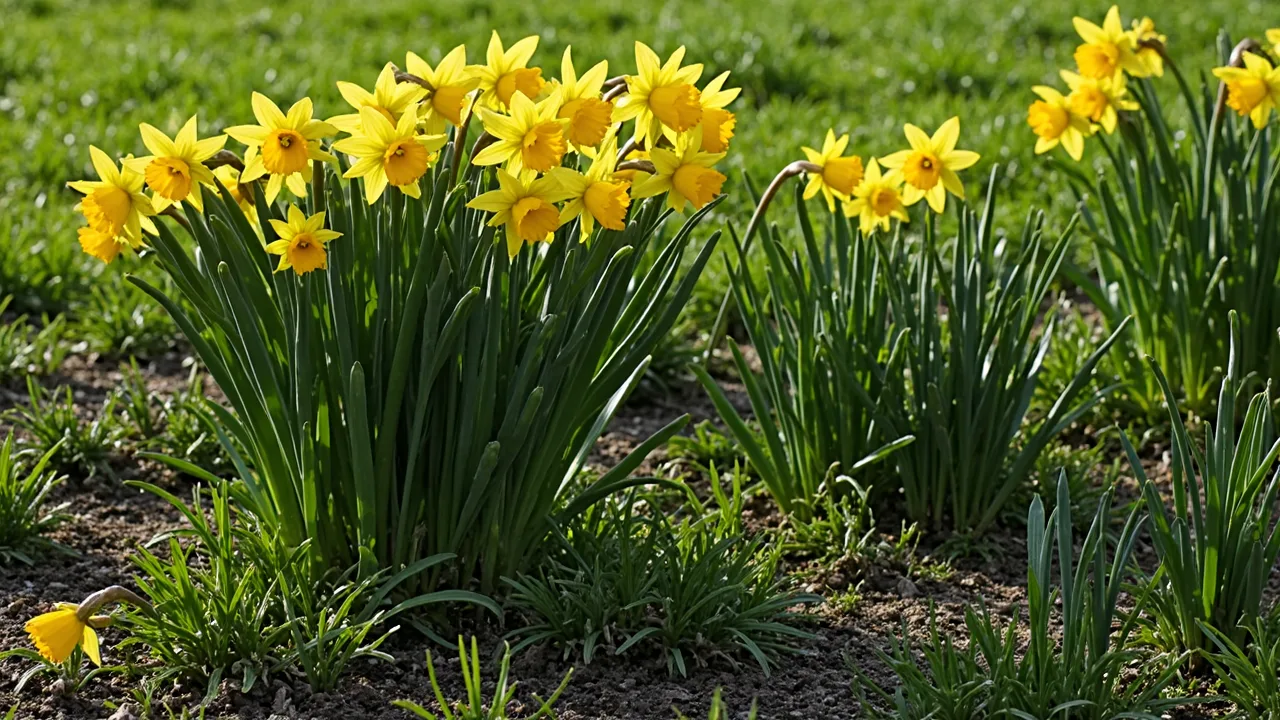
The flower is borne singly on a stout, rounded stem and nods gently to one side. It has a typical narcissus structure: six outer tepals (more accurately, perianth segments) arranged in two whorls of three, surrounding a central trumpet-shaped corona. In the wild species the outer tepals are pale to mid sulphur-yellow, often slightly twisted and pointed at the tip, and the corona is a deeper, more saturated yellow, distinctly frilled or ruffled at its rim, and roughly as long as the tepals. The overall effect is a pendulous, two-tone yellow flower 4 to 6 cm across, with the corona projecting forward like a small horn. After pollination a three-angled seed capsule may form, but seed is rarely set in cultivation and the species increases almost entirely by offsets from the parent bulb.
A characteristic feature of established clumps is the way the leaves persist in a loose green tassel long after the flowers have faded. The bulb then sits dormant through the summer and autumn, and a new root system is produced in late summer before the shoot emerges the following winter. Mature clumps in undisturbed ground can form broad drifts over decades, with dozens of flowering stems arising from a single original planting.
Growing Conditions
Daffodils perform best in full sun or very light, dappled shade, in well-drained but reasonably moist soil that does not dry out completely in summer. The species is native to cool, maritime climates with mild, wet winters and warm, dry summers, and it has adapted readily to similar conditions across the United Kingdom. Soils that are too dry at depth restrict root growth and can lead to poor flowering; soils that stay waterlogged through winter cause the bulbs to rot. A neutral to slightly acid loam suits the plant well, but it tolerates a wide pH range from about 5.5 to 7.5 provided drainage is adequate.
The species is fully hardy across the UK and is rated H6 by the Royal Horticultural Society, meaning it tolerates winter temperatures down to roughly -15 to -20 °C without protection. In the coldest inland areas and in exposed upland gardens a mulch of leaf mould or bracken applied after the ground has cooled in late autumn helps to insulate the soil, but in most British gardens no winter protection is needed. Bulbs need a period of winter chilling to flower well, and the cool British climate is therefore close to ideal.
Daffodils are particularly effective naturalised in short grass, in the light shade of deciduous trees and shrubs, and in mixed spring borders with herbaceous perennials that will mask the dying foliage. They are unsuitable for deep, dry shade under evergreen trees, for permanently waterlogged ground, and for tropical-style bedding in heavily fertilised soils, where soft leafy growth tends to follow at the expense of flowers.
Planting and Care
Plant dry bulbs in autumn, ideally between September and November while the soil is still warm. Set them pointed end up, at a depth of roughly two to three times the height of the bulb, which works out at about 10 to 15 cm in most garden soils; in light, sandy soils plant slightly deeper, and in heavy clay plant slightly shallower and on a small bed of grit. Space bulbs 10 to 15 cm apart for naturalised drifts and 5 to 8 cm apart for formal bedding displays. Water the ground thoroughly after planting to settle the soil around the bulbs and to start them into growth.
Once established, daffodils need remarkably little attention. Watering is rarely required outside prolonged drought, because the bulbs sit dormant through the summer when the soil is driest. A single light application of a balanced general-purpose fertiliser such as Growmore, or a proprietary bulb feed, scattered over the clump in early spring as the shoots emerge, supports strong flowering without producing soft, leafy growth. High-nitrogen lawn feeds should be avoided on grass containing naturalised daffodils, as they promote leaves at the expense of flowers and may also reduce the persistence of the bulbs.
After flowering, the single most important task is to leave the foliage to die back naturally for at least six weeks, and ideally until it has yellowed and detached from the bulb with a gentle tug. Folding, braiding or cutting the leaves while they are still green starves the bulb of the reserves it needs to flower the following year. Clumps that have become overcrowded and are flowering less freely should be lifted in late summer or early autumn, once the foliage has fully died back, divided into single bulbs or small groups, and replanted immediately at the correct depth in freshly prepared ground.
Propagation is almost always by offsets: small daughter bulbs that form against the basal plate of the parent and can be separated at lifting time. Seed propagation is possible but slow, taking four to six years to reach flowering size, and is used mainly by breeders rather than gardeners. The species comes reasonably true from seed where populations are isolated, and selected wild forms can be raised in this way.
Common Problems
The most common problem with daffodils in British gardens is a failure to flower, usually caused by premature removal of the foliage the previous year, planting the bulbs too shallow, or overcrowding in old clumps. A simple autumn lift and replant at the correct depth normally restores flowering within a season.
Basal rot, caused by the fungus Fusarium oxysporum f. sp. narcissi, produces soft, brown, foul-smelling bulbs that fail to shoot in spring. Infected bulbs should be lifted and destroyed, and the ground not replanted with narcissi for several years. Planting in well-drained soil and avoiding fresh manure at planting time reduces the risk.
The large narcissus bulb fly (Merodon equestris) lays eggs at the neck of the bulbs in late spring; the larvae tunnel into the bulb and eat out the centre, leaving a hollow shell. Infested bulbs should be lifted and destroyed. A physical barrier of fine horticultural fleece placed over the foliage from mid-spring until the flowers fade can help prevent egg-laying in vulnerable plantings.
Narcissus cyst nematode (Ditylenchus dipsaci) is a less common but more serious problem, causing distorted, stunted growth and characteristic brown rings when the leaves are sliced across. Infected plants and the surrounding soil should be removed and quarantined, and the area kept free of all narcissus bulbs for several years. Always buy bulbs from a reputable supplier and inspect them carefully before planting.
Slugs and snails graze the emerging shoots and the edges of the flowers in damp springs. They can usually be managed by hand-picking, by pet-safe slug pellets based on ferric phosphate, or by physical barriers such as crushed eggshell or copper rings around particularly choice clumps. Mice and squirrels occasionally dig up and eat newly planted bulbs in autumn; planting at the recommended depth and covering the bed with a small-gauge wire mesh for the first few weeks after planting is usually sufficient.
Popular Varieties
Within the species Narcissus pseudonarcissus there are several named wild forms, regional variants and primary hybrids of long standing in British cultivation. The species itself is most often sold simply as Narcissus pseudonarcissus or as the Lent Lily, and seed-raised stock from Welsh populations has been used in many conservation plantings in the west of Britain. The form sometimes listed as subsp. pseudonarcissus is the taller, paler yellow plant of lowland meadows, while subsp. nobilis, the large-flowered trumpet daffodil of mountain meadows in northern Spain and Portugal, has been used in hybridising programmes to introduce vigour and a longer trumpet into garden daffodils.
Narcissus pseudonarcissus subsp. obvallaris, the Tenby Daffodil, is a compact, early-flowering form found wild in south-west Wales and widely naturalised in British gardens; it carries a single, deep yellow flower on a 20 to 25 cm stem and is one of the most reliable forms for naturalising in short grass. It holds the RHS Award of Garden Merit and is the form most often sold in garden centres simply as 'Narcissus obvallaris'. The Welsh native form often sold as 'Narcissus pseudonarcissus var. lobularis' is a smaller, paler plant with a narrow trumpet, well suited to rock gardens and to naturalising in thin, stony soils.
The Lobularis Group covers a range of small, narrow-trumpeted wild-type daffodils derived from British native populations, including white- and bicoloured forms that are valuable for naturalising in wild gardens. Most modern hybrid daffodils grown in British gardens, from 'King Alfred' types to the more recent 'Dutch Master' and 'Ice Follies', are hybrids of N. pseudonarcissus with other species rather than the species itself, but they share its tolerance of British conditions and follow the same cultivation rules.
Cultivars and Varieties
| Cultivar | Height | Flower | Notes | AGM |
|---|---|---|---|---|
| 'Abba' | — | — | RHS AGM (H6) | ✓ |
| 'Aberfoyle' | — | — | RHS AGM (H6) | ✓ |
| 'Actaea' | — | — | RHS AGM (H6) | ✓ |
| 'Arctic Gold' | — | — | RHS AGM (H6) | ✓ |
| 'Arkle' | — | — | RHS AGM (H6) | ✓ |
| 'Avalanche' | — | — | RHS AGM (H4) | ✓ |
| 'Badbury Rings' | — | — | RHS AGM (H6) | ✓ |
| 'Bantam' | — | — | RHS AGM (H6) | ✓ |
| 'Barnum' | — | — | RHS AGM (H6) | ✓ |
| 'Bell Rock' | — | — | RHS AGM (H6) | ✓ |
| 'Border Beauty' | — | — | RHS AGM (H6) | ✓ |
| 'Boslowick' | — | — | RHS AGM (H6) | ✓ |
| 'Boulder Bay' | — | — | RHS AGM (H6) | ✓ |
| 'Bravoure' | — | — | RHS AGM (H6) | ✓ |
| 'Breezand Tristar' | — | — | RHS AGM (H6) | ✓ |
| 'Bridal Crown' | — | — | RHS AGM (H6) | ✓ |
| 'Brooke Ager' | — | — | RHS AGM (H6) | ✓ |
| 'Broomhill' | — | — | RHS AGM (H6) | ✓ |
| 'Bryanston' | — | — | RHS AGM (H6) | ✓ |
| 'Bunting' | — | — | RHS AGM (H6) | ✓ |
| 'Camelot' | — | — | RHS AGM (H6) | ✓ |
| 'Cantabile' | — | — | RHS AGM (H6) | ✓ |
| 'Carib Gipsy' | — | — | RHS AGM (H6) | ✓ |
| 'Carlton' | — | — | RHS AGM (H6) | ✓ |
| 'Chanson' | — | — | RHS AGM (H6) | ✓ |
| 'Chappie' | — | — | RHS AGM (H6) | ✓ |
| 'Cheerfulness' | — | — | RHS AGM (H6) | ✓ |
| 'Chesterton' | — | — | RHS AGM (H6) | ✓ |
| 'Chit Chat' | — | — | RHS AGM (H6) | ✓ |
| 'Chromacolor' | — | — | RHS AGM (H6) | ✓ |
| 'Classic Gold' | — | — | RHS AGM (H6) | ✓ |
| 'Cornish Chuckles' | — | — | RHS AGM (H6) | ✓ |
| 'Cornish Vanguard' | — | — | RHS AGM (H6) | ✓ |
| 'Crackington' | — | — | RHS AGM (H6) | ✓ |
| 'Crofty' | — | — | RHS AGM (H6) | ✓ |
| 'Curlew' | — | — | RHS AGM (H6) | ✓ |
| 'Desdemona' | — | — | RHS AGM (H6) | ✓ |
| 'Dickcissel' | — | — | RHS AGM (H6) | ✓ |
| 'Dinnerplate' | — | — | RHS AGM (H6) | ✓ |
| 'Dispatch Box' | — | — | RHS AGM (H6) | ✓ |
| 'Doctor Hugh' | — | — | RHS AGM (H6) | ✓ |
| 'Dutch Lemon Drops' | — | — | RHS AGM (H6) | ✓ |
| 'Dutch Master' | — | — | RHS AGM (H6) | ✓ |
| 'Eaton Song' | — | — | RHS AGM (H6) | ✓ |
| 'Elka' | — | — | RHS AGM (H6) | ✓ |
| 'Englander' | — | — | RHS AGM (H6) | ✓ |
| 'Falconet' | — | — | RHS AGM (H6) | ✓ |
| 'February Gold' | — | — | RHS AGM (H6) | ✓ |
| 'Freedom Stars' | — | — | RHS AGM (H6) | ✓ |
| 'Garden Opera' | — | — | RHS AGM (H6) | ✓ |
| 'Gay Kybo' | — | — | RHS AGM (H6) | ✓ |
| 'Geranium' | — | — | RHS AGM (H6) | ✓ |
| 'Gold Convention' | — | — | RHS AGM (H6) | ✓ |
| 'Golden Aura' | — | — | RHS AGM (H6) | ✓ |
| 'Golden Dawn' | — | — | RHS AGM (H4) | ✓ |
| 'Golden Jewel' | — | — | RHS AGM (H6) | ✓ |
| 'Goldfinger' | — | — | RHS AGM (H6) | ✓ |
| 'Gold Ingot' | — | — | RHS AGM (H6) | ✓ |
| 'Gold Medal' | — | — | RHS AGM (H6) | ✓ |
| 'Hambledon' | — | — | RHS AGM (H6) | ✓ |
| 'Hawera' | — | — | RHS AGM (H6) | ✓ |
| 'Heamoor' | — | — | RHS AGM (H6) | ✓ |
| 'Highfield Beauty' | — | — | RHS AGM (H6) | ✓ |
| 'High Society' | — | — | RHS AGM (H6) | ✓ |
| 'Hillstar' | — | — | RHS AGM (H6) | ✓ |
| 'Homestead' | — | — | RHS AGM (H6) | ✓ |
| 'Hoopoe' | — | — | RHS AGM (H6) | ✓ |
| 'Hungarian Rhapsody' | — | — | RHS AGM (H6) | ✓ |
| 'Ice Follies' | — | — | RHS AGM (H6) | ✓ |
| 'Ice Wings' | — | — | RHS AGM (H6) | ✓ |
| 'Indian Maid' | — | — | RHS AGM (H6) | ✓ |
| 'Intrigue' | — | — | RHS AGM (H6) | ✓ |
| 'Irish Minstrel' | — | — | RHS AGM (H6) | ✓ |
| 'Itzim' | — | — | RHS AGM (H6) | ✓ |
| 'Jack Snipe' | — | — | RHS AGM (H6) | ✓ |
| 'Jenny' | — | — | RHS AGM (H6) | ✓ |
| 'Jenny Out' | — | — | RHS AGM (H6) | ✓ |
| 'Jetfire' | — | — | RHS AGM (H6) | ✓ |
| 'Jumblie' | — | — | RHS AGM (H6) | ✓ |
| 'Katherine Jenkins' | — | — | RHS AGM (H6) | ✓ |
| 'Kaydee' | — | — | RHS AGM (H6) | ✓ |
| 'Kokopelli' | — | — | RHS AGM (H6) | ✓ |
| 'Le Torch' | — | — | RHS AGM (H6) | ✓ |
| 'Lingerie' | — | — | RHS AGM (H6) | ✓ |
| 'Mallee' | — | — | RHS AGM (H6) | ✓ |
| 'Manly' | — | — | RHS AGM (H6) | ✓ |
| 'Marie Curie Diamond' | — | — | RHS AGM (H6) | ✓ |
| 'Medway Gold' | — | — | RHS AGM (H6) | ✓ |
| 'Menehay' | — | — | RHS AGM (H6) | ✓ |
| 'Merlin' | — | — | RHS AGM (H6) | ✓ |
| 'Minnow' | — | — | RHS AGM (H6) | ✓ |
| 'Mint Julep' | — | — | RHS AGM (H6) | ✓ |
| 'Mission Bells' | — | — | RHS AGM (H6) | ✓ |
| 'Misty Glen' | — | — | RHS AGM (H6) | ✓ |
| 'Mite' | — | — | RHS AGM (H6) | ✓ |
| 'Moonlight Sensation' | — | — | RHS AGM (H6) | ✓ |
| 'More and More' | — | — | RHS AGM (H6) | ✓ |
| 'Mount Hood' | — | — | RHS AGM (H6) | ✓ |
| 'Mrs Iwasa Masako' | — | — | RHS AGM (H6) | ✓ |
| 'My Story' | — | — | RHS AGM (H6) | ✓ |
| 'Notre Dame' | — | — | RHS AGM (H6) | ✓ |
| 'Oregon Snow' | — | — | RHS AGM (H6) | ✓ |
| 'Oryx' | — | — | RHS AGM (H6) | ✓ |
| 'Oxford Gold' | — | — | RHS AGM (H6) | ✓ |
| 'Pacific Coast' | — | — | RHS AGM (H6) | ✓ |
| 'Passionale' | — | — | RHS AGM (H6) | ✓ |
| 'Patrick Hacket' | — | — | RHS AGM (H6) | ✓ |
| 'Peeping Tom' | — | — | RHS AGM (H6) | ✓ |
| 'Penkivel' | — | — | RHS AGM (H6) | ✓ |
| 'Pimpernel' | — | — | RHS AGM (H6) | ✓ |
| 'Pinza' | — | — | RHS AGM (H6) | ✓ |
| 'Pistachio' | — | — | RHS AGM (H6) | ✓ |
| 'Precocious' | — | — | RHS AGM (H6) | ✓ |
| 'Prom Dance' | — | — | RHS AGM (H6) | ✓ |
| 'Punchline' | — | — | RHS AGM (H6) | ✓ |
| 'Purbeck' | — | — | RHS AGM (H6) | ✓ |
| 'Quail' | — | — | RHS AGM (H6) | ✓ |
| 'Quasar' | — | — | RHS AGM (H6) | ✓ |
| 'Queen Beatrix' | — | — | RHS AGM (H6) | ✓ |
| 'Rainbow' | — | — | RHS AGM (H6) | ✓ |
| 'Rapture' | — | — | RHS AGM (H6) | ✓ |
| 'Reggae' | — | — | RHS AGM (H6) | ✓ |
| 'Rising Star' | — | — | RHS AGM (H6) | ✓ |
| 'Romance' | — | — | RHS AGM (H6) | ✓ |
| 'Rosemoor Gold' | — | — | RHS AGM (H6) | ✓ |
| 'Sabrosa' | — | — | RHS AGM (H6) | ✓ |
| 'Sagitta' | — | — | RHS AGM (H6) | ✓ |
| 'Sailboat' | — | — | RHS AGM (H6) | ✓ |
| 'Saint Keverne' | — | — | RHS AGM (H6) | ✓ |
| 'Salome' | — | — | RHS AGM (H6) | ✓ |
| 'Segovia' | — | — | RHS AGM (H6) | ✓ |
| 'Serena Lodge' | — | — | RHS AGM (H6) | ✓ |
| 'Sherborne' | — | — | RHS AGM (H6) | ✓ |
| 'Shrike' | — | — | RHS AGM (H6) | ✓ |
| 'Sint Victor' | — | — | RHS AGM (H6) | ✓ |
| 'Sir Winston Churchill' | — | — | RHS AGM (H6) | ✓ |
| 'Skilliwidden' | — | — | RHS AGM (H6) | ✓ |
| 'Small Talk' | — | — | RHS AGM (H6) | ✓ |
| 'Snipe' | — | — | RHS AGM (H6) | ✓ |
| 'Spoirot' | — | — | RHS AGM (H6) | ✓ |
| 'Spring Essence' | — | — | RHS AGM (H6) | ✓ |
| 'Stint' | — | — | RHS AGM (H6) | ✓ |
| 'Stratosphere' | — | — | RHS AGM (H6) | ✓ |
| 'Strines' | — | — | RHS AGM (H6) | ✓ |
| 'Sun Disc' | — | — | RHS AGM (H6) | ✓ |
| 'Sunnyside Up' | — | — | RHS AGM (H6) | ✓ |
| 'Surfside' | — | — | RHS AGM (H6) | ✓ |
| 'Sweetness' | — | — | RHS AGM (H6) | ✓ |
| 'Swift Arrow' | — | — | RHS AGM (H6) | ✓ |
| 'Tahiti' | — | — | RHS AGM (H6) | ✓ |
| 'Tamar Fire' | — | — | RHS AGM (H6) | ✓ |
| 'Tête-à-tête' | — | — | RHS AGM (H6) | ✓ |
| 'Tête Bouclé' | — | — | RHS AGM (H6) | ✓ |
| 'The Alliance' | — | — | RHS AGM (H6) | ✓ |
| 'Tiny Bubbles' | — | — | RHS AGM (H6) | ✓ |
| 'Topolino' | — | — | RHS AGM (H6) | ✓ |
| 'Torianne' | — | — | RHS AGM (H6) | ✓ |
| 'Toto' | — | — | RHS AGM (H6) | ✓ |
| 'Trebah' | — | — | RHS AGM (H6) | ✓ |
| 'Trena' | — | — | RHS AGM (H6) | ✓ |
| 'Trigonometry' | — | — | RHS AGM (H6) | ✓ |
| 'Tripartite' | — | — | RHS AGM (H6) | ✓ |
| 'Triple Crown' | — | — | RHS AGM (H6) | ✓ |
| 'Trumpet Warrior' | — | — | RHS AGM (H6) | ✓ |
| 'Twinkling Yellow' | — | — | RHS AGM (H6) | ✓ |
| 'Tyrone Gold' | — | — | RHS AGM (H6) | ✓ |
| 'Unique' | — | — | RHS AGM (H6) | ✓ |
| 'Vernal Prince' | — | — | RHS AGM (H6) | ✓ |
| 'Verona' | — | — | RHS AGM (H6) | ✓ |
| 'Viking' | — | — | RHS AGM (H6) | ✓ |
| 'Warbler' | — | — | RHS AGM (H6) | ✓ |
| 'Wheal Coates' | — | — | RHS AGM (H6) | ✓ |
| 'Wheatear' | — | — | RHS AGM (H6) | ✓ |
| 'Whipcord' | — | — | RHS AGM (H6) | ✓ |
| 'White Lion' | — | — | RHS AGM (H6) | ✓ |
| 'Wimbledon County Girl' | — | — | RHS AGM (H6) | ✓ |
| 'Winter Waltz' | — | — | RHS AGM (H6) | ✓ |
| 'Wisley' | — | — | RHS AGM (H6) | ✓ |
| 'Yellow Cheerfulness' | — | — | RHS AGM (H6) | ✓ |
| 'Yellow River' | — | — | RHS AGM (H6) | ✓ |
| 'Yellow Sailboat' | — | — | RHS AGM (H6) | ✓ |
Pests and Diseases
| Problem | Symptoms | Management |
|---|---|---|
| Narcissus bulb fly | Bulbs become soft and rot from within, often containing a maggot and muddy excrement. | Dig up affected bulbs immediately to destroy larvae and dispose of them in household waste. |
| Slugs and snails | Irregular holes eaten into emerging foliage and flower buds, often accompanied by slime trails. | Use physical barriers like copper tape or apply iron phosphate-based slug pellets around plants. |
| Narcissus yellow stripe virus | Yellow streaks running down the leaves and distorted flowers with white flecks or streaks. | Remove and destroy infected plants as there is no cure; source virus-free stock for new plantings. |
| Narcissus basal rot | Bulbs develop a soft, brown rot at the base, causing foliage to yellow and collapse. | Ensure well-drained soil and avoid waterlogging; remove and discard infected bulbs promptly. |
| Daffodil blindness | Plants produce healthy green foliage but fail to produce any flower stems or blooms. | Lift and divide overcrowded clumps every few years and ensure adequate sunlight and nutrients. |
For step-by-step help, read Dealing with Slugs and Snails. Or browse the full plant problem solver to diagnose an issue by symptom.
Daffodils in our guides
- Garden Tools for Beginners: What You Actually Need
- How to Deadhead Flowers for More Blooms All Summer
- Designing a Cottage Garden
- Gravel Gardens Explained
- Autumn Garden Jobs
- Gardening Jobs for October in the UK
Recommended Products
GardenWizz earns a commission from qualifying purchases made through affiliate links on this page (including links within the article) — as an Amazon Associate, and from Thompson & Morgan via the Awin network. This does not affect the price you pay. See our disclaimer for details.