Cypripedium hank
Cypripedium hank
The Gardening Year
Best months in UK gardens · full planting calendar →
🖨 Printable care card (PDF)At a Glance
| Botanical name | Cypripedium hank |
|---|---|
| Common name(s) | Cypripedium hank |
| Family | Orchidaceae |
| Plant type | perennial (terrestrial orchid with short robust rhizome) |
| Height × Spread | 15–60 cm × — |
| Position | — |
| Soil | leaf-mould rich, moist, free-draining |
| Flowering | April–May |
| Toxicity | — |
| Native range | Northern Hemisphere, including most of Europe and Africa (Algeria), Russia, China, Central Asia, Canada the United States, Mexico, and Central America |
--- title: "Cypripedium Hank Small (Cypripedium Hank Small)" slug: cypripedium-hank-small botanical_name: Cypripedium Hank Small common_names: ["Hank Small"] plant_type: perennial hardiness: rhs_h5 sunlight: dappled-shade soil: leafy, humus-rich, slightly alkaline flowering_months: [4, 5] planting_months: [10, 11, 3] mature_height_cm: 30 mature_spread_cm: 30 rhs_agm: true ---
Cypripedium Hank Small (Cypripedium Hank Small)
Cypripedium Hank Small gx is one of the easiest of the hardy lady's slipper hybrids for UK gardeners, and a recipient of the Royal Horticultural Society's Award of Garden Merit. It was raised from a cross between the North American yellow lady's slipper (Cypripedium parviflorum) and the Chinese species Cypripedium henryi, and it combines the warm yellow lip of the American parent with the larger, rounder flower form and the leafy, vigorous rhizome of C. henryi. Plants in good condition reliably form a flowering clump of six or more stems in four to five years, and the heavily marked flowers open in mid to late spring.
Overview
Hank Small is a hybrid grex (a family of sister seedlings from the same cross) rather than a single clone, so individual plants vary a little in colour and lip size, but the overall habit is consistent. The stems carry three to five bright green, ovate to elliptic leaves and usually one, sometimes two, pouch-shaped flowers per stem. Established plants are robust enough to thrive in a shaded border or in a large patio container, and they ask for little beyond the damp, leafy soil of a woodland edge.
Appearance
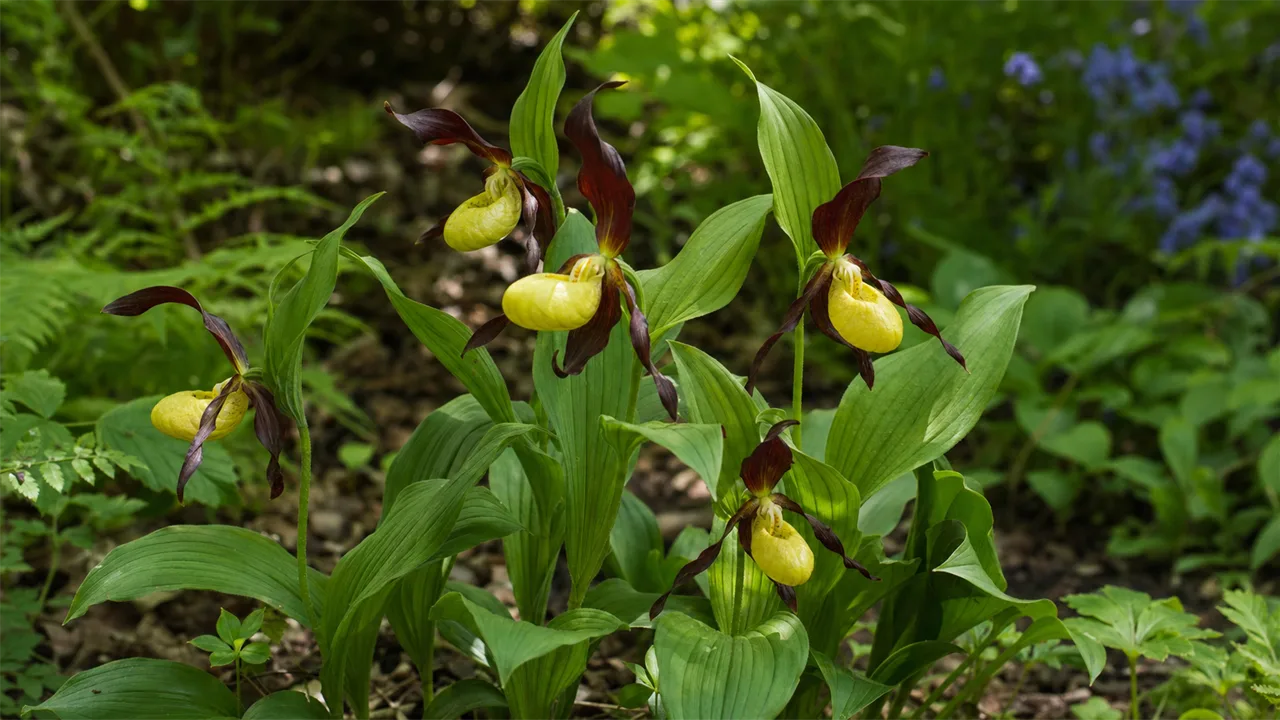
Stems are upright, finely downy, and usually 20–35 cm tall, arising singly from a short, creeping rhizome that grows just below the soil surface. Each stem carries three to five alternate, ovate to elliptic leaves 5–12 cm long, bright green, with parallel veins and slightly pleated surfaces. The flower sits at the top of the stem on a short pedicel and is built on the classic lady's slipper plan: a showy, inflated pouch (the labellum) flanked by three spreading outer segments and two narrower inner petals.
In Hank Small the pouch is a clear, saturated yellow, often with a faint pinkish flush at the mouth and a few reddish speckles inside. The lateral petals are held outwards and downwards, sometimes twisted or gently spiralled, and are coloured a warm reddish brown to mahogany with paler tips. The dorsal sepal arches forward over the pouch and is usually a greenish yellow veined and edged with maroon. Each flower lasts two to three weeks in cool weather; the flowering period for the whole plant is typically mid April to late May in southern England, and two to three weeks later in Scotland and the north of England.
After flowering the entire stem yellows and dies back by midsummer; new shoots appear the following spring from the same rhizome, so a mature clump is a slowly expanding colony rather than a tidy single rosette.
Growing Conditions
In the UK this hybrid tolerates a wider range of conditions than most lady's slipper orchids, but it still has firm preferences. The Royal Horticultural Society's advice for hardy Cypripedium is to grow them in moist, fertile, leafy, humus-rich, slightly alkaline soil in a sheltered site with dappled or partial shade, ideally with some morning sun.
Site: a north- or east-facing border, the shaded side of a hedge, or the dappled light beneath a deep-rooted deciduous tree such as beech, ash, or oak is ideal. Avoid the dry root run directly under thirsty conifers and avoid sites that bake in summer sun, where the rhizome can desiccate.
Soil: aim for a moist but free-draining, leafy loam that holds summer moisture without waterlogging. The single most common cause of failure in UK gardens is a dry, peaty, or strongly acid bed; this is not a rhododendron. Work a 5–8 cm top-dressing of well-rotted leaf mould or garden compost into the top 15–20 cm before planting, and finish with a 3–5 cm mulch of the same material after planting.
pH: a near-neutral to slightly alkaline soil in the pH 6.5–7.5 range suits this hybrid. Very acid Scottish or Welsh upland soils benefit from a light dusting of horticultural lime (about 50 g per square metre, raked in) before planting, then a fresh top-dressing of leaf mould every autumn.
Moisture: even moisture from spring through to early autumn is the goal. The rhizome sits only 2–3 cm below the surface, so it cools itself by contact with damp soil; a hot, dry August is the most dangerous time.
Planting and Care
When to plant. The best window in the UK is autumn, between mid October and late November, while the rhizome is dormant but the soil is still warm. Container-grown plants from specialist nurseries can also go in during March, once the worst frosts have passed.
How to plant. Soak the pot thoroughly an hour before planting. Dig a hole wider than the pot and just deep enough so that, when the plant is set in, the top of the compost and the tip of the youngest shoot sit 2–3 cm below the surrounding soil surface. Tip the rootball out without disturbing it, place it on a small mound of gritty, loam-based compost at the bottom of the hole, and backfill with a 50:50 mix of the native soil and leaf mould. Water in with a full can, and finish with a 3–5 cm mulch of leaf mould or fine bark, keeping the mulch a finger's width away from the new shoots.
Watering. From March to September, water deeply once a week if the weather is dry; in a normal British summer rainfall is usually enough once the plant is established. In pots, never let the compost dry to dust, and never let it sit in a saucer of water for more than an hour.
Feeding. A light, slow-release feed in March is plenty: a small handful of fish, blood and bone per plant, or a single teaspoon of a balanced organic fertiliser such as seaweed meal. Heavy nitrogen feeds produce soft, leafy growth that rots in winter; this is a woodland plant and rewards restraint.
Pruning. None. Leave the dying stems in place until they have yellowed and pulled away cleanly in late summer, because the rhizome is still drawing a little starch back from them. Cutting green stems back invites rot through the hollow crown. (Cypripedium falls under the herbaceous-perennial calendar class, where hard pruning is forbidden.)
Propagation. The only reliable home method is division of a mature, flowering-sized clump in late October, every four to five years. Lift the entire rhizome mass with a border fork, wash the soil off, and cut it into pieces with at least two strong growth buds and a healthy fan of roots. Replant immediately, water in, and label. Pot-grown plants can also be divided when they have filled their container; in either case, expect a flowering-size plant in two to three years from a well-grown division. Seed is technically possible but requires sterile lab conditions and a symbiotic soil fungus; do not attempt it from garden-saved seed.
Seasonal care.
- March: top-dress the bed with leaf mould, apply a light spring feed, and watch for emerging shoots; protect from slugs, which can chew the new tips.
- April–May: peak flowering; provide extra water if the soil is dry, and a temporary shade cloth during a hard frost forecast for late April.
- June–August: keep watering; do not let containers dry out.
- September: stop feeding, reduce watering as growth slows.
- October–November: divide mature clumps if needed, top-dress with fresh leaf mould, and clear fallen leaves from the crown only if they are sodden and likely to mat.
Common Problems
Slug damage on emerging shoots
Symptom: chewed or missing shoot tips in March and April; the leaf fan may be ragged before it has unfurled. Cause: native slugs, particularly in damp woodland beds. Fix: scatter organic ferric-phosphate slug pellets around the emerging shoots, or use a copper ring on container-grown plants. Many gardeners find a night-time torch-and-pick patrol the most effective control in March.
Failure to flower after a dry summer
Symptom: a healthy clump sends up blind shoots with no bud the following spring. Cause: the rhizome dried out during August or September, when the next year's buds are being initiated. Fix: deep-water weekly through the driest part of summer, especially in the south and east of England, and refresh the leaf-mould mulch so the soil surface stays cool.
Rot at the crown
Symptom: stems collapse in late spring or early summer, the base of the plant is mushy and brown, and the surrounding soil smells sour. Cause: waterlogged soil, especially in heavy clay over winter, or mulch piled against the new shoots. Fix: lift the plant in autumn, trim rotten tissue back to firm white rhizome, dust the cuts with sulphur, and replant in a free-draining, humus-rich bed on a slight mound. Improve the drainage of the original site with grit and leaf mould before replanting.
Yellowing leaves by midsummer
Symptom: leaves are normal green in May but fade and yellow by late June or early July. Cause: natural dormancy. The above-ground growth dies back as the rhizome enters summer rest. Fix: none needed. Do not cut the stems until they have yellowed fully and pull away cleanly; the rhizome is still feeding from them.
Aphids on flower stems
Symptom: small green or black aphids clustered on the new stems and beneath the bracts in late April. Cause: the soft new growth is attractive to aphids, and they can transmit virus between plants. Fix: wash them off with a strong jet of water, or apply a fatty-acid insecticidal soap at dusk. Avoid broad-spectrum insecticides, which also kill pollinating insects visiting the flowers.
Popular Varieties
Cypripedium Hank Small gx — the AGM-winning grex described in this article; vigorous, yellow-pouched, and the easiest entry point for a new UK grower.
Cypripedium calceolus — the native European yellow lady's slipper, smaller-flowered and slower to clump, but a conservation success in the Lake District and a fine garden plant in cool, limy soil.
Cypripedium formosanum — the Formosan lady's slipper, with beautifully pleated fan-shaped leaves and a soft pink-and-white flower in May; the best choice for a shadier, damper spot.
Cypripedium reginae — the showy lady's slipper from North America, with a white lip boldly streaked rose-pink; needs more moisture than Hank Small but rewards the patient grower.
Cypripedium kentuckiense — the Kentucky lady's slipper, the largest-flowered hardy species, with a creamy pouch and long, sweeping mahogany petals; needs free-draining soil and a touch more sun.
Sources & Further Reading
- Royal Horticultural Society, Cypripedium Hank Small gx plant profile: https://www.rhs.org.uk/plants/117068/cypripedium-hank-small-gx/details (accessed 2026-07-24).
- Royal Horticultural Society, Hardy orchids to try at home: https://www.rhs.org.uk/plants/articles/misc/hardy-orchids (accessed 2026-07-24).
- Royal Horticultural Society, Cypripedium calceolus (cultivation notes): https://www.rhs.org.uk/plants/112182/cypripedium-calceolus/details (accessed 2026-07-24).
- Royal Botanic Gardens Kew, Cypripedium in Plants of the World Online: https://powo.science.kew.org/taxon/urn:lsid:ipni.org:names:30008155-2 (accessed 2026-07-24).
- Frosch Exclusive Perennials, Cypripedium Hank Small (parentage and growth habit): https://www.cypripedium.de/English/plants/hank-small-e.html (accessed 2026-07-24).
- OrchidRoots, Cypripedium Hank Small hybrid record (C. parviflorum × C. henryi): https://orchidroots.com/display/summary/orchidaceae/100089314/ (accessed 2026-07-24).
Pests and Diseases
| Problem | Symptoms | Management |
|---|---|---|
| Slugs and snails | Irregular holes chewed in leaves or seedlings eaten entirely. | Use slug pellets, copper tape barriers, or hand-pick at night. |
| Root rot | Leaves turn yellow and wilt despite moist soil; roots appear mushy. | Ensure excellent drainage with gritty compost and avoid overwatering. |
| Powdery mildew | White powdery fungal growth on leaf surfaces causing distortion. | Improve air circulation and apply a suitable fungicide if severe. |
| Vine weevil | Notches on leaf margins during the day; larvae damage roots at night. | Apply nematodes to soil in autumn or use biological controls. |
For step-by-step help, read Dealing with Slugs and Snails and Treating Powdery Mildew. Or browse the full plant problem solver to diagnose an issue by symptom.
Recommended Products
GardenWizz earns a commission from qualifying purchases made through affiliate links on this page (including links within the article) — as an Amazon Associate, and from Thompson & Morgan via the Awin network. This does not affect the price you pay. See our disclaimer for details.