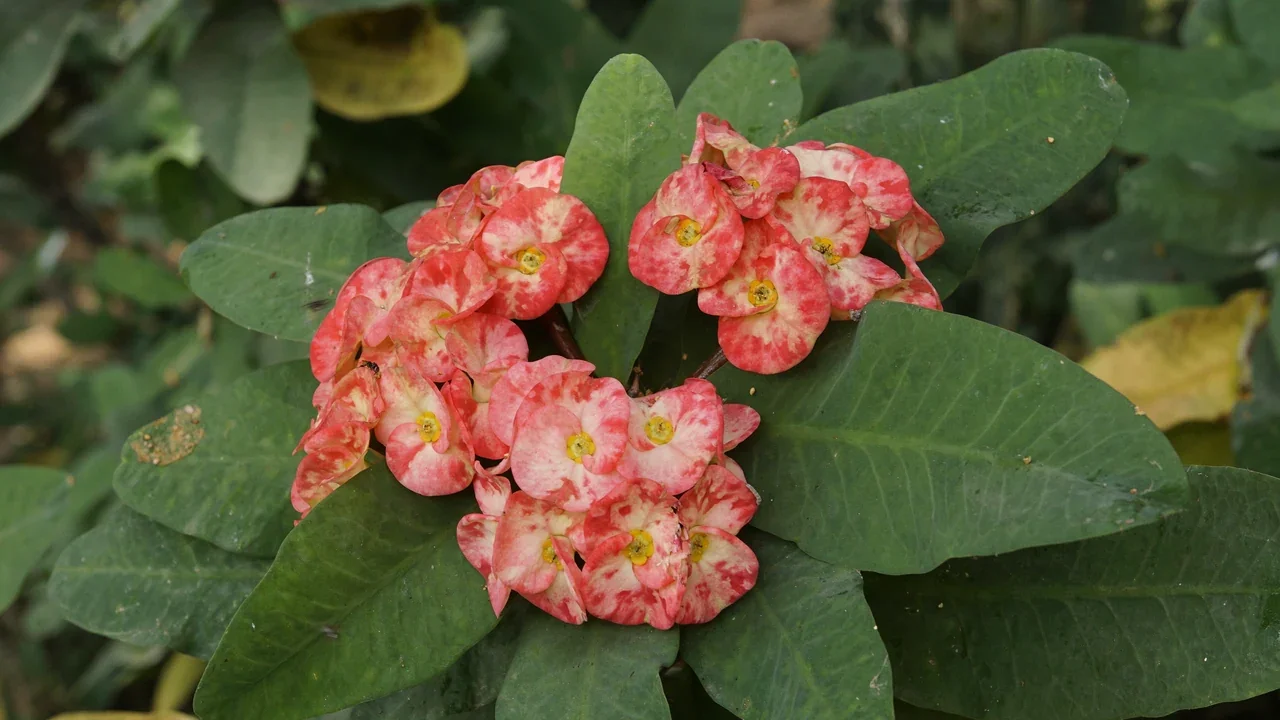
Crown of thorns
Euphorbia milii
The Gardening Year
Best months in UK gardens · full planting calendar →
🖨 Print-friendly care cardAt a Glance
| Botanical name | Euphorbia milii |
|---|---|
| Common name(s) | Crown of thorns |
| Family | Euphorbiaceae |
| Plant type | succulent |
| Height × Spread | ?–180 cm |
| Position | Full sun |
| Soil | Peat-free loam-based potting compost with added grit; free-draining. |
| Flowering | January–December |
| Toxicity | The sap is moderately poisonous and causes irritation on contact with skin or eyes. If ingested, it causes severe stomach pain, irritation of the throat and mouth, and vomiting. It is very toxic to domesticated animals such as horses, sheep, cats and dogs. For humans it is mildly toxic and only acts as an irritant. |
| Native range | Madagascar |
Growing crown of thorns
Euphorbia milii is a tender, spiny succulent shrub, usually grown in a bright conservatory or greenhouse in Britain. Use a peat-free, loam-based potting mixture improved with grit so water drains freely. It is not suitable for an exposed UK winter border.
Watering and care in winter
Water sparingly when new growth is active and give occasional low-nitrogen feed rather than heavy fertiliser. Keep much drier in winter, especially in cool, low-light conditions. Provide light and ventilation without exposing the plant to frost or prolonged cold damp.
Safety, pruning and problems
All parts should be treated as potentially harmful: the milky sap can irritate skin and eyes, and the plant is harmful if eaten. Keep away from children and pets, wear gloves and eye protection when cutting, and wash tools afterwards. Inspect for grey mould if air circulation is poor.
Source: RHS gardening guidance. Advice is adapted to UK growing conditions.
Pests and Diseases
| Problem | Symptoms | Management |
|---|---|---|
| Mealybugs | White, cottony wax masses appear in leaf axils and on stems, often accompanied by sticky honeydew. | Isolate the plant and treat infested areas with a cotton bud dipped in methylated spirits or apply an insecticidal soap. |
| Aphids | Small green or black insects cluster on new growth and flower buds, causing distortion and sticky residue. | Spray affected areas with a strong jet of water or apply a systemic insecticide if the infestation is severe. |
| Root rot | Leaves turn yellow and drop prematurely while stems become soft, mushy, and discoloured at the base. | Ensure well-draining compost and allow the soil to dry out between waterings; repot if necessary. |
| Leaf drop | Healthy-looking leaves fall off suddenly, often triggered by drafts, temperature changes, or overwatering. | Maintain consistent temperatures above 10°C and avoid moving the plant frequently or exposing it to cold drafts. |
| Spider mites | Fine webbing appears on leaves which become speckled, yellowed, and dry due to sap loss. | Increase humidity around the plant and spray with a miticide or insecticidal soap. |
Or browse the full plant problem solver to diagnose an issue by symptom.