bigleaf hydrangea
Hydrangea macrophylla · lacecap hydrangea
The Gardening Year
Best months in UK gardens · full planting calendar →
🖨 Print-friendly care cardAt a Glance
| Botanical name | Hydrangea macrophylla |
|---|---|
| Common name(s) | bigleaf hydrangea, lacecap hydrangea, mophead hydrangea, hortensia |
| Family | Hydrangeaceae |
| Plant type | shrub (deciduous) |
| Height × Spread | 3–3 m × 2.5–2.5 m |
| Position | Full sun |
| Soil | moist but well-drained soil |
| Flowering | June–November |
| Toxicity | hydrangine |
| Native range | Japan |
Overview
Hydrangea macrophylla is a deciduous, bushy shrub grown for broad foliage and generous summer flowerheads. The accepted botanical name is Hydrangea macrophylla (Thunb.) Ser., according to Kew Plants of the World Online. Kew places it in the Hydrangeaceae and records it as native to Japan, including southern central Japan, Izu Ōshima and Kazan Rettō, and as introduced in Great Britain. The RHS plant profile also treats H. macrophylla as the correct name and uses hortensia and mophead hydrangea as common names.
In a UK garden, this hydrangea is best understood as a moisture-loving shrub for a sheltered position. Light shade suits it particularly well. It can also grow in sun where the soil does not dry out, but drought and hot, exposed conditions raise the risk of scorched leaves and disappointing flowers. Its eventual dimensions and hardiness make it useful as a substantial garden shrub, although compact named selections can suit containers and smaller spaces.
The species guide below describes H. macrophylla as a whole. Individual cultivars vary in flower form, colour, final size and potentially hardiness, so a plant label or current cultivar-specific description should guide the final choice.
Plant record
- Botanical name: Hydrangea macrophylla (Thunb.) Ser.
- Common names: hortensia; mophead hydrangea
- Family: Hydrangeaceae
- Plant type and habit: deciduous, bushy shrub
- Eventual height: 1.5–2.5 m as a species-profile guide
- Eventual spread: 1.5–2.5 m as a species-profile guide
- Position: sheltered sun or partial shade; light shade is preferred, while sunnier sites need reliably moist soil
- Soil: moist but well-drained clay, loam or sand; acid, neutral or alkaline
- Flowering: mid- to late summer
- Hardiness: RHS H5, hardy in most UK places, including severe winters, approximately −15 to −10°C
- Safety: wear gloves or other protective equipment when handling because the RHS marks the plant as a skin allergen. All parts may cause mild stomach upset if ingested, and the RHS marks the plant as harmful if eaten by dogs and cats.
Appearance
The shrub has a bushy habit. Its broad, coarse, oval leaves are dark green and may reach 20 cm long. Because the foliage is deciduous, it is carried during the growing season and shed rather than remaining evergreen through winter.
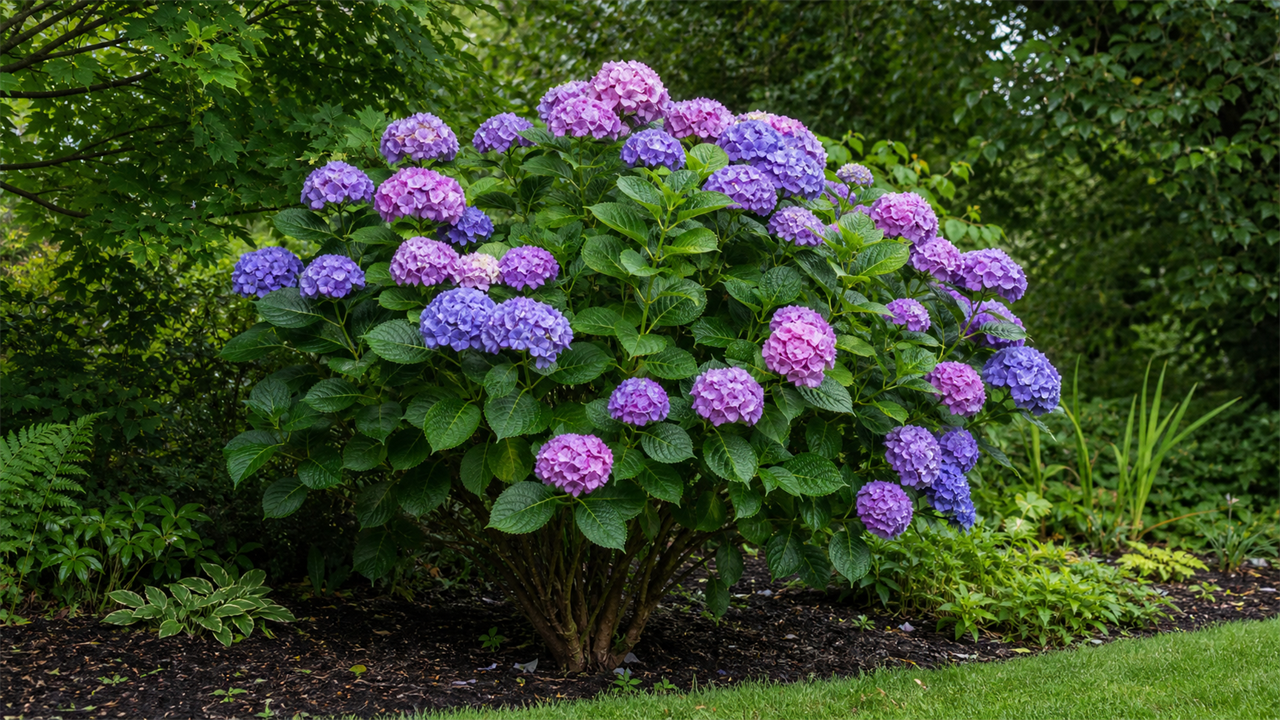
The familiar flowers appear in flattened heads from mid- to late summer, but the arrangement differs between the two main cultivated forms. Mopheads carry heads made up mainly of large, showy sterile florets. Lacecaps have a ring of showy sterile florets around many smaller fertile flowers in the centre. This distinction is more useful than assuming that every H. macrophylla has the same domed floral shape.
Flower colour also needs a careful reading. Suitable pink- and blue-flowered cultivars tend towards blue in acidic soil, mauve around neutral conditions and pink in alkaline soil. The RHS guide to shrubby hydrangeas gives approximately pH 4.5–5 for retaining blue flowers. That does not mean that every hydrangea changes colour: white, red and green cultivars are not reliable candidates for this response. Soil pH should therefore be treated as a way to influence colour in an appropriate cultivar, not as a universal rule for the species.
The 1.5–2.5 m height and spread in the plant record are useful expectations for the species profile, not a promise for every named plant. Some cultivars stay notably smaller. Check the eventual height and width of the particular selection before deciding where it will fit.
Growing Conditions
Moisture is the central requirement. Hydrangea macrophylla grows in clay, loam or sandy soil provided that it is moist but well drained. It accepts acid, neutral or alkaline conditions, although pH may affect the flowers of suitable blue- and pink-flowered cultivars. A site that remains waterlogged is not equivalent to one that holds useful moisture: waterlogging is a likely cause of poor performance.
Choose a sheltered position in sun or partial shade. Light shade reduces moisture stress and is the safer general recommendation. A sunnier place can work when the soil remains reliably non-dry through summer, but full sun combined with drought can lead to leaf scorch and reduced flowering. The same moisture requirement becomes particularly important for container-grown plants, because their compost can dry out quickly.
The RHS rates the species H5, which means it is hardy in most UK places, including severe winters, at roughly −15 to −10°C. Even so, hardiness does not prevent every kind of weather damage. Late frost can injure new shoots and flower buds, especially where growth has started in a vulnerable position. Shelter and the practice of retaining old flowerheads through winter help protect the developing buds beneath them.
Gardeners choosing a named cultivar should not automatically transfer the species dimensions or H5 rating to it. Cultivar labels govern final size and hardiness. The species profile is a sound starting point, while the named plant’s current description supplies the more specific expectation.
Planting and Care
Spring and autumn are the main planting seasons. A container-grown hydrangea can also be planted at other times of year when the ground is not frozen, waterlogged or excessively dry. Before planting, water the rootball. Set the shrub at the same depth at which it was growing in its container, then water it in thoroughly.
Apply an organic mulch to help the soil retain moisture, leaving a gap of 10–15 cm around the base of the plant. The gap keeps the mulch away from direct contact with the stems. For a newly planted shrub, water during dry spells throughout its first growing season. Established plants should also be watered in hot, dry weather rather than being left until the foliage and flowers suffer obvious stress.
Routine feeding is generally unnecessary once the shrub is established. More fertiliser is not automatically better: excessive feeding can encourage soft, leafy growth and increase the risk of frost damage. Attention to moisture, shelter and appropriate pruning is more important than pushing the plant into lush growth.
Prune H. macrophylla lightly in mid-spring. Leave the faded flowerheads in place over winter, then remove them to healthy buds when pruning. The shrub flowers on new shoots arising from stems made in the previous year. Cutting hard across the plant removes much of that flowering framework and can sacrifice the coming display.
If an established shrub needs renewal, remove one or two old stems at the base rather than cutting everything back. This retains younger flowering wood while gradually refreshing the plant. Where a hydrangea has produced few flowers after severe pruning, time and lighter future pruning may be more appropriate than another hard cut.
Propagation is possible from softwood cuttings in early summer or hardwood cuttings in winter. RHS guidance also records semi-ripe cuttings in midsummer. These timings refer to different stages of shoot maturity and should not be blended into a single cutting method.
Common Problems
Dry conditions and excessive sun are among the most common preventable problems. They can cause leaf scorch, moisture stress and poor flowering. Water new plants during dry spells, watch containers particularly closely, and use organic mulch to slow moisture loss. If a sunny site repeatedly dries out, the position may simply be a poor match for this shrub.
Late frost can damage fresh shoots and buds. A sheltered site and delayed removal of the previous season’s flowerheads offer some protection, although they cannot guarantee that every bud will escape an unusually late cold spell. Waterlogged soil presents the opposite moisture problem: roots need a moist but well-drained environment, not permanently saturated ground.
A shrub that grows strongly but produces few flowerheads may have been pruned too hard. Because new flowering shoots arise from the previous year’s stems, wholesale cutting in spring removes potential flowers. Keep pruning light and use selective removal of one or two old stems when renewal is needed.
Unexpected flower colour is not necessarily a sign of poor health. On suitable blue- or pink-flowered cultivars, the result may reflect soil pH: acidic conditions favour blue, near-neutral soil tends towards mauve and alkaline soil towards pink. The rule does not apply predictably to white, red or green cultivars, so adding acidity should not be presented as a universal colour correction.
The RHS lists aphids, capsid bug, hydrangea scale and vine weevil among possible pests. Hydrangea scale can be conspicuous in early summer, when white, waxy, flat deposits appear on stems and leaves. Listed diseases and disorders include leaf spot, grey mould, powdery mildew and honey fungus. A symptom should be identified before action is taken, because similar-looking decline can also follow drought, frost damage or waterlogging.
Wear gloves or other protective equipment when handling the plant because of the RHS skin-allergen warning. Do not eat any part of the plant: RHS genus guidance says ingestion may cause mild stomach upset, and its species profile marks H. macrophylla as harmful if eaten by dogs and cats.
Popular Varieties
Cultivar choice is the point at which flower form, colour and garden scale become specific. The RHS overview of shrubby hydrangeas identifies ‘Zorro’ as a lacecap selection, with a stated height and spread of 1–1.5 m. Its lacecap form means that the showy outer sterile florets frame many smaller fertile flowers in the centre.
‘Altona’ is a compact named selection. The RHS genus guide gives it a height of 0.5–1 m and a spread of 1–1.5 m, and RHS guidance includes it among examples for containers. ‘Red Hot Violet’ is another compact H. macrophylla cited by the RHS as a container example. These cultivar dimensions should not be substituted for the broader 1.5–2.5 m species guide, and the species size should not be imposed on a cultivar known to remain smaller.
These examples illustrate useful choices rather than a permanent list of what is universally popular or currently available. Nursery stock, award status and cultivar-specific hardiness can change or require a current dedicated source. Check an up-to-date cultivar description before purchase, especially where a precise mature size or particular level of hardiness is essential.
Start by choosing between mophead and lacecap flower structure, then consider eventual size, the available moisture and shelter, and whether the intended flower colour is one of those that can respond to pH. That sequence keeps the decision grounded in the real growing conditions of the garden rather than relying on flower colour alone.
Cultivars and Varieties
| Cultivar | Height | Flower | Notes | AGM |
|---|---|---|---|---|
| 'Altona' | — | — | RHS AGM (H5) | ✔ |
| 'Bläuling' | — | — | RHS AGM (H5) | ✔ |
| 'Blaumeise' | — | — | RHS AGM (H5) | ✔ |
| 'Brügg' | — | — | RHS AGM (H5) | ✔ |
| 'Dalian' | — | — | RHS AGM (H5) | ✔ |
| 'Étoile Violette' | — | — | RHS AGM (H5) | ✔ |
| 'Générale Vicomtesse de Vibraye' | — | — | RHS AGM (H5) | ✔ |
| 'Kardinal' | — | — | RHS AGM (H5) | ✔ |
| 'Klaveren' | — | — | RHS AGM (H5) | ✔ |
| 'Koria' | — | — | RHS AGM (H5) | ✔ |
| 'lacecap hydrangea' | — | small flowers surrounded by a halo of large sterile flowers | — | |
| 'Lanarth White' | — | — | RHS AGM (H5) | ✔ |
| 'Libelle' | — | — | RHS AGM (H5) | ✔ |
| 'Madame Emile Mouillère' | — | — | RHS AGM (H5) | ✔ |
| 'Mariesii Lilacina' | — | — | RHS AGM (H5) | ✔ |
| 'mophead hydrangea' | — | large, sterile or mostly sterile tetramerous flowers | — | |
| 'Möwe' | — | — | RHS AGM (H5) | ✔ |
| 'Nachtigall' | — | — | RHS AGM (H5) | ✔ |
| 'Parzifal' | — | — | RHS AGM (H5) | ✔ |
| 'Pengwyn' | — | — | RHS AGM (H5) | ✔ |
| 'Rotschwanz' | — | — | RHS AGM (H5) | ✔ |
| 'Schöne Bautznerin' | — | — | RHS AGM (H5) | ✔ |
| 'Tokyo Delight' | — | — | RHS AGM (H5) | ✔ |
| 'Trebah Silver' | — | — | RHS AGM (H5) | ✔ |
| 'Veitchii' | — | — | RHS AGM (H5) | ✔ |
| 'Wedding Gown' | — | — | RHS AGM (H5) | ✔ |
| 'Zorro' | — | — | RHS AGM (H5) | ✔ |
Pests and Diseases
| Problem | Symptoms | Management |
|---|---|---|
| Slugs and snails | Irregular holes chewed in leaves and stems, often accompanied by silvery slime trails. | Use physical barriers like copper tape or crushed eggshells, and apply iron phosphate pellets. |
| Hydrangea scale | White oval waxy patches on stems and leaves, leading to yellowing foliage and reduced vigour. | Prune out heavily infested branches and treat with horticultural oil during the crawler stage. |
| Powdery mildew | A white, dusty fungal growth appears on leaves and flower buds, causing distortion. | Improve air circulation, avoid overhead watering, and apply a sulphur-based fungicide if severe. |
| Leaf spot | Dark brown or black spots with yellow halos develop on leaves, which may eventually drop. | Remove affected foliage and avoid wetting leaves when watering to reduce fungal spread. |
| Vine weevil | Notched edges on leaves during the day and root damage causing wilting at night. | Apply systemic insecticide granules to the soil in spring and autumn to control larvae. |
Or browse the full plant problem solver to diagnose an issue by symptom.