Farges Willow
Salix fargesii
The Gardening Year
Best months in UK gardens · full planting calendar →
🖨 Printable care card (PDF)At a Glance
| Botanical name | Salix fargesii |
|---|---|
| Common name(s) | Farges willow |
| Family | Salicaceae |
| Plant type | shrub (deciduous) |
| Height × Spread | 2.5–4 m × 2.5–4 m |
| Position | Full sun, Partial shade |
| Soil | Moderately fertile, deep, moist but well-drained; clay, loam or sand; acid, neutral or alkaline |
| Flowering | March–May |
| Toxicity | — |
| Native range | Gansu, Hubei, Shaanxi, and Sichuan in China |
Overview
Farges willow, Salix fargesii, is a distinctive deciduous willow from central China. Rather than forming the familiar narrow-leaved outline associated with many willows, it develops into a broad, bushy shrub with large, glossy leaves, conspicuous red winter buds and upright spring catkins. These features give it interest across several seasons and make it a useful specimen for gardeners who want an unusual hardy shrub.
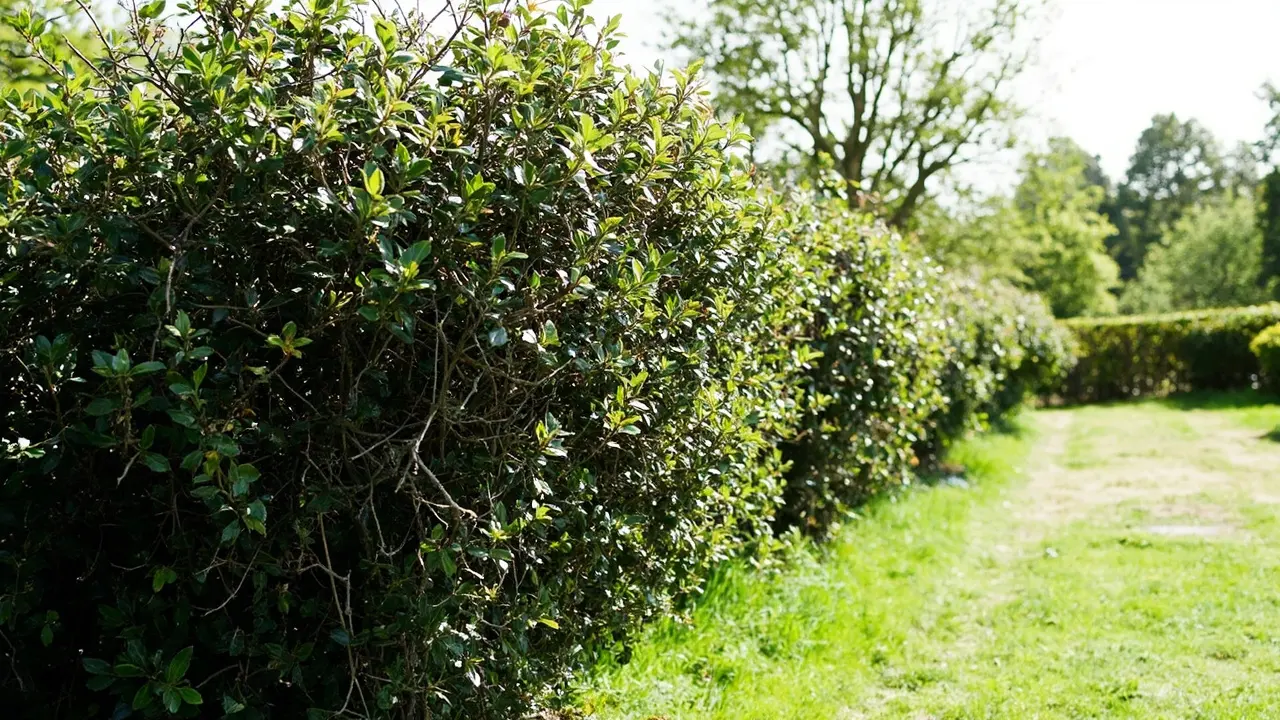
The Royal Horticultural Society (RHS) describes Salix fargesii as wide-spreading, with an eventual height and spread of about 2.5–4 metres after 10–20 years. A commonly quoted mature height is around 3 metres. That makes its mature footprint an important part of choosing a site: this is not a shrub to squeeze permanently into a narrow gap or directly beside a path.
The species is deciduous and non-native to Great Britain and Ireland. Its accepted botanical name is Salix fargesii Burkill, in the willow family, Salicaceae. Kew’s Plants of the World Online records its native range as central China. The RHS has given the species an Award of Garden Merit (AGM), indicating that it has proved to be a garden-worthy plant under appropriate conditions. The RHS also includes it in its Plants for Pollinators listing, describing its flowers as providing nectar and pollen for bees and other pollinating insects.
For a UK garden, its main strengths are reliable hardiness, bold foliage and striking winter-to-spring detail. It is best treated as a substantial ornamental shrub or small, shrub-like tree whose natural habit deserves room. Its requirements are not complicated, but good soil preparation, steady moisture during establishment and a reasonably sheltered position will help it develop well.
Appearance
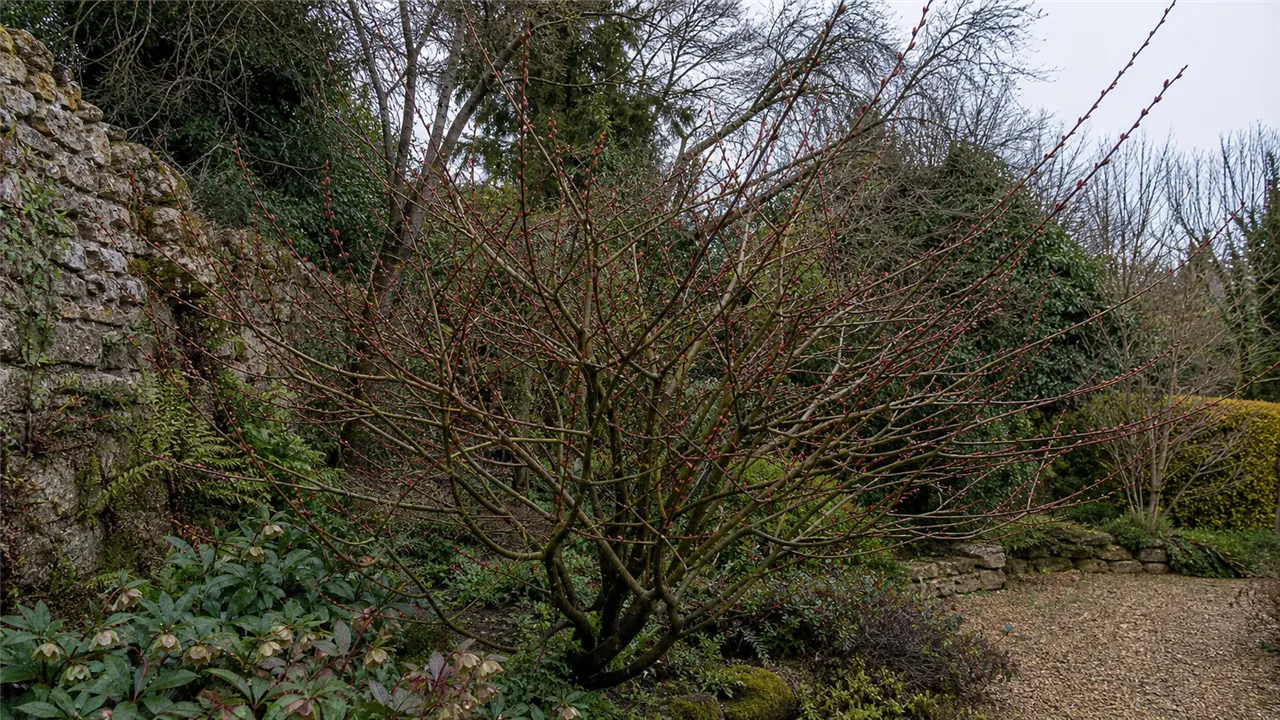
The combination of shoots, buds, leaves and catkins is the clearest way to identify Farges willow. Young branchlets are stout and glossy green. By their second year, they mature to a glossy dark brown, providing a strong framework behind the foliage. In winter, bright red buds stand out on the bare shoots and supply much of the plant’s off-season character.
The leaves are notably large for a willow, reaching up to about 18 cm long. They are glossy dark green above, with impressed veins that give the surface a strongly textured appearance, while the undersides are duller. Together, the broad leaves and wide-spreading growth create a dense, substantial effect rather than a light or weeping silhouette.
In spring, upright catkins appear. The RHS records slender male catkins up to about 12 cm long and female catkins up to about 18 cm. Willows generally bear male and female flowers on separate plants, so an individual plant’s floral display depends partly on its sex. Do not assume that every specimen will show catkins of both descriptions.
Appearance also changes with season and maturity. Red buds and the colour of older shoots are easiest to appreciate when the plant is leafless, while leaf gloss and deeply marked veins become prominent after growth resumes. Catkin size and character can vary between male and female plants. Use several features together when checking an identification, rather than relying on a single photograph or on foliage alone.
At maturity, expect a wide-spreading, bushy plant about 2.5–4 metres high and across. Its exact performance will depend on conditions and management, but planning for the full RHS size range avoids crowding neighbouring shrubs and reduces the temptation to control an unsuitable site through repeated hard pruning.
Growing Conditions
Choose a position with enough horizontal space for the plant’s eventual spread. Full sun is the preferred RHS position and should give the clearest starting point when selecting a site. The RHS cultivation guidance also allows partial shade, so a place with some shelter and lighter shade can be suitable; avoid turning that nuance into a promise that the shrub will thrive in deep shade.
Farges willow is rated RHS hardiness H6, meaning it is considered hardy throughout the UK and northern Europe, approximately down to −20 to −15°C. Cold tolerance does not remove the need for sensible siting. The RHS specifies a sheltered position, so an exposed, wind-scoured corner is not the ideal interpretation of “hardy”. Shelter can also help protect the large leaves and young growth from persistent damaging winds.
The plant accepts clay, loam or sandy soil and a broad pH range—acid, neutral or alkaline—provided the overall root environment is suitable. The most useful target is moderately fertile, deep soil that is moist but well drained. RHS information also accepts well-drained soil. This means the plant should have access to reliable moisture without being left in badly prepared ground where water remains stagnant around the roots.
Before planting, look at how the whole site behaves, not just the planting hole. Very dry, shallow soil will make establishment harder, while a compacted pocket that collects water after rain is also unsuitable. Improve the growing area as needed and keep the soil structure open. Where the garden is naturally dry, be realistic about whether regular establishment watering can be provided.
Allow 2.5–4 metres for both height and spread when considering nearby buildings, paths and other plants. This spacing is a practical recommendation derived from the RHS mature-size guidance. It is especially important with a wide shrub: allowing room at the outset is easier and healthier than repeatedly cutting it back from an obstruction.
Planting and Care
Plant into prepared, deep soil in a sunny or partly shaded, sheltered position. Dig over an area wide enough to encourage roots beyond the original root ball, dealing with compaction and perennial weeds before planting. Set the plant at the same depth at which it was growing, firm the soil gently and water it thoroughly. Avoid burying the base of the stems.
During establishment, keep the root zone consistently moist, particularly through dry spells. This is practical guidance based on the species’ preference for moist, well-drained soil, rather than a species-specific watering experiment. Check the soil before watering: the aim is steady moisture, not a permanently saturated planting hole.
A mulch can help reduce evaporation and competition from weeds. Apply it over the root area while leaving a clear gap around the stems, so damp material does not sit directly against the plant. Renew it when needed and continue to watch the soil below rather than assuming a mulched surface means the root zone is moist.
Once established, ongoing care is mostly a matter of monitoring moisture, maintaining space and removing damaged or misplaced growth. A naturally shaped specimen does not require annual hard pruning. The RHS places Salix fargesii in pruning group 1, which generally means minimal pruning: remove dead, damaged or crossing growth and make any shaping cuts thoughtfully.
Pollarding is an optional alternative management approach, not a universal requirement. The RHS suggests that a plant managed this way can be pollarded every three to four years. Use that regime only when a deliberately managed form suits the garden and the gardener understands the stronger intervention involved. It should not be presented as necessary annual care or as a remedy for planting the shrub where there was never enough room.
Propagation can be attempted from softwood cuttings in early summer or hardwood cuttings in winter, both methods listed by the RHS. Keep labels accurate throughout propagation so young plants are not confused with other willows. Because the reviewed evidence does not establish named garden cultivars, propagation advice here applies to the species as represented by the source plant; it does not demonstrate that a plant is a particular selection.
Common Problems
Farges willow may be affected by several pests, but their presence is possible rather than inevitable. The RHS lists aphids, caterpillars, leaf beetles, sawflies and willow scale. Inspect changes carefully before taking action: distorted growth, chewed foliage or insects on stems can have different causes, and correct identification should come before treatment.
Keep the plant in appropriate conditions and check it periodically, including the undersides of leaves and the stems. Where damage is limited, monitor whether it is increasing and use proportionate controls appropriate to the diagnosed pest. Avoid treating the plant merely because a general willow pest appears on a list.
Diseases identified by the RHS as possible problems include willow anthracnose, scab, canker, honey fungus and rust. Symptoms such as spotting, dieback, stem lesions or fungal growth are not, by themselves, a reliable diagnosis. Remove fallen affected material where appropriate, keep tools clean when pruning and seek an informed diagnosis when symptoms are persistent, severe or unclear. Honey fungus and canker in particular can require decisions based on the wider garden situation, not a generic one-size-fits-all response.
Good siting helps reduce avoidable stress. A deep, moderately fertile soil with reliable moisture, adequate drainage, shelter and enough space supports steadier growth than a cramped or drought-prone position. However, suitable cultivation cannot guarantee that a pest or disease will never occur.
No authoritative source reviewed for this guide supplied a species-specific statement that Salix fargesii is edible, medicinal, safe for people or safe for pets. It would therefore be misleading to make any of those claims. Prevent intentional ingestion and seek appropriate medical or veterinary advice if ingestion is suspected. This precaution records an evidence gap; it is not a claim that the species is known to be toxic.
Popular Varieties
Named garden cultivars of Salix fargesii are not established in the authoritative evidence reviewed for this guide. Gardeners should be cautious of lists that fill the gap with unrelated willows or that present botanical categories as though they were named ornamental selections.
Kew recognises two accepted infraspecific taxa: Salix fargesii var. fargesii and Salix fargesii var. kansuensis. These are botanical varieties, a taxonomic rank below species; they are not evidence of widely available UK garden cultivars. “Variety” in a botanical name and “cultivar” in horticultural trade are not interchangeable terms.
When buying, ask for the full botanical name shown on the label and check the supplier’s provenance information. If a plant is offered under a selection name, look for a reliable description explaining how it differs and whether that name is formally used in horticulture. Without that evidence, treat it as Salix fargesii rather than assuming special characteristics.
This limited selection need not be a disadvantage. The species itself supplies the qualities for which it is grown: glossy, strongly veined leaves, bright red winter buds, ageing dark-brown shoots, upright spring catkins and a broad, hardy habit. Keeping the choice centred on correctly identified Salix fargesii is more useful than padding a planting guide with other Salix species that may have different sizes, appearances and cultivation needs.
Sources
- Royal Horticultural Society: Salix fargesii — Farges willow
- Royal Botanic Gardens, Kew, Plants of the World Online: Salix fargesii Burkill
- University of Washington Botanic Gardens: Salix fargesii plant profile
Pests and Diseases
| Problem | Symptoms | Management |
|---|---|---|
| Aphids | Clusters of small soft-bodied insects on new growth causing leaf curling and sticky honeydew. | Squash by hand or spray with a strong jet of water; use insecticidal soap if infestation is severe. |
| Powdery mildew | White powdery fungal growth on leaves and stems, often leading to distorted new growth. | Improve air circulation and prune out affected shoots; apply a fungicide if necessary. |
| Slugs and snails | Irregular holes in young leaves and silvery slime trails on foliage and soil surface. | Use physical barriers like copper tape or apply iron phosphate-based slug pellets at night. |
| Vine weevil | Notched edges on leaves above ground and root damage below, causing wilting in potted plants. | Apply systemic insecticide drench or use nematodes to control larvae in the soil. |
| Leaf spot | Small brown or black spots on leaves that may enlarge and cause premature leaf drop. | Remove affected leaves and avoid overhead watering to keep foliage dry. |
For step-by-step help, read Controlling Aphids Naturally, Dealing with Slugs and Snails, Treating Powdery Mildew and Tackling Black Spot on Roses. Or browse the full plant problem solver to diagnose an issue by symptom.
Recommended Products
GardenWizz earns a commission from qualifying purchases made through affiliate links on this page (including links within the article) — as an Amazon Associate, and from Thompson & Morgan via the Awin network. This does not affect the price you pay. See our disclaimer for details.