
Russian Sage
Perovskia atriplicifolia
The Gardening Year
Best months in UK gardens · full planting calendar →
🖨 Printable care card (PDF)At a Glance
| Botanical name | Perovskia atriplicifolia |
|---|---|
| Common name(s) | Russian Sage |
| Family | Lamiaceae |
| Plant type | perennial (deciduous perennial subshrub) |
| Height × Spread | 50–120 cm × 60–120 cm |
| Position | Full sun |
| Soil | well-drained, poor to moderately fertile soil; tolerant of dry chalky soil and coastal conditions; succeeds on acidic, chalky, alkaline, light, sandy soils |
| Flowering | June–October |
| Toxicity | — |
| Native range | southwestern and central Asia; China |
Russian sage is a long-flowering, drought-tolerant sub-shrub grown for its hazy clouds of violet-blue flowers and silver-grey foliage from midsummer into autumn. Despite the common name, it is not a true sage: it belongs to the mint family alongside lavender and rosemary, and originates from the dry, rocky slopes of Central Asia rather than Russia. In UK gardens it is valued for surviving poor soils, exposed sites, and prolonged dry spells, and for providing pollinator-rich colour at a time when many border perennials are beginning to tire.
Overview
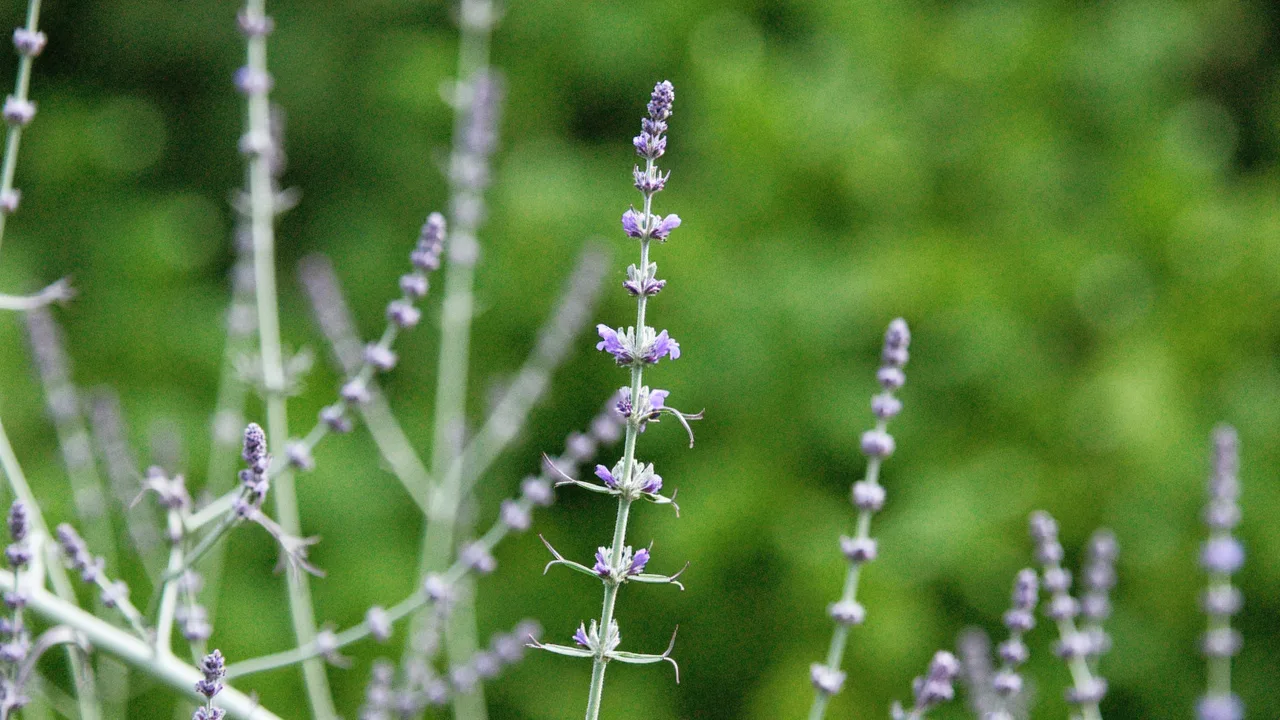
Perovskia atriplicifolia is a woody-based member of the Lamiaceae, forming an upright, vase-shaped clump of slender, square stems clothed in finely divided, aromatic grey-green leaves. From late July the upper portions of the stems erupt into branching terminal spikes studded with small, tubular, two-lipped flowers in a soft violet-blue. The hazy effect — silver foliage and pale blue flowers held on airy branching stems — has made it a staple of hot-coloured, drought-tolerant and prairie-style plantings.
The plant is fully hardy across most of the UK given sharp drainage, and will tolerate exposed coastal, chalk and gravel-garden conditions once established. It is also a first-class plant for pollinators, drawing in large numbers of bumblebees, honeybees and hoverflies through the late-summer dearth. Recent taxonomic work has transferred the species into Salvia (as Salvia yangii), but the name Perovskia atriplicifolia remains the form most widely sold in UK nurseries and is the name used throughout this entry.
Appearance
The overall habit is that of a soft, silver-grey mound roughly 90–150 cm tall and as much across at maturity, broader in warm, sheltered gardens and more restrained in cold or exposed sites. Stems are characteristically square — a defining feature of the mint family — and when young are coated in a dense pelt of fine white hairs that lends the whole plant its dusty appearance. Mature, overwintered stems turn pale grey-brown and develop a light woody base, though the upper portions remain herbaceous and are usually cut back each spring.
Leaves are opposite, deeply lobed, and roughly 3–5 cm long. They are grey-green above and paler beneath, with both surfaces carrying the same silvery pubescence. When bruised they release a slightly sage-like, resinous scent, though milder than true culinary sage (Salvia officinalis).
Flowering begins in late July and continues into October, peaking in August and early September. Individual blooms are small — perhaps 1 cm across — but they are carried in generous tiered whorls along branched terminal panicles, each whorl backed by a small, hairy, dark violet calyx that is itself decorative and persists after the petals have fallen. The combined effect is a soft, almost smoky blue haze that sits well against ornamental grasses and the hotter colours of late-summer perennials.
Growing Conditions
Russian sage wants sun, drainage and space. Full sun is essential: in anything more than light shade the stems elongate, the foliage loses its dense silver character, and flowering is sparse. Soil should be well-drained and lean rather than rich; it thrives on chalk, gravel and sandy soils, and tolerates the slightly alkaline conditions (pH 6.5–8.0) found across much of southern and eastern England. It will not tolerate winter waterlogging, and a heavy clay that holds moisture around the crown through January and February is the most common reason for failure in UK gardens. On heavier ground, plant on a slight ridge, in a raised bed, or work in generous grit before planting.
Hardiness is rated RHS H4, meaning the plant tolerates down to roughly −10 °C and is reliable across most of lowland and coastal Britain. In colder inland districts, northerly gardens, or exposed sites in the Scottish borders, top growth may be killed back in a hard winter, but the woody base usually resprouts in spring if drainage has been sound.
Wind resistance is excellent: the fine foliage yields rather than tears, and the wiry stems flex without breaking. This makes Russian sage particularly useful in coastal gardens, on exposed herbaceous borders, and in dry, sunny courtyards where taller, more brittle plants struggle.
Planting and Care
The best planting times in the UK are mid-spring (April–May) once frost risk has passed, or early autumn (September) in mild districts where plants can root before winter. Container-grown stock establishes readily. Space plants 60–90 cm apart, and on heavy ground set the crown slightly proud of the surrounding soil so that surface water runs away from the base.
Watering is needed only during the first growing season. Soak thoroughly at planting and during any prolonged dry spell in the first summer; thereafter, supplementary watering is rarely required and overwatering is actively harmful. Feeding is similarly minimal — a single light top-dressing of well-rotted compost in spring is plenty on reasonable soils, and on very poor or freedraining ground it can be omitted altogether. A surface mulch of coarse grit around the crown (not piled over the woody base) improves surface drainage, suppresses slug damage on emerging shoots, and reflects heat back into the plant.
Pruning is the single most important task. In March or early April, cut all of the previous year's stems back to roughly 10–15 cm above the woody base, leaving a low framework of healthy shoots. New growth is rapid and the plant flowers on wood produced in the same season. Pruning later than mid-spring delays flowering; pruning in autumn removes the very wood that would carry next year's display and exposes the crown to winter wet. Skipping the annual cut altogether leads to a sparse, leggy plant that flops and flowers poorly.
Propagation is straightforward. Softwood cuttings taken in late spring root readily in a gritty propagating mix under cover; semi-ripe cuttings in mid-summer work equally well. Seed-raised plants are variable and should not be used to perpetuate named cultivars, which must be propagated vegetatively to come true. Established clumps can also be lifted and divided in spring, though the woody base resents heavy disturbance and many gardeners find it easier to replace ageing plants after 8–10 years if the centre begins to hollow out.
Common Problems
Winter die-back from waterlogged soil is the leading cause of loss in UK gardens. Improving drainage, planting on a slight rise, and avoiding heavy autumn mulches that sit wet against the crown are the most effective preventions. In persistently damp sites, consider growing Russian sage in a large container of gritty loam-based compost rather than in the open ground.
Powdery mildew can appear in still, humid weather, particularly where plants are crowded or overfed. Symptoms are a grey-white bloom on the leaves, usually in late summer. Good air movement, careful spacing, and avoiding nitrogen-rich feeds keep it in check; cutting back affected stems at the end of the season and disposing of the prunings reduces carry-over.
Root rots, including Phytophthora, are associated with the same poorly drained conditions that cause winter die-back and are best prevented by siting rather than cured. Slugs and snails will graze the tender young shoots in spring; a grit mulch and, where necessary, organic slug pellets give reliable protection.
Failure to flower almost always traces to one of three causes: insufficient sun, pruning in autumn, or over-rich, over-watered soil that encourages leafy growth at the expense of blooms. Frost damage in cold districts is usually cosmetic — the top dies back but the crown resprouts — though a thick, dry mulch of straw or bracken placed over the crown in late autumn gives useful protection in inland gardens north of Yorkshire.
Popular Varieties
'Little Spire' is a compact selection reaching roughly 60–75 cm, with the same violet-blue flowers and silver foliage as the species. It received the RHS Award of Garden Merit in 2012 and is the best choice for smaller borders, raised beds and containers. 'Blue Spire' is taller (to about 120 cm), with deeply cut leaves and strong, upright branching spikes of deep violet-blue. 'Lacey Blue' ('Lisslitt') is one of the most compact cultivars available, generally topping out at 40–50 cm, with a particularly intense blue flower and a tidier, less sprawling habit than the species. Where space allows, 'Filigran' is valued for its exceptionally finely cut, almost lace-like foliage that holds its silver colouring well through summer. Buyers should note that the closely related Perovskia 'Rocketman' is sometimes listed in UK trade catalogues, though nomenclature in this group has been unsettled since the genus was subsumed into Salvia; plants offered under that name should be checked at point of sale for size and habit.
Pests and Diseases
| Problem | Symptoms | Management |
|---|---|---|
| Powdery mildew | A white, dusty fungal growth appears on the leaves and stems, particularly in humid conditions. | Ensure good air circulation by spacing plants well and prune out affected growth in spring. |
| Root rot | The plant wilts and collapses despite moist soil, often with blackened or mushy roots. | Plant only in sharply draining soil and avoid overwatering to prevent waterlogging. |
| Honey fungus | General decline, wilting, and dieback of stems, potentially with white fungal growth at the base. | Improve drainage and remove infected plants entirely to prevent spread to neighbours. |
| Verticillium wilt | Sudden wilting and yellowing of leaves on one side of the plant, often with brown streaks in stems. | Remove and destroy infected plants immediately as there is no chemical cure. |
| Winter wet damage | Stems rot at the base during cold, wet winters, leading to plant collapse. | Avoid mulching heavily around the crown and ensure the site has excellent drainage. |
For step-by-step help, read Treating Powdery Mildew. Or browse the full plant problem solver to diagnose an issue by symptom.
As an Amazon Associate, GardenWizz earns from qualifying purchases made through links on this page (including links within the article). This does not affect the price you pay. See our disclaimer for details.