
Cherry Blossom
Prunus serrulata
The Gardening Year
Best months in UK gardens · full planting calendar →
🖨 Printable care card (PDF)At a Glance
| Botanical name | Prunus serrulata |
|---|---|
| Common name(s) | Cherry Blossom |
| Family | Rosaceae |
| Plant type | tree (Deciduous) |
| Height × Spread | 8–12 m × 8 m |
| Position | Full sun |
| Soil | Moist but well-drained, moderately fertile soil; tolerates chalk, clay, loam, sand; acid, alkaline, or neutral pH |
| Flowering | April–May |
| Toxicity | — |
| Native range | Japan, China, Korea, Vietnam |
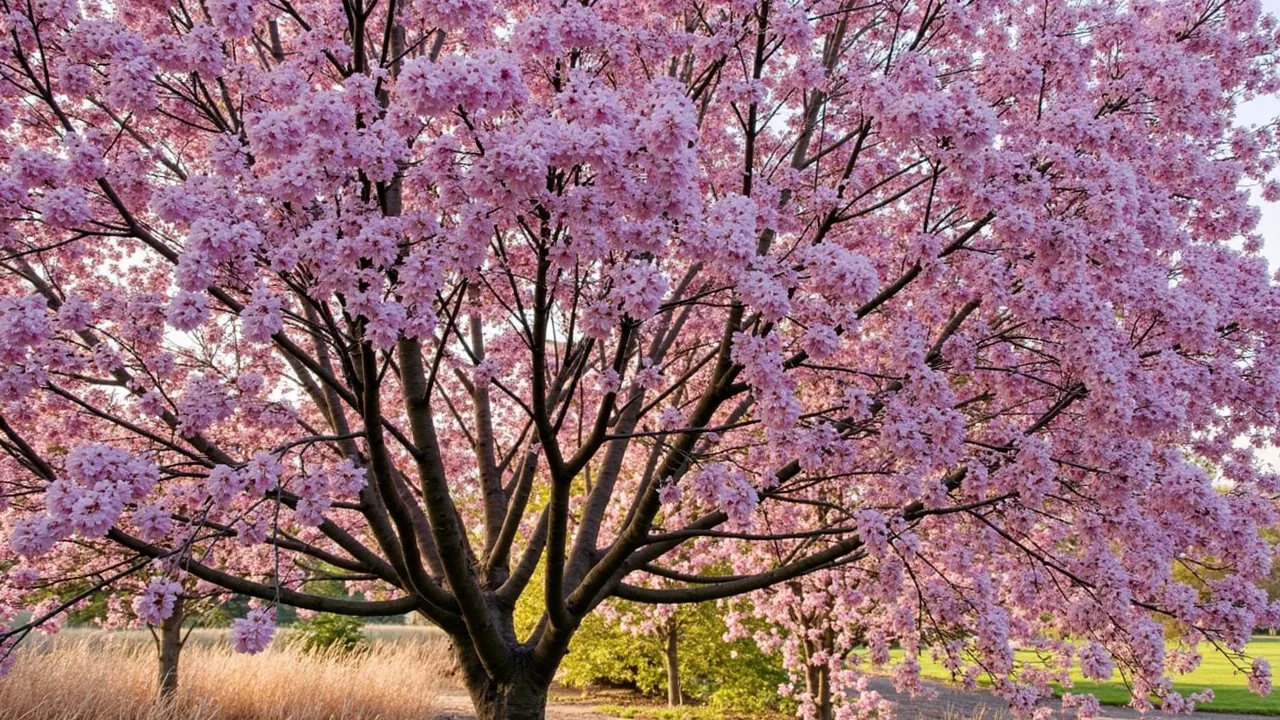
Cherry blossom refers to the ornamental flowering cherries of Prunus serrulata and its cultivars, deciduous trees grown across the UK for their spectacular spring display. Native to Japan, China and Korea, Prunus serrulata has been cultivated for centuries and forms the backbone of urban and garden cherry plantings in Britain, where it flowers reliably from late March through May.
Overview
Prunus serrulata belongs to the family Rosaceae and the genus Prunus, alongside plums, almonds, peaches and bird cherries. It is one of around 100 species in the genus, most of which produce flowers in clusters along bare or nearly bare branches before or with the emergence of new leaves. Ornamental cherries are valued almost entirely for this brief but overwhelming flowering display; their autumn foliage and architectural winter form are secondary attractions.
In the UK, flowering cherries are hardy across all but the coldest upland and exposed northern gardens and have naturalised very lightly in some areas. They are widely planted as street trees, parkland specimens and focal points in domestic gardens, and cultivars such as 'Kanzan' are among the most commonly planted ornamental trees in British towns. The species is long-lived for an ornamental, typically 30–50 years, with some specimens surviving considerably longer.
Appearance
Prunus serrulata is a broadly vase-shaped, spreading deciduous tree that ultimately reaches 5–12 m in height with a similar spread, depending on rootstock and cultivar. The bark is smooth and dark grey-brown, marked with prominent horizontal lenticels that give the trunk a banded appearance as it matures. Young branches are slender and often slightly pendulous at the tips, particularly in weeping cultivars.
Leaves are oval to obovate, 5–13 cm long, with finely and sharply serrated margins — the specific epithet serrulata refers to these saw-toothed edges. They emerge bronze-green in spring, mature to a mid- to dark-green in summer, and turn orange, red and deep crimson in autumn before falling.
The flowers are the plant's defining feature. They are produced in clusters of two to five along the previous year's wood, opening before or with the leaves in March to May depending on cultivar and local climate. Individual flowers are 3–6 cm across and range from pure white through pale blush to deep rose-pink, with single, semi-double and fully double forms available. Flowers typically last two to three weeks in cool spring weather, though hot or windy conditions shorten the display considerably.
A small number of cultivars produce small, glossy black drupes (cherries) in midsummer. These are edible but intensely bitter and are not used for culinary purposes; they may be useful to birds.
Growing Conditions
Prunus serrulata thrives in a sunny, open position sheltered from strong easterly and northerly winds, which can scorch open blossom and shorten the display. Best flowering occurs in full sun, though light dappled shade is tolerated. Avoid deeply shaded sites, where flowering will be sparse and the tree's natural form will be lost.
The ideal soil is moist but well-drained and reasonably fertile, with a pH between about 5.5 and 7.5. Cherries are intolerant of waterlogged conditions, which quickly lead to root death and bacterial canker, and they perform poorly on thin chalk soils unless improved with organic matter. Established trees are reasonably drought-tolerant once their root system has developed, but prolonged summer drought in the first two years after planting is the most common cause of failure.
RHS hardiness rating H5 indicates the species tolerates winter temperatures down to about -15 to -20 °C, making it suitable for all lowland and most upland parts of the UK. Container-grown specimens are more vulnerable to root damage in prolonged frost and benefit from being moved against a south-facing wall in colder regions.
Growth rate is moderate: young trees put on 30–60 cm of extension growth per year for the first decade, slowing as the crown matures. Most garden cultivars reach flowering size within three to five years of planting.
Planting and Care
Plant bare-root specimens between November and March, when the tree is dormant, taking care not to plant when the ground is frozen or waterlogged. Container-grown stock can be planted at any time of year, though autumn and early spring remain preferable as they avoid the need for daily watering through summer. Prepare a planting hole at least twice the width of the rootball and of similar depth, incorporating well-rotted organic matter into the backfill on poor soils. Stake taller specimens for the first two growing seasons and remove the stake once the root system is established.
Water thoroughly during the first two growing seasons, particularly during dry spells from May to September. After this, supplementary watering is needed only in prolonged drought. Apply a 5–8 cm mulch of well-rotted compost or bark in early spring, keeping it clear of the trunk, to conserve moisture, suppress weeds and supply slow-release nutrients.
Pruning should be minimal. Ornamental cherries have a naturally graceful form that is easily spoiled by hard cutting. Remove dead, damaged or crossing branches after flowering in late May or June, and cut out any suckers arising from the rootstock at the base. Avoid heavy pruning in winter or early spring, which stimulates watershoots and increases the risk of bacterial canker entering fresh wounds.
Feeding is generally unnecessary on fertile soils. On thin or sandy soils, apply a balanced general fertiliser such as growmore or blood, fish and bone in late February or early March at the manufacturer's recommended rate.
Propagation of ornamental cherries is by softwood or semi-ripe cuttings in early summer, by budding onto clonal rootstocks (mainly Prunus avium or Prunus 'Colt') in commercial production, or by grafting. Seed-raised plants will not come true to cultivar. Home propagation from cuttings is slow and often unsuccessful without bottom heat and mist.
Common Problems
Blossom wilt (Monilinia laxa) is the most damaging disease of flowering cherries in the UK. It causes flowers to turn brown and wither, often remaining attached to the twig, and can spread into the wood causing dieback. Prompt removal of infected material, cutting back to healthy wood, and disposal (not composting) are the main controls. Avoid planting in poorly ventilated sites.
Bacterial canker (Pseudomonas syringae) produces sunken, oozing lesions on the bark, often at the base of shoots or around leaf scars, and is the principal cause of branch dieback in older trees. It is most active in cool, wet conditions. Prune affected wood back to healthy tissue during dry weather, sterilising tools between cuts, and avoid heavy winter pruning.
Silver leaf (Chondrostereum purpureum) causes leaves to develop a metallic silver sheen and is most common on Prunus species. Remove affected branches promptly, cutting well back into healthy wood. Spores enter through wounds, so prune only in summer when infection risk is lowest.
Aphids, principally blackfly and greenfly, may colonise young shoot tips in late spring and distort new growth. They are largely cosmetic on healthy trees and are usually controlled by natural predators; severe infestations can be treated with a soap-based wash if needed.
Leaf spot (Coccomyces hiemalis and related fungi) causes small brown or purple spots on leaves, particularly in wet summers, with premature leaf fall. Rake up and dispose of fallen leaves in autumn to reduce carry-over of infection.
Late frosts are a recurrent threat in inland and northern gardens. A single sharp frost during flowering can brown open blossom overnight; choose a sheltered site and, in marginal areas, prefer later-flowering cultivars such as 'Shirofugen' and 'Shirotae' which tend to escape the worst of the frost.
Popular Varieties
'Kanzan' is the most widely planted ornamental cherry in the UK, a vigorous upright tree reaching 8–12 m with a stiff, vase-shaped crown. It bears dense clusters of large, fully double, deep pink flowers in late April to early May, with bronze young foliage that turns green in summer and orange-red in autumn. It is tough, urban-tolerant and commonly seen as a street tree.
'Tai-haku', the great white cherry, is a spreading tree to 6–8 m grown for its very large single white flowers, up to 6 cm across, opening with bronze young foliage in mid- to late April. It was thought lost to cultivation in Japan before being identified in Sussex in the early twentieth century, and remains one of the finest single-flowered cultivars.
'Shirofugen' is a broad, spreading tree to 6–8 m noted for its long-lasting double flowers that open white in late April and gradually age to pink as they fade, producing a two-tone effect. It flowers slightly later than most, which can be valuable in frost-prone gardens.
'Shirotae' ('Mount Fuji') is a wide-spreading, almost horizontal tree to 4–6 m tall and 7–9 m across, with fragrant, semi-double pure white flowers in mid-April. It needs space and is best as a specimen in an open lawn.
'Amanogawa' is a narrowly columnar form reaching 5–7 m tall by only 1.5–2 m wide, with semi-double pale pink flowers in late April. It is useful in smaller gardens and for narrow borders where a vertical accent is needed.
'Royal Burgundy' is a sport of 'Kanzan' with the same habit and double pink flowers but with deep purple-bronze foliage that holds its colour through summer and turns scarlet in autumn. It grows slightly slower than its parent and is valued for the contrast between pink flowers and dark leaves.
Pests and Diseases
| Problem | Symptoms | Management |
|---|---|---|
| Cherry leaf scorch | Leaves turn brown, shrivel, and remain attached to the tree throughout winter. | Remove fallen leaves in autumn to reduce fungal spores for the following year. |
| Cherry leaf spot | Leaves develop purple spots or yellow blotches and drop prematurely before autumn. | Collect and destroy fallen leaves to minimize overwintering fungal inoculum. |
| Silver leaf fungus | Branches show silver-grey patches on the underside of leaves and dieback occurs. | Prune out infected branches well below the visible symptoms and sterilize tools. |
| Powdery mildew | A white, dusty fungal growth appears on young shoots and leaves in spring. | Improve air circulation by thinning the canopy and avoid overhead watering. |
| Vine weevil | Notched edges on leaves above ground and root damage causing wilting below. | Apply nematodes to the soil in autumn or use physical barriers around pots. |
For step-by-step help, read Treating Powdery Mildew. Or browse the full plant problem solver to diagnose an issue by symptom.
As an Amazon Associate, GardenWizz earns from qualifying purchases made through links on this page (including links within the article). This does not affect the price you pay. See our disclaimer for details.