
Blackthorn
Prunus spinosa
The Gardening Year
Best months in UK gardens · full planting calendar →
🖨 Printable care card (PDF)At a Glance
| Botanical name | Prunus spinosa |
|---|---|
| Common name(s) | Blackthorn |
| Family | Rosaceae |
| Plant type | shrub (deciduous, suckering shrub; can grow to become a tree) |
| Height × Spread | 2.5–6 m × 2.5–4 m |
| Position | Full sun |
| Soil | moist well-drained soil; Chalk, Clay, Loam, Sand; Acid, Alkaline, Neutral pH |
| Flowering | March–April |
| Toxicity | All parts other than the flesh of the fruits are harmful to pets and humans if eaten; seed contains trace amounts of hydrogen cyanide |
| Native range | Europe, West Asia, northwest Africa |
Overview
Blackthorn (Prunus spinosa) is a dense, spiny deciduous shrub native to the British Isles and much of Europe, western Asia and north Africa. It is one of the earliest flowering woody plants in the UK, producing its small white blossoms on bare blackish branches from March into April, before the leaves emerge. The same plant later carries the hard, blue-black sloes that are gathered in autumn for sloe gin, jams and country wines. In gardens and hedgerows it is valued primarily as a wildlife plant and as a stock-proof barrier, but selected forms are also grown as ornamental specimens, particularly for the mass spring display.
In the wild, blackthorn is a coloniser of woodland edges, scrub, downland and old quarries, and it forms a major component of many traditional mixed hedgerows laid across the English and Welsh countryside. It is long-lived, hardy throughout the UK, and tolerant of a wide range of soils, which is why it remains a fixture of rural planting schemes and naturalistic garden designs.
Appearance
Blackthorn forms a dense, twiggy, suckering shrub with a rounded, irregular outline. The overall character is dark and angular: the bark on older wood is blackish-brown and somewhat rough, while the younger twigs that carry the flowers are a deep, near-black brown, giving rise to the common name. Every twig ends in a sharp, stiff spine, which is technically a modified shoot rather than a true thorn.
The leaves are small, oval to obovate, finely toothed along the margin, and pointed at the tip. They are typically 2–4 cm long, dull mid-green above and slightly paler beneath, and they emerge only after flowering has largely finished. In autumn they often turn a modest yellow before falling.
The flowers are the plant's chief ornamental feature. Each flower is roughly 1.5 cm across with five white, rounded petals and a cluster of yellow-tipped stamens at the centre. They are borne singly or in pairs from buds along the previous year's wood, so densely that the entire shrub can appear white in a cold, still March. The scent is mild, slightly almond-like, and on milder days will attract early bumblebees and solitary bees.
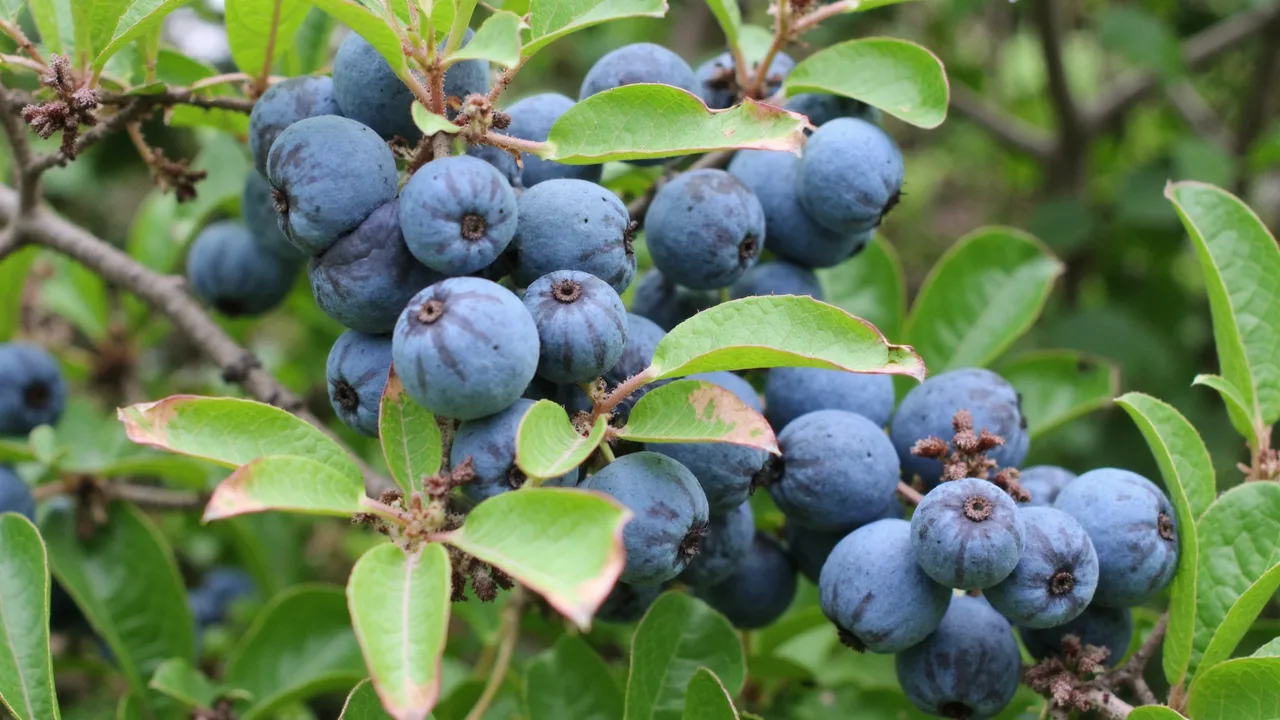
Fruits develop over summer and ripen from September into November. Each sloe is a small drupe about 1–1.5 cm across, green at first, then reddening, and finally reaching the familiar bloomed, blue-black colour when ripe. They are extremely astringent when raw, with a high tannin content, and are usually sweetened or processed before eating.
The root system is wide-spreading and produces suckers freely, which is what allows blackthorn to colonise hedge bottoms, embankments and field corners so effectively. Gardeners who want a contained plant should plan for this suckering habit from the outset.
Growing Conditions
Blackthorn is straightforward in most UK gardens, provided its basic requirements are met. It is fully cold-hardy across the whole of Britain, including upland areas of northern England and Scotland, and tolerates exposed sites that would damage less robust flowering shrubs. It grows well from sea level up to roughly 400 m in northern Britain, and higher in the more sheltered western districts.
It flowers most freely in full sun, where the wood ripens well and the spring display is densest, but it will tolerate light dappled shade, particularly in mixed hedgerows. Deep shade under evergreen canopy produces a leggy, sparse plant with poor flowering.
Soil-wise, blackthorn is undemanding. It grows on chalk, limestone, clay, loam and even quite poor, stony ground, and tolerates a pH range from mildly acid through to strongly alkaline. The one condition it dislikes is waterlogged ground, where it can develop root problems; on heavy clay it is worth planting on a slightly raised position or incorporating coarse organic matter to improve drainage. Once established it is notably drought-tolerant.
Because it suckers and grows densely, blackthorn is unsuitable for very small gardens unless the gardener is prepared to manage the suckers or confine the roots. It is ideal for the back of a large border, as part of a mixed wildlife hedge, or as a standalone specimen in a wild or naturalistic planting. Coastal gardens can use it successfully; it tolerates salt-laden wind reasonably well.
Planting and Care
Container-grown blackthorn can be planted at any time of year when the ground is workable, but autumn through to early spring is preferable, as it allows the roots to establish before the spring flowering and the onset of dry summer weather. Bare-root whips, the form traditionally used for hedging, are best planted between November and March while dormant. For a stock-proof hedge, set plants in a double staggered row about 30–45 cm apart, and cut back hard after planting to encourage bushy regrowth from the base.
Watering needs are modest. For the first growing season after planting, water during prolonged dry spells to help the roots establish. Thereafter, established plants in the open garden rarely need supplementary watering except in severe drought. Container-grown specimens do need regular watering through the growing season, as restricted rooting dries out quickly.
Feeding is not usually necessary on reasonable garden soil. If growth is poor or the foliage is pale, a general-purpose fertiliser such as blood, fish and bone, or a slow-release shrub fertiliser applied in early spring, will improve vigour. Mulching with well-rotted garden compost or bark in spring helps conserve moisture and suppresses weeds, particularly useful around young hedging plants.
Pruning is the main task. Blackthorn flowers on the previous year's wood, so the traditional advice is to prune immediately after flowering in April or May, which still allows the shrub plenty of time to produce new shoots that will carry next year's blossom. For a specimen shrub, remove dead, damaged or crossing stems, and thin out a few of the oldest stems at the base each year to encourage fresh replacement growth. For a hedge, trim once or twice a year, ideally after flowering, and be aware that heavy cuts into very old, thick wood do not always reshoot reliably. Always wear thick gloves and eye protection: the spines are sharp enough to penetrate garden gloves and can cause painful wounds.
Propagation is easy. Seed (the stones inside the sloes) needs a period of cold stratification and can take two winters to germinate, so vegetative methods are quicker. Semi-ripe cuttings taken in mid to late summer and rooted in a gritty compost under cover strike reasonably well. Suckers can be detached from the parent plant in autumn and re-planted, which is the simplest method for the species.
Seasonal care is light. In late winter, check stakes and ties on hedge plants, and clear fallen leaves from around the base if disease has been a problem the previous year. In summer, watch for excessively long whippy growth on hedging plants and tie it in if necessary. In autumn, harvest sloes after the first frost for the best flavour, or freeze picked fruit overnight to mimic this effect.
Common Problems
Blackthorn is generally trouble-free in UK gardens, but a few issues are worth knowing about. The most significant is blackthorn die-back, associated with the fungus Monilinia laxa (a close relative of the brown rot fungi of orchard fruit). Affected branches fail to leaf out in spring, or leaves and flowers wither suddenly in May. Prune back into healthy wood at least 15 cm below any visible discolouration, and dispose of infected material rather than composting it.
Bacterial canker (Pseudomonas syringae) can also affect blackthorn, causing sunken lesions on stems and die-back of young shoots. It is more prevalent in damp, sheltered sites and on stressed plants. Improving airflow by thinning congested growth reduces risk, as does avoiding late-summer pruning, which leaves cuts vulnerable to infection through autumn and winter.
Aphids, particularly the leaf-curling plum aphid, can colonise young shoots in late spring, causing some leaf distortion. They rarely do serious damage to a mature plant, and natural predators normally bring them under control; a strong jet of water or, if necessary, an insecticidal soap will manage heavier attacks.
Bullfinches can be locally troublesome, as they are fond of the flower buds in winter and early spring and can noticeably reduce the display on garden plants. Netting of small specimens or planting in areas less attractive to bullfinches is the usual remedy in gardens where this is a recurring problem.
Suckering can itself be regarded as a problem where space is limited. Installing a root barrier at planting time, or mowing around the plant to remove emerging suckers, keeps the clump within bounds.
The spines and suckering habit mean blackthorn should be sited well away from play areas and narrow paths.
Popular Varieties
The species itself is by far the most commonly planted form in the UK, but several cultivars are offered by specialist nurseries. Availability varies year to year, so it is worth ordering early if a particular clone is wanted.
- Prunus spinosa 'Purpurea' — a purple-leaved form in which the young foliage emerges a deep reddish-purple, contrasting strongly with the white spring flowers. Slower and more compact than the type, typically reaching 2–3 m. Useful where the green of the species would be too vigorous.
- Prunus spinosa 'Plena' — a double-flowered selection with fuller, longer-lasting blossoms. The display is more sustained than that of the single-flowered type, though the individual flowers are less conspicuous to early pollinators. Less widely available than the species.
- Prunus spinosa var. macrocarpa — sometimes listed under cultivar names such as 'Macrocarpa', this is a large-fruited selection grown specifically for heavier crops of sloes. Worth seeking out where the fruit is the main reason for growing the plant.
In addition, garden centres and hedging suppliers frequently sell Prunus spinosa simply as bare-root whips for mixed native hedging, often alongside hawthorn, dog rose and field maple. These are seedling-raised and variable, but they establish quickly and are the most economical choice for farm-scale or large garden plantings.
Note on toxicity: the sloe fruit itself is safe to eat once ripe and is widely used in preserves and drinks, though it is intensely astringent when unripe. The stones inside, like those of related Prunus fruits, should not be crushed or chewed in quantity. Foliage and fresh shoots are not normally considered a hazard to humans, but as with many Prunus species, reasonable caution around browsing livestock is sensible.
Pests and Diseases
| Problem | Symptoms | Management |
|---|---|---|
| Silver leaf | Leaves develop a silvery sheen and shoots may die back, often following winter pruning wounds. | Prune only in mid-summer to allow wounds to heal before fungal spores are active. |
| Blossom wilt | Flowers turn brown and shrivel prematurely without opening fully, often accompanied by blackening of buds. | Improve air circulation and avoid wetting foliage when watering to reduce fungal pressure. |
| Aphids | Clusters of small soft-bodied insects on new growth causing leaf curling and sticky honeydew. | Encourage natural predators like ladybirds or use a strong jet of water to dislodge them. |
| Bullfinch damage | Flower buds are stripped from branches in early spring, leaving bare stems before flowering. | Erect netting or bird deterrents around the shrub during the budding stage. |
| Caterpillar defoliation | Irregular holes chewed into leaves by various moth larvae feeding on foliage. | Monitor for webbing or frass and remove affected branches if infestation is severe. |
For step-by-step help, read Controlling Aphids Naturally. Or browse the full plant problem solver to diagnose an issue by symptom.
As an Amazon Associate, GardenWizz earns from qualifying purchases made through links on this page (including links within the article). This does not affect the price you pay. See our disclaimer for details.