
Speedwell
Veronica officinalis
The Gardening Year
Best months in UK gardens · full planting calendar →
🖨 Printable care card (PDF)At a Glance
| Botanical name | Veronica officinalis |
|---|---|
| Common name(s) | Speedwell |
| Family | Plantaginaceae |
| Plant type | perennial |
| Height × Spread | 10–50 cm × — |
| Position | Full sun, Partial shade |
| Soil | fertile, moisture-retentive soil |
| Flowering | May–August |
| Toxicity | — |
| Native range | Europe and western Asia |
A low, mat-forming herbaceous perennial of European woodland edges and meadows, common speedwell is one of the most widespread native members of the Veronica genus across the British Isles. Its pale blue, four-petalled flowers carried on short upright spikes from late spring through summer make it a quietly valuable plant for naturalistic borders, wildlife lawns and shaded corners, where it tolerates conditions that defeat fussier ornamentals. Although it has a long history in European herbalism, today it is grown chiefly for its ornamental and ecological qualities.
Overview
Veronica officinalis belongs to the family Plantaginaceae (the family to which most Veronicas were reassigned from the older Scrophulariaceae following molecular reclassification). It is native to much of Europe, including the whole of the British Isles, and extends into western Asia. In the wild it is found in grasslands, meadows, woodland rides, hedgerows and acidic heathlands, particularly on lighter, free-draining soils.
In gardens it functions as a low, soft ground cover, useful beneath shrubs, at the front of shaded borders or in lawn substitutes where some foot traffic is acceptable. Its value to pollinators is considerable: the open, shallow flowers are accessible to bees, hoverflies and small butterflies, and the foliage supports the larvae of several native moth species. The plant is fully hardy throughout the UK, carrying an RHS hardiness rating of H7 (the highest category, indicating tolerance of temperatures below −20 °C), and is reliably perennial in every region from the Scottish Highlands to the Channel Islands.
Appearance
Common speedwell forms a low, creeping mat. The stems are prostrate to ascending, finely hairy, and root where they touch bare soil at the nodes, allowing the plant to colonise ground steadily but not aggressively. Mature stands typically reach 10–30 cm in height and spread 30–60 cm across, depending on soil richness and moisture.
The leaves are arranged in opposite pairs along the stem. They are oval to broadly lanceolate, 1.5–4 cm long, dark green, and covered in fine soft hairs that give them a slightly grey appearance in dry weather. Margins are shallowly and finely toothed.
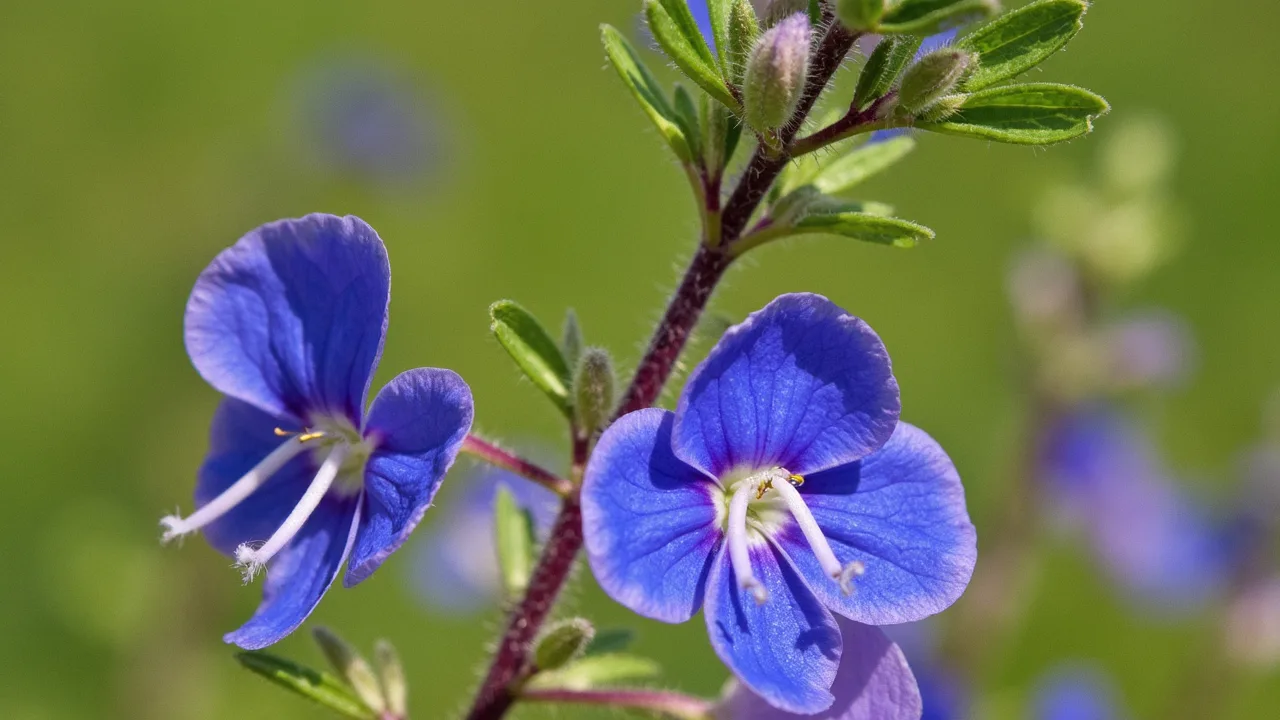
Flowers appear from May through August. Each bloom is 6–10 mm across and carries four petals — a useful identification feature, since many related Veronica species have only three petals on the lower side. In V. officinalis the upper three petals are usually slightly larger than the lower one, and the colour ranges from pale, washed blue to lilac, with occasional white or pinkish forms. The flowers are arranged in dense, upright terminal racemes carried on slender, erect flower stalks that lift the inflorescence clear of the foliage.
After pollination the flowers develop into small, flattened, heart-shaped seed capsules. In good seasons the plant self-seeds modestly, though dead-heading limits this.
Growing Conditions
Speedwell thrives in conditions that mimic its native woodland-edge and meadow habitats: partial to dappled shade, with soil that holds some moisture through the summer but never becomes waterlogged.
Soil. A moist but well-drained, moderately fertile loam is ideal. The plant tolerates poorer, sandier soils and slightly acidic conditions, with a working pH range of roughly 4.5–7.0. Heavy clay that drains slowly is the main soil to avoid, particularly in winter; a generous mulch of leaf mould or compost will help on borderline sites.
Light. Partial shade suits it best, but it grows equally well in dappled shade beneath deciduous shrubs and in full shade, where flowering is slightly reduced but the foliage remains healthy. Full sun is tolerated where the soil does not dry out, though leaves may scorch on thin, sandy soils in prolonged dry spells.
Hardiness. RHS H7, fully hardy throughout the UK. The plant tolerates frosts well below −20 °C and requires no winter protection in any region.
UK seasonal pattern. New growth emerges from a persistent crown in March or April, depending on latitude and exposure. Flowering typically begins in mid to late May, peaks in June and July, and tails off through August. Foliage dies back with the first hard frosts in October or November.
Planting and Care
Sowing and planting. Seed can be scattered outdoors in autumn or early spring into a fine, raked seedbed; a period of cold stratification over winter improves germination. Container-grown plants from nurseries establish more reliably and can be planted out at any time from spring to early autumn, provided they are kept watered during dry spells. Space plants roughly 20–30 cm apart if using them as ground cover; they will fill in within a single growing season.
Watering. Water regularly during the first growing season to keep the soil moist but not saturated. Once established, V. officinalis is moderately drought-tolerant and only needs supplementary watering during prolonged dry periods in summer.
Feeding. In reasonably fertile garden soil, no feeding is required. On thin or sandy soils, a single application of a balanced general-purpose fertiliser in early spring will support stronger flowering.
Pruning and tidying. Cut plants back lightly after the main flush of flowering in late July or August to remove spent flower spikes, encourage a smaller second flush and limit unwanted self-seeding. In late autumn or early spring, shear or rake off the previous season's dead growth to tidy the crown before new shoots emerge.
Propagation. Three reliable methods are available. Mature clumps can be divided in spring or autumn every two to three years, which both rejuvenates the original plant and yields new individuals. Softwood cuttings taken in early summer root readily in a shaded cold frame or pot of moist, sharp sand. Seed, collected as capsules begin to brown in late summer, germinates well after a cold period.
Seasonal care. In UK conditions the plant needs very little attention beyond the points above. In particularly wet winters, watch for crown rot on heavier soils; improve drainage or relocate affected plants in spring.
Common Problems
Common speedwell is generally robust, and serious pest or disease issues are uncommon in UK gardens. The most frequent cultural problem is poor drainage, which predisposes plants to crown and root rots during wet winters.
Powdery mildew. A greyish-white fungal coating on leaves can appear in dry, crowded conditions, particularly towards the end of summer. Improve air circulation by thinning surrounding growth and avoid overhead watering in the evening.
Leaf spot (Septoria spp.). Small brown spots with darker margins may develop on foliage in damp weather. Remove and destroy affected leaves rather than composting them, and clear old growth in autumn to reduce overwintering spores.
Aphids. Greenfly occasionally cluster on young shoots and flower buds in late spring. They rarely cause lasting damage and are usually controlled by natural predators; if infestations are heavy, a spray of insecticidal soap or a fatty-acid product is sufficient.
Slugs and snails. Young spring growth can be grazed, particularly in damp, shaded sites. Organic deterrents such as wool pellets, beer traps or night-time hand-picking are usually adequate; chemical control is rarely necessary.
Rust fungi. Orange-brown pustules occasionally appear on the undersides of leaves in late summer. Prompt removal of affected foliage and good garden hygiene are usually sufficient; infected material should not be composted.
The plant is not known to be toxic to humans, pets or livestock, and no significant toxicity claims are made for it in modern horticultural literature.
Popular Varieties
True cultivar selection within Veronica officinalis is limited, and gardeners will most often encounter the species itself sold as seed or as small container plants from wildflower and native-plant nurseries. The following are forms that appear in UK trade or in botanical literature, listed conservatively.
- Veronica officinalis 'Trehane' — a golden-leaved selection occasionally offered by specialist perennial nurseries; the foliage retains its bright chartreuse colour through the growing season and contrasts well with the pale blue flowers in partial shade.
- Veronica officinalis var. albiflora — a white-flowered form found occasionally in the wild and maintained by a small number of wildflower nurseries; otherwise identical to the species in habit.
- Veronica officinalis var. tournefortii — a more prostrate, mat-forming variant recorded from upland parts of western Europe and sometimes offered as a distinct native selection.
Many other Veronica species grown ornamentally — such as V. austriaca subsp. teucrium, V. gentianoides and the mat-forming V. prostrata and its cultivars — are closely related and often confused with V. officinalis in garden centre labelling, but they are distinct species and not cultivars of this plant. Where uncertainty exists, plants purchased from reputable native-plant specialists carrying correct botanical names are the most reliable source.
Pests and Diseases
| Problem | Symptoms | Management |
|---|---|---|
| Powdery mildew | White, dusty fungal growth appears on leaves and stems, potentially causing distortion. | Improve air circulation and water at the base; apply a biological fungicide if severe. |
| Slugs and snails | Irregular holes in foliage and silvery slime trails on leaves and surrounding soil. | Use beer traps, copper tape barriers, or iron phosphate-based pellets to control populations. |
| Aphids | Clusters of small soft-bodied insects on new growth, often accompanied by sticky honeydew. | Spray off with a strong jet of water or introduce natural predators like ladybirds. |
| Root rot | Plant wilts and yellowing occurs despite moist soil, indicating poor drainage issues. | Ensure well-draining soil and avoid overwatering; remove affected plants to prevent spread. |
| Vine weevil | Notched edges on leaves during the day and root damage leading to plant collapse at night. | Apply nematodes to the soil in autumn or use biological controls for adult beetles. |
For step-by-step help, read Controlling Aphids Naturally, Dealing with Slugs and Snails and Treating Powdery Mildew. Or browse the full plant problem solver to diagnose an issue by symptom.
As an Amazon Associate, GardenWizz earns from qualifying purchases made through links on this page (including links within the article). This does not affect the price you pay. See our disclaimer for details.