Weigela
Weigela florida
The Gardening Year
Best months in UK gardens · full planting calendar →
🖨 Printable care card (PDF)At a Glance
| Botanical name | Weigela florida |
|---|---|
| Common name(s) | Weigela |
| Family | Caprifoliaceae |
| Plant type | shrub (deciduous) |
| Height × Spread | 1.5–2.5 m × 1.5–2.5 m |
| Position | Full sun, Partial shade |
| Soil | moist but well-drained soil; tolerant of many soil types |
| Flowering | June |
| Toxicity | Not known to be toxic to humans, pets or livestock. |
| Native range | Inner Mongolia, Manchuria, northern and south-central China, Primorsky Krai in the Russian Far East, the Korean Peninsula, and Kyushu in Japan |
Overview
Weigela florida is a deciduous flowering shrub in the honeysuckle family (Caprifoliaceae), native to East Asia and widely cultivated in British gardens for its arching habit and prolific late-spring display of trumpet-shaped pink flowers. Introduced to European cultivation in the mid-19th century, it has become a mainstay of mixed and cottage-style borders across the UK, valued as much for its reliability as for its seasonal colour. Mature plants reach roughly 1.5–2.5 m in both height and spread, forming a fountain-shaped outline that flatters informal plantings. Its RHS hardiness rating is H6, indicating tolerance of winter temperatures between approximately −20 °C and −15 °C. It accepts a broad range of soils and sites, including clay and chalk, provided drainage is adequate. It is an easy shrub for beginners and a useful pollinator plant, attracting bumblebees and long-tongued bees to its flowers.
Appearance
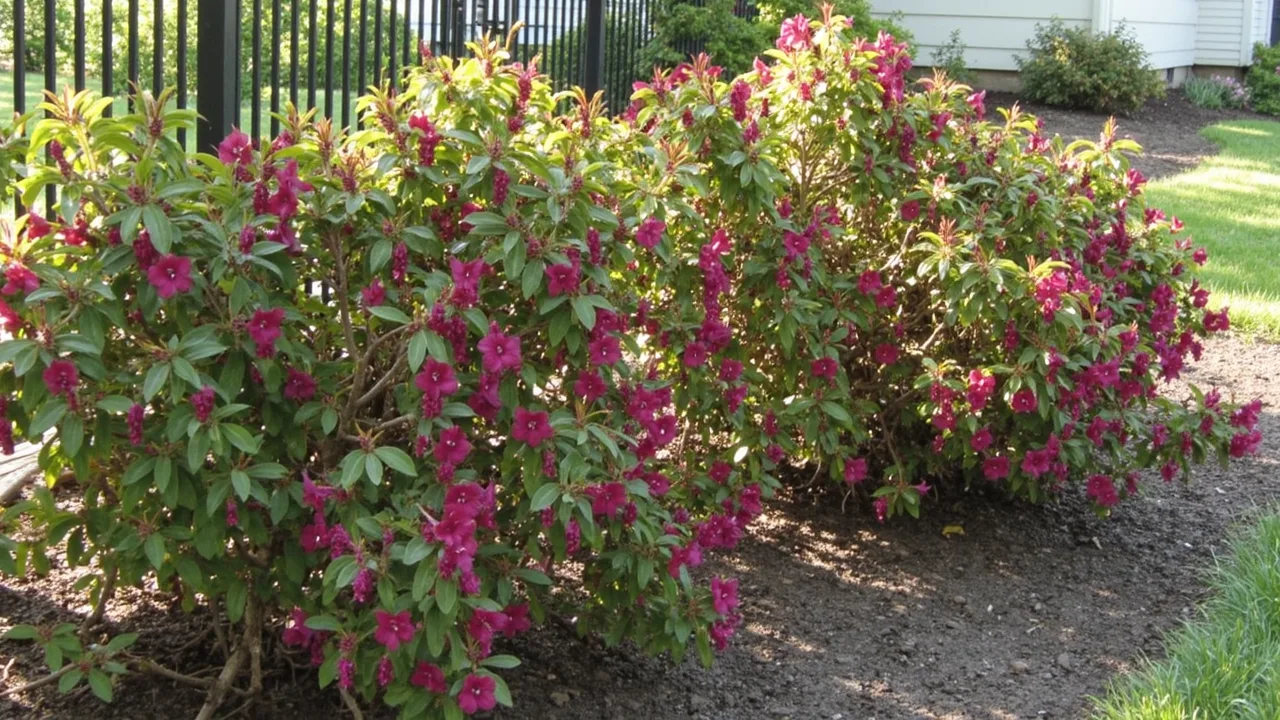
Weigela florida develops a multi-stemmed, arching habit that broadens with age. Young stems tend to grow more upright, but as the shrub matures the branches take on a graceful, fountain-like silhouette, often reaching wider than the plant is tall once established. Bark is grey-brown and tends to shred lightly on older wood, which adds some winter interest in mixed borders. Heights of 1.5–2.5 m are typical in UK cultivation; very old, unpruned specimens can approach 3 m where conditions suit them.
The leaves are opposite, simple and oval to broadly lance-shaped, 4–10 cm long, with finely toothed margins. They emerge mid-green and mature to a deeper, slightly glossy green through summer, before turning a rather unremarkable yellow-brown in autumn. The species is grown for its flowers rather than its foliage.
Flowers are the main feature: tubular to narrowly trumpet-shaped, about 2–3 cm long, borne in small clusters on short lateral shoots along the previous year's stems. In the species these are soft pink to rose-purple, with paler interiors, and they open from late May into June. After flowering, plants set small, dry, woody seed capsules which are not ornamentally significant and are best removed during routine tidying.
Growing Conditions
Weigela florida is among the most adaptable flowering shrubs for British gardens. It performs best in moist but well-drained soil of moderate fertility and is notably tolerant of less-than-ideal conditions once established, including clay, chalk and slightly alkaline ground. Soil pH from roughly neutral through mildly alkaline is acceptable; very acid soils are uncommon in most of the UK and rarely cause problems.
A position in full sun gives the heaviest flowering. Light, dappled shade is tolerated but flowering is reduced and growth tends to become leggy, with foliage concentrated at the shoot tips. Avoid cold, exposed north- or east-facing sites where late frosts can damage emerging flower buds in spring. The shrub copes well with urban pollution and tolerates some coastal exposure once established, although salt-laden winds can scorch young foliage.
Hardiness is not usually a concern across the UK: the RHS H6 rating indicates tolerance of winter temperatures between approximately −20 °C and −15 °C. Drought tolerance is moderate once the root system has developed, but prolonged dry spells reduce flowering and can scorch foliage; supplementary watering is worthwhile in hot summers, particularly on light, free-draining soils.
Planting and Care
Planting time. The best planting windows in the UK are autumn (October–November) and spring (March–April), when the soil is workable, frost-free and warm enough to allow rapid root establishment. Container-grown stock from garden centres can be planted at any time of year provided the ground is not frozen or waterlogged, with extra attention to watering in summer.
Site preparation. Dig a hole roughly twice the width of the root ball and the same depth. Fork the base lightly and incorporate a bucket of well-rotted garden compost or manure into the backfill, particularly on poor or very sandy soils. Tease out congested roots on container-grown plants and set the top of the root ball level with the surrounding soil.
Watering. Water in thoroughly at planting and keep the soil consistently moist through the first two growing seasons. Once established, supplementary watering is only needed during prolonged dry spells, especially on light soils or for plants in containers.
Feeding. An annual mulch of well-rotted organic matter in spring is usually sufficient. On thin or hungry soils, a light dressing of a general-purpose fertiliser such as blood, fish and bone in March boosts vigour and flower production.
Mulching. Apply a 5–8 cm layer of organic mulch (compost, leaf mould or bark) over the root area each spring, keeping it clear of the stems, to conserve moisture and suppress weeds.
Pruning. This is the most important aspect of Weigela florida care. The shrub flowers on wood produced the previous season, so pruning should take place immediately after flowering has finished — typically by mid- to late summer — to avoid removing the next year's buds. Cut flowered shoots back to a strong, vigorous young shoot or to a healthy pair of buds, and remove one or two of the oldest, most congested stems at the base every two or three years to encourage fresh, productive growth from low down. Hard pruning in autumn or winter will sacrifice the following summer's display and should be avoided.
Propagation. Increase stock by taking softwood cuttings in early summer (June) or hardwood cuttings in autumn. Low, arching branches often layer naturally where they touch the soil and can be detached and transplanted once rooted.
Seasonal care. In late winter, remove any winter-damaged or dead stems. After flowering, carry out the annual prune as described above. In late autumn, rake up and dispose of fallen leaves if fungal leaf spot has been a problem.
Common Problems
Weigela florida is generally robust but a handful of issues are worth watching for.
Powdery mildew can affect foliage in dry summers or where air circulation is poor around the plant, leaving a white, dusty coating on leaves. Improve airflow by thinning congested growth and avoid overhead watering; treat with a suitable fungicide if severe.
Fungal leaf spot appears as brown or purplish spots on leaves, sometimes with yellowing. It is rarely serious, but raking up and disposing of fallen leaves in autumn reduces carry-over to the next season.
Blossom blight (grey mould, Botrytis) may blemish flowers in cool, wet springs. Removing and disposing of affected blooms and improving airflow around the shrub are usually enough; fungicides are rarely needed.
Aphids — greenfly and blackfly — may colonise soft shoot tips and flower buds in late spring. They are generally kept in check by natural predators; severe infestations respond to insecticidal soap or a strong jet of water.
Leaf scorch shows as browning leaf margins in hot, dry, exposed sites, especially in container-grown plants. Maintaining even soil moisture and, where practical, providing light afternoon shade solves the problem.
Lack of flowering is almost always caused by pruning at the wrong time of year (cutting back too early or in autumn removes the flower buds) or by insufficient sun. Move or restructure pruning before assuming the plant is failing.
Weigela florida is not considered toxic to humans, pets or livestock, and it has no significant invasive tendency in the UK climate.
Popular Varieties
Cultivar selection in Weigela florida and its close relatives is centred on flower colour, foliage colour and overall size. The following are well-established, widely available cultivars in UK nurseries and garden centres, and none of the RHS ratings quoted should be assumed for cultivars not listed below.
'Bristol Ruby' — one of the best-known red-flowered cultivars, with deep ruby-red, trumpet-shaped flowers in June and a robust habit reaching about 2 m. Vigorous and reliable on most soils.
'Eva Supreme' (sold in some UK catalogues as 'Kosteriana Variegata') — valued for its cream- and green-variegated foliage, which lightens a border even when the plant is out of flower. Pink flowers in late spring. Tends to be a little more compact, around 1.5 m.
'Foliis Purpureis' — a compact form, typically 1–1.2 m tall, with bronze-tinted foliage and soft pink flowers. Useful at the front of a border or in smaller gardens where larger cultivars would be out of scale.
'Variegata' — broadly similar to 'Eva Supreme', with creamy-edged leaves and pink flowers; mature size around 1.5–2 m.
'Wine and Roses' (syn. 'Alexandra') — a modern cultivar bred for dramatic dark burgundy-purple foliage contrasted with bright pink flowers. Compact, around 1.2–1.5 m, and useful where foliage colour is wanted through the season as well as at flowering time.
When choosing, match the mature size to the site: dwarf forms such as 'Foliis Purpureis' suit smaller borders and containers, while vigorous cultivars like 'Bristol Ruby' need space to develop their arching habit. Cultivars with coloured or variegated foliage flower less heavily in shade, so site them accordingly.
---
Cultivars and Varieties
| Cultivar | Height | Flower | Notes | AGM |
|---|---|---|---|---|
| 'Alexandra' | — | — | RHS AGM (H6) | ✓ |
Pests and Diseases
| Problem | Symptoms | Management |
|---|---|---|
| Honey fungus | General decline, wilting, or dieback of branches with possible white fungal growth at the base. | Improve drainage and avoid planting in soil previously infected; remove severely affected plants. |
| Leaf and bud eelworms | Distorted, stunted leaves and buds that fail to open properly or drop prematurely. | Remove and burn affected shoots; ensure good air circulation and avoid overcrowding. |
| Capsid bug | Small brown spots on leaves and distorted, blistered new growth due to sap sucking. | Encourage natural predators like birds and lacewings; use horticultural oil if infestations are severe. |
| Brown scale | Small, brown, immobile bumps on stems and leaves, often accompanied by sticky honeydew. | Scrape off scales manually or apply a systemic insecticide in early spring before they hatch. |
| Slugs and snails | Irregular holes chewed into young leaves and shoots, often with slimy trails visible. | Use physical barriers like copper tape or apply iron phosphate-based slug pellets. |
For step-by-step help, read Dealing with Slugs and Snails. Or browse the full plant problem solver to diagnose an issue by symptom.
Recommended Products
GardenWizz earns a commission from qualifying purchases made through affiliate links on this page (including links within the article) — as an Amazon Associate, and from Thompson & Morgan via the Awin network. This does not affect the price you pay. See our disclaimer for details.