Common Dog-Violet
Viola riviniana
The Gardening Year
Best months in UK gardens · full planting calendar →
🖨 Printable care card (PDF)At a Glance
| Botanical name | Viola riviniana |
|---|---|
| Common name(s) | Common Dog-violet |
| Family | Violaceae |
| Plant type | perennial |
| Height × Spread | 10 cm × 50 cm |
| Position | Full sun, Partial shade, Full shade |
| Soil | moist but well-drained soil; fertile with plenty of organic matter, and which drains well; all soils except those which are acid or very wet |
| Flowering | May–June |
| Toxicity | Not known to be toxic to humans or pets. |
| Native range | Eurasia and Africa |
The common dog-violet (Viola riviniana Rchb.) is a low-growing herbaceous perennial native to the UK and much of temperate Europe. Despite the name, it bears no relation to dogs — "dog" was historically used in common names to denote a plant considered inferior or scentless compared with a more prized relative, in this case the sweet violet (Viola odorata). Dog-violet flowers are unscented. It is one of the most familiar sights on British woodland floors in spring and an excellent ground-cover plant for shaded gardens, naturalistic plantings and wildlife schemes.
Overview
Viola riviniana belongs to the family Violaceae, order Malpighiales, and is the commonest of several native violet species in Britain. It is a small, ground-hugging perennial with creeping stems (stolons) and a short rhizome, allowing it to form loose mats under deciduous trees and along hedgerow bottoms. It is fully hardy throughout the UK and survives even in cold inland gardens, making it one of the easiest native wildflowers to establish.
The plant's main ornamental contribution is its spring display of pale blue-violet flowers held above heart-shaped leaves, but its ecological value is at least as important. It is a larval food plant for fritillary butterflies — notably the silver-washed fritillary (Argynnis paphia) and dark green fritillary (Argynnis aglaja) — and its early blooms provide nectar for solitary bees, hoverflies and small butterflies when little else is in flower. Ant-dispersed seeds and tolerance of dry shade make it a near-ideal low-maintenance choice for awkward spots under trees where lawn grass typically fails.
It is not a culinary herb — unlike pansies and sweet violets, the leaves and flowers of common dog-violet are not widely eaten — and it has no significant modern medicinal use. Its place in British gardens is ornamental and ecological.
Appearance
Common dog-violet is a small, clump- and mat-forming perennial reaching roughly 5–15 cm in height when in flower. Once established it spreads steadily by means of slender creeping stolons that root where they touch the soil, building a patch 20–40 cm across over a few seasons. The growth habit is low and tidy rather than sprawling.
Leaves. The leaves are neat, heart-shaped (cordate) with a notched base and a slightly pointed tip, and finely toothed margins. They are bright to mid-green, often a fresh spring green when new, and carried on long stalks that frequently show a reddish or purplish tinge — a useful identification trait at a glance. Leaves arise in small rosettes along the creeping stems and persist through most of the year, dying back in late winter.
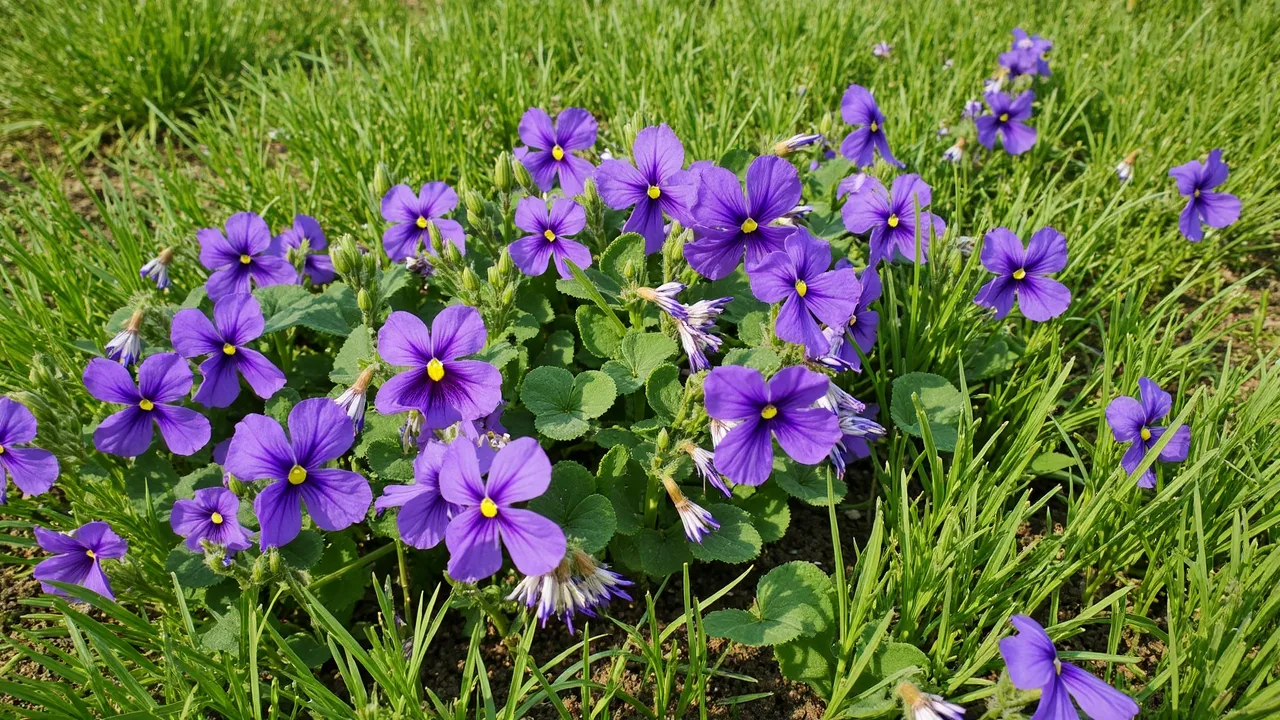
Flowers. The flowers are pale blue-violet, around 12–18 mm across, with five uneven petals: the lower petal is the largest and serves as a landing platform for pollinators, bearing darker purple veins that guide insects towards the centre. The most reliable way to distinguish common dog-violet from sweet violet is the spur — the hollow, backward-projecting extension behind the flower. In V. riviniana it is blunt-tipped, relatively long, and pale, washed with whitish or yellowish-lilac; in V. odorata it is shorter, deeper violet, and the flower is scented.
Flowering begins in April in most of lowland Britain, peaks in May, and tails off through June. Occasional stray flowers can appear later in the year. Flowers are held clear of the leaves on slender upright stalks.
Fruit and seed. After pollination, flowers develop into small, rounded, three-valved capsules that dry and split to shed numerous small seeds. Each seed carries a pale, oily appendage (an elaiosome) that is attractive to ants, which carry the seeds back to their nests and disperse them — a classic example of myrmecochory. Seedlings appear in suitable undisturbed ground close to the parent plant.
Distinguishing it from similar species. Early dog-violet (Viola reichenbachiana) is very similar but typically flowers a little earlier, has narrower leaves and a darker, more slender spur. Heath dog-violet (Viola canina) grows in more open, acidic habitats and has a more upright habit with non-creeping stems.
Growing Conditions
Common dog-violet is one of the most accommodating native wildflowers for British gardens, provided its basic preference for cool, shaded, reasonably moist conditions is respected.
Light. It performs best in partial or dappled shade — the classic woodland-edge situation found beneath deciduous trees or beside north- and east-facing walls. It tolerates deep shade under established trees, where it will flower less profusely but still form useful ground cover. Full sun is acceptable only where the soil remains reliably moist through summer; in dry, sunny spots the foliage scorches and the plant fades.
Soil. The plant prefers moist but well-drained soil that is moderately acidic to near-neutral (roughly pH 5.5–7.5). It grows happily in loam, sandy loam, and chalk-rich soils, and tolerates clay provided drainage is not impeded. Soil that is waterlogged in winter causes rhizome rot; prolonged summer drought causes leaves to wither early.
Climate and hardiness. Common dog-violet is fully hardy across the UK, from the Highlands to the Channel Islands, and is generally classed H7 by the RHS hardiness scale — hardy to below −20 °C in well-drained soil. It tolerates frost, snow and exposed sites, and is unfussy about aspect. It is moderately drought-tolerant once established but looks best with consistent summer moisture.
Habitat in the wild. In the British Isles V. riviniana is found in deciduous and mixed woodland, on woodland edges and rides, in hedgerows, on shaded banks, and in unimproved acidic grassland. It is widespread and locally common throughout lowland Britain, becoming scarcer in the far north and on very exposed western coasts.
UK seasonal guidance. Sow seed in autumn (September–October). Plant out container-grown plants in autumn or early spring. Expect the main flowering flush from late April through May, with a secondary, lighter display into June. Growth slows in high summer and resumes in autumn; top growth dies back in late winter.
Planting and Care
Common dog-violet asks for very little once sited correctly.
Planting. Plant container-grown specimens in autumn or early spring, spacing them about 15–20 cm apart; they will colonise the gaps within a season or two. Water in well and mulch with leaf mould or well-rotted garden compost to retain moisture and mimic the woodland floor. Autumn planting allows roots to establish over winter for a strong display the following spring.
Watering. Water newly planted specimens regularly through their first growing season. Established plants need only occasional watering during prolonged dry spells; in most British summers natural rainfall is sufficient.
Feeding. No routine feeding is necessary. In reasonably fertile garden soil the plant will thrive without intervention. In very poor, hungry soil a single light top-dressing of leaf mould or well-rotted compost in autumn will both feed the soil and conserve moisture.
Pruning and tidying. Cut back old foliage in late winter (February) before new growth emerges, using shears or a strimmer on larger colonies. Otherwise the plant needs no pruning. Deadheading spent flowers is not necessary and is impractical at scale; allowing seed to set encourages naturalisation.
Propagation. Three methods are reliable:
- Seed. Sow in autumn in trays of seed compost, surface-sown or barely covered, and leave outdoors over winter to provide the cold stratification violets require to break dormancy. Germination occurs in spring. Seed does not keep well; sow fresh seed each year for best results. Note that common dog-violet hybridises readily with other Viola species, so saved seed may not come true if other violets are growing nearby.
- Division. Lift and split established clumps in early spring (March) or early autumn (September), replanting divisions at the same depth with at least 15 cm spacing.
- Rooted stolons. Creeping stems root naturally where they touch soil. Detach a rooted piece with a few leaves in autumn or spring and replant immediately.
Seasonal care. Spring: enjoy the flowering display; minimal intervention required. Summer: water during drought; mulch if soil is prone to drying out. Autumn: cut back if desired, top-dress with leaf mould, collect seed if raising new plants. Winter: leave old growth as cover and winter interest for invertebrates, or tidy in late February before new growth appears.
Naturalising. In informal areas — shaded lawns (where mowing is delayed), under shrubs, or in wild corners — common dog-violet self-seeds readily and will form self-sustaining colonies within two or three years. Avoid close mowing until seed has set (typically late June).
Common Problems
Common dog-violet is generally healthy and trouble-free in appropriate conditions.
Powdery mildew. A whitish fungal coating on leaves in dry, still, crowded conditions, caused by Erysiphe species. Improve air circulation by thinning surrounding vegetation; avoid overhead watering in the evening; remove and destroy badly affected leaves. The plant usually outgrows the problem with cooler, damper autumn weather.
Rust fungi. Puccinia violae produces orange-brown pustules on leaf undersides in late summer and autumn, occasionally causing premature leaf drop. Remove and destroy affected leaves; clear leaf litter around plants in autumn to reduce overwintering spores.
Aphids. Greenfly occasionally colonise young shoots and flower buds in spring. On a small scale, a strong spray of water or a wipe with a damp cloth is sufficient; heavier infestations can be treated with insecticidal soap. Aphids are also part of the wider garden food web and are usually controlled by natural predators.
Slugs and snails. May graze young leaves and petals in damp conditions, particularly on lush new growth in spring. Generally only a problem in the first season after planting; established plants tolerate light grazing. Use standard cultural controls (night-time picking, beer traps, wildlife-friendly pellets) where damage is unacceptable.
Other notes. Common dog-violet is deer- and rabbit-resistant, the slightly bitter foliage being unpalatable to browsing mammals. It is not regarded as toxic to humans or pets and rarely suffers serious viral or bacterial disease in UK gardens. Plants that fail to thrive are almost always in the wrong place — usually too dry and sunny, or in waterlogged soil — rather than suffering from any specific ailment.
Popular Varieties
Common dog-violet is grown overwhelmingly as the species V. riviniana. It has few formally named cultivars, in part because it hybridises freely with sweet violet and other native Viola species, producing seed strains that do not come true. The following selections are reliably available in British nurseries and seed lists and are grown either as ornamental or wildlife-friendly forms. None of these are assigned an Award of Garden Merit (AGM) by the Royal Horticultural Society — the species itself is widely grown but rarely individually ratified by the RHS, so no RHS rating is claimed here.
- Viola riviniana species form. The wild type, sold as seed or young plants by wildflower specialists such as Emorsgate Seeds and British Wildflower Plants. Pale blue-violet flowers, vigorous, true from seed collected from single-species colonies. The form most useful for ecological planting.
- Viola riviniana 'Purple Gem'. A compact, slightly larger-flowered selection sometimes offered by specialist perennial nurseries, with deeper violet blooms and a tidier, less spreading habit. Suited to smaller gardens or the front of a shaded border. Availability is sporadic and it is not widely listed; treat any nursery listing as worth verifying.
- Viola riviniana alba. A white-flowered form occasionally offered by alpine and wildflower specialists. Pure white petals with the usual violet spur structure but in a paler, greenish-white. Useful as a quiet highlight in a shaded planting where blue-violet would jar.
- Seed strains marketed for wildlife meadows. Several British wildflower seed suppliers (e.g. Emorsgate's EW1 woodland mixture components, or single-species packets from Chiltern Seeds) offer V. riviniana seed collected from native British populations. These are not cultivars but wild provenance lots — well worth preferring over unnamed continental seed for supporting local genetics and a longer-flowering display suited to UK climate.
In addition, several naturally occurring hybrids and closely related native species are sometimes offered as alternatives and are worth considering where they suit the site: early dog-violet (V. reichenbachiana), heath dog-violet (V. canina), and marsh violet (V. palustris) for reliably damp ground. All are British natives with broadly similar cultivation needs.
Where the gardener's aim is purely ecological, the species from a British provenance is the best choice; named cultivars are best reserved for ornamental use in cultivated shade borders where consistent flower colour matters more than genetic diversity.
Pests and Diseases
| Problem | Symptoms | Management |
|---|---|---|
| Slugs and snails | Irregular holes chewed in leaves and flowers, often accompanied by silky trails. | Use physical barriers like copper tape or apply iron phosphate pellets to control populations. |
| Powdery mildew | White, dusty fungal growth appears on the upper surfaces of leaves and stems. | Improve air circulation and spray with a fungicide containing myclobutanil if severe. |
| Violet gall midge | Leaves become distorted, thickened, or curled due to larval feeding inside the tissue. | Remove and destroy affected leaves immediately to prevent larvae from pupating in the soil. |
| Pansy leaf spot | Small, dark brown or purple spots develop on leaves, sometimes causing yellowing. | Avoid overhead watering and remove infected foliage to reduce fungal spread. |
| Glasshouse red spider mite | Fine webbing on stems and stippled, pale speckling on leaves indicating sap loss. | Increase humidity around the plant and treat with a suitable miticide if infestation persists. |
For step-by-step help, read Dealing with Slugs and Snails and Treating Powdery Mildew. Or browse the full plant problem solver to diagnose an issue by symptom.
Recommended Products
GardenWizz earns a commission from qualifying purchases made through affiliate links on this page (including links within the article) — as an Amazon Associate, and from Thompson & Morgan via the Awin network. This does not affect the price you pay. See our disclaimer for details.