
Ajuga reptans
Bugle
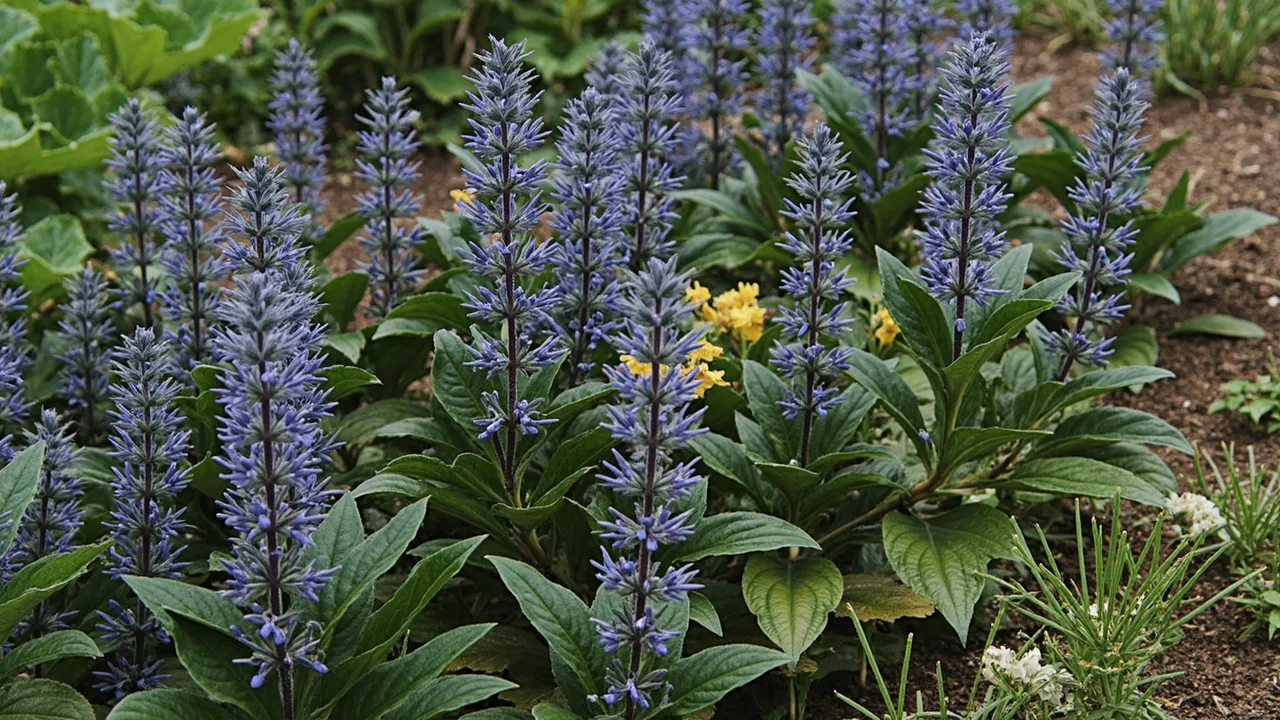
At a Glance
| Botanical name | Bugle |
|---|---|
| Common name(s) | Ajuga reptans |
| Family | — |
| Plant type | perennial (evergreen foliage) |
| Height × Spread | 10–50 cm × 50–100 cm |
| Hardiness | — |
| Position | Partial shade |
| Soil | moist but well-drained soil |
| Flowering | May |
| Toxicity | — |
| Native range | — |
Bugle is one of the most useful ground-cover perennials for British gardens. A native of the UK and much of Europe, Ajuga reptans forms dense, evergreen carpets of rosette foliage that suppress weeds, stabilise soil on banks, and flower reliably in shade where many other plants struggle. It belongs to the mint family (Lamiaceae) and is closely related to familiar culinary herbs such as mint, sage and thyme, though it is grown for its foliage and flowers rather than for any edible use. Its combination of hardiness, adaptability and pollinator value has made it a staple of UK planting schemes for centuries.
Overview
Ajuga reptans is a low-growing, mat-forming perennial that spreads steadily by above-ground runners (stolons), rooting where they touch bare soil. In the wild it is found in damp woodlands, meadows and hedge bottoms across Britain and temperate Europe, and it has long been recognised as one of the most reliable ground-cover plants for shaded or partly shaded garden situations. It is fully hardy across the UK (RHS hardiness rating H7) and tolerates a wide range of soils provided drainage is reasonable.
Bugle is grown primarily for two ornamental qualities: its rosettes of glossy, often richly coloured foliage, and its short spikes of lipped flowers that appear in late spring and early summer. The species is listed by the Royal Horticultural Society as a Plant for Pollinators, and a flowering patch will attract bumblebees, honeybees and a range of hoverflies. Historically the plant was also used in herbal medicine for its astringent and mildly anti-inflammatory properties, though it is not used in mainstream practice today.
Appearance
Bugle forms a basal rosette of leaves from which the flower spikes emerge in late spring. The leaves are ovate to broadly lance-shaped, with margins that are usually entire or only shallowly toothed. In the wild type they are a glossy dark green, often with a purplish flush, and they persist through most winters as the plant is evergreen to semi-evergreen. Cultivated forms extend the colour range considerably, with bronze, deep purple and variegated foliage widely available.
Each mature plant produces one or more flowering spikes reaching 15–30 cm in height. The small, tubular, two-lipped flowers are arranged in tiered whorls up the spike and are typically a deep violet-blue, though pink- and white-flowered forms exist. Individual flowers are modest in size, but a well-established colony produces a striking sheet of colour from May into July. The flowers are followed by small, four-seeded nutlets, though Bugle spreads far more effectively vegetatively via its stolons than it does from seed.
New plants are produced continuously at the tips of stolons, and a single specimen can colonise a square metre or more over a few seasons in favourable conditions. This vigorous vegetative spread is what makes Bugle such an effective weed-suppressing ground cover, and also what requires management where space is limited.
Growing Conditions
Bugle is among the most accommodating of British garden perennials and will establish in almost any reasonable garden soil. For best results, plant in moist but well-drained ground of neutral to slightly acidic pH; it tolerates clay, loam and lighter sandy soils, provided they do not dry out completely in summer. Very waterlogged sites should be avoided, as winter wet combined with poor drainage can lead to crown rot.
Aspect is flexible. Bugle grows in full sun where the soil remains moist, but foliage colour and general plant health are usually best in dappled or partial shade, particularly under deciduous shrubs and trees. Deep, dry shade under evergreens is less suitable, as is the combination of full sun and very free-draining sandy soil in midsummer.
Across the UK, Bugle is reliably hardy in every region, from the Scottish Highlands to the south coast of England, and is rated H7 by the Royal Horticultural Society — the highest hardiness rating, indicating it tolerates temperatures below −20 °C. Growth begins in early spring, flowers peak in May and June, and the foliage remains largely evergreen through winter, although the oldest leaves may deteriorate after prolonged frost.
Planting and Care
Plant Bugle in autumn or spring, when the soil is workable and rainfall is reliable. For general ground-cover use, space plants 30–45 cm apart; for rapid coverage of a larger area, smaller plugs or divisions set 15–20 cm apart will knit together within a single growing season. Water well during the first spring and summer after planting to help the stolons root in.
Once established, Bugle is largely self-sufficient. It tolerates dry shade under trees better than most flowering perennials, though it performs best where the soil does not parch completely. In containers, water regularly through summer as the compost dries out quickly. Feeding is rarely necessary in good garden soil; a light mulch of leaf mould or well-rotted compost in spring is usually sufficient.
Maintenance is minimal. After flowering, cut or mow the plants on a high setting (or shear with secateurs) to remove spent flower spikes and tidy the foliage; this often encourages a flush of fresh leaves. Where colonies have spread beyond their allotted space, lift and divide surplus rosettes in spring or autumn, and either pot them up, replant elsewhere, or compost them. Propagation is straightforward by division of established clumps, or by lifting and replanting rooted stolon tips. Growing from seed is possible but cultivars will not come true to type.
In UK gardens, Bugle combines well with spring bulbs such as Galanthus, Narcissus and Hyacinthoides non-scripta, and is useful for underplanting roses, hydrangeas and deciduous shrubs. It tolerates light foot traffic and is sometimes used as a lawn substitute in small, lightly used areas or in wildflower meadow schemes, though it will not withstand regular heavy wear.
Common Problems
Bugle is generally trouble-free, but a few issues are worth watching for.
Crown rot is the most serious, caused by Phytophthora species in cold, waterlogged soils. Affected plants collapse suddenly, with rosettes turning yellow and the crown going black and soft. Improve drainage, remove and destroy affected plants, and avoid replanting Bugle in the same spot.
Powdery mildew can coat the foliage in hot, dry, crowded conditions, particularly on stressed plants in full sun. Improve air circulation by thinning out congested growth, water at the base rather than overhead, and remove badly affected leaves.
Leaf spot (often Septoria) causes brown blotches on the leaves, especially in damp autumn weather. Remove and dispose of affected foliage and avoid overhead watering.
Slugs and snails will graze young growth and flower spikes in damp conditions, particularly in spring. Standard controls — night-time hand-picking, beer traps, or biological control with nematodes — are usually sufficient.
Aphids occasionally colonise flower spikes; a strong jet of water or insecticidal soap will deal with small outbreaks.
Invasiveness is sometimes listed as a problem in its own right. In fertile, moist soil with plenty of space, Bugle can spread faster than intended. Sit it accordingly, and thin out runners annually to keep it within bounds. It is not, however, regarded as an invasive alien in the UK — it is a native species.
Popular Varieties
Several named cultivars are widely grown in the UK and offer a useful range of foliage colours. The following are well-established and widely available; ratings and availability can vary between nurseries.
Ajuga reptans 'Catlin's Giant' — a vigorous selection with notably large, bronze-purple leaves and tall flower spikes. Often recommended for ground cover at scale and useful in mixed containers.
Ajuga reptans 'Burgundy Glow' — a compact, variegated form with leaves marked in cream, pink and green, taking on deeper pink and bronze tints in cooler weather. Less vigorous than 'Catlin's Giant', and useful for edging or smaller plantings.
Ajuga reptans 'Atropurpurea' — deep bronze-purple foliage that provides strong contrast with silver-leaved or golden foliage plants. A good choice for year-round colour in shade.
Ajuga reptans 'Multicolor' (sometimes sold as 'Rainbow') — small leaves splashed with pink, cream and green, giving a bright, almost patchwork effect. Slow-growing and best in a sheltered spot.
Ajuga reptans 'Alba' — a white-flowered form of the species, useful where a quieter flower colour is wanted, particularly in green-and-white planting schemes.
Pests and Diseases
| Problem | Symptoms | Management |
|---|---|---|
| Powdery mildew | A white, dusty fungal growth appears on the leaves and stems. | Improve air circulation and apply a fungicide if infection is severe. |
| Slugs and snails | Irregular holes are eaten in the soft foliage, often accompanied by slime trails. | Use physical barriers like copper tape or organic slug pellets to protect plants. |
| Vine weevil | Notched edges on leaves and wilting due to root damage in the soil. | Apply a systemic insecticide drench or use nematodes to control larvae. |
| Root rot | Leaves turn yellow and wilt despite moist soil conditions. | Ensure the soil is well-drained and avoid overwatering, especially in winter. |
| Leaf scorch | Leaf edges turn brown and crispy due to exposure to intense sunlight. | Plant in partial shade or ensure consistent moisture during hot spells. |
Quick Care Summary
| Sunlight | Partial shade |
|---|---|
| Soil | moist but well-drained soil |
| Hardiness | — |
| Sow | — |
| Plant | March, April, May, September, October, November |
| Prune | March, April, May, September, October, November |
As an Amazon Associate, GardenWizz earns from qualifying purchases made through the links above. This does not affect the price you pay. See our disclaimer for details.