
Hornbeam
Carpinus betulus
At a Glance
| Botanical name | Carpinus betulus |
|---|---|
| Common name(s) | Hornbeam |
| Family | Betulaceae |
| Plant type | tree (deciduous) |
| Height × Spread | 15–25 m × — |
| Hardiness | H7 (to -20.0 °C) |
| Position | Full sun, Partial shade |
| Soil | moist but well-drained |
| Flowering | June–August |
| Toxicity | — |
| Native range | Western Asia and central, eastern, and southern Europe |
Hornbeam is a deciduous broadleaf tree native to much of central and southern Europe, including southern England, where it has long been a fixture of ancient woodlands, field boundaries and formal gardens. Closely related to birch and hazel, it is a member of the family Betulaceae and is most often encountered in British horticulture either as a standalone specimen tree or, far more commonly, as a tightly clipped hedge. Its combination of slow growth, dense twiggy habit and excellent tolerance of shaping has made it one of the default choices for pleached avenues, topiary and the formal parterre hedges seen in many great British gardens.
Overview
Carpinus betulus is hardy across the whole of the British Isles and is well adapted to the temperate, maritime climate of the UK. It grows reliably from the Highlands of Scotland to the southern coasts of Cornwall, coping with damp winters, cool summers and the periodic droughts that have become more frequent in southern and eastern England. Mature trees reach around 15 to 20 metres in height with a broadly conical crown, although specimens grown as hedges are kept to anything from one to four metres by regular trimming.
In gardens it is valued for two quite different reasons. As a specimen tree it offers attractive spring foliage, conspicuous papery winged fruits in late summer and clear yellow autumn colour, together with a smooth, fluted grey trunk that becomes more striking with age. As a hedging plant it rivals beech (Fagus sylvatica) in popularity, with the advantage of holding much of its dead brown foliage through winter so that a hornbeam hedge remains reasonably opaque even when bare. It is also notably tolerant of heavy clay, partial shade and the kind of pollarding or hard pruning used to keep large trained specimens within bounds.
It is not invasive in the UK, although the winged bracts can self-seed into nearby borders and gravel paths where seed falls from overhead branches. Wildlife value is modest but real: the leaves are eaten by the larvae of several moths, and the seeds are taken by finches and small mammals in autumn and winter.
Appearance
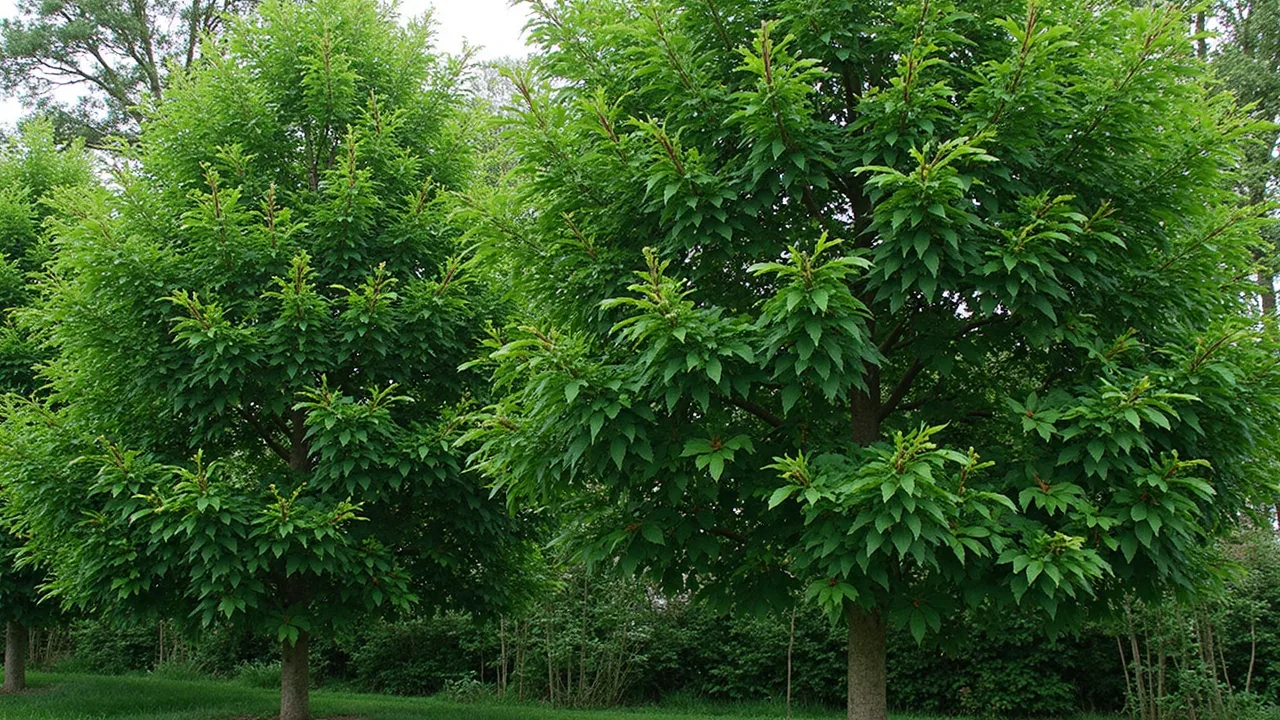
The hornbeam is a medium-sized tree with a characteristically muscular trunk. The bark is pale grey and very smooth on young trees, becoming shallowly fluted and lightly ridged on older specimens, rather than cracking into plates like oak or ash. The overall crown shape is rounded to conical, denser than beech and held on strongly ascending lower branches that often persist low on the trunk when the tree is grown as a lawn specimen.
Leaves are alternate, oval to oblong, typically 7 to 12 cm long, with strongly impressed parallel veins running from the midrib to the finely and sharply double-serrated margin. The upper surface is a fresh mid-green and slightly corrugated between the veins; the underside is paler and may carry a few silky hairs along the veins when young. In autumn the foliage turns a clear butter-yellow, often with tints of pale orange, and a notable proportion of the dead leaves is retained on the branches through winter, particularly on clipped hedges.
Flowers are catkins, appearing with the new leaves in late April or May. The male catkins are slim, yellowish and pendulous; the female catkins are shorter and greenish. By late summer these develop into the distinctive hop-like fruiting clusters, each nutlet sitting at the base of a three-lobed, pale green, papery bract. As the bracts ripen they turn a buff brown and hang in loose bunches well into autumn, giving the tree one of its most ornamental phases. Some sources describe the foliage as holding rust-brown through winter; the precise tone varies between individual trees and exposure.
Growing Conditions
Hornbeam grows happily across most of the UK. It performs best on a moist but well-drained loam and tolerates clay far better than many other hedging trees. It is not fussy about pH and grows successfully on mildly acidic, neutral and chalky soils alike, although on very thin, dry chalk it will grow more slowly and benefit from generous mulching and watering during establishment.
For sun it is adaptable: full sun gives the densest, most upright growth, but hornbeam is one of the better broadleaf trees for dappled or partial shade and is frequently used as an understorey tree in larger gardens. It is also notably wind-firm once established, making it a sound choice for exposed gardens in the north and west, although on the very worst maritime sites in the far north-west and west of Scotland, siting it with some shelter is wise.
RHS hardiness ratings are not formally published for many broadleaf trees, but hornbeam is generally regarded as hardy throughout the UK, tolerating winter minima well below -15 °C once established. It flowers and leafs up late enough to escape most spring frosts, and it tolerates urban pollution well. There is no significant pest or disease that restricts its use anywhere in Britain.
Planting and Care
Bare-root hornbeam is the standard, economical choice for hedge planting between early November and late March, provided the ground is not frozen or waterlogged. Container-grown stock can be planted at any time of year but establishes most reliably when set out in autumn or early spring. For a single hedge, space plants 45 to 60 cm apart in a single row; for a denser, thicker hedge, a staggered double row at 60 cm each way gives an excellent result. Specimen trees should be given at least 4 to 6 metres of clearance from other trees and from buildings.
Watering is important in the first two seasons. A thorough soak once a week during dry spells from late spring through to early autumn is far more useful than frequent light sprinklings. Once established, hornbeam is notably drought-tolerant for a broadleaf tree, although on thin soils an occasional heavy soak in prolonged drought will keep foliage looking its best. Feeding need not be heavy: a single application of a balanced general-purpose fertiliser such as growmore or blood, fish and bone in early spring, scattered over the rooting area and watered in, is sufficient for most garden trees and hedges. Mulching with 5 to 8 cm of well-rotted bark or garden compost in late spring helps to conserve moisture and suppress weeds; mulch should be kept clear of the trunk itself.
Pruning is straightforward and depends on the intended use. Hedges should be cut once a year in late summer, between mid-July and late August, which is the traditional timing for neat, formal hornbeam and beech hedges. A second, lighter tidy in early autumn can be carried out if desired, but cutting into winter should be avoided as the freshly exposed stems can be damaged by hard frost. Specimen trees need little routine pruning beyond the removal of crossing, dead or damaged branches in late winter, while pleached or trained specimens are usually shaped in late summer and then again in winter, when the structure of branches is most easily assessed. Hornbeam responds well to hard renovation pruning: an old, neglected hedge can be cut back almost to the main framework in late winter and will usually regenerate, although it may miss a season of growth while it does so.
Propagation is usually by seed. The winged seeds are gathered in autumn when the bracts turn buff, and can be sown immediately outdoors in a seedbed, or stratified for a winter at around 4 °C and sown the following spring. Germination can be slow and irregular. Cultivars must be propagated vegetatively, typically by grafting onto seedling rootstocks in late winter, which is a job for a specialist nursery rather than a home gardener. Semi-ripe cuttings taken in mid-summer will root but with limited success and are not generally recommended for amateurs.
Common Problems
Hornbeam is one of the more trouble-free broadleaf trees in British cultivation and rarely suffers serious problems. The most frequent complaint in gardens is poor establishment, almost always caused by planting into dry or compacted ground and failing to water through the first summer. Mulching and steady watering in the early years will prevent most of these losses.
Aphids, particularly the common aphid species that colonise many garden trees, can appear on the soft new growth in late spring and may produce some sticky honeydew on paths and cars beneath. They rarely justify treatment and are usually brought under control naturally by ladybirds, lacewings and hoverflies within a few weeks. Powdery mildew can mark the foliage of stressed trees in hot, dry summers, again rarely serious enough to require action beyond improving watering and mulching.
Caterpillars of various moths feed on the leaves, occasionally producing partial defoliation in late summer. In most years this is cosmetic rather than damaging and the tree re-foliates normally the following spring. There is no significant canker, wilt or honey fungus problem specific to hornbeam in the UK, which is one of the reasons it is so widely planted in public and amenity landscapes.
Two non-biological issues are more common than any disease. Newly planted trees can be lifted by frost heave on heavy clay, and staking that allows some flex of the trunk is helpful in the first winter. And the winged bracts, while ornamental, will self-seed into adjacent borders, where the seedlings are easily hoed out while young.
Popular Varieties
A small number of cultivars of Carpinus betulus are widely available from British nurseries and are worth seeking out where they suit a particular design need.
Carpinus betulus 'Fastigiata' is the best-known and most widely planted cultivar, with a narrow, tightly upright habit that broadens only with age. It is the standard choice for street planting, formal avenues and small gardens where a vertically accent is wanted without the spread of the species, and typically reaches 12 to 15 metres in height with a spread of only 4 to 6 metres.
Carpinus betulus 'Frans Fontaine' is similar in character to 'Fastigiata' but holds its narrow, columnar shape into maturity rather than broadening with age, making it the preferred form for tight avenues and restricted urban sites where consistent width matters.
Carpinus betulus 'Pendula' has gracefully weeping branches and is usually grown as a specimen on a clear stem, forming a small dome of cascading foliage rather than a tall tree. It is the form most often seen in the show gardens of large country gardens and is best given space to develop as a focal point.
Two further forms are occasionally offered by specialist nurseries. Carpinus betulus 'Quercifolia' has leaves with deeper, more pronounced lobes resembling small oak leaves, while Carpinus betulus 'Variegata' carries leaves marked with creamy-white flecks and margins; both are slower-growing than the species and tend to be planted as collector's specimens rather than as workhorse hedging plants. Gardeners should note that named cultivars are propagated by grafting and so cost more than seedling-raised hedging stock, although for specimen planting this is rarely a problem.
Pests and Diseases
| Problem | Symptoms | Management |
|---|---|---|
| Powdery mildew | White powdery fungal growth appears on leaves and shoots. | Improve air circulation and prune out affected branches in dry weather. |
| Coral spot (Nectria) | Bright orange or coral-red fungal fruiting bodies form on dead wood. | Prune out infected wood and disinfect tools to prevent spread. |
| Honey fungus | White fungal growth under bark and wilting or dieback of branches. | Remove infected trees and avoid replanting susceptible species nearby. |
| Aphids | Clusters of small soft-bodied insects on new growth causing sticky honeydew. | Spray with water jet or use insecticidal soap if infestations are heavy. |
| Caterpillars | Visible leaf skeletonization or holes chewed by larvae. | Encourage natural predators like birds and wasps to control populations. |
Quick Care Summary
| Sunlight | Full sun, Partial shade |
|---|---|
| Soil | moist but well-drained |
| Hardiness | H7 (-20.0 °C) |
| Sow | — |
| Plant | September–November |
| Prune | July–August |
As an Amazon Associate, GardenWizz earns from qualifying purchases made through the links above. This does not affect the price you pay. See our disclaimer for details.