
Cornflower
Centaurea cyanus
At a Glance
| Botanical name | Centaurea cyanus |
|---|---|
| Common name(s) | Cornflower |
| Family | Asteraceae |
| Plant type | annual |
| Height × Spread | 20–100 cm × 10–50 cm |
| Hardiness | H6 (to -20.0 °C) |
| Position | Full sun |
| Soil | well-drained soil; loam, sand; acid, alkaline, neutral pH; adaptable to poor soils |
| Flowering | June–September |
| Toxicity | — |
| Native range | Europe |
The cornflower is a hardy annual wildflower of European arable land, instantly recognisable for its vivid blue flower heads. Once a common weed of wheat fields, it has become a staple of cottage gardens, wildflower meadows and pollinator-friendly plantings across the UK. Easy to raise from seed and unfussy about soil, it remains one of the most rewarding annuals for British gardeners.
Overview
Centaurea cyanus belongs to the daisy family, Asteraceae, and is the type species of the Centaurea genus. It is native to temperate Europe, where it evolved as a companion of cereal crops on light, low-nutrient soils. Centuries of seed-corn movement carried it widely across the continent, and it is now fully naturalised throughout the British Isles.
Although technically an annual, the cornflower behaves as a self-perpetuating feature of any garden where it is allowed to set seed. A single sowing can produce a self-sustaining colony for many years. It is fully hardy across the UK (rated H7 by the Royal Horticultural Society, tolerating temperatures below −20 °C), germinating in autumn or spring, flowering through summer, and dying back after setting seed in early autumn.
Beyond its ornamental value, the cornflower carries considerable ecological weight. Its open, nectar-rich heads are accessible to short-tongued bees, hoverflies and butterflies, and it is a useful mid- to late-summer forage source. The species is the national flower of Estonia, and in the UK it has become an emblem of wildflower meadow restoration and wildlife-friendly farming.
Appearance
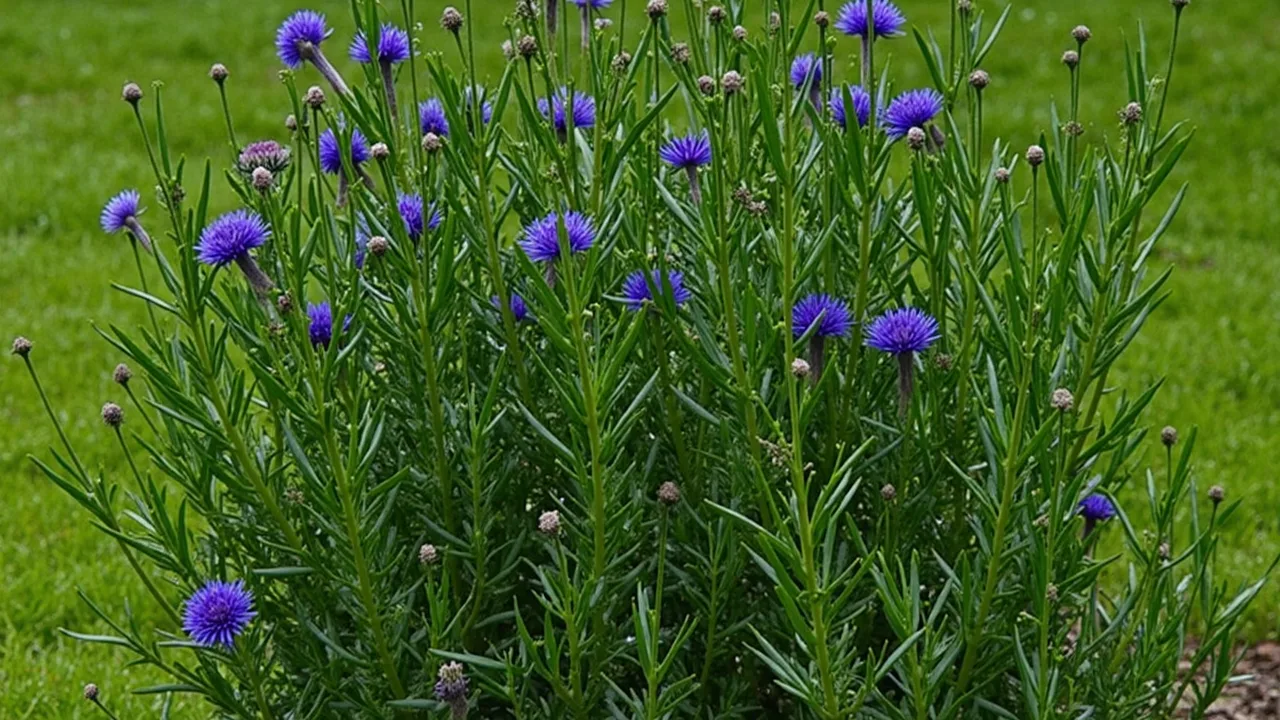
The cornflower is a slender, upright annual reaching 40–90 cm in height depending on cultivar and growing conditions. The stems are wiry, branched and slightly woolly, giving the plant an airy, see-through quality that integrates well into mixed plantings.
The leaves are narrow and lance-shaped, 1–10 cm long, and a soft greyish-green. Lower leaves are often slightly lobed or toothed, while the upper leaves are usually entire and clasp the stem more closely. The grey-green foliage sets off the flower colour particularly well.
Flowers are borne singly at the tips of the stems and measure 1.5–3 cm across. Each head is a composite, in the manner of all daisies: what appears to be a ring of blue petals is in fact a circle of sterile ray florets surrounding a denser centre of fertile disc florets in deeper blue-purple. Wild-type plants are the brilliant cornflower blue that gives the species its name, but cultivated strains extend the palette to pink, white, deep crimson, maroon and bicolour forms. The flower head is wrapped at its base by a tight, burr-like involucre of bracts with characteristically finely toothed, almost silvery edges — a useful identification feature.
After flowering the head ripens to a small, pale achene tipped with a short pappus of bristles, which assists in localised seed dispersal. Left in place, these seed heads will shed and germinate the following spring, often producing a fresh generation of plants without any intervention.
Growing Conditions
Cornflowers are plants of low-nutrient, free-draining ground. In the wild they thrive on the chalky boulder clays and limestone brash of traditional arable land, but they adapt readily to most garden soils provided drainage is good and fertility is not excessive.
Aspect should be open and sunny. Full sun produces the strongest, most upright plants and the deepest flower colour; in shade, stems tend to stretch and flop, and flowering is reduced. Some light, dappled shade is acceptable, especially in the south of England, but the open border or dedicated wildflower patch is ideal.
Soil should be light and well-drained, ideally neutral to slightly acidic (pH 6.5–7.5). Rich, heavily improved garden soil is actively unhelpful: it promotes leafy growth at the expense of flowers and can shorten the flowering season. Avoid sites where fresh manure or high-nitrogen fertiliser has recently been applied.
Climate is rarely an issue across the UK. The species is fully hardy to well below −20 °C and tolerates wind, rain and drought equally well once established. In exposed coastal or upland sites, taller plants may need light support to prevent lodging.
Planting and Care
Cornflowers are almost always raised from seed, and they dislike root disturbance, so direct sowing is strongly preferred. Sow in autumn (September to early October) for the strongest, earliest-flowering plants the following year, or in spring (March to April) for a later display. Prepare the bed by clearing weeds and raking the surface to a fine tilth, then scatter the seed thinly and cover with about 1 cm of soil or compost. Water gently to settle the seed into contact with the soil.
Alternatively, sow into modules or 9 cm pots in autumn or spring and transplant with care while the plants are still small. Autumn-sown module plants often flower earlier and more vigorously than spring-sown ones.
Thin or plant out at 15–30 cm spacings. Overcrowded plants are more prone to mildew and tend to flop in summer rain.
Watering is minimal once plants are established. Cornflowers are notably drought-tolerant and will cope with typical British summers without supplemental irrigation. Water only during prolonged dry spells, and aim the water at the soil rather than the foliage.
Feeding is unnecessary and usually counterproductive. Do not apply nitrogen-rich fertiliser, which produces lush leaves and few flowers. On very poor soils, a light dressing of bone meal in spring can support steady growth without encouraging excess foliage.
Dead-heading is the single most useful intervention. Removing spent flower heads every week or so encourages continued blooming well into September. Where self-seeding is desired, leave a final flush of heads in place from late August onward to set and shed seed.
Support is rarely needed for modern compact cultivars but can be useful in exposed sites for taller traditional types. Twiggy pea sticks pushed in early in the season are sufficient.
Propagation is overwhelmingly by seed. The species does not come true from cuttings, and there is no practical vegetative method. Save seed from open-pollinated plants in late summer by shaking ripe heads into a paper bag; store dry and cool, and sow within two to three years for best germination.
After flowering, pull up and compost spent plants once they have shed seed, or simply cut down and leave the roots in place. Reliable self-sown seedlings will normally appear from October onward or the following spring.
Common Problems
Cornflowers are largely trouble-free, but a few issues are worth anticipating.
Powdery mildew is the most frequent complaint, appearing as a white, powdery coating on leaves and stems in mid- to late summer. It is favoured by dry soil combined with humid air around the foliage, and by overcrowding. Improve air circulation by thinning, water at the base of the plant during dry spells, and clear affected growth at the end of the season. The disease is rarely fatal and is mainly aesthetic.
Aphids, particularly the black bean aphid, sometimes colonise young shoots and flower stems. A jet of water or a treatment of insecticidal soap is usually sufficient. Encouraging natural predators such as hoverflies and ladybirds through companion planting helps keep populations in check.
Leaf miners, principally Chromatomyia syngenisiae, can produce pale, serpentine tunnels in the leaves. The damage is largely cosmetic; remove and dispose of affected leaves to interrupt the life cycle.
Foot rot and damping off can affect seedlings in cold, wet soils. The remedy is good drainage and avoiding overwatering at the germination stage.
Slugs and snails are the principal threat to autumn-sown and early-spring seedlings. Protect with biological nematodes, beer traps, or a coarse grit mulch if pressure is high.
The cornflower has no significant toxicity to humans, pets or livestock and is generally considered safe in family gardens.
Popular Varieties
Several well-established cultivars and seed strains are widely available in the UK. Cultivar names below are real, established selections; ratings beyond the species' H7 should be confirmed with the supplier at the point of purchase.
- 'Blue Boy' — A traditional tall cornflower, around 80–90 cm, with the classic vivid blue flowers. Reliable, vigorous and excellent for cutting.
- 'Blue Diadem' — A slightly more compact selection, around 60–75 cm, with large, intense blue double flower heads. A popular choice for borders.
- 'Black Ball' — Distinctive deep maroon, almost chocolate-coloured flowers on 60–75 cm stems. A useful counterpoint in mixed meadow sowings.
- 'Red Boy' — A clear crimson form, around 70 cm tall, that mixes well with blue and white types in cottage-garden plantings.
- 'Snowman' ('Snowball') — A pure white cultivar, 60–80 cm tall, useful for cutting and for brightening shaded parts of the border.
- 'Polka Dot' — A dwarf, mixed-colour blend typically reaching 30–45 cm, well suited to containers, edging, and the front of sunny borders.
- Classic Fantastic — A mixed seed strain offering shades of blue, mauve, pink, white and bicolour, around 60–90 cm tall, sold for general sowing in meadow mixtures.
Pests and Diseases
| Problem | Symptoms | Management |
|---|---|---|
| Powdery mildew | White, dusty fungal growth appears on leaves and stems, potentially causing distortion. | Ensure good air circulation and avoid overhead watering; remove severely affected foliage. |
| Slugs and snails | Irregular holes chewed in young leaves and seedlings, often accompanied by slimy trails. | Use physical barriers like copper tape or organic pellets to protect vulnerable young plants. |
| Vine weevil | Notched edges on leaves above ground and wilting due to root damage below soil level. | Check potted seedlings for grubs and apply biological nematodes or systemic controls if found. |
| Aphids | Clusters of small soft-bodied insects on new growth, often leaving sticky honeydew. | Encourage natural predators like ladybirds or blast off with a strong jet of water. |
| Root rot | Plants wilt and collapse despite moist soil due to waterlogged, poorly drained conditions. | Plant in well-drained soil and avoid overwatering to prevent fungal attack on roots. |
Quick Care Summary
| Sunlight | Full sun |
|---|---|
| Soil | well-drained soil; loam, sand; acid, alkaline, neutral pH; adaptable to poor soils |
| Hardiness | H6 (-20.0 °C) |
| Sow | March, April, May, August, September |
| Plant | March–May |
| Prune | — |
As an Amazon Associate, GardenWizz earns from qualifying purchases made through the links above. This does not affect the price you pay. See our disclaimer for details.