
Wood Anemone
Anemonoides nemorosa
At a Glance
| Botanical name | Anemonoides nemorosa |
|---|---|
| Common name(s) | Wood Anemone |
| Family | Ranunculaceae |
| Plant type | perennial (Summer dormant; dies back by mid summer.) |
| Height × Spread | 5–30 cm × 10–50 cm |
| Hardiness | H5 (to -15.0 °C) |
| Position | Partial shade |
| Soil | Moist but well-drained, humus-rich soil; tolerates chalk, loam, sand, clay; pH acid, alkaline, or neutral. |
| Flowering | March–May |
| Toxicity | — |
| Native range | Europe to western Asia (including Caucasus Mountains in Turkey) |
A familiar sight across British woodlands in early spring, the wood anemone forms carpets of starry white blooms beneath hazel, beech and oak before the leaf canopy fully closes. Long valued as an indicator of ancient woodland, it is equally at home in shaded garden borders where it can be allowed to naturalise over many years.
Overview
Anemonoides nemorosa is a low-growing, rhizomatous perennial native to the UK and much of temperate Europe. It belongs to the buttercup family, Ranunculaceae, and was reclassified from the genus Anemone into Anemonoides on the basis of molecular evidence, although many growers and reference works continue to use the older name. The species is a classic spring ephemeral: it grows, flowers and sets seed within a few short weeks before dying back below ground by midsummer.
In the wild, wood anemone is a strong indicator of ancient broadleaved woodland. Its slow, rhizomatous spread means that large, continuous colonies are often centuries old and pre-date the planting of the current tree cover. As a result, the plant is afforded some protection in parts of the UK; in several counties it is a Section 41 priority species under the biodiversity action plans, and it should never be lifted from the wild for garden use.
In cultivation it is an undemanding and quietly beautiful choice for damp, shaded corners, where it will gradually form a low, flowering ground cover. Given time and the right conditions, a single planting can colonise several square metres.
Appearance
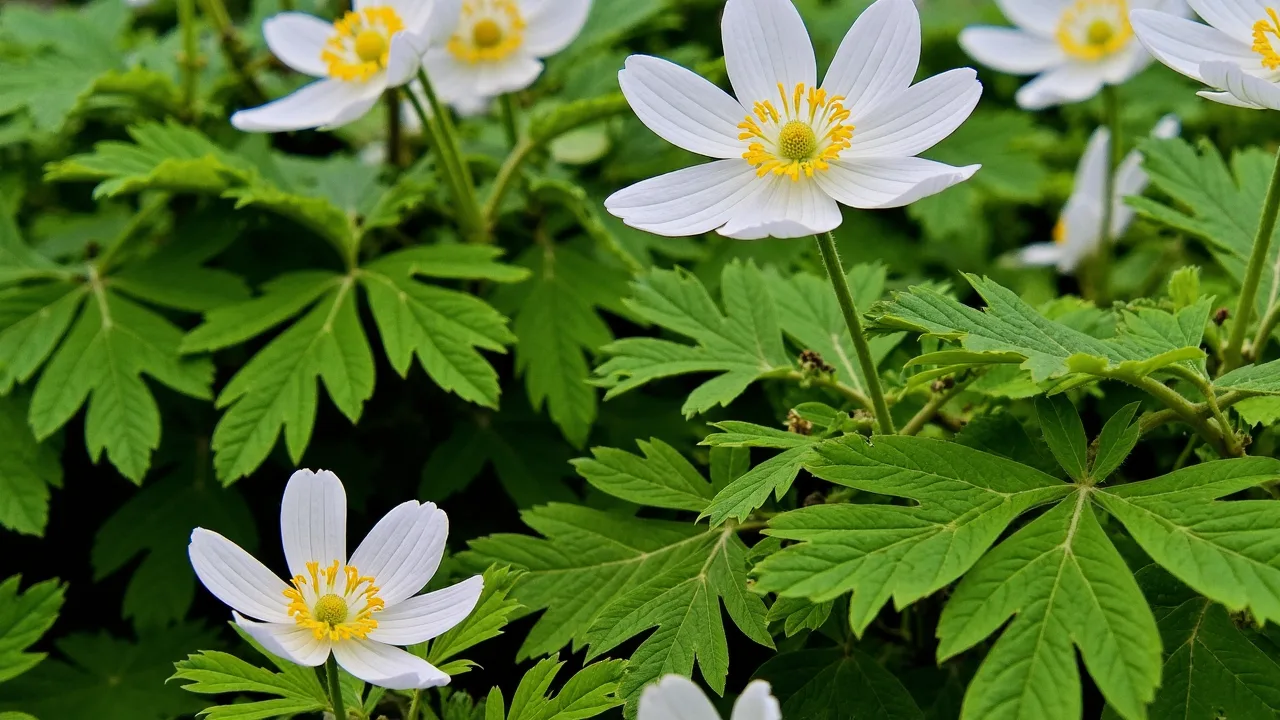
Wood anemone grows from a slender, creeping rhizome that sits just beneath the soil surface. Each year the plant sends up a short stem, typically 10–25 cm tall, bearing a single flower above a whorl of leaves.
The leaves are deeply divided into three lobed leaflets, each further toothed and cut, giving a delicate, almost lacy appearance. They are a fresh, slightly glossy mid-green when they emerge and often bronze-tinged in early growth.
The flowers are the species' chief ornament. Each bloom is 2–4 cm across and composed of six to eight petal-like sepals (true petals are absent in this genus). The colour is most often clean white, sometimes flushed pink or lilac, particularly as the flowers age or in cool, shaded conditions. A ring of stamens at the centre of each bloom is a subtle contrast of yellow and pale green.
A characteristic feature is that the flowers respond to light and weather. In bright spring sunshine they open flat; in overcast conditions, heavy rain, or evening light they close and nod downwards, protecting the pollen within. Seed is set in small, green achenes that are shed as the foliage dies back.
Growing Conditions
Wood anemone thrives in conditions that mimic the deciduous woodland floor. It needs light in early spring, before the tree canopy leafs up, and then cool, shaded conditions through the rest of the growing season. Hot, dry sites in full sun will quickly scorch the foliage and shorten the growing season.
Soil should be moist but free-draining and high in organic matter. Leaf mould, well-rotted garden compost or similar woodland debris incorporated at planting time replicates the natural substrate well. The plant prefers a slightly acid to near-neutral pH, roughly 5.5–7.0, and resents compacted or waterlogged ground, where the rhizomes are prone to rot.
Across the UK the plant is fully hardy, rated H6 on the RHS hardiness scale (hardy throughout the UK down to around −20 °C). It performs reliably from the Scottish Highlands to the south coast and tolerates the damp, mild winters of the western seaboard with ease. Cold, exposed sites are not a problem provided drainage is good.
Suitable companions include other woodland species such as primroses, bluebells, dog's-tooth violets, hart's tongue ferns and sweet woodruff, all of which share similar moisture and shade requirements.
Planting and Care
The best time to plant wood anemone is in autumn, between September and November, while the soil is still warm and the rhizomes are entering active root growth. Container-grown plants can also go in during early spring, but they need careful watering through their first summer.
For bare rhizomes, plant them horizontally about 3–5 cm deep and 10–15 cm apart, in groups of at least a dozen for a natural drift. Water in well and mulch lightly with leaf mould. Established plants will colonise slowly by rhizome; allow at least two to three seasons before judging the effect.
Watering is most important during the spring growth period. In dry springs, soak the ground once a week while the plants are in leaf. Once foliage yellows and dies back in early summer, watering can stop. Established colonies in shaded sites rarely need supplementary water in normal UK summers.
Feeding is generally unnecessary. Wood anemone has evolved in low-nutrient woodland soils and resents rich, nitrogen-heavy ground, which tends to encourage leafy growth at the expense of flowers. An annual autumn mulch of leaf mould is sufficient.
Pruning is minimal. Allow the foliage to die back naturally, removing it only once it has yellowed fully. The leaves are needed to replenish the rhizome for the following year's display.
Propagation is straightforward but slow. Lift and divide established clumps in early autumn, immediately after the foliage has died back, replanting the rhizomes at the same depth. Seed can be sown fresh in autumn; germination is slow and irregular, typically taking one to two springs, so division remains the more reliable method.
Common Problems
Wood anemone is largely trouble-free when grown in suitable conditions. The most frequent problems arise from planting in the wrong place rather than from pest or disease pressure.
Slugs and snails will graze young foliage and flowers in damp springs, particularly in heavy or newly planted beds. Cultural control — removing debris, encouraging ground beetles and using wool-based mulches — is usually sufficient; chemical control is rarely needed.
Powdery mildew can appear on foliage in dry, overcrowded or poorly ventilated sites, although it is uncommon. Improving air circulation and avoiding overhead watering late in the day usually resolves the issue.
Aphids occasionally colonise young shoots in spring but rarely cause serious damage. A strong jet of water or natural predators will normally keep them in check.
Crown and rhizome rot is the most damaging problem, caused by waterlogged or compacted soil. The rhizomes turn soft and black and fail to reappear the following spring. Prevention is far easier than cure: plant only in well-drained soil and avoid heavy mulches that hold excess moisture against the rhizomes.
In appropriate woodland conditions, established colonies are notably long-lived and largely self-sufficient, often outlasting several generations of gardeners.
Popular Varieties
Several named forms of Anemonoides nemorosa are available from specialist UK nurseries, although they can be slow to bulk up and are often sold in small quantities.
- Anemonoides nemorosa — the wild type, with single white flowers 2–4 cm across. The form most commonly offered and the most vigorous in the garden.
- Anemonoides nemorosa 'Allenii' — a selected form with larger, slightly lavender-flushed pale blue flowers. Slightly slower to increase than the type but reliable in cooler sites.
- Anemonoides nemorosa 'Robinsoniana' — a vigorous variety bearing soft lavender-blue flowers, found originally in Ireland. Often considered one of the best blue forms for garden use.
- Anemonoides nemorosa 'Vestal' — a distinctive double form with a central tuft of narrow white petaloid segments surrounded by the usual outer sepals. More delicate in habit and best in a sheltered spot.
- Anemonoides nemorosa 'Bracteata Pleniflora' — an old, semi-double form with a green-fringed ruff at the flower centre. A curiosity for collectors rather than a strong garden performer.
- Anemonoides nemorosa 'Leeds' Variety' — large, pure white flowers on slightly taller stems; a useful form for naturalising in grass at the edge of shade.
When buying cultivated forms it is important to source from reputable growers; wild-collected stock is illegal in many counties and should be avoided. Several specialist RHS Plant Finder nurseries list named forms and can advise on availability.
Pests and Diseases
| Problem | Symptoms | Management |
|---|---|---|
| Slugs and snails | Irregular holes chewed in young leaves and flower buds, often accompanied by slimy trails. | Use copper tape barriers, beer traps, or iron phosphate-based pellets to deter feeding. |
| Powdery mildew | White, dusty fungal growth appears on leaves and stems, potentially causing distortion. | Improve air circulation and apply a suitable fungicide if infection is severe. |
| Leaf eelworms | Leaves show blistering, distortion, or necrotic patches due to nematode infestation. | Remove and destroy affected plants; avoid replanting in the same spot for several years. |
| Caterpillars | Leaves are skeletonised or eaten, with visible frass (droppings) on foliage. | Hand-pick caterpillars or use biological controls like nematodes for larger infestations. |
| Root rot | Foliage wilts and yellows despite moist soil, indicating waterlogged conditions. | Ensure well-drained soil and avoid overwatering, especially during winter dormancy. |
Quick Care Summary
| Sunlight | Partial shade |
|---|---|
| Soil | Moist but well-drained, humus-rich soil; tolerates chalk, loam, sand, clay; pH acid, alkaline, or neutral. |
| Hardiness | H5 (-15.0 °C) |
| Sow | — |
| Plant | — |
| Prune | — |
As an Amazon Associate, GardenWizz earns from qualifying purchases made through the links above. This does not affect the price you pay. See our disclaimer for details.