
Calendula officinalis
Pot Marigold
At a Glance
| Botanical name | Pot Marigold |
|---|---|
| Common name(s) | Calendula officinalis |
| Family | Asteraceae |
| Plant type | annual (Short-lived aromatic herbaceous perennial, commonly treated as an annual.) |
| Height × Spread | 10–80 cm × 10–50 cm |
| Hardiness | H5 (to -15.0 °C) |
| Position | Full sun, Partial shade |
| Soil | Light, poor, free-draining soil; tolerates most soils including dry and poor soil. Dislikes very wet, overly fertile soil. |
| Flowering | May–September |
| Toxicity | — |
| Native range | Southern Europe |
Calendula officinalis, widely known in British gardens as the pot marigold, is a hardy annual belonging to the daisy family (Asteraceae). Native to the Mediterranean region and southern Europe, it has been grown in the British Isles for centuries as a cottage-garden favourite, a medicinal herb and a colourful addition to the kitchen garden. Its vivid orange and yellow blooms, long flowering season and easy cultivation make it one of the most rewarding annuals for UK gardeners, from the smallest courtyard to the largest mixed border.
Quick-Care Table
Overview
Calendula officinalis is a fast-growing annual that completes its life cycle in a single UK growing season. It is not related to the French or African marigolds of the genus Tagetes, despite the shared common name, and the distinction is worth noting for gardeners comparing seed catalogues. The plant's Latin name is derived from calendae, the Latin word for the first day of the month, a reference to its long and near-continuous flowering habit.
In the UK, pot marigold is treated as a self-seeding fixture of cottage, kitchen and cut-flower gardens. It tolerates a wide range of soils, performs well in coastal gardens, and is widely used as a companion plant in vegetable plots. The petals are edible and have a long history of culinary and herbal use, lending the species a dual role as both ornament and useful plant.
The Royal Horticultural Society has long recognised the species' garden worth, and Calendula officinalis holds the RHS Award of Garden Merit (AGM). The species is fully hardy across all but the most exposed Scottish Highland and upland sites, and self-sows reliably in undisturbed ground.
Beyond the ornamental display, pot marigold has a long history of practical use in British households. The fresh petals — best gathered in mid-morning once the dew has dried — add a peppery, slightly bitter note and a bright orange tint to salads, soups, soft cheeses, herb butters and rice dishes, and have been used as an inexpensive saffron substitute. The young leaves can be chopped sparingly into salads in the same way. In the herb garden, dried petals have been used to make infused oils and salves for minor skin irritations, chapped skin and small cuts, while a simple petal tea has been taken after meals as a gentle digestive. As a companion plant in the vegetable garden, calendula is widely planted alongside tomatoes, carrots, brassicas and asparagus, where it is said to draw aphids away from the crop and to attract hoverflies, whose larvae eat greenfly.
Appearance
Pot marigold forms an upright, bushy plant typically 30–60 cm tall, with a similar spread of 30–45 cm. The branching stems are slightly sticky and aromatic when bruised, clothed in lance-shaped (lanceolate) leaves 5–15 cm long. The leaves are bright green, often described as pale or mid-green, and carry a sparse covering of fine hairs that give them a slightly rough texture.
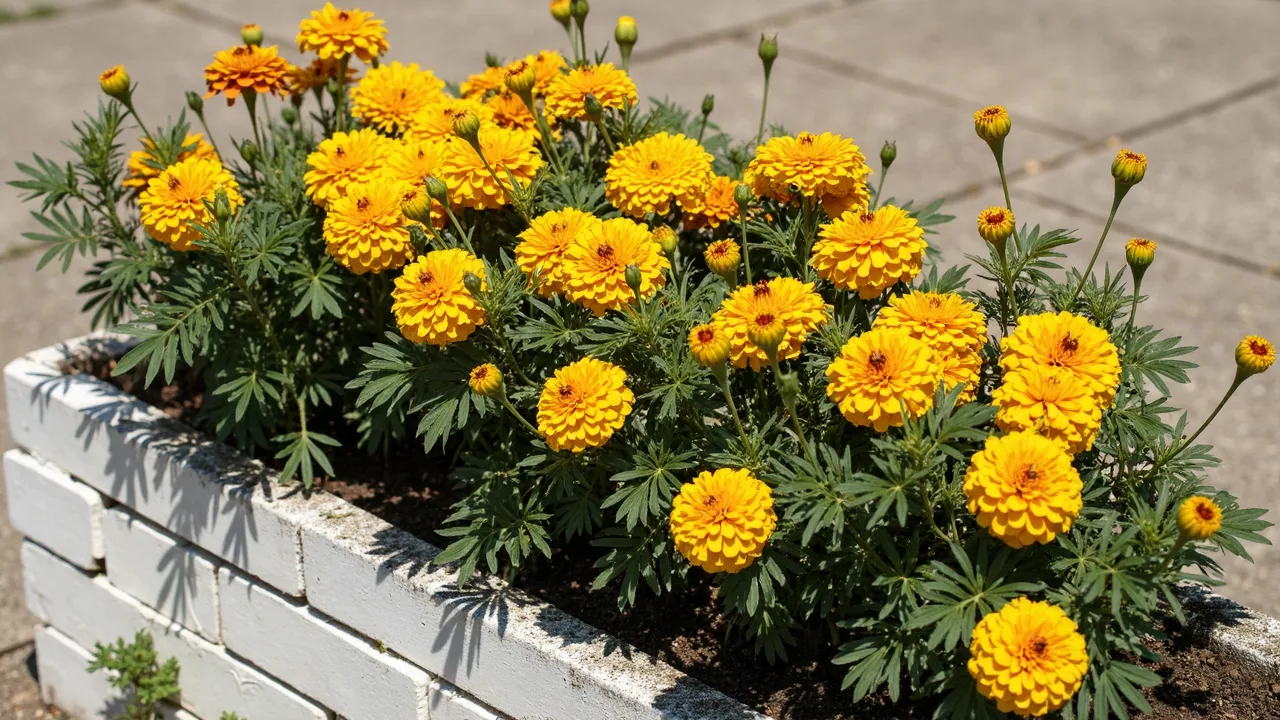
The flowers are daisy-like, 4–7 cm across, with a single or double row of ray petals surrounding a darker central disc. Wild-type plants are usually single, with flat, golden-orange ray florets radiating from a deeper orange or amber disc. Modern seed strains offer a colour range from pale butter-yellow ('Kablouna', 'Snow Princess') through every shade of orange to apricot and even a pinkish 'Touch of Red' tint. Double-flowered cultivars such as 'Indian Prince' and the 'Bon Bon' series pack the centre with extra rows of petals, producing a rounded, almost chrysanthemum-like form.
The flowers close at night and reopen in daylight, a habit that distinguishes Calendula from many other Asteraceae. Foliage remains attractive throughout the season provided plants are not allowed to dry out completely, and dead-heading is rewarded by a continuous flush of new buds from late spring until the first hard frosts.
Growing Conditions
Calendula thrives in any reasonable garden soil provided drainage is adequate. It is notably tolerant of poor, hungry soils, and on rich ground the plant can become leafy at the expense of flowers. A neutral to slightly alkaline pH in the range 6.0–7.5 is ideal, although the plant grows successfully outside this band. Very acid soils can be improved with a light dressing of garden lime before sowing.
Full sun produces the most floriferous display and the strongest stems, but the plant tolerates light dappled shade, particularly in hotter southern English gardens where afternoon shade can prolong flowering into late summer. The species is hardy throughout the British Isles, including northern England, Wales and most of Scotland, although in colder inland areas young autumn-sown plants benefit from a light mulch of bracken or straw through their first winter.
In containers, use a loam-based compost such as John Innes No. 2 with a little extra grit for drainage. Pot-grown plants need more frequent watering than those in the open ground, and benefit from a fortnightly liquid feed once flowering begins, since nutrients leach quickly from the root zone.
Calendula is well suited to coastal gardens, where it tolerates salt-laden winds better than many annuals, and is a useful filler in newly planted borders where soil is still being improved — its tap roots help break up the ground for later plantings. In a wildlife or pollinator garden the single-flowered forms are particularly valuable, providing nectar for honey bees, bumblebees, hoverflies and small butterflies from early summer through to the first frosts, and the seed heads are enjoyed by goldfinches in late summer.
Planting and Care
Sow seed directly where it is to flower, in a prepared, raked seedbed, from March to May once the soil has warmed. Alternatively, sow in late August or September for overwintered plants that flower earlier and more strongly the following year. Cover the large, curved seeds with about 1 cm of soil and water in. Germination takes 7–14 days at 15–18 °C.
Seed can also be started in modules or small pots under glass in early spring, which gives larger, more advanced plants by the time frosts end in mid-to-late May. Harden off before planting out at 20–30 cm spacings. Closer planting produces a fuller effect but reduces air circulation and can increase mildew risk later in the season.
Once established, calendula is essentially low-maintenance. Water during prolonged dry spells, particularly on light soils, but avoid overhead watering in the evening as wet foliage encourages powdery mildew. Dead-heading is the single most important task: removing faded flowers every few days extends the display from June through to October or the first hard frosts, and prevents self-seeding where that is not wanted. Allowing a few heads to set seed at the end of the season is an easy way to ensure a fresh crop of seedlings the following spring.
Feeding is rarely necessary in open ground; a light mulch of garden compost in spring is sufficient. Plants grown in pots benefit from a high-potash liquid feed (such as a tomato fertiliser) every two weeks during flowering to maintain bud production. Staking is seldom required for modern compact cultivars, although taller strains on rich soil may need pea sticks or short canes in exposed sites.
Propagation is almost always from seed. Calendula officinalis comes reasonably true from saved seed, although cross-pollination by bees means named cultivars will not always breed true. The plant self-seeds readily, and in many gardens a single sowing establishes a self-perpetuating population for years.
Common Problems
Aphids are the most frequent pest, clustering on young shoot tips and unopened buds in late spring and early summer. A jet of water from a hose, encouragement of natural predators such as hoverflies and ladybirds, or a soft soap spray is usually sufficient. Avoiding over-use of nitrogen fertiliser reduces the risk of severe infestations.
Powdery mildew is the most common disease, appearing as a white powdery coating on the leaves in late summer, especially after hot, dry weather followed by humid nights. The condition is largely cosmetic but can shorten the display. Prevent it by spacing plants generously, watering at the base rather than over the foliage, and removing badly affected material at the end of the season.
Slugs and snails are particularly fond of young seedlings, and direct-sown patches can be grazed to the ground in damp conditions. Protection with copper tape around seed beds, organic slug pellets based on ferric phosphate, or night-time hand-picking is effective.
Leaf miners occasionally produce pale, serpentine tunnels in the leaves, and a fungal rust can cause small orange-brown pustules on the undersides of leaves in damp seasons. In both cases, removing and destroying affected material is usually sufficient; chemical treatment is rarely justified in a garden setting.
Popular Varieties
Several seed strains and cultivars of Calendula officinalis are widely available in the UK. The following are well-established in British seed catalogues and worth seeking out.
'Indian Prince' is a popular double-flowered cultivar with deep orange petals backed with a mahogany-red reverse, giving a striking two-tone effect. It reaches 45–60 cm tall and is a favourite for cut-flower work.
'Resina' is grown specifically for herbal use, selected for a high resin content in the petals. The flowers are bright yellow to pale orange and semi-double, and the plant is robust at around 50 cm.
'Bon Bon Mix' (also sold as 'Bon Bon') produces a balanced blend of pastel apricot, yellow and orange double blooms on compact 30 cm plants, ideal for the front of a border or for containers.
'Kablouna' is notable for its unusual quilled, almost chrysanthemum-like central petals in mixed yellow and orange shades. It grows to about 50 cm and is a reliable cut-flower subject.
'Snow Princess' is a paler cultivar with creamy-yellow, almost white petals around a darker disc, useful for softer planting schemes and pastel borders.
'Touch of Red Buff' carries a distinctive pinkish-apricot tint with red petal tips, an unusual colour break for the species, and is a popular choice for unusual cut-flower arrangements.
Gardeners seeking wildlife value should note that single-flowered forms are generally more useful for bees and hoverflies than the densely double cultivars, since the extra petal rows obscure the central disc florets where the nectar is produced.
Pests and Diseases
| Problem | Symptoms | Management |
|---|---|---|
| Aphids | Clusters of small green or black insects on new growth and flower buds, often accompanied by sticky honeydew. | Squash infestations by hand or spray with a strong jet of water; use insecticidal soap for severe cases. |
| Powdery mildew | A white, dusty fungal growth appears on leaves and stems, potentially causing yellowing and distortion. | Improve air circulation, avoid overhead watering, and apply a fungicide if the infection is severe. |
| Slugs and snails | Irregular holes chewed in leaves and flowers, with slimy trails visible on foliage and soil. | Use physical barriers like copper tape or eggshells, or apply slug pellets sparingly around the base. |
| Cucumber mosaic virus | Mottled or distorted leaves and stunted growth, often transmitted by aphids. | Remove and destroy infected plants immediately to prevent spread; control aphid populations. |
| Heat stress | Flowering dwindles and plants appear wilted or 'sulky' during hot, dry summer spells. | Provide afternoon shade in hot areas and cut back severely to encourage fresh growth when cool. |
Quick Care Summary
| Sunlight | Full sun, Partial shade |
|---|---|
| Soil | Light, poor, free-draining soil; tolerates most soils including dry and poor soil. Dislikes very wet, overly fertile soil. |
| Hardiness | H5 (-15.0 °C) |
| Sow | March, April, May, September, October, November |
| Plant | — |
| Prune | June–September |
As an Amazon Associate, GardenWizz earns from qualifying purchases made through the links above. This does not affect the price you pay. See our disclaimer for details.