
Willow Herb
Epilobium angustifolium
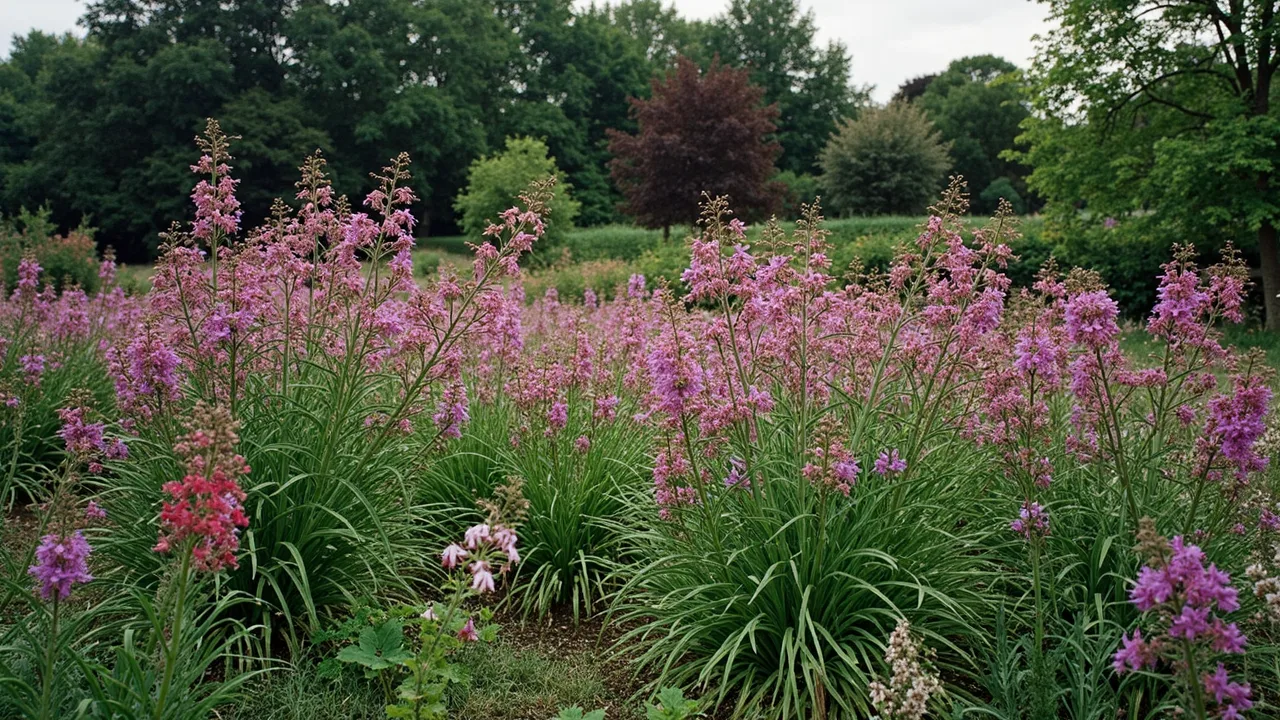
At a Glance
| Botanical name | Epilobium angustifolium |
|---|---|
| Common name(s) | Willow Herb |
| Family | Onagraceae |
| Plant type | perennial |
| Height × Spread | 0.5–2 m × — |
| Hardiness | H7 (to -20.0 °C) |
| Position | Full sun, Partial shade |
| Soil | wide range of soils; damp, wild areas such as streamsides or marshy ground; well-drained; chalk; pH Acid, Alkaline, Neutral |
| Flowering | June–September |
| Toxicity | — |
| Native range | temperate Northern Hemisphere |
Willow herb (Epilobium angustifolium), widely known in the UK as rosebay willowherb, is a tall, vigorous perennial wildflower in the family Onagraceae. Once regarded chiefly as a pioneer of waste ground and wayside verges, it has grown in popularity with gardeners seeking pollinator-friendly plants that thrive on poor, dry soils where fussier ornamentals struggle. Its wand-like spires of pink flowers, drawn-out summer display and tolerance of a wide range of conditions make it a useful, if exuberant, choice for naturalistic plantings, wildlife borders and difficult corners of the garden. GardenWizz's overview of willow herb covers its appearance, cultivation in British conditions, routine care, common problems, and the small handful of named varieties that are most widely grown.
Overview
Willow herb is a native British wildflower, found throughout England, Scotland, Wales and Ireland in clearings, woodland edges, heathland, railway embankments and urban wasteground. The species spreads by both seed and creeping rhizomes, which is why it is often the first colonist to appear on land cleared by fire — hence its American name, fireweed — and on disturbed soil after building work or tree felling.
In gardens, willow herb is best understood as a useful but assertive perennial rather than a tame border plant. It suits informal, wildlife-focused planting schemes, including wildflower meadows, naturalistic prairie-style borders and the edges of woodland or large shrub plantings. It is less suited to small, highly maintained mixed borders, where its spreading habit and prolific seeding can become a chore.
The plant is highly attractive to bees, hoverflies, moths and other pollinating insects, and is the principal UK food plant of the elephant hawk-moth, whose conspicuous pink-and-green caterpillars feed on the foliage in late summer. A single flowering spike can support dozens of bumblebees on a warm July day.
Appearance
Willow herb is an upright, clump-forming perennial that throws up a clump of wand-like flowering stems in late spring. Plants typically reach 90–180 cm in height when in flower, with a spread of 60–90 cm once established.
The leaves are lance-shaped, narrow and willow-like — the source of the common name — and are arranged spirally up the stem. They are 5–20 cm long, smooth-edged or very finely toothed, and a soft, slightly greyish green. Young spring growth has a reddish tint, particularly on plants growing in poor or sun-baked soil.
Flowering begins in June in the south of England and may be a fortnight or so later in northern Britain and at higher altitudes. Each plant produces one to several upright racemes densely packed with 20–80 individual flowers. The flowers are 2–3 cm across, with four broad, rounded, rose-pink petals and a paler, almost white style in the centre. As the flowering spike matures, lower flowers fade to a deeper pink and go on to develop long, slender seed pods that split open from late July onwards to release thousands of silky-tufted seeds on the wind — a familiar sight on late-summer days and the main reason the plant colonises so readily.
The root system is fibrous but backed by creeping rhizomes, which can extend 30 cm or more per year in loose soil and are responsible for the plant's ability to form sizeable colonies.
Growing Conditions
Willow herb is, by British standards, an easy plant to please. It performs best in full sun but tolerates light, dappled shade, particularly at the cooler end of its range in northern and western Britain.
Soil requirements are modest. The plant prefers a moist but well-drained loam but will grow in clay, sandy, chalky and peaty soils. It is notably tolerant of acidic ground, which is one reason it does so well on damp heaths and in cleared conifer plantations. Established plants cope well with summer drought, although flowering may be reduced in prolonged dry spells on the very lightest soils.
Willow herb is fully hardy across the UK. The Royal Horticultural Society has not awarded it a hardiness rating as a garden cultivar (it is treated as a native wildflower rather than an introduced ornamental), but in practical terms it tolerates winter temperatures well below –15 °C without protection, and the aerial growth dies back naturally in autumn and reshoots from the base in spring.
It is unsuitable for very boggy or waterlogged sites, where the rhizomes may rot, and it does not flower well in deep shade.
Planting and Care
Sowing and planting. Willow herb can be raised from seed sown in spring or autumn, or introduced as container-grown plants from a reputable nursery. Seed requires no special treatment and germinates readily in a few weeks at 15–20 °C. Pot-grown plants can be set out at any time of year when the soil is workable, but spring and early autumn are best as they allow time to establish before the first summer's flowering. Space plants 60–90 cm apart; closer planting will not prevent the species from colonising the gaps within a season.
Watering. Water newly planted specimens regularly through their first growing season. Once established, willow herb needs little supplementary irrigation in most British summers, except on the very lightest, free-draining soils in the south and east of England.
Feeding. In reasonably fertile garden soil, no feeding is necessary and, indeed, rich soil encourages leafy growth at the expense of flowers. On very poor soils, a light mulch of well-rotted garden compost in early spring is sufficient.
Pruning and tidying. Cut back the dead flowering stems to ground level in late autumn or winter once seeding is complete. If self-seeding is a concern — and in a small garden it usually is — deadhead spent spikes promptly in July and August before the seed pods ripen. Wear gloves when clearing seed heads, as the silky down can irritate skin and eyes.
Containment. Because of its vigorous rhizomes and prolific seed, willow herb can become a nuisance in mixed borders. Two practical options are: (1) plant it in a sunken container, such as a large bottomless bucket or a half-barrel, to restrict the roots; or (2) site it where its spread is an asset, for example in a wild patch, a gravel garden, or beneath a hedge.
Propagation. Increase stock by division of established clumps in autumn or early spring, or by seed as described above. Cuttings of non-flowering basal shoots taken in early summer root readily in pots of gritty compost under cover.
Seasonal care. In the UK the main seasonal tasks are minimal: a late-winter tidy of old stems, an optional spring mulch, and deadheading in high summer. Potted specimens benefit from being divided every two to three years, as they soon fill their container.
Common Problems
Willow herb is largely trouble-free in British gardens. The most frequently reported issues are cultural or ecological rather than disease-based.
- Excessive self-seeding. The single most common "problem" in a managed garden. Hundreds of silky-tufted seeds are released from each spent spike and germinate freely in disturbed ground. Deadhead before seed pods split, or accept and manage seedlings as they appear.
- Spreading rhizomes. In light, loose soil, willow herb can colonise several metres from the original clump. Restrict roots with a deep barrier, or grow it where spread is welcome.
- Powdery mildew. A white, dusty coating on the leaves can appear in warm, dry late summers, especially on plants under stress or in crowded plantings. Improve air circulation, avoid overhead watering, and remove affected foliage in autumn. The disease is rarely serious enough to warrant fungicide treatment.
- Aphids. Greenfly and blackfly sometimes colonise the soft shoot tips in late spring. They are usually kept in check by natural predators, including ladybirds, hoverflies and lacewings, and rarely need treatment. A strong jet of water dislodges early colonies.
- Elephant hawk-moth caterpillars. Large, brown-and-pink caterpillars seen feeding on the foliage in August and September are almost certainly the larvae of Deilephila elpenor. They are harmless to the plant's long-term health and should be left in place as part of any wildlife-friendly garden.
- Rabbits and deer. Willow herb is generally unpalatable to rabbits and deer and is sometimes planted in rural gardens specifically because it is left alone.
There are no significant viral or bacterial diseases of willow herb recorded in UK horticulture.
Popular Varieties
True cultivars of Epilobium angustifolium are few. The species itself is variable across its range, and many garden plants offered for sale are seed-raised forms of the wild type. The following are the most widely available and reliable.
- 'Album' — a pure white-flowered form, otherwise identical in habit to the wild species. Less common in cultivation but prized for its luminous, late-evening colour in wildlife borders. Height 120–150 cm.
- 'Stahl Rose' — a compact, deep rose-pink selection that holds its colour well in sun and is slightly less vigorous than the wild type, making it a better choice for smaller borders. Height 90–120 cm.
- 'Isobel' — a relatively recent cultivar with slightly broader, more rounded leaves and a denser flower spike in a clear mid-pink. Reported to be slower to spread from rhizomes than the species. Height 100–140 cm.
In addition, a number of seed-raised mixes sold simply as "rosebay willowherb" or "fireweed" are widely available and produce plants of the wild type. The closely related Epilobium angustifolium var. micranthum is a smaller, more delicate subspecies occasionally offered by specialist wildflower nurseries; it reaches only 60–80 cm and is useful at the front of a wild border.
A note on the plant's relatives: the small-flowered willowherbs — Epilobium montanum, Epilobium parviflorum and Epilobium hirsutum — are sometimes confused with rosebay willowherb in garden centres, but they are distinctly different plants with much smaller flowers and a weedy habit, and are not covered by this entry.
Pests and Diseases
| Problem | Symptoms | Management |
|---|---|---|
| Slugs and snails | Irregular holes chewed in young leaves and stems, often accompanied by silky trails. | Use physical barriers like copper tape or organic pellets to protect emerging growth. |
| Powdery mildew | White, dusty fungal growth appears on leaves and stems in humid conditions. | Improve air circulation and water at the base to keep foliage dry; remove affected parts. |
| Rust diseases | Orange or brown pustules develop on the undersides of leaves, causing yellowing. | Remove infected leaves promptly and avoid overhead watering to reduce humidity. |
| Excessive self-seeding | Dense colonies of seedlings spread rapidly across the garden via wind-dispersed seeds. | Deadhead flowers before seed heads form or cut back plants after flowering. |
Quick Care Summary
| Sunlight | Full sun, Partial shade |
|---|---|
| Soil | wide range of soils; damp, wild areas such as streamsides or marshy ground; well-drained; chalk; pH Acid, Alkaline, Neutral |
| Hardiness | H7 (-20.0 °C) |
| Sow | — |
| Plant | March, April, May, September, October, November |
| Prune | — |