
Privet
Ligustrum vulgare
At a Glance
| Botanical name | Ligustrum vulgare |
|---|---|
| Common name(s) | Privet |
| Family | Oleaceae |
| Plant type | shrub (semi-evergreen or deciduous) |
| Height × Spread | 3–5 m × — |
| Hardiness | H6 (to -20.0 °C) |
| Position | Full sun, Partial shade |
| Soil | any well-drained soil |
| Flowering | June–August |
| Toxicity | Harmful if eaten. Wear gloves and other protective equipment when handling |
| Native range | central and southern Europe, north Africa and southwestern Asia, from Ireland and southwestern Sweden south to Morocco, and east to Poland and northwestern Iran |
Common privet (Ligustrum vulgare) is a vigorous, dense shrub of the olive family (Oleaceae) and one of the longest-serving hedging plants in British horticulture. Native to central and southern Europe, north Africa and south-western Asia — including the British Isles — it grows wild in hedgerows, woodland edges and limestone scrub and has been cultivated since at least the Tudor period. Its tolerance of clipping, exposure, pollution and a wide range of soils made it the default village-hedge shrub for much of the twentieth century, and it remains a reliable choice for formal hedges and topiary.
Privet is deciduous in cold districts and semi-evergreen in milder parts of the south and west, holding its leaves well into winter. The creamy-white, strongly scented flowers open in midsummer, and the glossy black berries that follow sustain thrushes, blackbirds, redwings and fieldfares through autumn and winter.
Quick-Care Table
Overview
Ligustrum vulgare is a tough, fast-growing shrub prized less for ornament than for its willingness to be cut. Unpruned specimens can reach 5 m, but most cultivated plants are kept between 1.2 m and 2.5 m as a hedge. The species is fully hardy across the United Kingdom, including exposed northern and upland sites, and tolerates coastal winds, road salt, compacted soil and atmospheric pollution.
The flowers are rich in nectar, attracting bees, hoverflies and butterflies, and the dense, twiggy growth provides secure nesting cover for small birds. The persistent berries sustain thrushes through midwinter. All parts — berries, leaves and bark — are, however, mildly toxic to humans and several domestic animals, containing ligustrin and other glycosides that cause gastric upset if eaten. Wear gloves when handling large quantities of cut material and wash hands afterwards. In some regions privet is recorded as a self-seeding colonist of woodland and calcareous grassland, so gardeners in those habitats may prefer to confine it as a clipped hedge rather than allow naturalisation.
Appearance
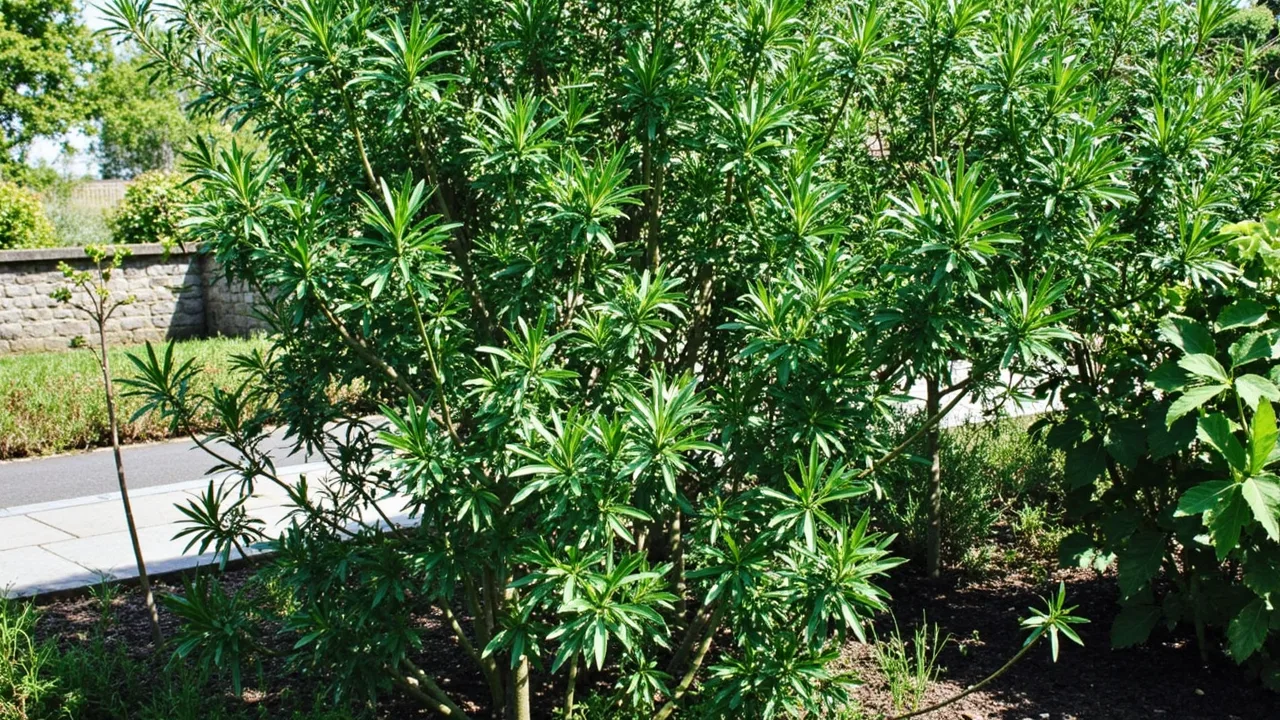
Privet forms a dense, upright shrub with stiffly arching branches. The bark is smooth and grey-brown on young wood, becoming finely fissured and paler on older stems. Left unpruned, mature plants develop an irregular, leggy outline with bare lower branches — a habit that, combined with the species' tolerance of hard cutting, is precisely why it has been so widely used as a hedge.
The leaves are opposite, narrowly lanceolate to ovate, 2–6 cm long, with smooth margins and a short stalk. The upper surface is a dull, dark green; the underside is paler and slightly glaucous. In a hard winter the foliage bronzes on exposed sides, but in most British gardens the leaves remain from spring through to a slow abscission in late winter. New growth emerges bright green in April and matures to the characteristic leathery texture by midsummer.
Flowering begins in late June and continues into August. Each terminal panicle is a conical cluster 3–8 cm long of small, four-lobed, creamy-white flowers with a strong, slightly acrid scent. They are followed by ovoid, glossy black drupes 6–8 mm across, each containing one or two seeds. The berries ripen in September and October, hang on the bare twigs through winter, and are stripped progressively by birds and weathering.
The root system is fibrous and relatively shallow, which makes privet easy to transplant but also means it competes vigorously with neighbouring plants within a metre or so of the hedge line.
Growing Conditions
Privet is one of the most accommodating hedging plants available. It grows in any reasonable garden soil — clay, loam, sand or chalk — provided drainage is reasonable. It tolerates pH from mildly acid (around 5.5) through to strongly alkaline (around 8), and will establish on thin soils overlying rock where many shrubs struggle. Where drainage is poor, the addition of coarse organic matter and grit at planting helps avoid root rots.
Position is similarly uncritical. Full sun gives the heaviest flowering and berry set, but privet is more shade-tolerant than most hedging shrubs and performs well on north-facing boundaries and beneath light tree canopies, making a useful understorey filler. It tolerates exposed coastal sites, salt-laden winds and the desiccating conditions of east-facing walls; in town gardens it withstands compaction, road salt and vehicle pollution.
The Royal Horticultural Society rates Ligustrum vulgare as H6, meaning it is hardy throughout the United Kingdom and tolerates winter lows of −15 to −20 °C without injury. Neither the species nor the cultivars listed below currently holds the RHS Award of Garden Merit.
Planting and Care
Planting. Container-grown privet can be planted at any time of year when the soil is workable, though autumn to early spring is ideal. Bare-root plants — cheaper and quicker to establish in quantity — are available from November to March and must be planted while dormant. For a single hedge, set plants 30–45 cm apart in a staggered row; for a stock-proof barrier, plant a double row 45 cm apart with 60 cm between rows. Soak bare-root plants in water for an hour before planting, water container specimens thoroughly the day before, plant to the depth of the nursery mark, firm in well, water generously, and mulch with composted bark.
Watering. Water newly planted privet weekly during the first two growing seasons, particularly in late spring and summer, to establish the root system. Once established, the species is notably drought-tolerant and will survive on rainfall alone in most British summers, only flagging in prolonged dry spells on thin, sandy soils.
Feeding. A single annual application of a balanced fertiliser such as Growmore, or an organic equivalent such as blood, fish and bone, applied in March and lightly forked into the soil around the drip line, supports strong growth and good berry production. A 5–8 cm mulch of composted bark or well-rotted compost, refreshed each spring, performs a similar function and suppresses weeds.
Pruning. As a formal hedge, trim two or three times between late May and early September, finishing the last cut by early autumn so that new growth hardens before the first frosts. Cut to a slightly tapered profile — narrower at the top than the base — to allow light to reach the lower foliage and prevent the common complaint of a bare, leggy base. For an overgrown hedge, hard renovation is possible: cut the entire plant back to within 30–45 cm of the ground in late winter, feed and mulch heavily in spring, and a flush of vigorous new shoots will produce a fresh framework by midsummer. Single specimens used as background shrubs need only a light formative prune after flowering.
Propagation. Semi-hardwood cuttings 10–15 cm long, taken in July or August and inserted into a 50:50 mix of peat-free compost and sharp sand, root readily under a cold frame. Propagation from seed is straightforward but slow: collect ripe berries in October, macerate them in water to separate seed from pulp, and sow immediately. The seed requires cold stratification and germinates erratically the following spring.
Seasonal care. Sweep up fallen leaves in autumn to reduce fungal leaf-spot carry-over, and inspect the hedge in late spring for aphid colonies on the new growth, treating promptly with insecticidal soap if numbers build up.
Common Problems
Privet aphid (Silvestriana nigra). The most frequent pest, this pale yellow-green aphid colonises shoot tips in late spring and early summer, sucking sap and causing young leaves to pucker, curl and distort. Heavy infestations produce sticky honeydew on which sooty moulds develop. Encourage natural predators such as ladybirds, lacewings and hoverflies; treat serious outbreaks with insecticidal soap or a systemic spray applied as soon as the damage is seen.
Leaf-mining moths (Gracillaria syringella and related species). Small, blotch-shaped pale patches appear as the caterpillars tunnel within the leaves. Damage is cosmetic; natural enemies normally keep populations in check. Rake up and destroy fallen leaves in autumn to interrupt the life cycle in severe cases.
Scale insects. Small, brown, limpet-like insects on stems and leaf undersides, often with honeydew and sooty mould. Light infestations can be rubbed off by hand; heavier cases respond to a winter wash of plant oil applied when the plant is dormant.
Thrips. Silvery flecking on the upper leaf surface and tiny black specks of frass below indicate thrips activity in hot, dry summers. Syringing the foliage in the evening and maintaining a moist root run reduce the problem.
Leaf spots. Several fungi — Alternaria, Phyllosticta and others — cause brown or grey-brown spots, often with a yellow halo, in damp summers. Rarely serious; improve air circulation by thinning an overgrown hedge, avoid overhead watering, and clear up fallen leaves in autumn.
Powdery mildew. A white, powdery coating on leaves in late summer, encouraged by warm days, cool nights and stagnant air. Ensure good spacing, water at the base rather than over the foliage, and remove affected growth.
Honey fungus (Armillaria spp.) and Verticillium wilt. Soil-borne fungi that can affect privet, the first producing white mycelial fans beneath the bark and black bootlace rhizomorphs in the soil, the second causing sudden wilting and dieback. There is no practical cure; affected plants should be removed and the soil avoided for replanting of susceptible species.
Root rot (Phytophthora). Persistent waterlogging leads to yellowing foliage, dieback and collapse. Improve drainage at planting or choose a drier site.
Toxicity. All parts — particularly the berries — are harmful if eaten and may irritate sensitive skin. Keep children and pets from sampling the fruits, wear gloves when handling large quantities of prunings, and dispose of clippings through the green-waste route rather than home composting.
Popular Varieties
Ligustrum vulgare is variable in the wild, and a number of cultivars have been selected for leaf colour, habit and fruit. None of those listed below currently holds the RHS Award of Garden Merit.
- Ligustrum vulgare 'Aureum'. Golden-leaved form whose leaves are broadly edged or entirely suffused with yellow. Best in light shade, where the colour is brightest and the foliage less liable to scorch. Useful as a foliage accent in mixed hedging.
- Ligustrum vulgare 'Buxifolium'. A compact selection with small, oval leaves not exceeding about 2.5 cm long, giving a finer, box-like texture. Useful where a low, neat edging or parterre plant is required.
- Ligustrum vulgare 'Cheyenne'. A cold-tolerant clone selected in North America, hardier than the species and useful in exposed inland sites. Habit is upright and vigorous.
- Ligustrum vulgare 'Chlorocarpum'. Distinctive for its green, rather than black, ripe berries — a curiosity for the wildlife gardener who wishes to track and identify seedlings in a hedge.
- Ligustrum vulgare 'Insulense'. Bears long, narrow leaves 5–11 cm long and only 1–2.5 cm broad, giving a more graceful, almost willow-like appearance.
- Ligustrum vulgare 'Leucocarpum'. A form with greenish-white berries, in contrast to the usual black. Otherwise identical to the species in habit and vigour.
- Ligustrum vulgare 'Lodense'. A dense, dwarf cultivar reaching only about 90 cm if left unpruned. Useful for low hedges, knot garden edgings and formal parterres.
- Ligustrum vulgare 'Pyramidale'. A fastigiate, almost columnar form, narrower in outline than the type. Useful for taller hedging or as a vertical accent in a shrub border.
Pests and Diseases
| Problem | Symptoms | Management |
|---|---|---|
| Privet aphid | Leaves yellow and curl in spring and early summer due to sap-sucking activity. | Tolerate minor damage as natural predators usually control populations by mid-summer. |
| Honey fungus | General decline, wilting, and dieback of branches often accompanied by white fungal growth at the base. | Improve drainage and avoid planting in soil previously infected; remove severely affected plants. |
| Verticillium wilt | Sudden wilting and browning of leaves on one side of the plant or individual branches. | Remove and burn infected material to prevent spread; avoid replanting privet in the same spot. |
| Scale insects | Small, immobile bumps on stems and leaves causing yellowing and sticky honeydew residue. | Scrape off small infestations or use horticultural oil sprays in early spring before they hatch. |
| Leaf-mining moths | Winding, blotchy white trails visible within the leaf tissue as larvae feed inside. | Prune out heavily infested leaves; damage is usually cosmetic and rarely harms established plants. |
| Leaf spots | Small, circular brown or black spots appear on foliage, sometimes causing premature leaf drop. | Improve air circulation by thinning dense growth and clear fallen leaves to reduce spore load. |
Quick Care Summary
| Sunlight | Full sun, Partial shade |
|---|---|
| Soil | any well-drained soil |
| Hardiness | H6 (-20.0 °C) |
| Sow | — |
| Plant | January–July |
| Prune | June–August |
As an Amazon Associate, GardenWizz earns from qualifying purchases made through the links above. This does not affect the price you pay. See our disclaimer for details.