
Common Rose
Rosa gallica
At a Glance
| Botanical name | Rosa gallica |
|---|---|
| Common name(s) | Common Rose |
| Family | Rosaceae |
| Plant type | shrub (Deciduous) |
| Height × Spread | — × — |
| Hardiness | H7 (to -25.0 °C) |
| Position | Full sun, Partial shade |
| Soil | fertile, humus-rich, moist but well-drained soil |
| Flowering | June–August |
| Toxicity | Fruit are ornamental - not to be eaten. Wear gloves and other protective equipment when handling. |
| Native range | southern and central Europe eastwards to Turkey and the Caucasus |
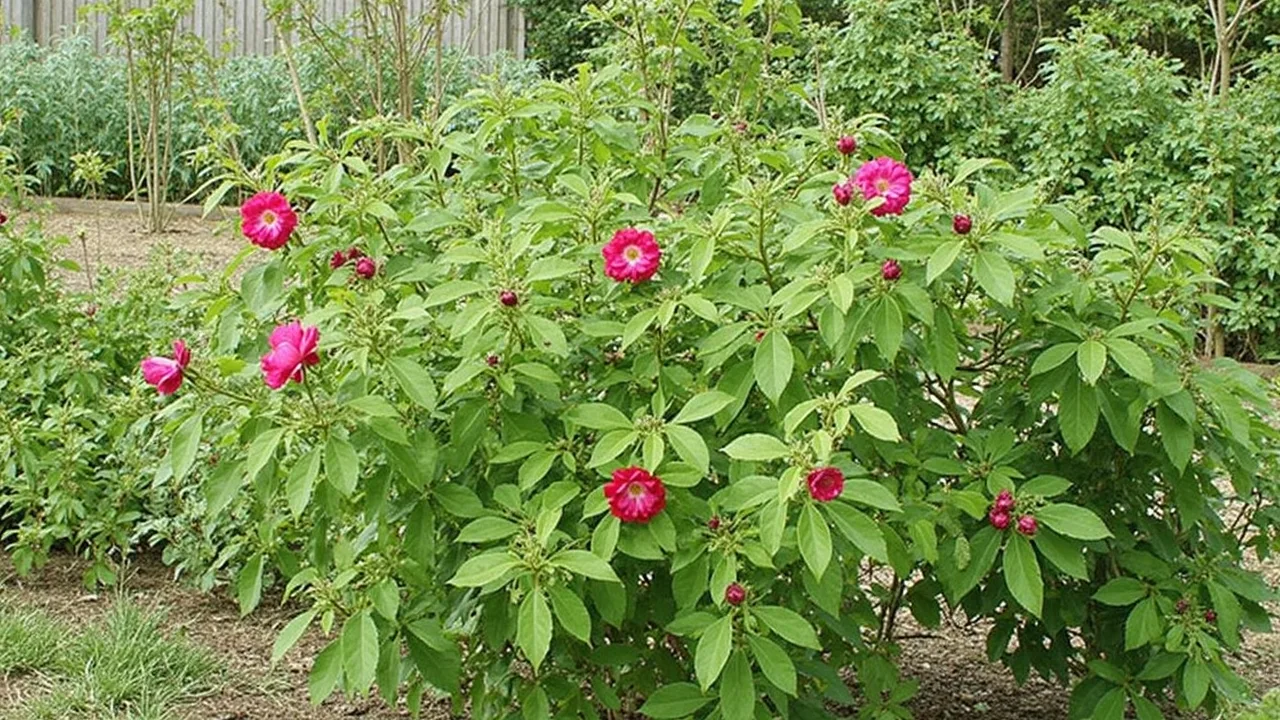
The Common Rose, Rosa gallica, is one of the oldest cultivated roses in the Western world and the wild ancestor of numerous heritage shrub roses still grown in British gardens. A compact, suckering deciduous shrub, it is prized for its strongly fragrant, deep pink to crimson flowers, its tolerance of poorer soils, and its long history in British horticulture stretching back to the Romans and the mediaeval monastic garden. It remains an excellent choice for mixed borders, cottage plantings and informal low hedging throughout the United Kingdom.
Overview
Rosa gallica belongs to the family Rosaceae and the large genus Rosa, where it sits within the gallica Group — a small set of closely related wild and near-wild shrub roses native to southern and central Europe. In parts of Britain the species is recorded as naturalised, particularly on chalky soils, and it has been grown here continuously for at least a thousand years. It is the parent, through a long line of crosses, of many old garden roses including the damasks, the albas' near relatives, and most famously the apothecary's rose.
The plant forms a dense, bushy shrub that spreads steadily by underground suckers, eventually making broad thickets. Its compact habit and willingness to grow on thin, chalky ground make it one of the more useful species roses for tricky border edges and wild corners. It is fully hardy across the UK and reliable in even cold inland gardens, flowering reliably each June and July with little routine intervention.
Appearance
The species typically reaches 60–90 cm in height and spreads by suckers to form dense clumps between 1 and 1.5 m across. The stems are slender, armed with fine, straight or slightly curved prickles rather than the heavy thorns of many modern roses, and they tend to be a warm green when young, ageing to a greyish brown. The leaves are pinnate, divided into three to seven leaflets, each leaflet oval, matte mid-green, with a finely toothed margin and a slightly rough texture.
The flowers are the plant's chief ornament. They are semi-double to fully double, 5–8 cm across, and range in colour from a clear deep pink through to a rich, velvety crimson, with paler centres in some forms. The petals are broad and slightly ruffled, and in the centre a boss of golden stamens is usually visible in the wild-type plant. The fragrance is strong, sweet and distinctly old-rose in character, carrying well across the garden on a still June evening. Flowers are borne singly or in small clusters at the ends of the previous year's stems.
In a good year flowering begins in mid-June and runs well into July. If spent flowers are left on the plant rather than deadheaded, small, globular to slightly turbinate red hips form in late summer and ripen through autumn, often persisting after leaf fall and providing useful winter food for thrushes, blackbirds and other garden birds.
Growing Conditions
Rosa gallica is one of the most accommodating of the species roses and grows well throughout the UK, from southern coastal gardens to cold inland sites in the north. It is fully hardy, rated RHS H7, which means it tolerates temperatures below −20 °C without protection. It performs best in an open, sunny position, where it will flower most freely, but it tolerates light dappled shade for part of the day without significant loss of bloom.
The plant prefers a humus-rich, well-drained loam with a pH of roughly 6.0 to 7.0, but it is noticeably more tolerant of poor and chalky soils than most roses and will establish on thin, stony ground where hybrid teas struggle. Wet, badly drained ground is its main dislike; on heavy clay it is worth planting on a shallow mound or improving the subsoil with grit and organic matter before planting. A south-, east- or west-facing aspect suits it, and a position sheltered from cold north and east winds helps protect early growth from late spring frosts.
In UK gardens the species typically leafs out in April, flowers in June and July, and sets hips from late August into autumn before dropping its leaves in November.
Planting and Care
Planting is best done between November and March, when bare-root stock is available and the soil is workable. Container-grown plants can be put in at any time of year provided the ground is not frozen or waterlogged. Before planting, dig a hole comfortably wider than the root spread and incorporate a generous forkful of well-rotted manure or garden compost into the backfill. For grafted plants, set the graft union 2–3 cm below the soil surface to encourage own-root growth from the scion, which the species produces readily.
Water well after planting and keep the soil moist through the first growing season. Once established, Rosa gallica is moderately drought-tolerant, but it benefits from a deep soaking during prolonged dry spells in summer. Feeding is straightforward: apply a balanced rose fertiliser such as Toprose in early spring as growth begins, and a second lighter dressing after the first flush of flowers to support the development of new wood for the following year. An annual mulch in spring of 5–8 cm of well-rotted manure or compost, kept clear of the immediate stem, conserves moisture, suppresses weeds and adds slow-release nutrients.
Pruning is light. In late winter or early spring, remove any dead, damaged or crossing wood and thin out a few of the oldest stems at the base to encourage vigorous new growth from below. The species flowers on the previous year's wood, so hard pruning reduces the following summer's display; a gentle shaping and renewal regime is all that is required. Suckers arising from the base or roots of grafted plants should be removed promptly, although in ungrafted, own-root plants these can be left to thicken the clump or lifted for propagation.
Propagation is easy. Heel cuttings of firm young stems taken in late summer and inserted into a gritty, free-draining compost under a cold frame usually root well within a few months. Established clumps can also be divided in winter, lifting the suckering mass and separating it into well-rooted sections. From seed, hips collected in autumn and stratified over winter will germinate in spring, though seedlings will not come true to the parent if it is a named cultivar.
Common Problems
The gallica group is generally less troubled by disease than modern hybrid teas, but the usual rose problems can appear in damp or crowded conditions.
Black spot (Diplocarpon rosae) is the most common fungal disease, producing dark, feathery-margined blotches on the upper leaf surface and causing premature yellowing and leaf drop in late summer. Improving air circulation by light pruning and by not overcrowding the plant reduces pressure; in persistent cases a suitable fungicide can be applied in spring as the leaves expand.
Powdery mildew (Sphaerotheca pannosa) appears as a white, powdery coating on young leaves, shoots and buds, and is most troublesome in dry soil combined with humid air. Mulching, regular deep watering in dry spells and good spacing help prevent it.
Aphids — principally greenfly and blackfly — colonise soft young shoots and flower buds in late spring. Light infestations are easily dealt with by hand or by a strong jet of water; heavier populations respond to insecticidal soap. Encouraging natural predators such as ladybirds and lacewing larvae keeps numbers in check.
Rose rust (Phragmidium spp.) is occasionally seen, producing bright orange pustules on the undersides of leaves in mid- to late summer. Removing and destroying affected leaves at the first sign and, in severe cases, applying a suitable fungicide usually brings it under control.
Canker and die-back appear as sunken, darkened patches on stems, often following wounding or drought stress. Affected stems should be cut back well into clean, healthy wood with a white pith and the prunings disposed of rather than composted.
Rabbits and deer occasionally browse the soft young growth, and the usual root pests of roses (vine weevil grubs in containers, for example) can occur but are rarely a serious problem in open garden soil.
Popular Varieties
Several well-established cultivars of Rosa gallica have been grown in British gardens for centuries and remain widely available from specialist rose nurseries.
'Officinalis' (also sold as the Apothecary's Rose, and historically as Rosa gallica ' maxima') is the most famous form: a large, semi-double, clear pink flower with a prominent boss of golden stamens and a strong old-rose scent. It has been in continuous cultivation since at least the thirteenth century and is the rose traditionally associated with the House of Lancaster. It reaches around 90 cm tall and flowers generously in June.
'Versicolor' (Rosa Mundi) is a striking, very old striped sport of 'Officinalis'. The semi-double flowers are pink splashed and striped with pale blush to white, giving each bloom a slightly different pattern. It is sterile, sets no hips, and is grown purely for ornament. Height and spread are similar to the species.
'Cardinal de Richelieu' is a more recent (nineteenth-century) gallica hybrid, notable for its unusual deep, dusky purple-crimson flowers with a velvety texture. The blooms are small to medium, fully double, and borne in clusters. It is slightly more compact than the wild type, around 75 cm tall, and is one of the darkest-flowered roses reliably hardy in the UK.
'Tuscany Superb' is an improved form of the older 'Tuscany', with larger, fuller, deep crimson flowers showing a clear golden eye. It grows to about 1.2 m and is a particularly good choice for a sunny back-of-border position.
All four are hardy throughout the UK, thrive in the same conditions as the species, and benefit from the same light pruning regime.
Pests and Diseases
| Problem | Symptoms | Management |
|---|---|---|
| Blackspot | Circular black spots with fringed edges appear on leaves, causing them to yellow and drop prematurely. | Remove fallen leaves in autumn and apply a fungicide or lime sulphur spray in early spring. |
| Powdery mildew | A white, dusty fungal growth covers new shoots, buds, and the upper surfaces of leaves. | Improve air circulation by pruning and treat with a sulphur-based fungicide or milk spray. |
| Rose rust | Orange-yellow pustules form on the undersides of leaves, causing them to curl and turn brown. | Prune out affected growth and apply a systemic fungicide at the first sign of infection. |
| Aphids | Clusters of small green or black insects cluster on new shoots and buds, causing stunted growth. | Squash by hand, blast with water, or use insecticidal soap for heavy infestations. |
| Crown gall | Large, rough, tumour-like swellings develop on the stem base or roots, weakening the plant. | Cut out galls with sterile tools and destroy infected material; avoid replanting roses in affected soil. |
| Scale insects | Small, immobile, brown or white bumps encrust stems and leaves, often accompanied by sticky honeydew. | Scrape off small infestations manually or apply horticultural oil during the dormant season. |
Quick Care Summary
| Sunlight | Full sun, Partial shade |
|---|---|
| Soil | fertile, humus-rich, moist but well-drained soil |
| Hardiness | H7 (-25.0 °C) |
| Sow | — |
| Plant | January–December |
| Prune | January, February, December |