
Wild Strawberry
Fragaria vesca
At a Glance
| Botanical name | Fragaria vesca |
|---|---|
| Common name(s) | Wild Strawberry |
| Family | Rosaceae |
| Plant type | perennial (Semi evergreen; stoloniferous perennial with leaves composed of three leaflets.) |
| Height × Spread | — × — |
| Hardiness | H6 (to -20.0 °C) |
| Position | Full sun, Partial shade |
| Soil | Moist but well-drained; tolerant of clay, loam, sand; thrives in alkaline soils. |
| Flowering | March–November |
| Toxicity | — |
| Native range | Northern Hemisphere; Europe; Native to GB / Ireland |
The wild strawberry is a low, creeping herbaceous perennial of the rose family, native to the British Isles and much of the temperate Northern Hemisphere. Long valued for its intensely flavoured little fruits, its tolerance of shade, and its quiet usefulness as ground cover, Fragaria vesca is one of the most rewarding wild plants to bring into a UK garden. The same species gave rise to the modern cultivated strawberry through hybridisation centuries ago, and growing it today offers a glimpse of what that original flavour was like — concentrated, aromatic, and noticeably more pronounced than the berry we buy in punnets.
Quick-Care Table
Overview
Fragaria vesca is a native British perennial, widespread across lowland England and Wales and present in much of Scotland and Ireland, though more localised in the north. In the wild it occupies woodland edges, clearings, hedgerow banks, old walls and rocky outcrops — anywhere there is moist, leafy soil and a little broken light. It is not an introduced garden escapee; it belongs here.
For gardeners, the species offers two distinct things. It is an honest-to-goodness edible crop, producing small fruits with a flavour that reliably outpaces the supermarket strawberry, and it is a useful ornamental for awkward shaded corners where little else will settle in. The same patch can fulfil both roles. Once planted, a colony tends to look after itself, asking only for an annual tidy and the occasional refresh of older plants.
The plant's willingness to naturalise means it should be sited with some thought. In a cottage garden bed it stays politely where put. In a wilder or woodland setting it can colonise freely and may need thinning after a few years.
Appearance
Wild strawberry is a small, neat plant. The leaves rise in loose rosettes on slender, hairy stalks, each leaf divided into three oval leaflets with sharply serrated edges. Individual leaflets are usually 1–4 cm long, bright to mid-green, and slightly paler and downy beneath. The overall rosette sits 5–20 cm above the ground, depending on richness of soil and exposure.
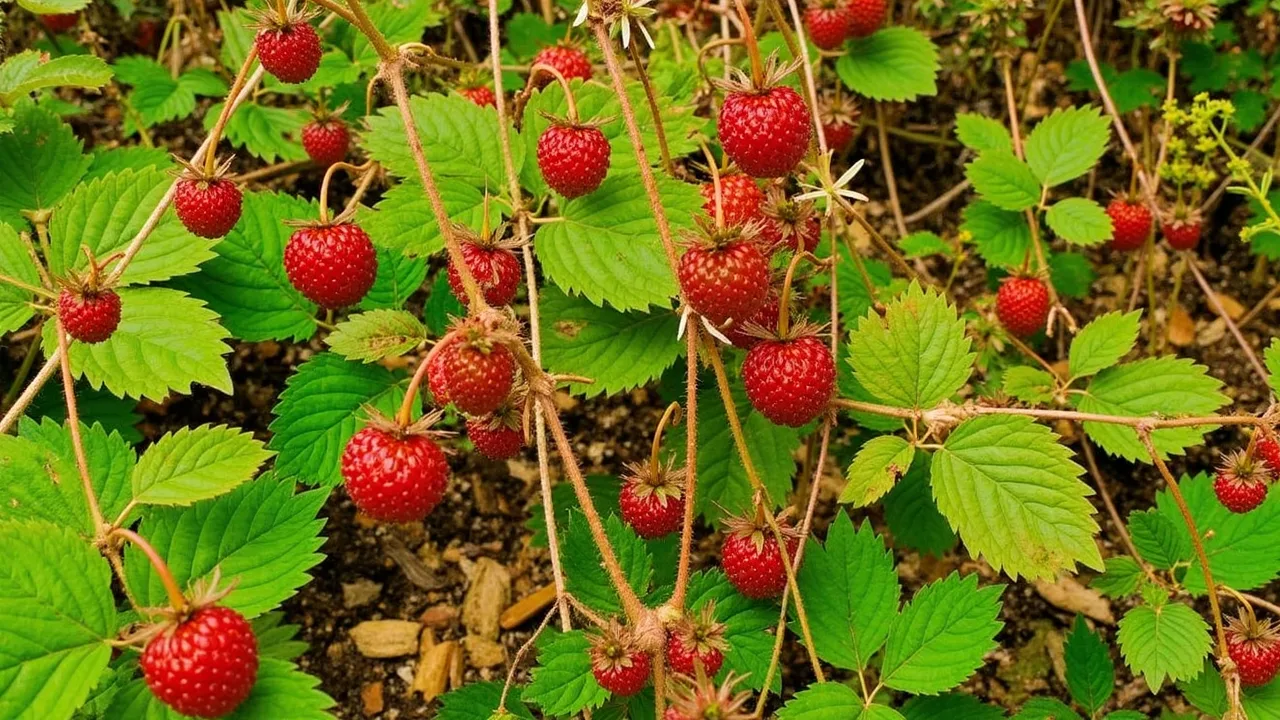
Flowers appear from April into July on slender stems that usually rise just above the foliage. Each flower is about 1–2 cm across, with five rounded white petals, a pale yellow centre, and a ring of green sepals that remain visible underneath the developing fruit. They are followed, in succession, by the fruits themselves: small, conical to rounded berries, typically 1–2 cm across, ripening from pale green through to a clear, bright red. The achenes (the tiny yellow "seeds") sit in shallow pits on the surface, a feature that distinguishes Fragaria vesca from the cultivated strawberry, in which they are set into deeper depressions.
The flavour is the plant's signature. The fruits are drier and less watery than those of Fragaria × ananassa, but markedly more aromatic, with notes often described as musky, candy-sweet and slightly resinous. They are best picked fully coloured and eaten within a few hours.
The plant spreads by slender horizontal runners (stolons) that root at the tip, forming new rosettes. In good conditions a single plant can colonise a square metre within two or three seasons. Older mats become dense and may benefit from lifting, dividing and replanting with fresh young stock.
Growing Conditions
Wild strawberry is at home in a wide range of UK conditions, provided a few basics are met.
Aspect and light. It tolerates more shade than the cultivated strawberry, and is one of the few genuinely productive fruits for partly shaded sites. A position in dappled shade, such as beneath a deciduous canopy or along a north-facing wall, suits it well. Full sun is also acceptable, particularly in cooler northerly districts, though plants in sun will need more watering and the fruits may be smaller.
Soil. The plant prefers a moist but well-drained soil rich in organic matter. A loam with plenty of leaf mould or well-rotted garden compost is ideal. Sandy soils are tolerated if mulched and watered; heavy clay is tolerated if improved with grit and organic matter to prevent waterlogging in winter. Soil pH is not critical, though a slightly acidic to neutral reading (around 5.5–7.0) is typical.
Hardiness. Fully hardy throughout the UK. Gardeners sometimes quote an RHS hardiness rating of H5, H6 or H7 for the species and its cultivars, reflecting different degrees of cold tolerance; ratings for specific cultivars vary. The plant tolerates frost, snow and prolonged cold without protection, and is among the most cold-tolerant of the genus.
Native range and status. Fragaria vesca is native to the UK. It is most common in southern and central England, becoming more scattered in upland areas of the north and west. It is not a neophyte, and planting it in a garden carries no conservation concern.
Pollination and wildlife. The flowers are visited by bees, hoverflies and small butterflies, and the fruits are eaten by birds and small mammals, which is worth bearing in mind if a harvest is desired.
Planting and Care
Planting. Plant young crowns or rooted runners in autumn or early spring, when the soil is workable and moisture levels are reliable. Space plants 20–30 cm apart for a quick ground-cover effect, or further apart if a slower, more deliberate spread is wanted. Set the crown so that the growing point sits at soil level — buried too deep, it will rot; perched too high, it will dry out. Water in well and keep the soil just moist for the first few weeks until new growth is visible.
Watering. Once established, wild strawberry tolerates short dry spells, but the fruits swell best with steady moisture. Water deeply during dry periods in May and June, ideally at the base of the plant rather than over the foliage, to reduce the risk of fungal disease. Container-grown plants will need more frequent watering than those in the ground.
Feeding. The plant is not a heavy feeder. A single mulch of well-rotted compost or leaf mould in late winter is usually enough. If growth is poor, a light dressing of blood, fish and bone in spring is sufficient. Over-feeding produces lush leaf at the expense of fruit and makes the plant more attractive to aphids.
Mulching. A 3–5 cm mulch of leaf mould, garden compost or chopped bark keeps the roots cool, conserves moisture and keeps the developing fruits clean. Fresh straw, the traditional strawberry mulch, also works well as the fruits begin to ripen.
Pruning and tidying. Cut back old, tired foliage in late winter or very early spring before new growth emerges, and remove any rotted or blackened leaves from the previous season. During the growing season, remove damaged or yellowing leaves as seen.
Runners. Plants send out runners from early summer. If a controlled clump is wanted, snip these off close to the parent rosette. If naturalised ground cover is the aim, let them root where they land. Rooted runners can be lifted in autumn and used to extend the planting.
Propagation. Divide established clumps every two to three years in autumn or early spring, replanting the youngest, most vigorous rosettes and discarding old woody centres. Runners root readily when pegged into a small pot of compost while still attached to the parent plant, then severed and grown on.
Seasonal care. Spring: tidy old foliage, top-dress with compost, watch for early aphids. Summer: water in dry spells, net against birds if a harvest is wanted, harvest fruits as they ripen. Autumn: divide overgrown clumps, plant new stock. Winter: mulch, leave old foliage as frost protection if preferred.
Container growing. Wild strawberry does well in pots, troughs and hanging baskets, where the runners trail attractively over the edge. Use a loam-based compost with added grit for drainage, and feed lightly with a general-purpose liquid fertiliser every few weeks during the growing season.
Common Problems
Wild strawberry is generally trouble-free, particularly when grown in conditions close to its woodland-edge niche.
Grey mould (Botrytis cinerea). The most likely problem in damp summers, showing as fuzzy grey growth on ripening fruits and sometimes on flowers. Improve air circulation by thinning dense growth, avoid overhead watering, and remove affected fruits promptly.
Powdery mildew. A whitish coating on leaves in still, dry weather. Less common than in cultivated strawberries, but seen occasionally. Mulch to keep roots moist, water at the base, and remove badly affected leaves.
Aphids. Greenfly sometimes colonise young shoots and flower buds in late spring. They rarely cause serious harm, but heavy infestations distort growth. A strong spray of water, insecticidal soap, or encouraging natural predators (ladybirds, lacewings, hoverflies) usually brings them under control.
Birds. Blackbirds and thrushes are fond of the ripe fruits and can strip a small patch overnight. Netting is the most reliable protection where birds are a problem.
Slugs and snails. Can damage ripening fruits and graze the leaves, particularly in damp shaded sites. Standard organic controls (night picking, beer traps, wool pellets, nematodes) are effective; mulching with sharp grit also helps.
Vine weevil. Container-grown plants are occasionally attacked by vine weevil grubs, which chew the roots. Inspect pots before planting and use biological control (nematodes) if the pest is suspected.
Popular Varieties
A small number of F. vesca cultivars are widely available from UK nurseries and seed suppliers. All are worth growing; choice depends on whether fruit or ornamental effect is the priority.
'Alexandria'. A vigorous, runnerless selection raised for fruit production. Plants form neat clumps rather than spreading mats, making them ideal for the front of a border or a container. Fruits are small, bright red and intensely flavoured, cropping from early summer into autumn. Often grown from seed.
'Baron Solemacher'. Another runnerless, clump-forming cultivar of similar habit to 'Alexandria', also typically raised from seed. Bears small, aromatic fruits over a long season. A traditional choice for kitchen gardens and alpine beds.
'Yellow Wonder' (also sold as 'Yellow Alpine'). A form that produces pale yellow fruits rather than red. The flavour is said to be milder and the colour makes the ripe fruits less attractive to birds — a useful trait in gardens where netting is impractical. Runnerless and clumping.
'Semperflorens'. A name sometimes attached to any continuously-cropping form of F. vesca, applied loosely to several selections. Plants in this group fruit from late spring well into autumn. Worth checking with the supplier as to the exact provenance of the seed or plants offered under this name.
'Fructu Albo'. A white-fruited form, occasionally listed by specialist fruit nurseries. The fruits stay pale cream even when ripe and are correspondingly ignored by birds. Less commonly seen than the yellow form.
MATURE_SIZE: 5–20 cm tall; clumps or mats 30–60 cm across within 2–3 seasons.
Pests and Diseases
| Problem | Symptoms | Management |
|---|---|---|
| Strawberry viruses | Leaves show mottling, crinkling, yellow spotting or vein banding, leading to reduced vigour and yield. | Plant only certified virus-free stock and replace plants every two to three years. |
| Slugs and snails | Irregular holes in leaves and fruit, often accompanied by silky trails and slime. | Use physical barriers like copper tape or beer traps, and hand-pick at night. |
| Aphids | Clusters of small soft-bodied insects on new growth, causing leaf curling and sticky honeydew. | Squash by hand or blast off with a strong jet of water; encourage natural predators like ladybirds. |
| Grey mould | Fruit becomes soft, brown and covered in fuzzy grey spores, especially in damp conditions. | Ensure good air circulation, avoid overhead watering and remove affected fruit promptly. |
| Root rot | Plants wilt and decline despite moist soil, with roots appearing dark, mushy or dead. | Plant in well-drained soil and avoid waterlogging to prevent fungal infection. |
Quick Care Summary
| Sunlight | Full sun, Partial shade |
|---|---|
| Soil | Moist but well-drained; tolerant of clay, loam, sand; thrives in alkaline soils. |
| Hardiness | H6 (-20.0 °C) |
| Sow | March–May |
| Plant | March, September, October, November |
| Prune | March, August, September, October, November |