
Arbutus unedo
Strawberry Tree
At a Glance
| Botanical name | Strawberry Tree |
|---|---|
| Common name(s) | Arbutus unedo |
| Family | Ericaceae |
| Plant type | tree (Evergreen) |
| Height × Spread | 4–8 m × — |
| Hardiness | H5 (to -10.0 °C) |
| Position | Full sun, Partial shade |
| Soil | Well-drained, neutral to acidic soil rich in organic matter; also tolerates basic (limy) pH soils. |
| Flowering | September–November |
| Toxicity | Fruit are ornamental - not to be eaten. Wear gloves and other protective equipment when handling. |
| Native range | Mediterranean region (Portugal, Spain, southeastern France, Algeria, Morocco, Libya, Tunisia, Italy, Malta, Slovenia, Croatia, Montenegro, Greece, Turkey, Israel, Palestine, Jordan, Lebanon, Syria), western France, Albania, Bulgaria, and southwestern Ireland. |
Overview
Arbutus unedo, the strawberry tree, is a slow-growing evergreen tree or large shrub from the family Ericaceae, valued in British gardens for its year-round interest. Native to the Mediterranean basin and the Atlantic fringe of southern Europe, including the mild west of Ireland, it thrives in the temperate oceanic climate of the United Kingdom and is fully hardy across most lowland regions. The following quick-care table summarises its essentials; the full article below covers each in detail.
Arbutus unedo is grown chiefly for the unusual combination of features it offers through the year: glossy evergreen foliage, clusters of white or pinkish bell-shaped flowers in late autumn, and rounded warty red-orange fruits that ripen at the same time the following year, often on the plant alongside the new flowers. The bark, which is reddish-brown and peels in thin strips to reveal a smoother pale layer beneath, adds a second season of ornament at close quarters. In the United Kingdom, the species is widely used as a specimen plant in sheltered gardens, particularly in coastal and southern districts, and it tolerates urban pollution and exposed sites once established. Mature plants are long-lived and develop a gnarled, characterful framework over decades. It should not be confused with the true strawberry (Fragaria × ananata); the common name refers only to the superficial resemblance of the fruit.
Appearance
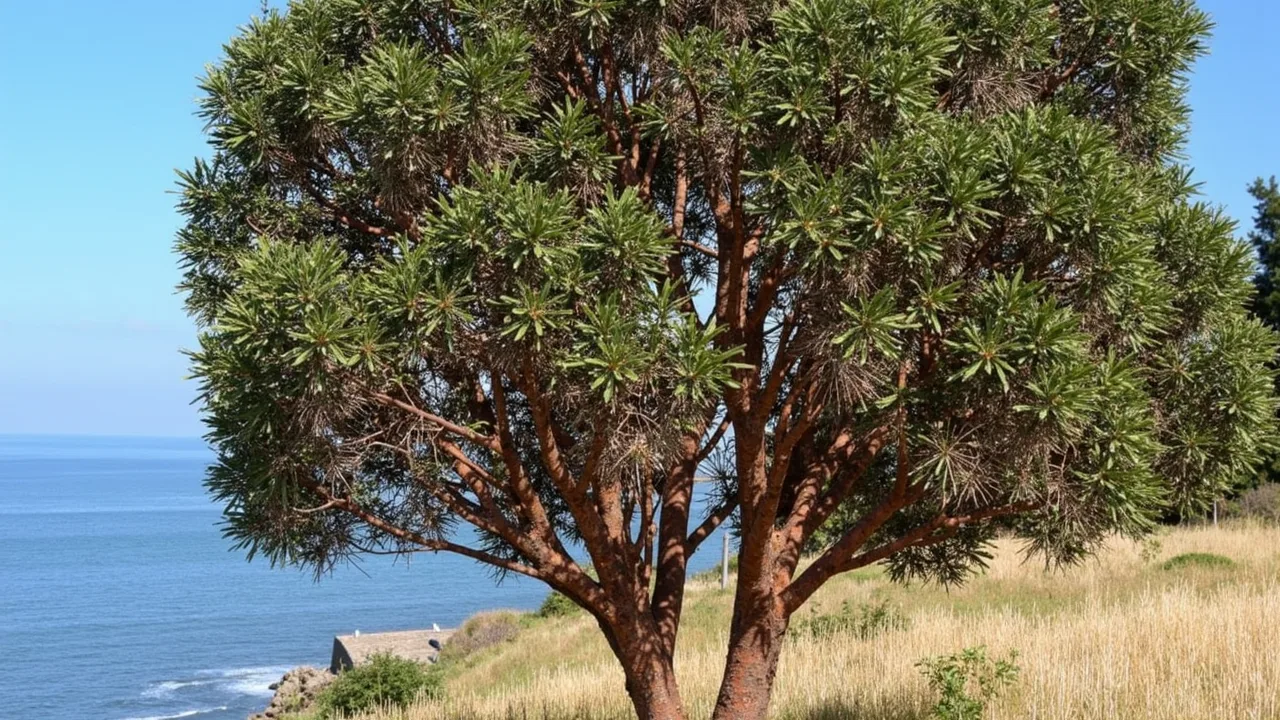
Arbutus unedo forms a rounded, densely branched tree or large shrub with a typically low, spreading canopy. In the United Kingdom, mature specimens usually reach 5 to 8 m in height with a similar spread, although very old or sheltered plants in mild districts can approach 12 m. The overall habit is irregular and often multi-stemmed from low down, with sinuous, slightly twisted limbs that give older trees a sculpted, almost bonsai-like appearance.
The leaves are alternate, simple, and leathery, 5 to 10 cm long, with a glossy dark green upper surface and a paler underside. The margins are finely serrated, which distinguishes the species from the closely related Arbutus andrachne. New growth in spring is often a brighter, glossier green than the older leaves and gradually darkens through the year. The leaves are retained for two to three seasons, so the canopy is dense year-round.
The flowers appear in drooping terminal panicles from October into December, with the main display usually peaking in November in the south of England. Each panicle carries 10 to 30 small, urn-shaped flowers, 6 to 10 mm across, typically white but often flushed with pink, particularly in cold weather. They are a valuable late-season nectar source for bees and other insects.
The fruits develop slowly over about twelve months and ripen from green through yellow to a deep red-orange in the autumn following flowering. They are spherical, 1.5 to 2.5 cm across, covered in small wart-like protuberances, and carry the remains of the calyx at the tip. Mature specimens carry flowers and ripe fruit at the same time, which is one of the species' main ornamental attractions. The flesh is pale, soft and granular; the fruit is edible but bland and mealy, and is more often used for preserves and liqueurs than eaten raw. Birds, particularly starlings and thrushes, take the fruit readily from late autumn into winter.
The bark is a defining feature at close range. On young stems it is smooth and greenish; on older wood it becomes a warm reddish-brown and exfoliates in thin vertical strips, exposing a fresh, paler layer beneath. The effect is most pronounced on the trunk and main limbs of a mature specimen.
Growing Conditions
Arbutus unedo is one of the more accommodating broadleaf evergreens for British gardens, provided the soil is well drained and the position is not heavily shaded. It performs best in full sun or light dappled shade, in a sheltered site that still allows good air movement. In the United Kingdom it is rated RHS H4, meaning it tolerates winter temperatures down to roughly -10 °C and is therefore suitable for gardens across lowland England, Wales and most of lowland Scotland. In colder inland or northern gardens, young plants benefit from a sheltered wall-side planting for the first few winters.
The ideal soil is moderately fertile, free-draining, and slightly acid to neutral, roughly pH 5.5 to 7.0. The species will tolerate poorer, stony or rocky soils and is notably drought-tolerant once its root system is established, which makes it well suited to dry banks, gravel gardens and the tops of walls. It does not, however, tolerate heavy, waterlogged ground, particularly through winter, where root-rotting Phytophthora can quickly kill a mature specimen. On heavy clay, plant on a raised mound or in a raised bed improved with sharp grit, and avoid burying the root collar. The plant is also reasonably tolerant of coastal salt spray, atmospheric pollution, and slightly alkaline soils, although chlorosis can develop in very chalky ground over time.
The species has a slow to moderate growth rate, typically putting on 20 to 30 cm a year in favourable conditions, and is long-lived, with documented specimens in the United Kingdom and Ireland well over a hundred years old. Once established, it needs little routine attention, which makes it a useful low-maintenance choice for larger gardens and public plantings.
Planting and Care
Plant container-grown specimens in spring or early autumn, when the soil is workable and the ground is naturally moist. Water in well after planting and keep the surrounding soil just moist through the first two or three growing seasons; established plants rarely need supplementary watering except in prolonged summer drought. A 5 to 8 cm mulch of leaf mould or well-rotted bark in early spring helps to retain moisture and keep the roots cool, but keep the mulch clear of the trunk itself.
Feeding is generally unnecessary. If growth is poor on exhausted soil, a single light dressing of a balanced general fertiliser in early spring is sufficient; overfeeding produces soft, leafy growth that is more vulnerable to winter damage and produces fewer flowers. The species thrives in lean conditions.
Pruning should be kept to a minimum. Remove dead, damaged or crossing branches in late spring, immediately after the last of the frosts, and lightly shape the canopy to keep the form balanced. The plant does not regenerate readily from old wood, so hard cutting back into bare stems is not recommended and often kills a branch. Any major reshaping is best done by removing whole limbs back to a younger side-shoot over several seasons rather than in one operation.
Propagation is from seed or from semi-hardwood cuttings. Seed should be stratified for two to three months at about 4 °C and then sown in a gritty ericaceous compost; germination is slow and seedlings are variable. Semi-hardwood cuttings of 8 to 10 cm, taken in late summer and inserted into a 50:50 mix of peat-free compost and sharp sand under a cold frame, root in a few months for a high proportion of material. Named cultivars are normally propagated by cuttings or by grafting onto seedling Arbutus unedo rootstocks to maintain their characteristics.
Seasonal care in the United Kingdom follows a simple rhythm. In spring, check for frost damage to the previous autumn's growth and remove any affected shoots; apply a light mulch if the soil is dry. In summer, water only during extended drought, especially on thin or sandy soils. In autumn, the flowers appear alongside ripening fruit and the bark is at its most striking as the older layers begin to peel; no intervention is needed. In winter, the plant is best left undisturbed, with protection for young specimens only in the coldest inland districts.
Common Problems
The most damaging problem on Arbutus unedo is root rot caused by Phytophthora species, almost always associated with poorly drained or waterlogged soil. Symptoms include die-back of the upper canopy in late spring and early summer, with the foliage suddenly turning dull grey-green and the bark at the collar of the plant appearing dark and wet. By the time the canopy shows damage, the root system is usually beyond saving, and the affected specimen should be removed and the site improved before replanting. Prevention, by ensuring good drainage at planting, is far more effective than any cure.
Aphids, particularly the Ericaphis species that affects heaths and heathers, can colonise young shoots in late spring but rarely cause lasting damage and are usually controlled naturally by predators. Scale insects, mainly soft scale, occasionally appear on the undersides of leaves and on young stems; treat minor infestations by hand or, if persistent, by an application of horticultural oil in late winter. Leaf spot, caused by the fungus Elsinoe, can produce small reddish-brown spots on the foliage in damp seasons but is rarely serious.
Frost damage is limited to the youngest growth in cold inland districts, and established plants recover quickly in spring. Bird damage to ripe fruit is heavy in late autumn and is usually welcomed by gardeners who value the wildlife value, but the entire crop can be stripped in days in urban areas with high starling populations. The plant is not considered toxic to humans or domestic animals, although the unripe fruit can cause mild gastric upset if eaten in quantity.
Popular Varieties
'Compacta' is a dwarf, dense form that reaches only 1.5 to 2 m in height and spread after many years, making it the most widely planted Arbutus unedo for smaller gardens and large containers. It flowers and fruits freely despite its size and has all the ornamental features of the species, including the peeling bark, though on a reduced scale. It is sometimes sold under the name 'Nana'.
'Crouy', often sold in the United Kingdom as 'Atlantic', is a narrowly upright or columnar selection, useful where a vertical accent is needed in a small garden. It is reported to flower and fruit particularly heavily, although its tolerance of the coldest inland districts is less well established than that of the species.
'Elfin King' is a compact cultivar, broader than 'Compacta' and somewhat lower-growing, which begins to flower and fruit at a notably young age, often on plants under a metre tall. It is a useful choice for new gardens where an established specimen is required quickly.
f. roselia, the pink-flowered form, has noticeably deeper pink flowers and a slightly more delicate habit than the typical white-flowered species. It is uncommon in cultivation but worth seeking from specialist ericaceous nurseries for a softer autumn display.
'Rubra' is a selected form with redder flowers and fruit than the species, and is occasionally offered by larger shrub nurseries. Plants sold simply as Arbutus unedo 'Red' usually refer to this clone.
Pests and Diseases
| Problem | Symptoms | Management |
|---|---|---|
| Elsinoë leaf spot | Small circular spots with whitish centres appear on both upper and lower leaf surfaces. | Remove and destroy affected leaves and fallen debris to reduce fungal spores. |
| Ruptoseptoria leaf spot | Larger, irregular brown spots develop on foliage, potentially causing leaf loss. | Improve air circulation and remove infected material; avoid wetting foliage when watering. |
| Scale insects | Small, immobile, bump-like pests cluster on stems and undersides of leaves. | Scrape off heavy infestations manually or use horticultural oil during dormancy. |
| Aphids | Clusters of small soft-bodied insects suck sap from new growth, causing curling. | Encourage natural predators like ladybirds or blast off with a strong jet of water. |
| Frost damage | Young shoots and leaves turn black or brown after severe cold spells. | Plant in a sheltered, south-facing position and protect young plants in winter. |
Quick Care Summary
| Sunlight | Full sun, Partial shade |
|---|---|
| Soil | Well-drained, neutral to acidic soil rich in organic matter; also tolerates basic (limy) pH soils. |
| Hardiness | H5 (-10.0 °C) |
| Sow | — |
| Plant | — |
| Prune | — |
As an Amazon Associate, GardenWizz earns from qualifying purchases made through the links above. This does not affect the price you pay. See our disclaimer for details.