
Heather
Calluna vulgaris
At a Glance
| Botanical name | Calluna vulgaris |
|---|---|
| Common name(s) | Heather |
| Family | Ericaceae |
| Plant type | shrub (evergreen) |
| Height × Spread | 20–100 cm × — |
| Hardiness | H7 (to -20.0 °C) |
| Position | Full sun, Partial shade |
| Soil | acidic (ericaceous), well-drained |
| Flowering | July–September |
| Toxicity | — |
| Native range | Europe, Iceland, the Faroe Islands, and the Azores |
Calluna vulgaris, commonly known as heather or ling, is a low-growing evergreen shrub native to the heathlands, moors, and acidic grasslands of the UK, Europe, and western Asia. It is the sole species in the genus Calluna and a defining plant of British upland landscapes, where it forms the vast purple carpets visible on the North Yorkshire Moors, the Scottish Highlands, and Dartmoor from late summer onwards. Beyond its wild origins, heather has been cultivated for centuries and remains a staple of UK gardens, valued for its late-season flowers, year-round foliage colour, and exceptional hardiness.
Overview
Belonging to the family Ericaceae, heather shares its botanical kinship with rhododendrons, azaleas, and blueberries — all of which prefer acidic soil conditions. In cultivation, Calluna vulgaris is most often used as ground cover on acidic banks, in rock gardens, in patio containers filled with ericaceous compost, and as low edging for mixed borders. Its tolerance of poor, acidic soils where many other shrubs fail makes it a particularly useful plant in UK gardens with naturally acid ground, such as those overlying sandstone, granite, or peat.
Appearance
Calluna vulgaris is a compact, bushy shrub typically reaching 20–50 cm in height and spreading up to 60 cm wide, although in very exposed upland sites wild plants can be considerably smaller and more prostrate, hugging the ground to within 10–15 cm. Its wiry stems are densely clothed in tiny, opposite, scale-like leaves measuring just 1.5–3 mm long; unlike the true leaves of most shrubs, these are tightly appressed to the stem, giving the shoots a heather-like, almost conifer texture. Foliage is most commonly a muted mid-green, but many cultivated varieties carry golden, orange, copper, or red foliage that intensifies in autumn and winter, providing months of colour long after the flowers have faded. The foliage is evergreen, so the plant contributes structure to the garden in every month of the year.
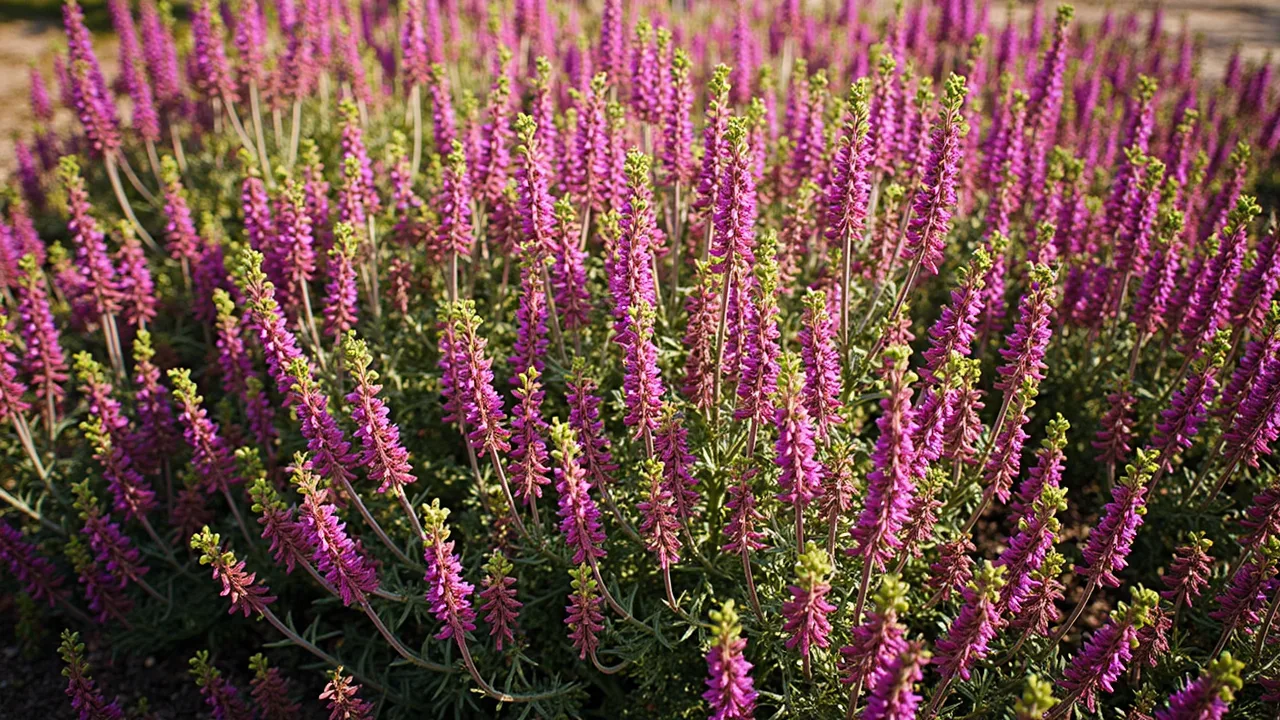
The flowering period runs from late July through October, with peak bloom in August and September. The flowers are small, bell-shaped, and arranged in elongated, one-sided racemes along the upper portions of the stems; a single well-grown plant may carry several hundred individual blooms. Individual flowers measure only 2–4 mm in length, and the four-lobed calyx — often pink, purple, or white — typically exceeds the corolla, giving the inflorescence its characteristic fluffy appearance and explaining why the colourful parts of the "flower" are technically sepals, not petals. Wild plants bear mostly mauve to deep pink flowers; cultivars extend the palette to include pure white, cerise, crimson, and fully double forms in which extra corolla lobes create a rosette-like, almost heather-rose effect.
Once flowering finishes, the dried flower heads remain on the plant well into winter, providing structural interest and a useful seed source for finches and other small birds. Mature specimens develop a dense, mat-forming habit through self-layering, where lower stems root where they touch the soil, and through basal branching from a woody rootstock. The bark on older stems turns a pale, shredding grey-brown.
Growing Conditions
Soil. Heather demands acidic soil, ideally with a pH between 4.5 and 6.0. It will not tolerate chalky or strongly alkaline conditions, which cause yellowing of the foliage (interveinal chlorosis) and eventual decline. It grows well in moist but well-drained ground, and tolerates poorer, sandier soils than most other ericaceous plants. Heavy clay is unsuitable unless sharply drained, as waterlogging in winter leads to root rot. On neutral-to-alkaline sites, soil must be amended with ericaceous compost, pine bark, or sulphur to lower the pH, or plants must be grown in containers filled with ericaceous (lime-free) compost such as John Innes ericaceous or a peat-free equivalent.
Aspect. Full sun is essential for the best display of flowers and the most vivid foliage colour. Light shade is tolerated but produces leggier growth and reduced flowering; in deep shade, plants become open, sparse, and fail to flower at all. South- or west-facing slopes are ideal, replicating the plant's native moorland habitats.
Hardiness. Fully hardy across the UK, rated H7 by the Royal Horticultural Society — the highest hardiness rating, indicating the plant withstands temperatures below −20 °C. It is reliable in exposed upland sites, coastal gardens, and cold inland districts alike, and is unaffected by late spring frosts that damage many other flowering shrubs.
Native status. Calluna vulgaris is native to the British Isles and is the dominant dwarf shrub over hundreds of thousands of hectares of heathland and moorland. It also occurs widely across western and northern Europe, in Iceland, the Faroes, and in parts of western Asia, reaching as far east as Siberia. In the UK it is a key indicator species of lowland heath — a Biodiversity Action Plan priority habitat — and of upland moorland managed by grazing and managed burning.
Growth rate. Slow to moderate. Plants typically reach their full size within three to five years and live for many decades where conditions suit them; individual plants in stable moorland can exceed 30–40 years of age.
Wildlife value. The flowers are an important late-season nectar source for honey bees, bumblebees, and hoverflies at a time of year when little else is in bloom. The seed heads sustain linnets, twites, and other finches through the winter, and the dense evergreen canopy provides shelter for ground-nesting birds, spiders, and small mammals.
Planting and Care
When to plant. Autumn (September–November) or spring (March–April) are the best planting times. Container-grown heather from garden centres can be planted at any time the soil is workable and the ground is not frozen or waterlogged, but autumn and spring plantings establish fastest. Space plants 30–45 cm apart for a dense ground-cover effect, or 50–60 cm apart where individual specimens are to be allowed to develop fully.
Soil preparation. On acidic soils, no amendment is needed beyond thorough weeding — particularly removal of perennial weeds such as couch grass, dock, and bindweed, which are difficult to eradicate once heather has covered them — and the incorporation of well-rotted leaf-mould or garden compost to improve moisture retention. On neutral or alkaline ground, dig in generous quantities of ericaceous compost and consider replacing the soil in the planting pit entirely, as localised acidification has limited effect over the long term. For containers, use a loam-based ericaceous compost such as John Innes Ericaceous; peat-free alternatives based on coir or bark are also suitable provided the mix is lime-free and free-draining.
Watering. Water thoroughly after planting and during the first growing season whenever the soil is dry. Established plants are notably drought-tolerant and will survive typical UK summers without supplementary watering, though they appreciate moisture during prolonged dry spells from July to September. Container-grown plants dry out faster than those in the ground and benefit from regular watering through the summer months, as the limited root volume cannot reach moisture reserves.
Feeding. Apply an ericaceous liquid fertiliser once or twice in spring if growth is weak or foliage appears pale. Avoid lime, bone meal, or any alkaline fertilisers, all of which raise soil pH and damage the plant. Mulching annually with pine bark, leaf-mould, or composted bracken conserves moisture, suppresses weeds, and helps maintain soil acidity.
Pruning. Annual pruning keeps plants compact and floriferous. Cut the flowered stems back to 2–3 cm below the spent flower heads in March or April, before new growth begins, using shears or hand shears. Alternatively, lightly trim the plants with shears immediately after flowering in autumn to tidy the shape, accepting that some flowers will be removed. Avoid cutting into old wood below the leafy growth, as heather does not readily regenerate from bare stems; plants that have become leggy and woody after years of neglect are best replaced rather than renovated.
Propagation. Propagate by semi-ripe cuttings taken in late summer (July–August): trim 4–6 cm shoots just below a leaf node, remove the lower leaves, and insert into a 50:50 mix of peat-free ericaceous compost and perlite, kept moist and shaded until rooted in 4–8 weeks. Layering of trailing stems in autumn is reliable but slow. Division of established clumps in spring works for older plants. Seed propagation is possible but slow, and cultivars do not come true from seed.
Seasonal care. In spring, prune and apply a mulch; in summer, water during drought and watch for aphids on young growth; in autumn, plant new specimens and tidy up fallen leaves from around the base; in winter, leave the spent flower heads in place to feed birds and provide structure, and avoid walking on frozen ground beneath plantings to prevent root damage.
Common Problems
Grey mould (Botrytis cinerea). Affects dense, unpruned plants in cool, wet seasons, causing browning of stems and dieback. Improve air circulation by pruning, remove affected material, and avoid overhead watering.
Rhododendron bud blast (Seifertia azaleae). A fungal infection that turns developing flower buds black and bristly. Pick off and destroy affected buds; the disease also affects rhododendrons, so treat both together if both are grown.
Phytophthora root rot. A serious disease causing wilting, yellowing, and eventual collapse, especially on poorly drained or waterlogged soils. There is no cure; prevent it by ensuring sharp drainage and avoiding planting in frost pockets or heavy clay.
Leaf spot (Septoria spp. and others). Produces brown or yellow spots on the foliage. Usually cosmetic; remove heavily affected shoots and clear up fallen leaves in autumn.
Aphids and vine weevil. Aphids colonise soft young growth in late spring; vine weevil grubs attack the roots of container-grown plants in autumn and winter. Inspect regularly and treat with appropriate biological or chemical controls.
Manganese deficiency. On neutral or alkaline soils, leaves develop interveinal chlorosis — yellowing between the veins while the veins themselves remain green. Apply ericaceous sequestrene or chelated iron, and address the underlying soil pH problem.
Popular Varieties
- 'Allegro' — vigorous, upright habit to 40 cm, with deep cerise single flowers in long racemes from August onwards; one of the most widely planted pink cultivars.
- 'Dark Beauty' — compact to 30 cm, fully double, deep red flowers that hold their colour well; useful for late-season impact in containers.
- 'Firefly' — striking year-round orange-red foliage, brighter still in winter, with mauve flowers in September; one of the finest foliage forms.
- 'Hammondii' — taller to 45 cm, with cream-and-green variegated foliage and pure white flowers; useful for lifting darker planting schemes.
- 'Long White' — tall, upright cultivar to 60 cm, with long racemes of pure white flowers in late September and October; valuable for extending the flowering season.
- 'Silver Knight' — compact to 30 cm, with silvery-grey foliage all year and lavender flowers; pairs well with darker-leaved forms.
- 'Sister Anne' — very dwarf, to 15 cm, forming a dense mat of pink flowers over fresh green foliage; excellent for troughs, sinks, and crevices in paving.
- 'Wickwar Flame' — orange-red winter foliage, mauve flowers in late summer; a classic foliage cultivar for winter containers.
Pests and Diseases
| Problem | Symptoms | Management |
|---|---|---|
| Honey fungus (Armillaria) | Stems become brittle and snap off easily, often with white fungal growth at the base. | Remove infected plants completely and avoid replanting ericaceous species in that spot for several years. |
| Root rot (Phytophthora) | Foliage turns brown and shrivels while the soil remains wet, indicating waterlogged roots. | Ensure excellent drainage by planting in sandy, acidic soil and avoid overwatering. |
| Powdery mildew | A white, dusty fungal coating appears on leaves and stems, particularly in humid conditions. | Improve air circulation by thinning dense growth and apply a suitable fungicide if severe. |
| Vine weevil | Notches appear on leaf margins at night, while larvae damage roots causing plant decline. | Apply nematodes to the soil in autumn or use a systemic insecticide for potted plants. |
| Slugs and snails | Irregular holes are eaten into young shoots and leaves, often accompanied by slime trails. | Use slug pellets, beer traps, or hand-pick pests at night to protect new growth. |
| Nutrient deficiency (Chlorosis) | Leaves turn yellow or pale green due to alkaline soil preventing iron uptake. | Lower soil pH using ericaceous compost and apply an acid-loving plant fertiliser. |
Quick Care Summary
| Sunlight | Full sun, Partial shade |
|---|---|
| Soil | acidic (ericaceous), well-drained |
| Hardiness | H7 (-20.0 °C) |
| Sow | March–May |
| Plant | March, April, May, September, October, November |
| Prune | — |
As an Amazon Associate, GardenWizz earns from qualifying purchases made through the links above. This does not affect the price you pay. See our disclaimer for details.