Common Buckthorn
Rhamnus frangula
At a Glance
| Botanical name | Rhamnus frangula |
|---|---|
| Common name(s) | Common Buckthorn |
| Family | Rhamnaceae |
| Plant type | shrub (deciduous) |
| Height × Spread | 3–7 m × — |
| Hardiness | H7 (to -20.0 °C) |
| Position | Full sun, Partial shade |
| Soil | moist but well-drained; acidic, neutral, or alkaline |
| Flowering | May–June |
| Toxicity | Harmful if eaten |
| Native range | Europe, northernmost Africa, and western Asia |
Overview
Common Buckthorn (Rhamnus frangula, syn. Frangula alnus) is a deciduous native shrub or small tree found across the United Kingdom in damp woodlands, hedgerows, heathland and along riverbanks. The quick-care table below summarises the essentials for UK growers.
Common Buckthorn (Rhamnus frangula) is a hardy deciduous shrub in the family Rhamnaceae, native to the United Kingdom, much of Europe, temperate Asia and North Africa. In Britain it is a familiar sight in damp woodland, on heathland edges, along riversides and in older mixed hedgerows, where it is valued as much for its wildlife value as for its modest ornamental qualities. Left unpruned it develops into a large, multi-stemmed shrub or small tree typically 3 to 7 m tall, with a slightly open, irregular habit. The species is fully hardy across the whole of the UK and tolerates a remarkable range of soils and conditions, including wet ground, acidic peat and periods of drought once established. In gardens it is most often used in mixed native hedging, in naturalistic planting on damp or difficult ground, and as a component of wildlife schemes, where its early flowers feed pollinators and its late-summer fruits feed thrushes, redwings and other birds. The leaves turn a clean, bright yellow in autumn, which is one of the species' most useful ornamental attributes. The plant has a long history of use in herbal medicine, principally as a source of anthraquinone compounds from the bark, though this application is now considered obsolete and is not recommended without professional supervision.
Appearance
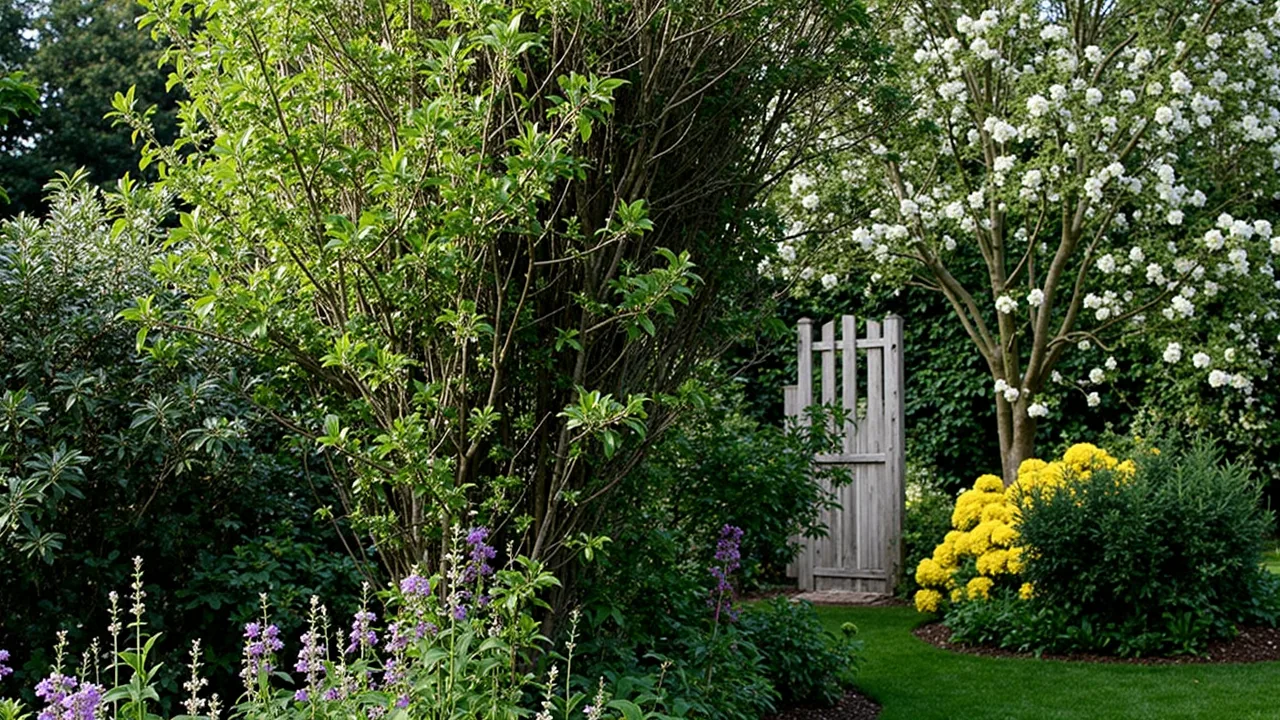
Rhamnus frangula is a vigorous, often multi-stemmed shrub or small tree with a rounded, slightly spreading outline. The bark on young stems is smooth and reddish-brown, becoming grey-brown and roughly fissured with age; the wood itself is soft and yellowish, and was once valued for charcoal-burning and the production of gunpowder charcoal, an origin reflected in one of its older vernacular names, "powder berry". The leaves are simple, alternate, elliptical to obovate, 3 to 8 cm long, with finely serrated margins and a short petiole. The upper surface is a fresh, dark green with prominent veins, while the underside is paler and slightly downy, particularly when young. The flowers are small, star-shaped and greenish-white, around 4 to 5 mm across, and are produced in small clusters of two to eight in the leaf axils from April through June. They are faintly fragrant and rich in nectar, attracting bees, hoverflies, butterflies and other early-season pollinators. The fruit is a globose drupe about 6 to 8 mm in diameter that ripens unevenly from green through red to a glossy dark purple-black from July into September, with the whole colour sequence often visible on a single shrub. Each fruit contains two to three small, pale, hard-coated seeds. The autumn colour is one of the species' defining features: the leaves drop cleanly in October and November after turning a uniform, luminous yellow that is unusual among large native shrubs and that holds for several weeks in still weather.
Growing Conditions
Common Buckthorn is one of the most tolerant native shrubs in cultivation. It is fully hardy throughout the United Kingdom, from the western Highlands of Scotland to the South Coast, and the RHS hardiness rating of H7 places it in the most hardy category (tolerating winter temperatures below -20 °C). In the wild it is most abundant on damp, acidic to neutral soils over clay or peat, particularly in alder woodland, on the edges of raised bogs and along river floodplains, but it grows equally well on free-draining loam and sandy heathland soils. Soil pH is not a serious constraint: the species tolerates strongly acidic peat through to mildly alkaline ground, although on very thin, dry chalk it benefits from organic matter at planting. Light requirements are similarly broad. Flowering and fruiting are heaviest in full sun or light dappled shade, and in deeper woodland the shrub becomes leggy and produces fewer berries; an open position or the edge of light woodland gives the best balance of growth and flower. Common Buckthorn is an excellent choice for the difficult, damp corners where little else will thrive: bog gardens, the margins of wildlife ponds, the shaded side of a mixed hedge, and the wettest end of a rain garden. Once established it is also drought-tolerant, sending down a deep tap-root that draws on moisture well below the surface.
Planting and Care
Plant bare-root specimens between November and March when dormant, and container-grown plants at any time of year though autumn and spring are best. For a hedgerow, space plants 1.5 to 2 m apart in a single row, or stagger in a double row 1 m apart with 1.5 m between rows for a thicker barrier. Site preparation is straightforward: remove perennial weeds, dig over a strip at least 60 cm wide, and incorporate a bucketful of well-rotted garden compost or leafmould into the backfill on poorer soils. Water in well and keep the soil reliably moist through the first two growing seasons; thereafter supplementary watering is rarely needed except in severe drought. Feeding is not normally required on reasonably fertile soil; on thin ground a single light application of a general-purpose fertiliser in early spring, or a top-dressing of garden compost, will support strong growth. Pruning is minimal. In late winter, remove any dead, damaged or crossing stems, and shorten wayward shoots to maintain a balanced outline. Mature plants tolerate hard renovation well and will regenerate from the base if cut back to within 30 cm of the ground, though this sacrifices one season's flowers. Propagation is most easily done from seed: collect ripe fruits in autumn, clean the pulp away, and sow immediately outdoors, as the seeds require a period of cold stratification. Semi-ripe cuttings of 8 to 10 cm taken in midsummer also root readily in a gritty compost under a cold frame. Seasonal care in the UK is light: a late-winter tidy, occasional watering in the first year, and patience while the plant establishes its deep root system.
Common Problems
Common Buckthorn is generally healthy and largely free of serious pest and disease problems in the United Kingdom. The most frequently reported issues are minor fungal complaints such as leaf spot and occasional rust infections, neither of which usually requires treatment; affected foliage is best raked up and disposed of in autumn to reduce carry-over of inoculum. Deer and rabbits generally leave the plant alone, which is one reason it persists in mixed countryside hedges where more palatable species are eaten back. Gardeners should, however, be aware of two issues. First, R. frangula is recorded as invasive in parts of North America, particularly in the Great Lakes region and across the north-eastern United States and eastern Canada, where it forms dense thickets that outcompete native flora. In the UK it is a native species and is not classed as invasive, but its bird-dispersed seeds can colonise adjacent countryside, especially heathland, moorland and the edges of woodland nature reserves; deadheading spent fruits in late summer is a sensible precaution in gardens adjoining sensitive habitats. Second, on very exposed sites young growth can be wind-scoured, and in poorly drained planting holes young plants may sulk for a season; both issues are easily avoided by correct siting and planting technique. The plant is not considered toxic to humans or domestic animals in normal garden use, although the bark and unripe fruit contain anthraquinone compounds historically used as purgatives. Ingestion of any part of the plant should be regarded with caution, particularly by children.
Popular Varieties
The species is most often grown as the straight Rhamnus frangula, but a small number of well-established selections are available from UK nurseries, mostly valued for foliage effect or habit rather than flower or fruit. Reliable named forms include 'Asplenifolia', an old cultivar with very narrow, almost fern-like leaves that give the plant a finely textured, airy appearance and that turn the same clean yellow in autumn as the type; 'Columnaris', a tightly upright, narrowly columnar form that reaches a useful 3 to 4 m in height with a spread of little more than 1 m, valued for narrow screens and tight spaces where the broad habit of the species would be unsuitable; and 'Ron Williams', sometimes sold as 'Fine Line', a relatively recent selection with extremely narrow, almost thread-like leaves and a narrowly upright habit, useful as a specimen in small gardens. Plants sold simply as Rhamnus frangula or under the older name Frangula alnus are by far the most commonly encountered in the trade, and for naturalistic planting, hedging and wildlife use the straight species is generally the best choice. Cultivar information for this species is comparatively limited compared with mainstream garden shrubs, and the three forms listed above are the ones most consistently documented in UK nursery catalogues and horticultural references; gardeners seeking rarer selections may need to order from specialist woody-plant nurseries.
Pests and Diseases
| Problem | Symptoms | Management |
|---|---|---|
| Slugs and snails | Irregular holes chewed in young leaves and seedlings, often accompanied by slimy trails. | Use physical barriers like copper tape or crushed eggshells, and hand-pick at night. |
| Powdery mildew | White, dusty fungal growth on leaves and stems, potentially causing distortion. | Improve air circulation and water at the base; apply a sulphur-based fungicide if severe. |
| Leaf spot | Small, dark or brown spots appearing on foliage, sometimes leading to premature leaf drop. | Remove affected leaves and avoid overhead watering to keep foliage dry. |
| Aphids | Clusters of small soft-bodied insects on new growth, causing sticky honeydew residue. | Encourage natural predators like ladybirds or spray with a strong jet of water. |
| Root rot | Wilting and yellowing leaves despite moist soil, indicating poor drainage issues. | Ensure well-drained soil conditions and avoid overwatering during wet periods. |
Quick Care Summary
| Sunlight | Full sun, Partial shade |
|---|---|
| Soil | moist but well-drained; acidic, neutral, or alkaline |
| Hardiness | H7 (-20.0 °C) |
| Sow | — |
| Plant | — |
| Prune | March–May |
As an Amazon Associate, GardenWizz earns from qualifying purchases made through the links above. This does not affect the price you pay. See our disclaimer for details.