
Laburnum
Laburnum anagyroides
At a Glance
| Botanical name | Laburnum anagyroides |
|---|---|
| Common name(s) | Laburnum |
| Family | Fabaceae |
| Plant type | tree (deciduous) |
| Height × Spread | 8 m × — |
| Hardiness | H6 (to -20.0 °C) |
| Position | Full sun, Partial shade |
| Soil | moist, well-drained; chalk, clay, loam, sand; acid, alkaline, neutral pH |
| Flowering | May–June |
| Toxicity | All parts of the tree, especially the seeds, are toxic to humans and animals if ingested. Contains cytisine. |
| Native range | Central and Southern Europe |
Overview
Laburnum (Laburnum anagyroides) is a small deciduous tree grown in British gardens chiefly for its long, drooping racemes of yellow pea-flowers in late spring and early summer. The following quick-care table summarises the essentials for UK growers; the full article below covers each in detail.
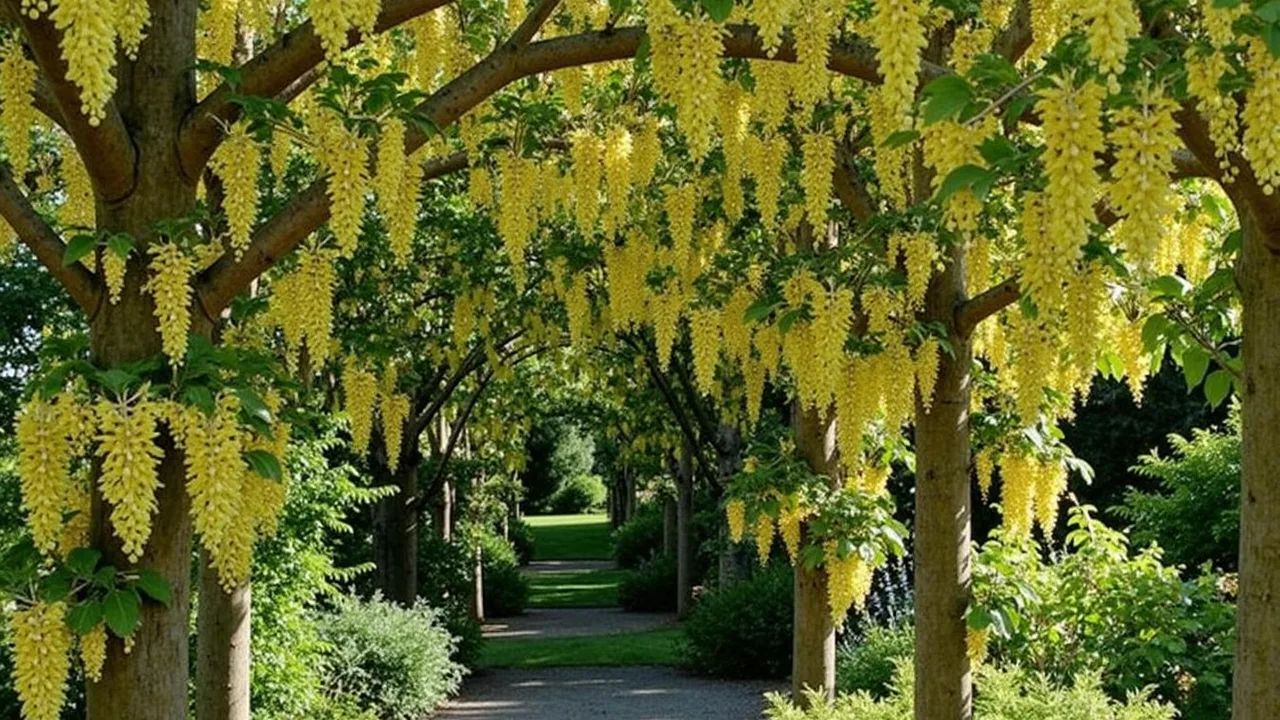
Laburnum anagyroides, commonly called common laburnum or golden chain, is a deciduous tree in the legume family (Fabaceae), native to central and southern Europe and long naturalised in parts of the United Kingdom. It is grown almost entirely for its display of bright yellow, pea-like flowers carried in pendulous racemes up to 25 cm long, which appear in late May and June and give the tree its common name. The species has been grown in British gardens since the sixteenth century and was a particular favourite of the Arts and Crafts garden designers, who used it as a specimen on lawns and trained over pergolas to form a flowering tunnel in early summer. Mature specimens reach roughly 5 to 8 m in height with a similar or slightly smaller spread, developing a short, often leaning trunk and a broad, domed crown of light, bright green foliage. The most commonly planted form in UK gardens is in fact the hybrid Laburnum × watereri, and in particular the cultivar 'Vossii', which is often regarded as the finest flowering laburnum for British conditions. Laburnum is comparatively short-lived for a tree, typically reaching its best display between 20 and 40 years of age, and should always be sited with its well-known toxicity in mind, particularly where young children are present.
Appearance
Laburnum anagyroides has a distinctive light, almost feathery silhouette in leaf. The trunk is short and often leans, with smooth, olive-green bark that becomes finely fissured with age; the tree develops a broad, domed crown rather than a single straight leader. The leaves are trifoliate, that is, divided into three narrow oval leaflets each 3 to 8 cm long, giving a clover-like appearance; they are slightly bluish mid-green above, paler and silky-hairy beneath, and turn a plain yellow-green in autumn. The flowers are borne in pendulous racemes 10 to 25 cm long, each carrying 20 to 40 pea-flowers in a rich, uniform yellow. The blooms open in late May and June in a single heavy flush over two to three weeks, and are followed by slender pea-pod-like fruits 4 to 6 cm long, pale green at first, then papery and grey-brown at maturity, each containing a few hard, dark brown seeds. In full flower the branches are almost completely covered in hanging yellow racemes, an effect best appreciated from below, which is why laburnum is often trained over arches and pergolas. In winter the tree is unremarkable, with a fine tracery of bare twigs and a few persistent seed pods.
Growing Conditions
Laburnum performs best in full sun, in moderately fertile, well-drained soil with a near-neutral to slightly alkaline pH. It tolerates a wide range of soil types, including chalky and stony ground, but it dislikes waterlogged conditions, particularly through the dormant season, where young specimens may succumb to root rot. The RHS rates Laburnum anagyroides as H6, meaning it is hardy across the whole of the United Kingdom and tolerates winter temperatures down to roughly -15 to -20 °C, with no routine need for winter protection in lowland and most upland gardens. Once established, laburnum is reasonably drought-tolerant on deeper soils, though on very thin, free-draining ground it appreciates watering in long dry spells during its first few summers. The tree flowers most freely in a sheltered, sunny position: cold, exposed sites delay flowering, reduce the length of the racemes, and can scorch the soft spring foliage in late frosts. Laburnum is unsuitable for dense shade, for waterlogged ground, and for very acid peaty soils, where growth tends to be thin and the foliage yellows. It also resents root disturbance, so permanent positioning at planting time, with no later transplanting, gives the best results.
Planting and Care
Plant container-grown or root-balled specimens in autumn or early spring, ideally while the tree is dormant. Choose a permanent open site in full sun, allowing at least 4 to 5 m of spread for a standard, and prepare a wide rather than deep planting hole, mixing the back-fill with a little well-rotted garden compost on thin soils. Stake standard specimens with a short, low stake for the first two to three years only; laburnum develops a stronger trunk when allowed a small amount of flex, and a permanent tall stake tends to produce a weak, leaning tree. Water in well and keep the soil just moist through the first growing season; thereafter, supplementary watering is rarely needed except in prolonged drought. Feeding should be modest: a single application of a general-purpose fertiliser in early spring, or a top-dressing of garden compost, is sufficient, and overfeeding produces soft growth that flowers poorly and is more vulnerable to late frosts. Pruning is kept to a minimum because laburnum bleeds sap readily if cut hard in late winter or spring. The only routine work is the removal of dead, damaged or crossing wood in mid- to late summer, immediately after flowering, and the removal of any shoots on grafted plants below the graft union. Hard pruning into old wood is best avoided; if a specimen has outgrown its site it is generally better replaced. Propagation is normally by seed sown in autumn, with the seed pre-soaked in warm water for 24 hours to soften the hard coat, or by summer budding on to seedling laburnum rootstocks for named cultivars; layering of low shoots is also possible but slow. Seed-raised trees flower reliably within five to seven years. Seasonal care follows a simple pattern: light formative pruning in summer after flowering, no routine autumn or winter pruning, a top-dressing of compost in early spring, and watering only in extended dry spells on light soils.
Common Problems
The single most important point about laburnum is that all parts of the plant, and in particular the seeds within the pods, are highly toxic to humans, dogs, livestock and most domestic animals, owing to the alkaloid cytisine. Ingestion of even a small number of seeds can produce vomiting, sweating, pupil dilation and, in larger quantities, more serious neurological effects, and on rare occasions has proved fatal to children. The risk is greatest in late summer and autumn when the pods ripen and split, scattering the seed on the ground beneath the tree, and any garden with toddlers should consider siting laburnum out of easy reach or choosing a different flowering tree. Gardeners handling prunings or seed pods are advised to wear gloves and to wash their hands afterwards. Beyond toxicity, laburnum is generally a healthy tree in UK conditions. The most frequently seen disorder is laburnum leaf miner, a small moth (Leucoptera laburnella) whose caterpillars mine within the leaflets in early summer, producing pale blotches; the damage is unsightly but does not affect the long-term vigour of the tree, and control is rarely warranted. Aphids, particularly the black bean aphid, can colonise the soft new growth in late spring, sometimes causing leaf distortion and sticky honeydew, but they are usually kept in check by natural predators. Powdery mildew occasionally affects the foliage of stressed or droughted specimens in late summer. Honey fungus (Armillaria) and verticillium wilt have both been recorded on laburnum but are uncommon. The tree is also susceptible to snow and wind damage on weak forks in old age, owing to its short trunk and broad crown, and mature specimens occasionally require crown reduction by a qualified arboriculturist to remove heavy limbs safely.
Popular Varieties
The most widely planted laburnum in British gardens is in fact the hybrid Laburnum × watereri, a cross between L. anagyroides and L. alpinum, raised in the nineteenth century. Its best-known cultivar, 'Vossii', bears particularly long, slender racemes, often reaching 30 to 50 cm, packed with rich yellow flowers, on a tree of 4 to 7 m with a neat, upright habit; it holds the RHS Award of Garden Merit and is the form most commonly sold for garden planting and for training over pergolas. Laburnum anagyroides itself is also available as the straight species, which is slightly more vigorous, slightly later-flowering, and produces rather shorter racemes than 'Vossii'. 'Pendulum' is a small, weeping form of L. anagyroides, usually grown as a standard worked on a straight stem, which reaches only 2 to 3 m and is well suited to smaller gardens and lawn specimens, though its racemes are shorter than those of 'Vossii'. 'Aureum', sometimes sold as Laburnum anagyroides 'Aureum' and occasionally listed under the invalid name 'Golden Leaf', refers to seedlings raised for brighter yellow-green young foliage, although the golden tint fades as the leaves mature in summer. For gardeners specifically wanting the AGM-rated form, 'Vossii' (under Laburnum × watereri) is the safest choice; the AGM status of forms of the species L. anagyroides itself is not consistently recorded and should not be assumed. Whatever form is chosen, the planting advice and the toxicity warning above apply equally to all of them.
Pests and Diseases
| Problem | Symptoms | Management |
|---|---|---|
| Aphids | Clusters of small soft-bodied insects on new shoots causing sticky honeydew and distorted growth. | Squash by hand or use a strong jet of water; apply insecticidal soap if infestations are severe. |
| Powdery mildew | White powdery fungal growth on leaves and stems, potentially causing leaf distortion. | Improve air circulation by pruning; apply a fungicide if necessary and avoid overhead watering. |
| Silver leaf | Leaves develop a silvery sheen underneath and the tree shows general decline or dieback. | Prune out infected branches well below the visible symptoms and burn them to prevent spread. |
| Honey fungus | General decline, wilting foliage, and white fungal growth at the base of the trunk in autumn. | Improve drainage and soil health; remove infected roots and avoid replanting susceptible species nearby. |
| Leaf-mining insects | Winding white or brown trails visible within the leaf tissue caused by larvae feeding inside. | Rake up fallen leaves to reduce overwintering populations; severe cases may require insecticide. |
| Snails and slugs | Irregular holes chewed in young leaves and seedlings, often accompanied by slimy trails. | Use physical barriers like copper tape or apply iron phosphate-based slug pellets around the base. |
Quick Care Summary
| Sunlight | Full sun, Partial shade |
|---|---|
| Soil | moist, well-drained; chalk, clay, loam, sand; acid, alkaline, neutral pH |
| Hardiness | H6 (-20.0 °C) |
| Sow | — |
| Plant | January–February |
| Prune | August–December |
As an Amazon Associate, GardenWizz earns from qualifying purchases made through the links above. This does not affect the price you pay. See our disclaimer for details.